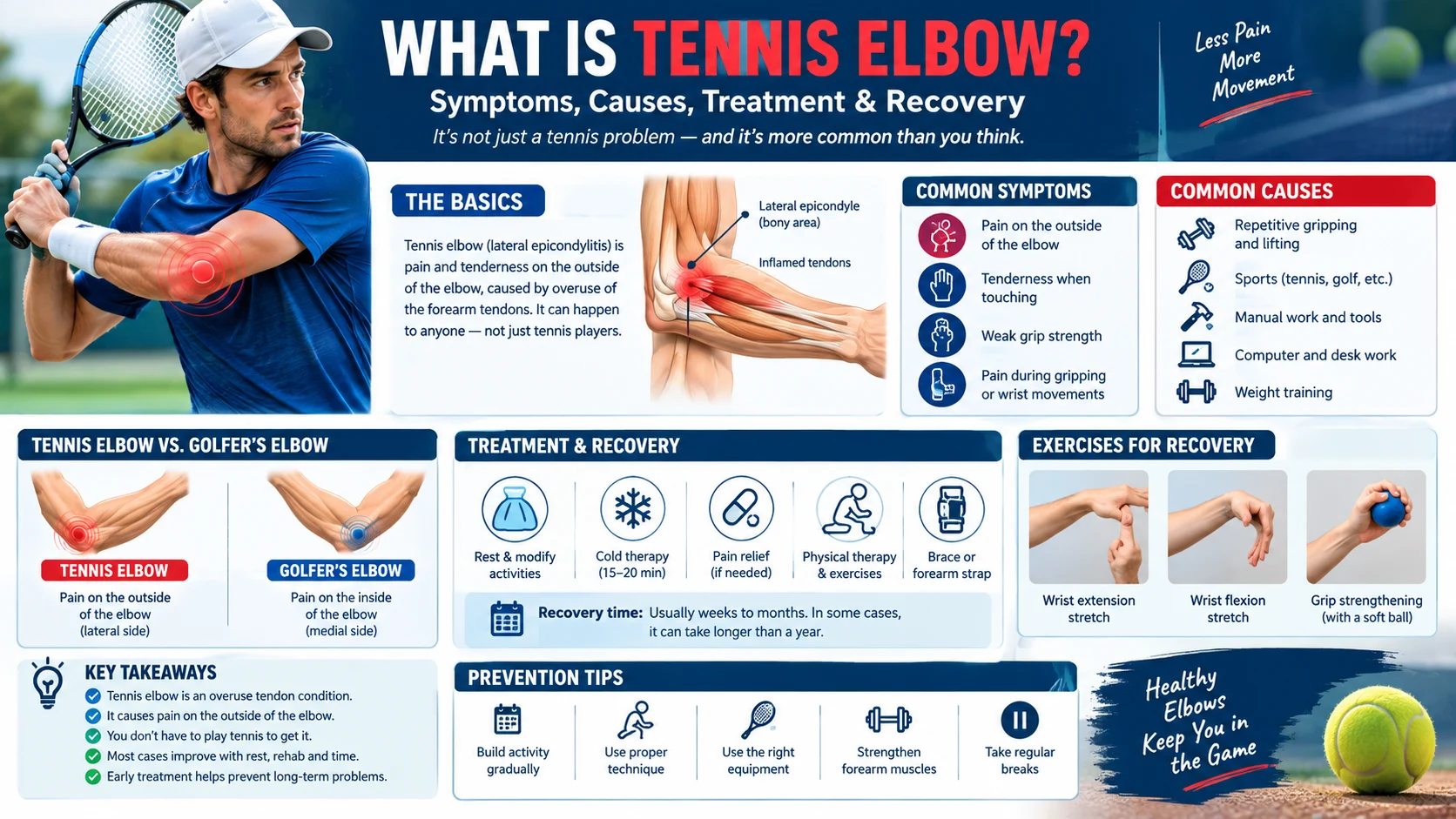
Tennis elbow is pain and tenderness on the outside of the elbow caused by overuse of the forearm tendons, especially with repeated gripping, lifting, or wrist movements. Despite its name, you do not have to play tennis to develop it.
Tennis elbow can start with something as ordinary as lifting a coffee cup, turning a doorknob, using a computer mouse, or hitting a tennis backhand. At first, it may feel like a minor ache. But as the tendon becomes repeatedly stressed, gripping and everyday arm movements can become surprisingly painful.
The medical name is lateral epicondylitis, although lateral elbow tendinopathy is also commonly used. It involves the tendons that attach the forearm muscles to the bony area on the outside of the elbow.
The good news? Most cases improve with appropriate activity modification, rehabilitation, and time. The key is recognizing the problem early and not repeatedly aggravating the tendon.
What Is Tennis Elbow?
Tennis elbow is an overuse-related tendon condition that causes pain on the outside of the elbow.
The pain usually comes from the area where forearm muscles and tendons attach near the outer elbow. Repeated loading of these tissues can lead to tendon changes and pain, particularly during gripping and wrist movements.
Despite the name, tennis players are far from the only people who develop it.
People who repeatedly use their wrists and forearms at work, during exercise, or around the home can also experience tennis elbow.
Quick Facts
| Question | Answer |
|---|---|
| Medical name | Lateral epicondylitis / lateral elbow tendinopathy |
| Main location | Outside of the elbow |
| Common trigger | Repetitive forearm and wrist use |
| Typical symptoms | Pain, tenderness, weakness |
| Can non-tennis players get it? | Yes |
| Does it usually require surgery? | No |
| Common treatment | Activity modification + rehabilitation |
| Recovery | Often gradual and may take weeks or months |
What Does Tennis Elbow Feel Like?
The classic symptom is pain or tenderness on the outside of the elbow.
The discomfort can sometimes extend down the forearm toward the wrist. You may notice it more when you:
- Grip a racket, tool, or handle
- Shake hands
- Lift a cup or pan
- Turn a doorknob
- Use a screwdriver
- Move your wrist against resistance
- Carry something with your arm extended
- Type or use a mouse repeatedly
Weakness can also develop, making everyday tasks feel more difficult than they normally would.
Where Does Tennis Elbow Hurt?
Tennis elbow typically causes pain around the outer or lateral side of the elbow, rather than the inner side.
That distinction is useful because pain on the inside of the elbow may point toward a different condition, such as golfer’s elbow.
However, elbow pain has many possible causes, so location alone cannot confirm a diagnosis.
What Causes Tennis Elbow?
The simplest explanation is repeated stress on the forearm tendons.
When the muscles responsible for wrist and hand movement are repeatedly loaded, the tendon attachment near the outer elbow can become painful and undergo degenerative changes. The exact cause is not always obvious.
Common triggers include:
Tennis and Racket Sports
Poor technique, repetitive backhands, unsuitable equipment, or suddenly increasing playing time can place additional stress on the forearm.
Weight Training
Repeated gripping and lifting can aggravate the forearm, particularly when training volume increases quickly.
Manual Work
Jobs involving repetitive gripping, twisting, lifting, or tool use can increase the risk.
Examples include:
- Plumbing
- Carpentry
- Painting
- Cooking
- Butchery
- Gardening
- Construction work
Computer and Desk Work
Heavy mouse or keyboard use can contribute to symptoms in some people, particularly when wrist and forearm movements are repeated for long periods.
Why Is It Called Tennis Elbow?
The name comes from its association with tennis, particularly repetitive movements involved in racket sports.
But you do not need to play tennis to have tennis elbow.
This is one of the biggest misconceptions about the condition. Repetitive forearm activity from work, exercise, hobbies, or daily tasks can produce similar symptoms.
Who Is Most Likely to Get Tennis Elbow?
Anyone can develop tennis elbow, but it is particularly common in adults who repeatedly perform wrist and forearm movements.
Risk can increase with:
- Repetitive manual work
- Racket sports
- Poor sports technique
- Sudden increases in training
- Repetitive gripping
- Certain occupational tasks
- Inadequate equipment or technique
Mayo Clinic notes that tennis elbow is most common in adults roughly between 30 and 60, while the NHS reports it is particularly common between 35 and 54.
Tennis Elbow Symptoms vs. Golfer’s Elbow
The easiest distinction is where the pain occurs.
| Condition | Typical Pain Location |
|---|---|
| Tennis elbow | Outside of elbow |
| Golfer’s elbow | Inside of elbow |
Tennis elbow generally affects the tendons associated with the muscles on the outer side of the forearm.
Golfer’s elbow involves the tendons on the inner side.
Because several elbow conditions can cause similar symptoms, persistent or severe pain should be properly assessed rather than self-diagnosed.
How Is Tennis Elbow Diagnosed?
A healthcare professional can often diagnose tennis elbow using your medical history and physical examination.
They may:
- Ask when the pain started
- Ask which activities make it worse
- Examine the outside of the elbow
- Test wrist and finger movements
- Assess strength and tenderness
- Look for other possible causes of elbow pain
Imaging such as an X-ray, ultrasound, or MRI may be considered when another condition needs to be ruled out or when symptoms are unusual or persistent.
How Do You Treat Tennis Elbow?
The right treatment depends on the severity and duration of symptoms, but treatment usually starts conservatively.
1. Reduce the Activity That Causes Pain
You do not necessarily need complete inactivity.
Instead, reduce or modify movements that repeatedly aggravate the elbow.
For a tennis player, that could mean temporarily reducing tennis or correcting technique. For someone with an occupational trigger, it may mean changing how a task is performed.
2. Use Cold Therapy for Pain Relief
A cold pack may help reduce discomfort.
The NHS recommends using a hot or cold pack wrapped in a towel for up to 20 minutes every 2–3 hours when needed.
Do not place ice directly against the skin.
3. Consider Pain Relief When Appropriate
Some people use over-the-counter pain medicines or topical anti-inflammatory products for symptom relief.
Because medicines are not appropriate for everyone, check the product instructions and ask a healthcare professional or pharmacist if you have medical conditions, take other medicines, or are unsure what is safe for you.
4. Start Rehabilitation Exercises
This is one of the most important parts of recovery.
Physical therapy can include stretching and progressive strengthening exercises for the wrist and forearm. Rehabilitation helps restore the tendon and surrounding muscles’ ability to tolerate everyday and sporting loads.
The goal is not simply to make the pain disappear. It is to gradually rebuild capacity so the elbow can handle the activity that caused the problem.
5. Try a Forearm Strap or Brace
A counterforce forearm strap or appropriate brace may reduce stress on the affected tissues and provide symptom relief for some people.
It should be viewed as a support, not a replacement for addressing the underlying movement or load problem.
How Long Does Tennis Elbow Take to Heal?
This is where patience matters.
Tennis elbow can improve within weeks for some people, but symptoms may persist for several months or longer. The NHS notes that it can sometimes last over a year.
Recovery is influenced by:
- How long symptoms have been present
- Whether the aggravating activity continues
- The severity of symptoms
- Rehabilitation
- Work demands
- Training load
- Individual healing and recovery
Trying to return to full activity too quickly can keep the tendon irritated.
Can You Play Tennis With Tennis Elbow?
Sometimes, but playing through significant pain is usually not a good strategy.
If tennis is the trigger, consider temporarily reducing the amount or intensity of play and addressing factors such as technique, racket setup, grip, and training volume.
A sports medicine professional or physical therapist can help identify whether your playing mechanics are contributing to the problem.
The goal should be a gradual return rather than repeatedly provoking the elbow.
Can Tennis Elbow Go Away on Its Own?
Yes. Many cases improve without surgery.
Rest or activity modification, appropriate pain management, and rehabilitation are commonly used approaches. If symptoms continue despite self-care, professional assessment can help determine whether additional treatment is needed.
When Should You See a Doctor?
Consider getting medical advice if:
- Your elbow pain does not improve with self-care.
- Pain is interfering with everyday activities.
- You have significant weakness.
- Symptoms continue or keep returning.
- You are unsure whether the problem is actually tennis elbow.
- You experienced a sudden injury.
The NHS advises seeking medical advice if elbow pain remains after at least two weeks of rest and self-care.
Seek prompt medical attention for severe pain, major swelling or bruising, a sudden injury with a snap or cracking sound, significant loss of movement, or an obviously deformed elbow. These symptoms can indicate something other than routine tennis elbow.
Can Tennis Elbow Be Prevented?
You cannot prevent every case, but you can reduce unnecessary stress on the elbow.
Build Activity Gradually
Avoid suddenly doubling your tennis sessions, gym workload, or manual activity.
Improve Your Technique
In tennis and other sports, inefficient movement can place additional stress on the forearm.
Use Suitable Equipment
Properly fitted sports equipment can help reduce unnecessary strain.
Strengthen the Forearm
Progressive strengthening can help the muscles and tendons tolerate the demands placed on them.
Take Breaks From Repetitive Tasks
If your work involves repeated gripping or wrist movements, regular breaks and changes in task position can help reduce continuous loading.
Frequently Asked Questions
Is tennis elbow actually a problem with the elbow?
The pain is felt at the elbow, but the condition primarily involves the forearm tendons attaching near the outer elbow.
Can you get tennis elbow without playing tennis?
Yes. Repetitive gripping, wrist movement, manual work, weight training, computer use, and other activities can contribute to tennis elbow.
What is the fastest way to get rid of tennis elbow?
There is no guaranteed overnight fix. The most useful approach is usually to reduce aggravating activity, manage pain appropriately, and gradually rebuild strength and tendon capacity through rehabilitation.
Is massage good for tennis elbow?
Massage may be included as part of physiotherapy, but treatment should not rely on massage alone. Progressive stretching and strengthening are important components of rehabilitation.
Does tennis elbow require surgery?
Usually not. Surgery is generally reserved for persistent cases that have not improved after months of appropriate nonsurgical treatment.
Is tennis elbow permanent?
Usually, no. Many people recover, but recovery can be slow and symptoms can sometimes persist for many months.
Final Thoughts
Tennis elbow is an overuse-related condition affecting the tendons around the outside of the elbow. Despite its name, it is not limited to tennis players. Repeated gripping, lifting, wrist movement, sports, manual work, and other activities can all contribute.
The most important thing is not to ignore persistent pain and simply keep doing whatever triggered it. Reducing aggravating activity, improving technique, and following a progressive rehabilitation plan can give the tendon a better chance to recover.
If elbow pain continues despite self-care, interferes with normal activities, or follows a significant injury, getting an accurate medical assessment is the smarter next step.

Emily Parker is a sports journalist at SportsOrbitX.com with a passion for covering cricket, tennis and major international sporting events. She is committed to producing clear, reliable and engaging content for sports enthusiasts worldwide.