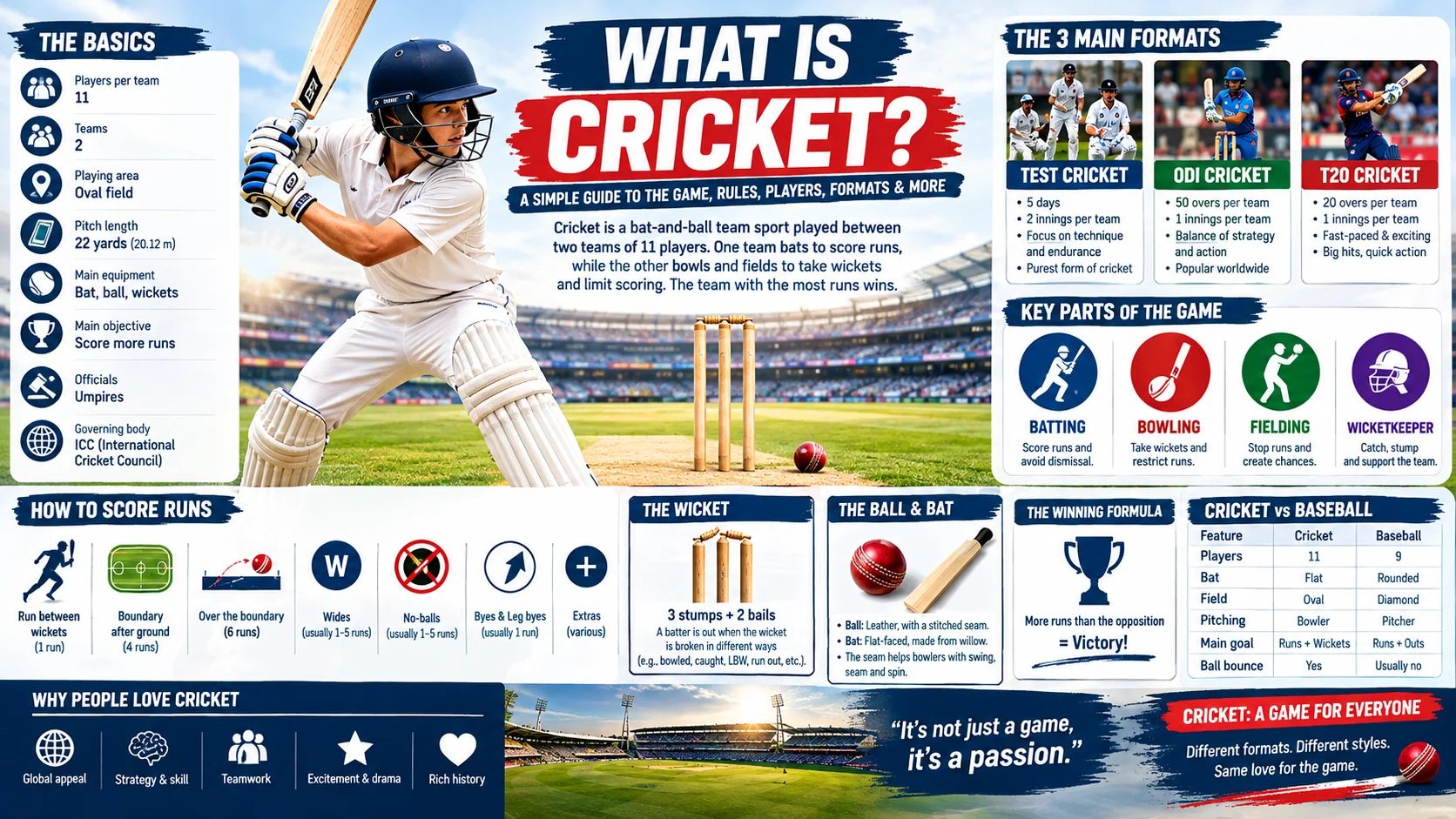
Cricket is a bat-and-ball team sport played between two teams of 11 players. One team bats to score runs, while the other bowls and fields to take wickets and limit scoring. The team with the most runs wins.
Cricket is a bat-and-ball team sport where two teams compete to score more runs than the other. Each team gets a chance to bat and bowl, with runs, wickets, overs, and strategic play deciding the winner.
From a five-day Test match to a fast-paced T20, cricket combines skill, patience, timing, strategy, and teamwork in one of the world’s most popular sports.
What Is Cricket?
Cricket is a team sport played between two teams of 11 players on a large oval-shaped field. At the center is a 22-yard (20.12-meter) pitch with three wooden stumps at each end.
One team bats while the other bowls and fields.
The batting team tries to score runs, while the bowling and fielding team tries to dismiss the batters and restrict the number of runs they score.
A cricket match can be won by:
- Scoring more runs than the opposition
- Chasing a target successfully
- Taking all available wickets while defending a total
- Finishing with the higher score when the allotted overs are completed
The basic idea sounds simple, but cricket has enormous tactical depth. Bowlers vary their speed, swing, seam, and spin, while batters choose when to attack, defend, or rotate the strike.
How Does Cricket Work?
In cricket, one team bats and attempts to score runs while the other team bowls and fields. Two batters are normally on the field at the same time, and the bowling team tries to dismiss them.
A batter can score by hitting the ball and running between the wickets, while boundaries automatically produce 4 or 6 runs. After a set number of overs or dismissals, the teams switch roles. The team with the most runs wins.
Cricket at a Glance
| Feature | Cricket |
|---|---|
| Players | 11 per team |
| Teams | 2 |
| Main objective | Score more runs |
| Playing area | Cricket field |
| Pitch length | 22 yards |
| Main equipment | Bat, ball, wickets |
| Scoring unit | Runs |
| Bowling unit | Over |
| Common formats | Test, ODI, T20 |
| Main officials | Umpires |
| Governing body | International Cricket Council (ICC) |
How Is Cricket Played?
A cricket match revolves around three major activities:
- Batting
- Bowling
- Fielding
The batting team attempts to build the highest possible score. The bowling team tries to take wickets and prevent runs.
There are two batters at the crease. One faces the bowler while the other waits at the opposite end.
After the ball is delivered, the batter can hit it and run between the wickets. Every completed run adds one run to the team’s score.
If the batter hits the ball over the boundary without it touching the ground, the team receives six runs.
If the ball reaches the boundary after touching the ground, the team generally receives four runs.
What Is a Run in Cricket?
A run is the basic unit of scoring in cricket.
The easiest way to score a run is for the batters to hit the ball and successfully change ends.
For example, if a batter hits the ball into the outfield and both batters run from one crease to the other, they score one run.
They can continue running if there is enough time.
Runs can also come from boundaries and certain extras awarded by the umpire.
Common Ways to Score Runs
- Running between the wickets
- Four runs from a boundary
- Six runs over the boundary
- Wides
- No-balls
- Byes
- Leg byes
What Is a Wicket in Cricket?
The word wicket has several meanings in cricket.
It can refer to the three wooden stumps and two bails at each end of the pitch. It can also refer to the dismissal of a batter.
For example, if a team has lost five wickets, five of its batters have been dismissed.
A team normally has 10 wickets available because two batters are required on the field, and an innings ends when 10 batters have been dismissed.
What Are the Stumps and Bails?
A cricket wicket consists of:
- Three stumps
- Two bails
The stumps are vertical wooden posts planted in the ground. The bails sit horizontally on top.
The bowler can dismiss a batter by hitting the stumps and knocking the bails off. This is known as bowled.
The wicket is therefore one of the most recognizable features of cricket.
What Is an Over in Cricket?
An over consists of six legal deliveries bowled by one bowler from the same end.
After six legal balls, another bowler bowls the next over from the opposite end.
For example:
10 overs = 60 legal deliveries
A bowler may not normally bowl two consecutive overs in the same innings.
Overs are especially important in limited-overs cricket because each team has a fixed number of them.
What Is a Cricket Innings?
An innings is the period during which a team bats.
Depending on the format, a team may have one or two innings.
Test Cricket
Each team can have two innings.
One-Day International Cricket
Each team normally has one innings of up to 50 overs.
T20 Cricket
Each team normally has one innings of up to 20 overs.
The innings structure is one of the biggest differences between cricket formats.
What Are the Main Types of Cricket?
Modern international cricket is generally divided into three major formats:
1. Test Cricket
Test cricket is the longest traditional format.
A Test match can last up to five days, with each team potentially batting twice.
Test cricket emphasizes:
- Patience
- Technique
- Endurance
- Bowling strategy
- Mental discipline
- Long-term tactical planning
A batter may spend hours at the crease, while bowlers work through different spells and conditions.
2. One-Day International Cricket
One-Day International cricket, commonly called ODI cricket, gives each team a maximum of 50 overs.
This creates a balance between traditional cricket and shorter formats.
Teams must manage:
- Powerplay overs
- Wickets
- Run rate
- Bowling resources
- Batting partnerships
- Death overs
An ODI match usually provides a full day’s cricket while remaining much shorter than a Test.
3. T20 Cricket
T20 cricket is the shortest major international format.
Each team receives a maximum of 20 overs, creating a fast and aggressive style of play.
T20 cricket emphasizes:
- Big hitting
- Fast scoring
- Innovative shots
- Specialized bowlers
- Aggressive field settings
- Matchups between batters and bowlers
Because every delivery matters, teams often take calculated risks much earlier than they would in Test cricket.
What Is a Cricket Bat?
A cricket bat is a flat wooden bat used by the batter to hit the ball.
Traditional cricket bats are generally made from willow, particularly English willow or Kashmir willow.
Unlike a baseball bat, a cricket bat has a broad, flat hitting surface.
Its design allows batters to play many different types of shots, including defensive strokes, drives, cuts, pulls, sweeps, and attacking shots.
What Is a Cricket Ball?
A cricket ball is a hard, leather-covered ball with a prominent stitched seam.
The ball’s seam is extremely important because bowlers can use it to influence how the ball moves after bouncing.
Fast bowlers may generate:
- Swing
- Seam movement
- Bounce
- Pace
Spin bowlers rely more heavily on:
- Turn
- Flight
- Dip
- Deception
The ball therefore plays a major role in the tactical battle between batter and bowler.
What Does a Cricket Bowler Do?
A bowler delivers the ball toward the batter while attempting to take wickets or prevent scoring.
There are two broad categories of bowlers.
Fast Bowlers
Fast bowlers rely on speed, bounce, swing, and seam movement.
They may bowl at speeds exceeding 140 km/h, with elite fast bowlers sometimes reaching even higher speeds.
Spin Bowlers
Spin bowlers deliver the ball more slowly but use rotation to make it turn after bouncing.
Common types include:
- Off-spin
- Leg-spin
- Left-arm orthodox spin
- Left-arm wrist spin
The best spin bowlers use changes in flight, speed, angle, and rotation to deceive batters.
What Does a Batter Do?
A batter’s primary job is to score runs while avoiding dismissal.
But batting is much more than simply hitting the ball.
A batter must judge:
- Line
- Length
- Speed
- Swing
- Spin
- Field placement
- Match situation
A defensive shot may be the correct choice when protecting a wicket, while an aggressive shot may be necessary when a team needs runs quickly.
This balance between risk and reward is one of cricket’s defining features.
What Does a Fielder Do?
Fielders support the bowler by stopping runs and creating opportunities to dismiss batters.
A cricket field can contain several specialized positions, including:
- Slip
- Gully
- Point
- Cover
- Mid-off
- Mid-on
- Square leg
- Fine leg
- Midwicket
- Wicketkeeper
Field placements change according to the bowler, batter, match format, and situation.
What Is a Wicketkeeper?
The wicketkeeper is the specialist fielder positioned behind the batter’s stumps.
The wicketkeeper wears gloves and protective equipment and is responsible for:
- Catching edges
- Collecting deliveries
- Stumping batters
- Supporting run-outs
- Communicating with the bowler and captain
A wicketkeeper often plays a crucial role in organizing the field and identifying opportunities for dismissal.
How Can a Batter Get Out in Cricket?
There are several ways a batter can be dismissed.
The most common include:
Bowled
The bowler hits the stumps and dislodges the bails.
Caught
A fielder catches the ball before it touches the ground.
LBW
Leg Before Wicket (LBW) occurs when the batter illegally intercepts the ball with their body under specific conditions defined by the Laws of Cricket.
Run Out
A batter is out when the fielding team breaks the wicket with the batter out of their ground while the ball is in play.
Stumped
The wicketkeeper breaks the wicket while the batter is outside the crease and not attempting a run, subject to the relevant laws.
Other forms of dismissal also exist, including hit wicket and obstructing the field.
What Is a Boundary in Cricket?
A boundary occurs when the ball reaches or crosses the boundary of the playing field.
There are two common boundary scores:
Four: The ball reaches the boundary after touching the ground.
Six: The batter hits the ball over the boundary without it touching the ground inside the field.
A six is the maximum number of runs normally scored from a single bat shot.
Why Is Cricket So Strategic?
Cricket may look slower than some sports, but its strategy is constantly changing.
A captain must decide:
- Which bowler should bowl?
- Where should fielders stand?
- Should the batter attack or defend?
- When should the bowling attack change?
- How aggressively should the team chase the target?
- When should risks be taken?
A match can turn because of one over, one partnership, one catch, or one tactical decision.
That combination of individual skill and team strategy is what makes cricket so compelling.
Cricket vs Baseball: What Is the Difference?
Cricket and baseball are both bat-and-ball sports, but their rules and gameplay are significantly different.
| Feature | Cricket | Baseball |
|---|---|---|
| Players | 11 per team | 9 on field |
| Bat | Flat-faced | Rounded |
| Main playing area | Oval field | Diamond |
| Pitching/bowling | Bowler runs in and delivers | Pitcher throws |
| Scoring | Runs | Runs |
| Innings | Varies by format | 9 innings in standard professional game |
| Ball can bounce before batter | Yes | Generally no |
| Main target | Wickets and runs | Outs and runs |
The biggest visual difference is the bat: cricket uses a broad, flat bat, while baseball uses a rounded bat.
Why Do People Love Cricket?
Cricket offers something for almost every type of sports fan.
If you enjoy explosive action, T20 cricket provides huge sixes, fast bowling, athletic fielding, and rapid momentum shifts.
If you prefer strategy and endurance, Test cricket offers extended battles between batters and bowlers.
ODI cricket sits between the two, combining tactical depth with a defined time and over limit.
The sport also creates memorable individual contests: a fast bowler against an elite batter, a spinner against a struggling middle order, or a chasing team trying to survive the final overs.
Frequently Asked Questions
What is cricket in simple words?
Cricket is a team sport played between two teams of 11 players. One team bats to score runs while the other bowls and fields to take wickets and restrict scoring.
How many players are on a cricket team?
A cricket team has 11 players on the field. A squad can contain additional players depending on the competition and format.
How many balls are in an over?
A standard over contains six legal deliveries.
How long is a cricket pitch?
The distance between the two wickets is 22 yards, or approximately 20.12 meters.
What is the highest score in cricket?
There is no single maximum team score across all cricket formats because the number of overs and innings varies. Individual and team scoring records differ between Test, ODI, T20, domestic, and other competitions.
What are the three main formats of cricket?
The three major international formats are Test cricket, One-Day International (ODI) cricket, and Twenty20 (T20) cricket.
Is cricket harder than baseball?
Cricket and baseball require different skill sets, so difficulty is difficult to measure objectively. Cricket involves batting against bouncing deliveries, running between wickets, bowling, and extensive fielding, while baseball has its own demanding pitching, hitting, and defensive skills.
Final Thoughts
Cricket is far more than hitting a ball with a bat. It is a strategic contest involving batting, bowling, fielding, running, timing, patience, and decision-making.
At its simplest, the objective is easy to understand: score more runs than the opposition. But once the ball is bowled, the game becomes a constant battle between attack and defense.
Whether it is a five-day Test, a 50-over ODI, or a high-energy T20, cricket offers a unique combination of skill, strategy, suspense, and teamwork which is why it has become one of the world’s most followed sports.

Daniel Brooks is a sports writer at SportsOrbitX.com, specializing in football, basketball and global sports news. He focuses on delivering accurate reporting, match analysis and timely updates that keep fans informed.