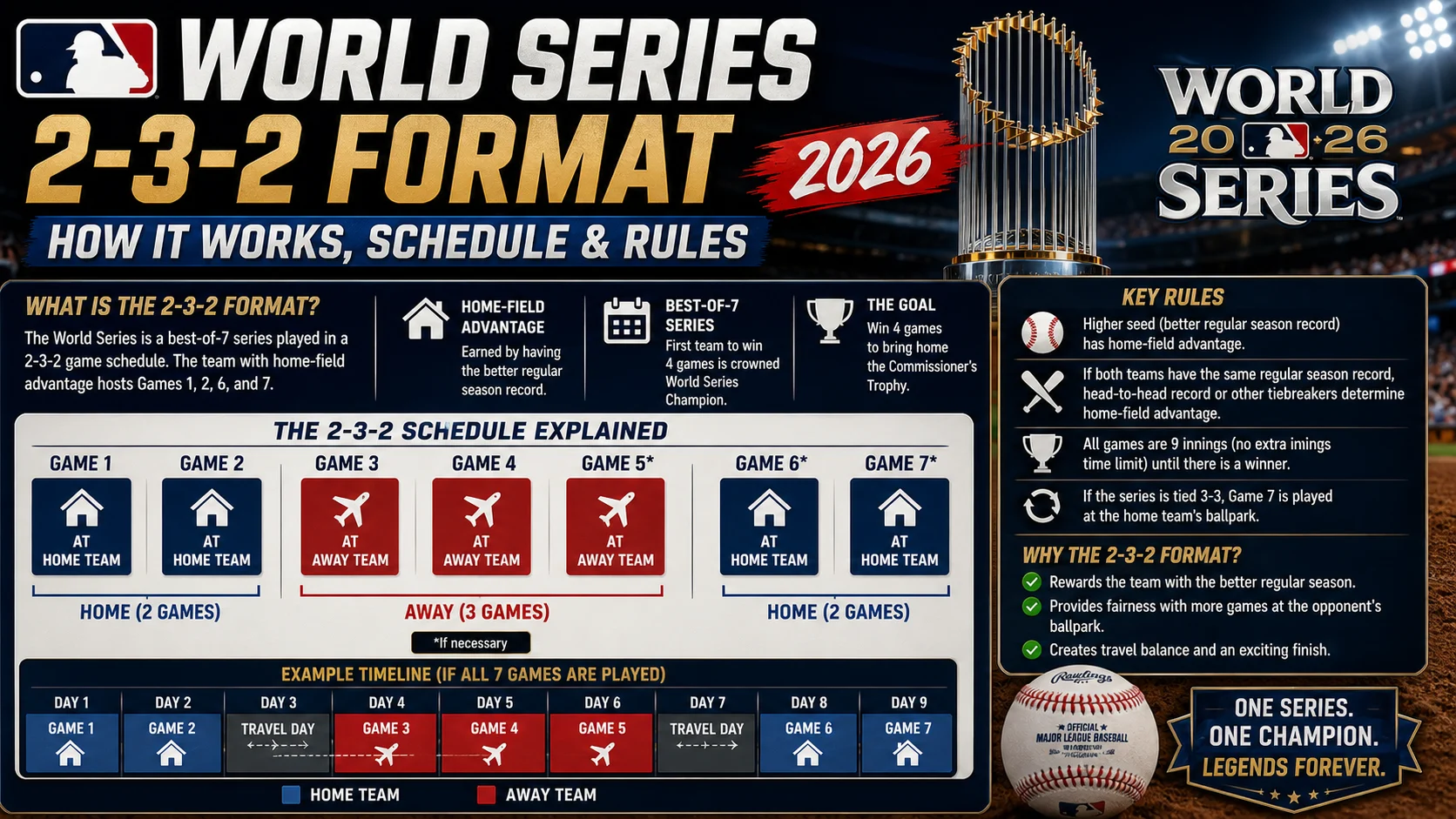
The World Series uses a 2-3-2 format, meaning one team hosts the first two games, the opponent hosts the next three, and the series returns to the first team’s ballpark for the final two games if necessary. The first team to win four games becomes MLB champion.
What Is the World Series 2-3-2 Format?
The World Series 2-3-2 format is a home-and-away scheduling system used in Major League Baseball’s best-of-seven championship series. It divides the potential seven games into three groups: two games at one ballpark, three at the other, and two back at the original venue.
The team with home-field advantage hosts Games 1 and 2, then Games 6 and 7 if the series lasts that long. Its opponent hosts Games 3, 4 and 5.
The format determines where each game is played, not how many games must be completed. A team that wins four games before Game 7 ends the series immediately.
World Series 2-3-2 Schedule at a Glance
| Game | Home team | Venue |
|---|---|---|
| Game 1 | Team A | Team A’s ballpark |
| Game 2 | Team A | Team A’s ballpark |
| Game 3 | Team B | Team B’s ballpark |
| Game 4 | Team B | Team B’s ballpark |
| Game 5 | Team B | Team B’s ballpark |
| Game 6* | Team A | Team A’s ballpark |
| Game 7* | Team A | Team A’s ballpark |
Games 6 and 7 are played only if needed.
Example: If the Milwaukee Brewers have home-field advantage against the Tampa Bay Rays, Milwaukee hosts Games 1 and 2. The series then moves to Tampa Bay for Games 3–5 before returning to Milwaukee for Games 6 and 7, if required.
Why Does the World Series Use a 2-3-2 Format?
The main reason is to organize a seven-game series between two teams playing in different cities while limiting repeated travel.
Under the 2-3-2 system, teams make one main change of venue after Game 2 and another after Game 5. This creates a predictable schedule for players, coaches, broadcasters and traveling fans.
MLB adopted the familiar format in the 1920s as part of its effort to make World Series scheduling more consistent and practical. Earlier championship schedules varied, and travel arrangements were less standardized. The 1925 World Series established the 2-3-2 pattern that became the long-term model, with special wartime exceptions in 1943 and 1945.
Three Main Benefits of the Format
- Predictable travel: Teams know when they will move between ballparks.
- A meaningful home-field advantage: The team with home-field advantage hosts four potential games, including a possible deciding Game 7.
- A dramatic finish: If the series reaches its final two games, the team with home-field advantage gets to play them at home.
The format also creates an important strategic challenge: a team must prepare for different ballparks, crowd environments and playing conditions as the series progresses.
Who Gets Home-Field Advantage in the World Series?
The World Series team with the better regular-season record receives home-field advantage, regardless of whether it represents the American League or National League. If both teams finish with identical records, MLB applies its tiebreaking rules.
This rule means the team that performs better over the regular season earns the opportunity to host Games 1 and 2, along with Games 6 and 7 if necessary.
Did the All-Star Game Ever Decide Home-Field Advantage?
Yes. From 2003 through 2016, the league that won the MLB All-Star Game received home-field advantage in the World Series.
MLB changed that policy in 2017. Home-field advantage is now based on regular-season performance rather than the outcome of an exhibition game.
The change gives the regular season a direct role in determining which World Series team gets the potential advantage of hosting four games.
How Does the 2-3-2 Format Affect World Series Strategy?
The schedule affects more than ticket sales and travel. It can influence pitching plans, bullpen management, player rest and the pressure surrounding each game.
Games 1 and 2: Start Strong at Home
The home team has the first opportunity to establish momentum. Winning both opening games creates a 2–0 lead before the series moves to the opponent’s ballpark.
However, losing both games can put the home team under immediate pressure. It must then try to recover on the road before returning home.
Games 3, 4 and 5: The Road Test
The series shifts to the other team’s ballpark for three consecutive games. This stretch can be decisive because the visiting team must adapt to a different environment while managing its pitching staff and lineup.
The middle games also create a major opportunity for the team without home-field advantage. Winning two or three games at home can transform the series, even if it lost the opening games.
Games 6 and 7: The Potential Championship Finish
If the series reaches Game 6, it returns to the original home venue. A team with home-field advantage may have the opportunity to win the championship in front of its own fans.
Game 7, if necessary, is a winner-take-all contest. One strong pitching performance, a defensive mistake or a timely extra-base hit can determine the championship.
Important: Home-field advantage does not guarantee a championship. The visiting team can win the series before it ever returns for Game 6.
Is the World Series Always Played Over Seven Games?
No. The World Series is a best-of-seven series, which means a team needs four wins to become champion. The series can last anywhere from four to seven games.
| Games played | What happens |
|---|---|
| 4 games | One team wins all four games and sweeps the series. |
| 5 games | One team wins four games by Game 5. |
| 6 games | One team reaches four wins by Game 6. |
| 7 games | The championship is decided in Game 7. |
For example, if Team A wins Games 1, 2, 3 and 4, the World Series ends after four games. Games 5, 6 and 7 are not played.
This is why the 2-3-2 format should be understood as a planned venue sequence rather than a guarantee that all seven games will take place.
World Series 2-3-2 vs. Other MLB Playoff Formats
Not every MLB postseason round uses the same home-game sequence.
| MLB postseason round | Series length | Home-game format |
|---|---|---|
| Wild Card Series | Best of 3 | All games at the higher seed’s ballpark |
| Division Series | Best of 5 | 2-2-1 |
| League Championship Series | Best of 7 | 2-3-2 |
| World Series | Best of 7 | 2-3-2 |
The Division Series uses a 2-2-1 arrangement: the higher-seeded team hosts Games 1 and 2, the opponent hosts Games 3 and 4, and Game 5 returns to the higher seed if needed. The League Championship Series and World Series use the 2-3-2 pattern.
The key distinction is that the World Series pairs the American League champion with the National League champion, while earlier rounds determine which teams reach that final matchup.
Does the Team With Home-Field Advantage Have a Better Chance to Win?
Home-field advantage can help, but it does not decide the series by itself.
A home crowd can energize players, and familiarity with the ballpark may provide some comfort. However, postseason outcomes depend on pitching, hitting, defense, health, managerial decisions and performance under pressure.
The 2-3-2 structure also means the home-field advantage team may have to win on the road to secure the championship. Even if it hosts a potential Game 7, it must first survive the middle three-game stretch.
For fans, that uncertainty is part of the appeal: the schedule provides a framework, but the teams still have to earn every win.
Frequently Asked Questions
What does 2-3-2 mean in the World Series?
It means the home-field advantage team hosts the first two games, the opponent hosts the next three, and the series returns to the first team’s ballpark for Games 6 and 7 if necessary.
Who hosts Game 7 of the World Series?
The team with home-field advantage hosts Game 7. That team is the World Series participant with the better regular-season record, subject to MLB’s tiebreaking rules if the records are equal.
Why does the World Series use a 2-3-2 format instead of 2-2-1-1-1?
The 2-3-2 format groups games by venue, reducing repeated travel between cities. It also creates a clear schedule for the opening, middle and potential closing stages of the series.
Can the World Series end in four games?
Yes. Because it is a best-of-seven series, the first team to win four games is champion. A team that wins the first four games completes a sweep.
Does the team with the better regular-season record always win the World Series?
No. A better regular-season record earns home-field advantage, but the championship is decided by the results of the World Series games.
When did MLB begin using the 2-3-2 format?
The familiar format was established for the 1925 World Series. MLB’s historical account notes that the system was introduced in the 1920s to reduce travel and has remained the standard, apart from special wartime arrangements.
Final Verdict
The World Series 2-3-2 format is a simple scheduling system with a major role in baseball’s biggest stage. It gives one team the opening two home games, shifts the series to its opponent for three games, and brings the action back for the final two if the championship remains undecided.
The team with the better regular-season record earns home-field advantage, but that advantage is only an opportunity not a guarantee of victory. To lift the Commissioner’s Trophy, a club must win four games, handle the pressure of different ballparks and perform when the stakes are highest.
For fans, understanding the 2-3-2 format makes every game easier to follow, especially when a series swings from a home crowd’s celebration to a hostile road environment and back again.

Daniel Brooks is a sports writer at SportsOrbitX.com, specializing in football, basketball and global sports news. He focuses on delivering accurate reporting, match analysis and timely updates that keep fans informed.