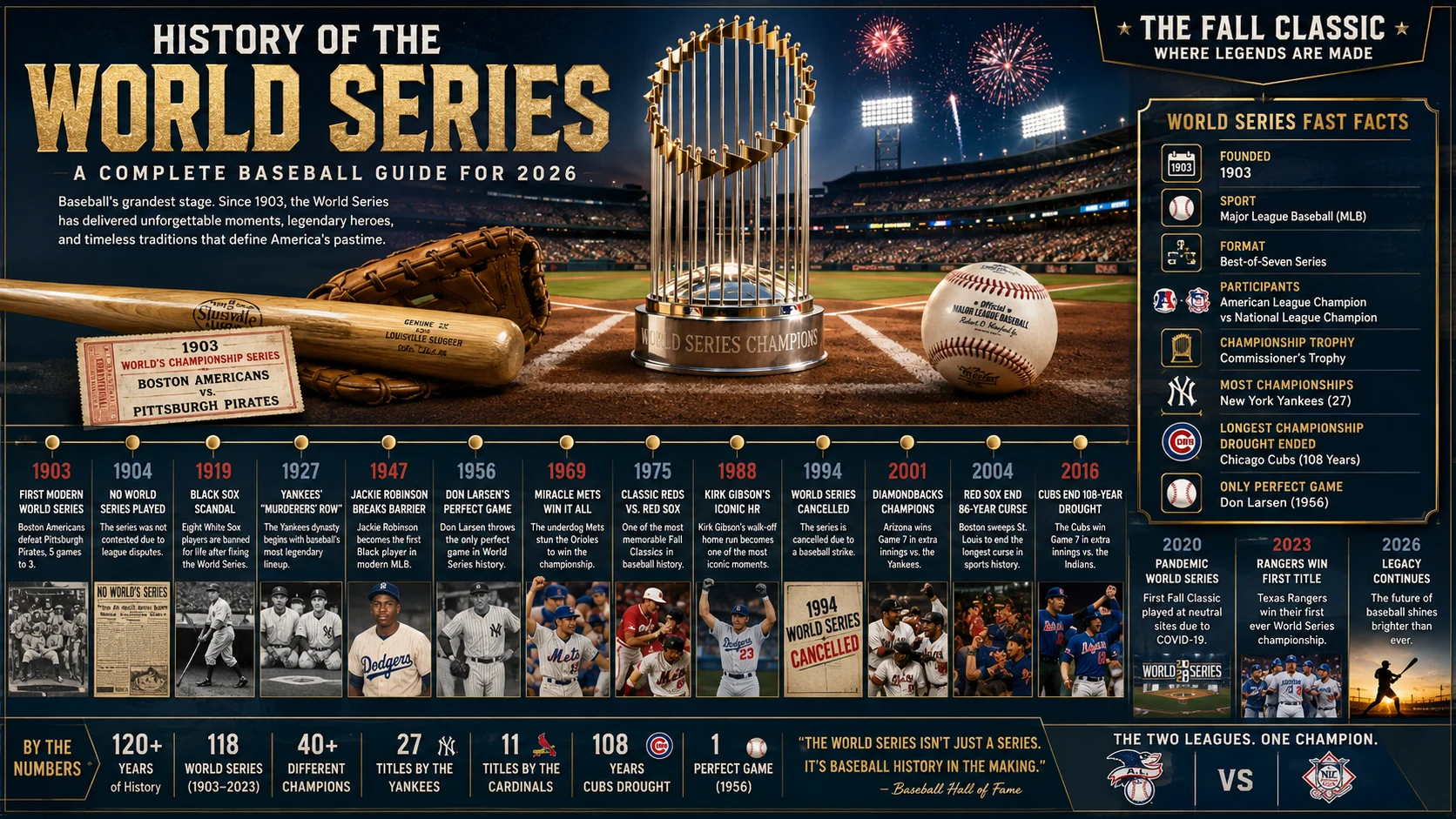
Quick Answer: The World Series began in 1903 as a best-of-nine series between the American League’s Boston Americans and the National League’s Pittsburgh Pirates, following years of hostility between the two leagues. Boston won the inaugural series 5 games to 3, and the event has grown into Major League Baseball’s championship, now a best-of-seven format played annually every October.
Two leagues that spent years raiding each other’s rosters, an owner who refused to even show up the following year, and a trophy that didn’t exist for the first six decades of competition the World Series wasn’t born out of tradition and ceremony. It was born out of a bitter business truce that both sides only reluctantly agreed to, and it nearly collapsed before it ever became America’s defining sporting event, one still watched by millions of fans every October.
This guide covers the complete history of the World Series, from the league rivalry that created it, through its near-cancellation in 1904, to the modern records and traditions that define it today across more than a century of championship baseball.
Before the World Series: Baseball’s Early Championship Attempts
Long before 1903, baseball had already experimented with postseason championships between rival leagues, though none achieved lasting success or widespread recognition. In 1884, the National League’s Providence Grays swept the American Association’s New York Metropolitans in a three-game series, an early precedent for cross-league competition that went largely unnoticed at the time. In 1894, Pittsburgh Pirates co-owner William C. Temple introduced the Temple Cup, a seven-game series between the National League’s first- and second-place finishers, though the format lasted only four seasons before being discontinued due to limited fan interest and the perception that it lacked genuine competitive stakes.
How Two Warring Leagues Created the World Series
The American League, founded in 1901 by Ban Johnson, quickly became a genuine rival to the long-established National League, leading to fierce competition over players, attendance, and overall legitimacy within the sport. Years of player raids and open hostility between the two leagues finally came to a head on January 9, 1903, when National League and American League officials met in Cincinnati and agreed to a peace settlement, formally recognizing each other’s legitimacy for the first time in the sport’s history. This truce created the conditions for the two leagues’ champions to finally meet on the field, rather than continuing to fight off it through legal and financial disputes.
The 1903 World Series: A Chaotic, Historic First
The inaugural World Series matched the American League champion Boston Americans, later renamed the Red Sox, against the National League champion Pittsburgh Pirates in a best-of-nine format spanning nearly two full weeks. Played from October 1 to October 13, 1903, Boston overcame an early series deficit to win four straight games, ultimately claiming the championship 5 games to 3. Boston pitcher Cy Young, who remains Major League Baseball’s all-time leader in career wins with 511, won two of the deciding games, cementing his legacy in the sport’s first modern championship. Attendance across the series totaled just over 100,000 fans, with each player’s individual winning share amounting to slightly more than $1,000, a modest sum by today’s standards but significant for the era.
1904: The Year the World Series Almost Didn’t Survive
Just one year after its historic debut, the fledgling World Series nearly collapsed entirely before it could establish itself as a genuine tradition. In 1904, the National League champion New York Giants, led by manager John McGraw, refused to play the American League champion Boston Americans, citing lingering resentment toward the rival league and viewing the American League as an inferior competition unworthy of a championship matchup. This refusal meant no World Series was held in 1904, exposing how fragile the informal agreement between the two leagues truly was at this early stage. The controversy surrounding the cancellation ultimately pushed both leagues to formalize the World Series as a mandatory, permanent postseason fixture starting in 1905, ensuring no single team’s owner or manager could unilaterally cancel the event again in the future.
How the Format Evolved Over Time
The World Series briefly experimented with different formats before settling into its now-familiar structure. The event returned in 1905 as a best-of-seven series, the format still used today, though a brief exception occurred between 1919 and 1921, when the series reverted to a best-of-nine format before permanently returning to best-of-seven in 1922. This early format experimentation reflected the sport’s broader uncertainty about the ideal championship structure during baseball’s formative decades as a professional, nationally organized sport.
The World Series Trophy: A Surprisingly Recent Addition
Despite the World Series dating back to 1903, an official trophy wasn’t created until 1967, when Major League Baseball commissioned one and presented it to the St. Louis Cardinals following their seven-game victory over the Boston Red Sox that year. Manufactured by Balfour of Attleboro, Massachusetts, the trophy featured a golden flag for every Major League club encircling its base, with a gold baseball and crown sculpture at its center representing the championship itself. The design was later updated as MLB expanded, growing from 20 flags at its introduction to 30 by the time the design was eventually retired and replaced with an updated version.
The 1994 Cancellation: Only Interruption Since 1904
The World Series has been played every year since 1905, with one notable exception that shocked the baseball world. In 1994, a players’ strike over salary cap negotiations led to the cancellation of the remainder of the MLB season, including the World Series, marking the first time since 1904 that the championship wasn’t held. This cancellation remains one of the most significant disruptions in the event’s history, underscoring how labor disputes, much like the league rivalry that delayed the very first World Series, have periodically threatened the tradition’s continuity across more than a century of competition.
World Series: Most Championships by Franchise
| Team | World Series Titles |
|---|---|
| New York Yankees | 27 |
| St. Louis Cardinals | 11 |
| Boston Red Sox | 9 |
| Philadelphia/Oakland Athletics | 9 |
The New York Yankees’ 27 titles remain by far the most in World Series history, a total no other franchise has come close to matching across the more than a century of competition since 1903.
Interesting Facts About the World Series
- The World Series is sometimes nicknamed the “Fall Classic,” a reference to its traditional October scheduling each year.
- Cy Young, the pitcher who won two games in the very first World Series, remains MLB’s all-time leader in career wins, a record widely considered unbreakable given modern pitching workloads.
- The 1903 series was originally scheduled as best-of-nine, a format briefly revived between 1919 and 1921 before being permanently abandoned.
- No official World Series trophy existed for the competition’s first 64 years, from 1903 until 1967.
- The Library of Congress maintains historical newspaper archives and photographs documenting World Series coverage dating back to 1903, preserving the event’s earliest recorded history.
The World Series and Baseball’s Integration Era
The World Series has also served as a stage for some of baseball’s most historically significant moments beyond pure athletic competition. Jackie Robinson, who broke Major League Baseball’s color barrier in 1947 with the Brooklyn Dodgers, went on to appear in six World Series during his career, including the Dodgers’ historic 1955 championship victory over the New York Yankees, their first title after several previous World Series defeats to their crosstown rivals. This period marked a significant cultural shift for the sport, with the World Series increasingly reflecting baseball’s gradual, often contentious integration throughout the mid-20th century.
Expansion Eras and the Growth of the Postseason
As Major League Baseball expanded from its original two-league, sixteen-team structure to today’s 30-team format, the path to the World Series itself grew considerably more complex. Early World Series matchups were determined simply by each league’s single pennant winner, but the introduction of divisional play in 1969, followed by additional playoff rounds in subsequent decades, meant teams increasingly had to survive multiple postseason series before even reaching the World Series itself. This evolution reflects broader trends across professional sports, where postseason formats have expanded considerably to accommodate larger leagues while still preserving a single, decisive championship series as the ultimate goal.
Memorable World Series Moments Across the Decades
Certain World Series matchups and moments have become deeply embedded in American sporting culture well beyond the box score itself. The Boston Red Sox’s 2004 championship, their first since 1918, ended what fans had long referred to as the “Curse of the Bambino,” a supposed hex tied to the team’s 1920 sale of Babe Ruth to the New York Yankees. The Chicago Cubs’ 2016 World Series victory similarly broke a 108-year championship drought, the longest in North American professional sports history at the time, capturing national attention well beyond the sport’s typical audience. These extended droughts and their eventual conclusions have become defining storylines that add considerable historical weight to the World Series tradition.
Frequently Asked Questions
When did the World Series begin? The World Series began in 1903, with the American League’s Boston Americans defeating the National League’s Pittsburgh Pirates 5 games to 3.
Why was there no World Series in 1904? The New York Giants refused to play the American League champion, citing hostility toward the rival league, leading both leagues to formalize the event as mandatory starting in 1905.
Who has won the most World Series titles? The New York Yankees have won 27 World Series titles, by far the most of any franchise in the competition’s history.
When did the World Series get an official trophy? An official trophy wasn’t created until 1967, when it was first presented to the St. Louis Cardinals following their championship win that year.
Has the World Series ever been cancelled since it began? Yes, the 1994 World Series was cancelled due to a players’ strike, the only cancellation since the event became a permanent annual fixture in 1905.
What was the original World Series format? The first World Series in 1903 was a best-of-nine format, which shifted to best-of-seven in 1905 and has remained the standard since 1922.
Which World Series championship droughts became legendary? The Boston Red Sox’s 86-year drought, ended in 2004, and the Chicago Cubs’ 108-year drought, ended in 2016, remain the two most famous championship droughts in World Series history.
Did Jackie Robinson play in the World Series? Yes, Jackie Robinson appeared in six World Series with the Brooklyn Dodgers, including their historic 1955 championship victory over the New York Yankees.
Conclusion
The World Series didn’t emerge from tradition or ceremony it was forged out of a bitter league rivalry, nearly collapsed after just one year, and existed for over six decades without even an official trophy to award its champion. From Jackie Robinson’s era-defining appearances to the Red Sox and Cubs finally breaking historic championship droughts, understanding this chaotic origin story makes the tradition’s modern significance all the more remarkable, a championship that survived its own near-cancellation to become the defining event of an entire sport.

Daniel Brooks is a sports writer at SportsOrbitX.com, specializing in football, basketball and global sports news. He focuses on delivering accurate reporting, match analysis and timely updates that keep fans informed.