Every four years, life pauses in almost every country on Earth for one tournament. Streets empty out during matches, offices install extra televisions, and a single goal can spark national celebrations that last for days. No other sporting event commands that kind of universal grip not the Olympics, not the Super Bowl. That event is the FIFA World Cup, and its story is nearly a century in the making.
From a 13-team experiment funded almost entirely by one small South American nation in 1930, to a 48-team global spectacle co-hosted across three countries in 2026, Football World Cup history is really the story of how the sport itself conquered the planet. This guide walks through that complete timeline the origins, the eras, the records, the controversies, and the numbers that explain why billions of people still stop what they’re doing every four years to watch.
- At SportsOrbitX.com, this history has been compiled and cross-checked against FIFA’s official tournament archives and IFAB historical records, so you can treat the facts, dates, and figures below as reliable reference material.
How the World Cup Began
Football had already spread across the globe by the early 1900s, carried by British sailors, traders, and railway workers to South America and continental Europe. By 1904, the sport needed a global governing body, which led to the founding of FIFA (Fédération Internationale de Football Association) in Paris. Football had also featured at the Olympic Games since 1900, but FIFA’s leadership particularly French administrator Jules Rimet wanted a standalone tournament that didn’t depend on the Olympic committee’s rules around amateur status.
In 1930, that vision became reality. Uruguay was chosen to host the first-ever FIFA World Cup, partly because the Uruguayan national team had won Olympic football gold in both 1924 and 1928, and partly because Uruguay agreed to cover the travel and accommodation costs for every visiting team a major factor during a period of global economic depression. A brand-new stadium, the Estadio Centenario in Montevideo, was built specifically for the tournament.
Only 13 teams participated in that inaugural event: seven from South America, four from Europe, and two from North America. Travel by ship across the Atlantic took nearly three weeks, which is why several strong European teams, including England, chose not to attend. Uruguay went on to win the very first title on home soil, defeating Argentina 4-2 in the final in front of roughly 68,000 fans.
Key Eras in World Cup History
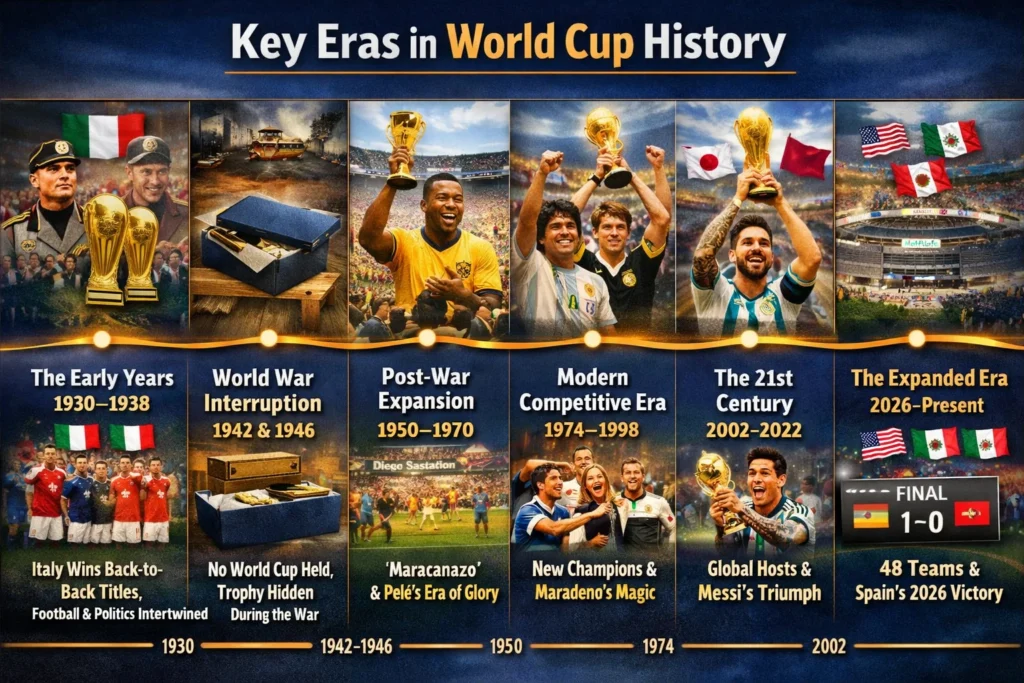
The Early Years (1930–1938)
The tournament aimed to run every four years, though the young competition faced real logistical hurdles from ocean travel times to political tensions in Europe. Italy hosted and won the 1934 edition, then defended their title in France in 1938, becoming the first nation to win back-to-back World Cups. Both Italian wins came under the fascist government of Benito Mussolini, which used the victories heavily for political propaganda, an early example of how deeply football and geopolitics have historically intertwined.
The World War Interruption (1942 & 1946)
No World Cups were held during these years. With much of Europe and Asia consumed by the Second World War, FIFA suspended the tournament entirely the only gap in its four-year cycle since the competition began in 1930. The trophy itself, then known as the Jules Rimet Trophy, was reportedly hidden inside a shoebox under a bed in Italy to protect it from being seized during the war.
Post-War Expansion (1950–1970)
Brazil hosted the first post-war tournament in 1950, drawing what remains one of the largest-ever crowds for a single football match: an estimated 199,854 spectators at the Maracanã Stadium for the final, in which Uruguay stunned the host nation a result still referred to in Brazil as the “Maracanazo.” This era also introduced the first true global superstar of the sport: Pelé, who won three World Cups with Brazil in 1958, 1962, and 1970, a joint individual record that still stands today. The 1970 Brazil squad, built around Pelé, is widely regarded by historians and football writers as one of the greatest teams ever assembled.
The Modern Competitive Era (1974–1998)
This period saw the tournament expand and diversify its winners. West Germany won on home soil in 1974, Argentina claimed its first title in 1978 (also as hosts), and Italy added a third star in 1982. The number of participating teams grew from 16 to 24 in 1982, then to 32 by the 1998 tournament in France a direct response to football’s rapidly growing popularity across Africa, Asia, and North America. Diego Maradona’s performance for Argentina in 1986, including the famous “Hand of God” goal and the “Goal of the Century” in the same match against England, remains one of the most analyzed moments in the sport’s history.
The 21st Century (2002–2022)
FIFA began rotating hosting duties more deliberately across continents to reflect football’s truly global reach. South Korea and Japan co-hosted in 2002 the first tournament held in Asia and the first with two host nations. South Africa hosted in 2010, the first World Cup held on African soil, introducing the now-iconic vuvuzela to a global audience. The 2022 tournament in Qatar was the first held in the Middle East and the first ever played in November–December rather than the traditional June–July window, a change made to avoid the extreme summer heat of the host country. Argentina, led by Lionel Messi, won that tournament in a final widely regarded as one of the greatest in World Cup history, finishing 3-3 after extra time before Argentina prevailed on penalties.
The Expanded Era (2026–Present)
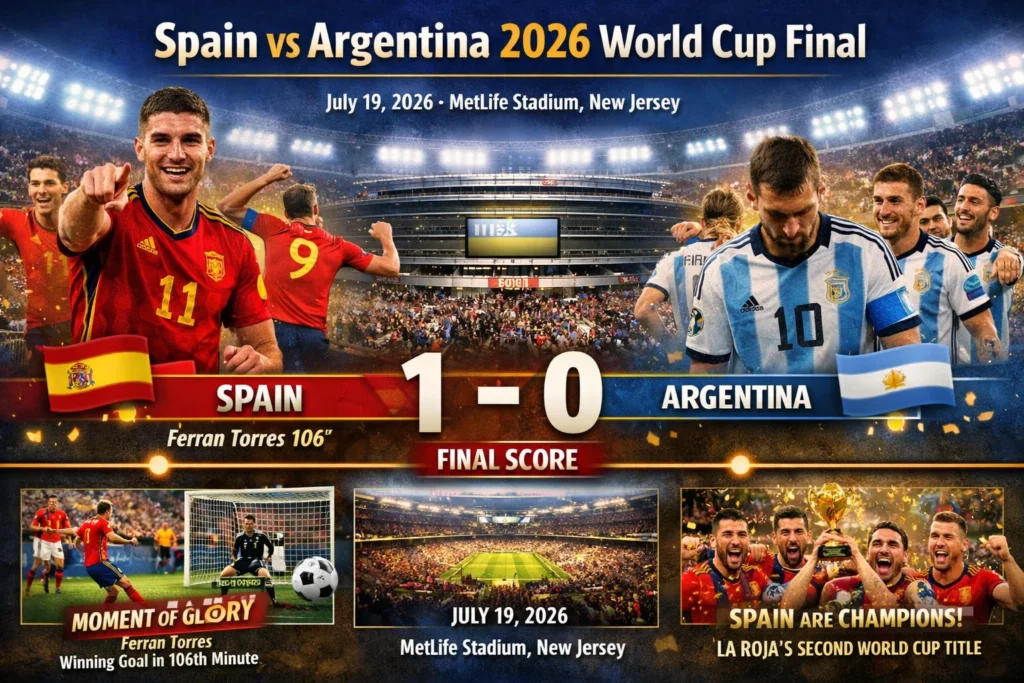
The 2026 World Cup, co-hosted by the United States, Canada, and Mexico, marked the biggest structural change in the tournament’s history: an expansion from 32 to 48 teams, the largest field ever assembled for the competition. This expansion means more nations qualify directly for the finals than at any point since 1930, extending the World Cup’s reach into football markets that had rarely, if ever, featured on this stage. In the final itself, played on July 19, 2026 at MetLife Stadium in New Jersey, Spain defeated Argentina 1-0 after extra time, with Ferran Torres scoring the decisive goal in the 106th minute. The win gave Spain their second World Cup title after 2010, and made them the first nation to simultaneously hold both the men’s and women’s World Cup titles. It marked the last World Cup final appearance for Argentina’s Lionel Messi, who started a record third World Cup final in his career.
The World Cup Trophy: A Brief History
The original trophy, the Jules Rimet Trophy, was awarded from 1930 until 1970, when Brazil won it outright after their third title (per a rule stating any nation to win three times would keep the trophy permanently). It was later stolen and never recovered. Since 1974, winners receive the current FIFA World Cup Trophy, an 18-karat gold trophy that nations do not keep instead, they receive a gold-plated replica, while the original returns to FIFA to be awarded again four years later.
Most Successful World Cup Teams
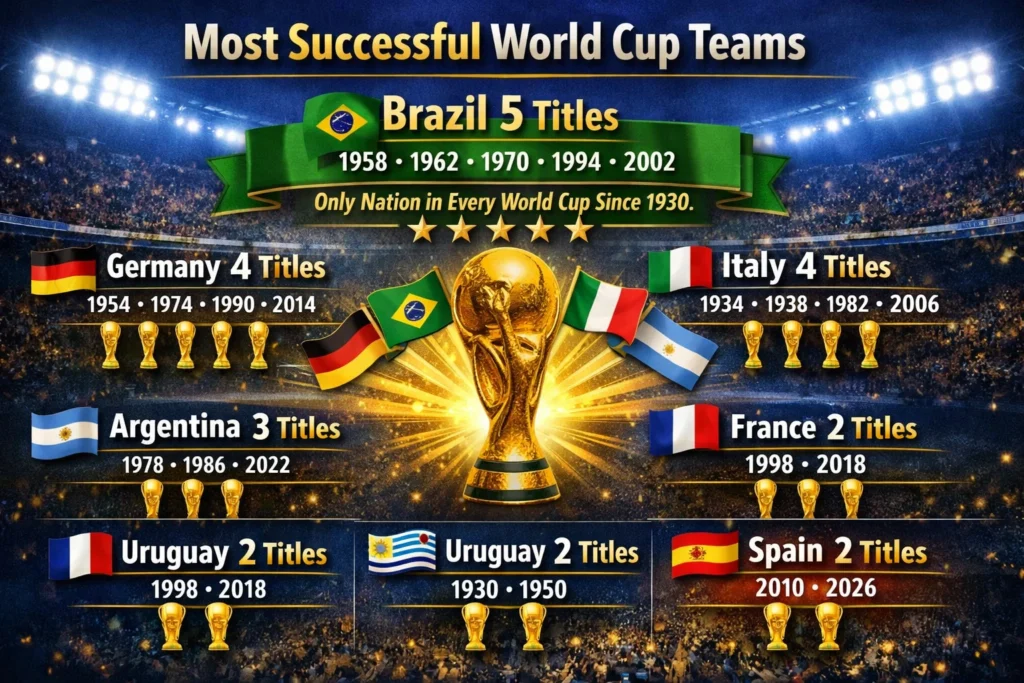
- Brazil — 5 titles (1958, 1962, 1970, 1994, 2002)
- Germany — 4 titles (1954, 1974, 1990, 2014)
- Italy — 4 titles (1934, 1938, 1982, 2006)
- Argentina — 3 titles (1978, 1986, 2022)
- France — 2 titles (1998, 2018)
- Uruguay — 2 titles (1930, 1950)
- Spain — 2 titles (2010, 2026)
Brazil is also the only nation to have played in every single World Cup tournament since the competition began in 1930, a streak of consistency no other football nation has matched.
Golden Boot Winners: Top Scorer at Every World Cup
Alongside the team trophy, FIFA also recognizes the tournament’s leading goal-scorer with the Golden Boot (historically called the Golden Shoe). Here’s the top scorer from every completed World Cup:
- 1930 (Uruguay) — Guillermo Stábile (Argentina), 8 goals
- 1934 (Italy) — Oldřich Nejedlý (Czechoslovakia), 5 goals
- 1938 (France) — Leônidas (Brazil), 7 goals
- 1950 (Brazil) — Ademir (Brazil), 9 goals
- 1954 (Switzerland) — Sándor Kocsis (Hungary), 11 goals
- 1958 (Sweden) — Just Fontaine (France), 13 goals — still the record for most goals in a single tournament
- 1962 (Chile) — Shared by six players with 4 goals each, including Garrincha and Vavá (Brazil)
- 1966 (England) — Eusébio (Portugal), 9 goals
- 1970 (Mexico) — Gerd Müller (West Germany), 10 goals
- 1974 (West Germany) — Grzegorz Lato (Poland), 7 goals
- 1978 (Argentina) — Mario Kempes (Argentina), 6 goals
- 1982 (Spain) — Paolo Rossi (Italy), 6 goals
- 1986 (Mexico) — Gary Lineker (England), 6 goals
- 1990 (Italy) — Salvatore Schillaci (Italy), 6 goals
- 1994 (USA) — Hristo Stoichkov (Bulgaria) and Oleg Salenko (Russia), 6 goals each
- 1998 (France) — Davor Šuker (Croatia), 6 goals
- 2002 (South Korea/Japan) — Ronaldo (Brazil), 8 goals
- 2006 (Germany) — Miroslav Klose (Germany), 5 goals
- 2010 (South Africa) — Thomas Müller (Germany), 5 goals
- 2014 (Brazil) — James Rodríguez (Colombia), 6 goals
- 2018 (Russia) — Harry Kane (England), 6 goals
- 2022 (Qatar) — Kylian Mbappé (France), 8 goals
2026 (USA/Canada/Mexico) — Kylian Mbappé (France), 10 goals. Mbappé became the first player since Gerd Müller in 1970 to score more than eight goals at a single men’s World Cup, and the first player ever to win the adidas Golden Boot at consecutive World Cups (2022 and 2026). Lionel Messi finished as runner-up with 8 goals, with Jude Bellingham third on 7.
Most World Cup Runner-Up Finishes
- Argentina — 4 runner-up finishes (1930, 1990, 2014, 2026)
- Germany — 4 runner-up finishes (1966, 1982, 1986, 2002)
- Netherlands — 3 runner-up finishes (1974, 1978, 2010)
- Brazil — 2 runner-up finishes (1950, 1998)
- Italy — 2 runner-up finishes (1970, 1994)
- Hungary — 2 runner-up finishes (1938, 1954)
- Czechoslovakia — 2 runner-up finishes (1934, 1962)
- France — 2 runner-up finishes (2006, 2022)
Interestingly, the Netherlands has reached the final three times (1974, 1978, 2010) but has never won the World Cup, making them the most successful nation without a title. Germany, meanwhile, is the only country to have both won the tournament four times and finished runner-up four times, reflecting its long-standing consistency at the top level of international football.
Memorable World Cup Records
- Most goals in a single tournament: 13 goals, Just Fontaine (France, 1958) a record that has stood for over six decades.
- Most career World Cup goals: Kylian Mbappé (France), 22 goals across three tournaments (2018–2026), surpassing the previous record of 16 held by Germany’s Miroslav Klose.
- Youngest World Cup hat-trick scorer: Pelé, age 17 (1958).
- Oldest World Cup hat-trick scorer: Lionel Messi, age 38, against Algeria at the 2026 tournament.
- Most World Cup appearances by a player: Lionel Messi, across six tournaments (2006–2026), among the most of any player in the competition’s history.
- Most-watched final: The 2022 final between Argentina and France, with a global audience estimated at over 1.5 billion viewers.
- Largest live attendance: An estimated 199,854 fans at the 1950 final in Brazil’s Maracanã Stadium.
- First nation to hold both World Cup titles simultaneously: Spain became the first country to hold the men’s and women’s FIFA World Cup titles at the same time following their 2026 triumph.
The World Cup’s Cultural and Economic Impact
Beyond the matches themselves, the World Cup has become a genuine global economic event. Host nations typically see billions of dollars in infrastructure investment, tourism revenue, and broadcasting income, though economists have long debated how much of that investment truly benefits host cities long-term. Broadcasting rights alone generate the majority of FIFA’s revenue from each cycle, with the tournament consistently drawing the largest cumulative television audience of any single sporting event on Earth larger than the Olympics, the Super Bowl, or any domestic league final.
How Teams Qualify for the World Cup
Qualification for the World Cup is not a single global process it runs through separate continental competitions organized by each region’s football confederation (UEFA for Europe, CONMEBOL for South America, CONCACAF for North and Central America, CAF for Africa, AFC for Asia, and OFC for Oceania). Each confederation is allocated a set number of direct qualification spots based on its historical strength and number of member nations, with the host country or countries receiving automatic qualification. With the move to a 48-team format in 2026, FIFA also expanded the number of qualification slots for every confederation, giving more nations from Africa, Asia, and North America a realistic path to the finals than at any point in the tournament’s history.
Notable World Cup Controversies
Not every chapter of World Cup history has been about celebration. The tournament has also been shaped by moments of genuine controversy:
- The 1986 “Hand of God” — Diego Maradona’s handled goal against England in the quarter-finals remains one of the most debated moments in football history, decades before video review technology existed to catch it.
- Host selection disputes — The choice of Qatar as 2022 host drew significant global criticism and scrutiny over labor conditions during stadium construction, prompting FIFA to introduce stronger commitments around worker welfare for future tournaments.
- Political boycotts — Several nations have withdrawn from World Cup qualification or the tournament itself over the decades due to political conflicts, including a number of European nations that declined to travel to the 1930 edition in Uruguay.
- Doping and disciplinary bans — A handful of players and even entire federations have faced sanctions tied to doping violations or disciplinary breaches across different tournament cycles.
These moments are part of the historical record too, and understanding them gives a fuller picture of how the tournament has evolved not just on the field, but in how it’s organized and governed.
Frequently Asked Questions
When was the first Football World Cup held? The first FIFA World Cup was held in 1930 in Uruguay, with the host nation winning the inaugural title by defeating Argentina 4-2 in the final.
Which country has won the most World Cups? Brazil holds the record with 5 titles, won in 1958, 1962, 1970, 1994, and 2002.
Why was the World Cup not held in 1942 and 1946? Both tournaments were cancelled due to the global disruption caused by World War II, the only interruption in the competition’s four-year cycle.
How many teams compete in the World Cup? The tournament expanded from 13 teams in 1930 to 32 teams by 1998, and then to a record 48 teams starting with the 2026 edition.
Who has scored the most World Cup goals in history? Miroslav Klose of Germany holds the all-time record with 16 goals across four tournaments between 2002 and 2014.
What was the original World Cup trophy called? It was called the Jules Rimet Trophy, awarded from 1930 to 1970, before being replaced by the current FIFA World Cup Trophy.
Has any team ever won three World Cups in a row? No team has ever won three consecutive World Cups. Italy and Brazil are the only nations to have won back-to-back titles (1934 & 1938, and 1958 & 1962, respectively).
Conclusion
From a 13-team tournament funded by a single host nation to a 48-team spectacle spanning three countries, Football World Cup history reflects the sport’s growth into the most-watched event on Earth. Nearly a century of legendary players, unforgettable finals, and evolving formats have shaped a competition that continues to unite billions of fans every four years and with the expanded format now in place, the next chapters of this history are set to be bigger than ever.
Want to explore more? Check out our guide on What is Football and How is it Played for the basics, or Football Positions Explained in Detail to understand the game deeper.

Emily Parker is a sports journalist at SportsOrbitX.com with a passion for covering cricket, tennis and major international sporting events. She is committed to producing clear, reliable and engaging content for sports enthusiasts worldwide.