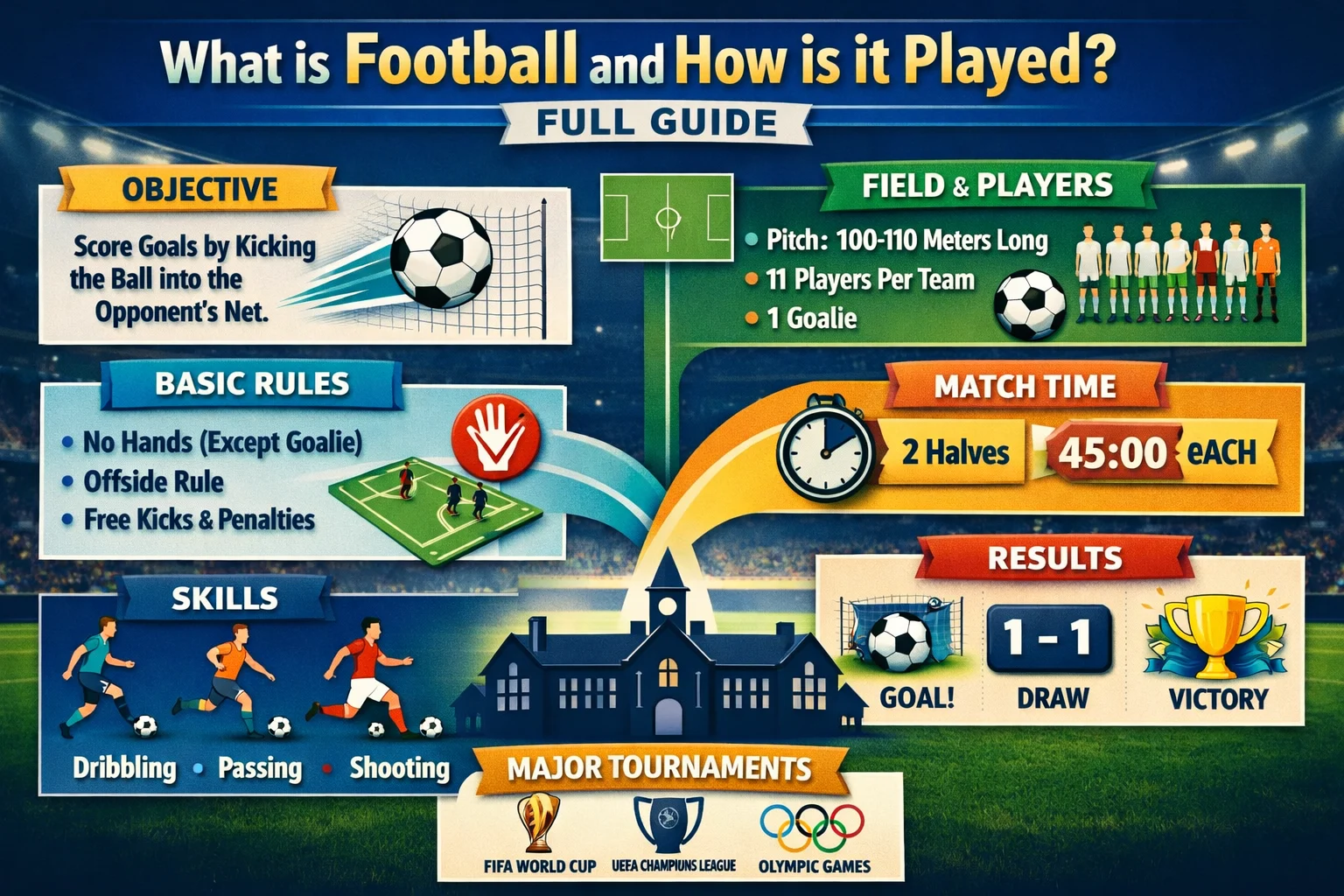
Football is the world’s most popular sport, played by two teams of 11 players who compete to score more goals than their opponent by getting the ball into the opposing net. But if you’re asking “what is football and how is it played” for the first time, there’s more to understand than just the goal from the field setup, to the rules, to how a 90-minute match actually unfolds.
Picture a stadium of 80,000 people, dead silent for a split second, then erupting all at once as a ball crosses a line. That single moment repeated in some form on pitches all over the world every single day is what makes football the sport that 3.5 billion fans follow. But if you’ve never played or watched a full match, the appeal can be hard to understand from the outside. What exactly are you supposed to be watching for? Why does everyone care so much about a ball going into a net?
This guide breaks it all down step by step, cross-checked against official IFAB and FIFA rules, so you can watch or play your first match with full confidence.
What is Football?
Football (called soccer in the US, Canada, and a few other countries) is a team sport played on a rectangular grass or turf field, called a pitch, between two teams of 11 players each. The objective is simple: score more goals than the opposing team within the match time. Players can use any part of their body except their hands and arms to control the ball only the goalkeeper is allowed to use their hands, and only inside their own penalty area.
According to FIFA, football is played and watched by an estimated 3.5 billion fans worldwide, making it the single most-followed sport on the planet.
The Football Pitch: Field Layout Explained
Before understanding gameplay, it helps to know the field itself. A standard football pitch is rectangular, typically between 100-130 yards long and 50-100 yards wide (exact dimensions vary by competition level). Key markings include:
- Center circle — Where kick-offs take place.
- Penalty box — The large rectangular area in front of each goal; fouls committed here result in a penalty kick.
- Goal area (six-yard box) — A smaller box inside the penalty area, used for goal kicks.
- Halfway line — Divides the pitch into two equal halves.
- Corner arcs — Small quarter-circles at each corner, marking where corner kicks are taken from.
How is Football Played? Step-by-Step
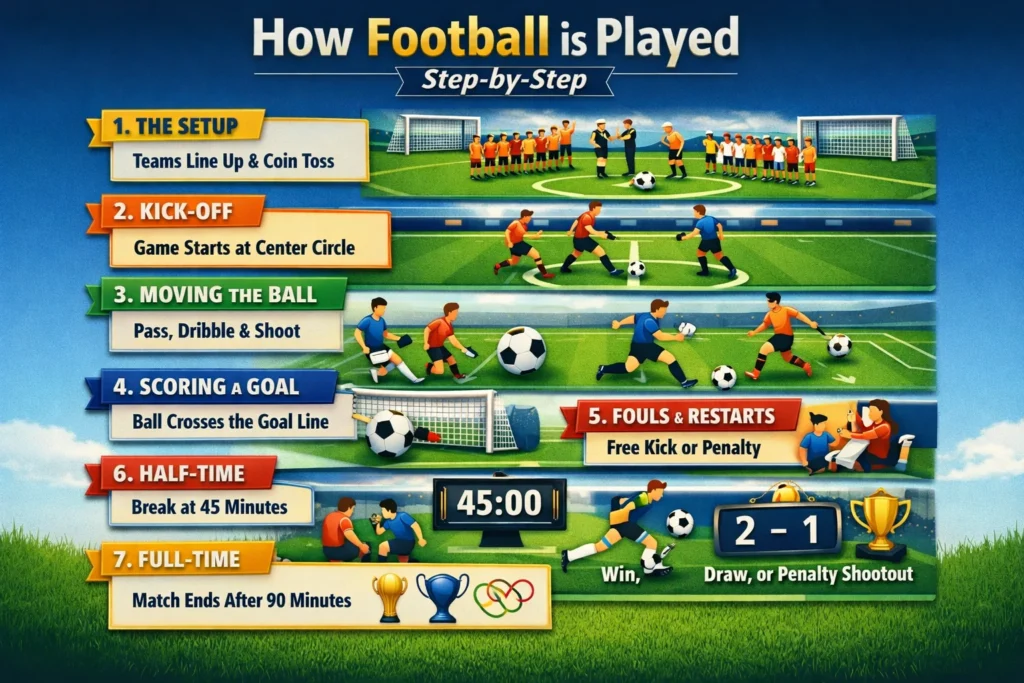
1. The Setup
Each team lines up in a formation across the pitch, with one goal at each end. A coin toss decides which team kicks off first and which side of the field each team defends.
2. Kick-Off
The match begins with a kick-off at the center circle. Play restarts the same way after every goal and at the start of the second half.
3. Moving the Ball
Players pass, dribble, and shoot the ball using their feet, chest, thighs, and head. The ball must stay in play within the marked boundary lines of the pitch.
4. Scoring a Goal
A goal is scored when the entire ball crosses the goal line, between the two posts and under the crossbar. Each goal counts as one point there’s no separate scoring system like in basketball or rugby.
5. Fouls and Restarts
When a player commits a foul (like tripping or pushing an opponent), the referee awards a free-kick or penalty kick to the other team, depending on where the foul occurred.
6. Half-Time
The match pauses for a short break at the 45-minute mark, after which teams switch sides for the second half.
7. Full-Time
After 90 minutes (plus any added stoppage time), the team with more goals wins. If it’s a league match and the score is level, it typically ends in a draw. In knockout tournaments, the game may go to extra time and then a penalty shootout.
Where Football Is Played at the Highest Level
Beyond international tournaments, most professional football happens in domestic club leagues that run for most of the year:
- Premier League (England) — Known for its fast pace and global broadcast reach.
- La Liga (Spain) — Home to some of the sport’s most decorated clubs and players.
- Serie A (Italy) — Historically known for tactical, defense-oriented football.
- Bundesliga (Germany) — Known for high attendances and a strong focus on youth development.
- UEFA Champions League — Not a domestic league, but the competition that brings the best club teams from across Europe together each season.
These leagues run alongside international football, meaning top players often compete for both their club and their national team throughout the year.
Basic Rules You Need to Know
For a quick refresher: 11 players per side (including one goalkeeper), 90-minute matches split into two halves, offside enforced against attackers, and yellow/red cards for fouls. For a full breakdown of every rule, including terminology, equipment, and officiating, see our complete guide on What is Football? A Complete Guide to Rules, Positions, and History.
Key Positions on the Field
Every team is built around four position groups: goalkeeper, defenders, midfielders, and forwards. For a full breakdown of each position’s specific responsibilities, check out our dedicated guide on Football Positions and Their Roles.
Common Mistakes Beginners Make When Watching or Playing
- Confusing offside — This is the rule that trips up most new fans. Remember: it only applies to the attacking team, and only at the moment the ball is passed, not when the player later runs onto it.
- Assuming every foul is a card — Most fouls simply result in a free-kick; yellow and red cards are reserved for more serious or reckless offenses.
- Overlooking the goalkeeper’s restriction — Even goalkeepers can’t use their hands outside their own penalty box.
- Not accounting for stoppage time — Matches often run a few minutes past the standard 45/90-minute mark to make up for time lost to injuries or substitutions.
How to Start Playing Football Yourself
If you’re inspired to get on the pitch rather than just watch, the entry point is simple: all you need is a ball and open space to begin. From there:
- Start with basic ball control passing and dribbling with both feet.
- Join a local five-a-side or futsal group, which is a lower-pressure way to learn the game’s flow.
- Learn one position well before trying to play everywhere on the pitch.
- Watch professional matches with the rules in mind it dramatically speeds up how quickly you understand tactics.
Who Officiates a Football Match?
A referee, two assistant referees, and a fourth official manage every professional match, with VAR now supporting big decisions at the top level. For a full breakdown of how VAR specifically works, see our guide on What Does VAR Stand For in Football.
Levels of Football: From Backyard to Professional
Football is played at wildly different levels of formality, but the core rules stay consistent throughout:
- Casual/recreational play — Often played with fewer players, smaller goals, and relaxed rules (no offside, no cards), just for fun and fitness.
- Youth and school football — Introduces structured rules gradually, often with smaller pitches and shorter match durations suited to younger players.
- Amateur/club football — Follows full IFAB rules, typically organized into local or regional leagues.
- Professional football — Played under strict IFAB Laws of the Game, with full officiating teams, VAR at the top level, and match durations of 90 minutes plus stoppage time.
Understanding these levels helps explain why a Sunday league match might look quite different from a Premier League fixture, even though both are technically “football.
Why is Football So Popular Worldwide?
A few factors explain football’s unmatched global reach. First, it’s accessible unlike sports that require expensive equipment or specialized facilities, football can be played almost anywhere with just a ball. Second, the rules are simple enough to understand within minutes, even if mastering the skills takes years. Third, international competitions like the FIFA World Cup create a sense of national identity and pride that few other events can match, uniting entire countries around a single team every four years.
Football by the Numbers
A few quick statistics help put the sport’s scale into perspective:
- 3.5 billion — estimated global fanbase, according to FIFA.
- 200+ — countries where football is played and followed.
- 11 — players per side on the pitch at any time.
- 90 minutes — standard match duration, plus stoppage time.
- 1930 — the year the first FIFA World Cup was held, in Uruguay.
What to Watch For as a First-Time Viewer
If you’re tuning into your first full match, it helps to know where to focus your attention rather than just following the ball constantly. Watch how a team shifts shape when they lose possession, how quickly players press to win the ball back, and how the tempo changes once a team is protecting a lead late in the second half. Commentary can also be genuinely useful for beginners, since commentators frequently explain tactical decisions in real time, helping new viewers connect the rules they’ve just learned to what’s actually happening on screen. Within a few matches, most new fans find that the game’s flow starts to feel intuitive rather than confusing, even without deep tactical knowledge.
Frequently Asked Questions
What is football in simple words? Football is a sport where two teams of 11 players try to score goals by getting a ball into the opposing team’s net, using any body part except their hands.
How is football played for beginners? Players pass and dribble the ball with their feet toward the opponent’s goal, working as a team to create scoring chances while defending their own net.
How long does a football match last? A standard match lasts 90 minutes, played in two 45-minute halves with a short break at half-time.
Can players use their hands in football? No, only the goalkeeper can use their hands, and only inside their own penalty area. All other players must use their feet, chest, or head.
What happens if the match ends in a tie? In regular league play, it ends in a draw. In knockout competitions, it goes to extra time and then penalty kicks if still tied.
What size is a football pitch? Pitches vary but typically measure between 100-130 yards long and 50-100 yards wide, depending on the level of competition.
Do you need special equipment to play football? No casually, all you need is a ball and open space. Organized play typically adds boots, shin guards, and team kits.
What’s the difference between football and futsal? Futsal is a smaller-sided indoor variant played on a hard court with a smaller, low-bounce ball, often used to build technical skills in a tighter space.
Conclusion
Now you know exactly what football is and how it’s played from the layout of the pitch, to kick-off, to full-time, and everything a referee and VAR team watch for in between. It’s a game built on a simple objective but layered with strategy, teamwork, and skill, which is exactly why it captivates 3.5 billion fans around the world and why it’s just as easy to pick up a ball and start playing yourself.
Whether you’re planning to watch your first match or step onto a pitch for the first time, you now have the foundation to follow the game with real understanding. Ready to go deeper? Check out our guide on Football Positions Explained in Detail next.

Emily Parker is a sports journalist at SportsOrbitX.com with a passion for covering cricket, tennis and major international sporting events. She is committed to producing clear, reliable and engaging content for sports enthusiasts worldwide.