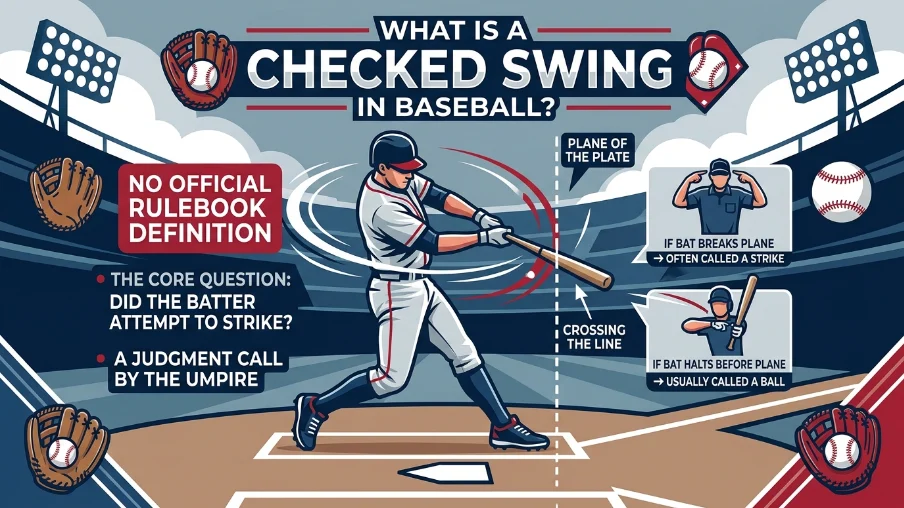
Quick Answer: A checked swing occurs when a batter begins to swing at a pitch but attempts to stop before completing the motion. The home plate umpire makes the initial ruling, and if the pitch is called a ball, the defensive catcher or manager can appeal to the first-base or third-base umpire, whichever has the better angle, for a final decision.
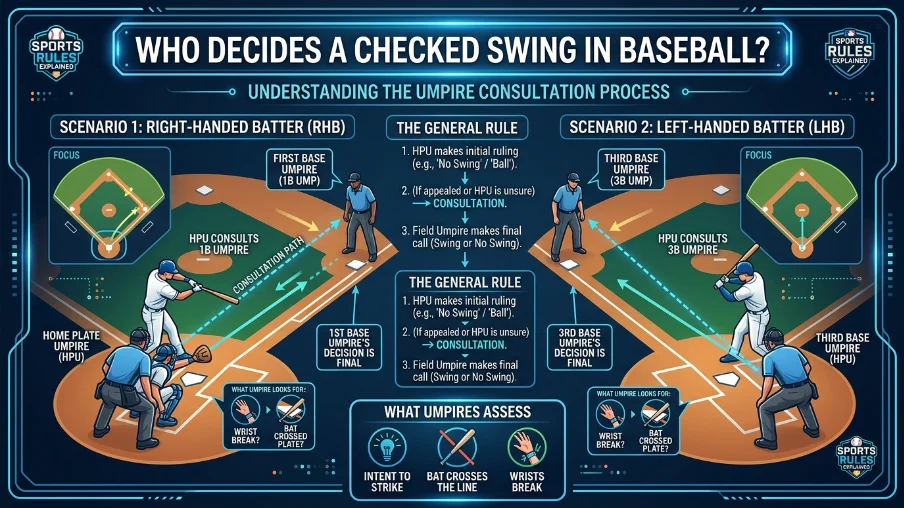
The pitch darts low and away, the batter’s hands jerk forward, and then stop. Was that a swing or wasn’t it? Few moments in baseball spark as much immediate disagreement between fans, players, and broadcasters as a checked swing, and the confusion only deepens once you learn that Major League Baseball’s own official rulebook doesn’t actually define the term at all, leaving the entire determination to a single umpire’s split-second judgment.
This guide explains exactly what is a checked swing in baseball, who decides it, how the appeal process actually works, and why instant replay still can’t be used to overturn the call even in the highest-stakes moments of a game.
What Counts as a Checked Swing?
A checked swing happens when a batter starts to swing at a pitch but attempts to stop the bat before making contact or completing a full swing motion. The central question an umpire must answer isn’t how far the bat physically traveled, but whether the batter genuinely attempted to strike at the pitch in the first place. Since the MLB rulebook officially defines a swing only as “an attempt to strike at the ball,” a checked swing is simply a case where the umpire judges that no real attempt was made, regardless of how far the bat moved toward the plate during the motion.
Who Actually Decides a Checked Swing?
The home plate umpire makes the first, and often only, ruling on every checked swing that occurs during a game. If the plate umpire judges that the batter did swing, the pitch is called a strike immediately, with no appeal possible under any circumstance whatsoever. Only when the plate umpire initially rules that no swing occurred, calling the pitch a ball, does the defense get any opportunity to challenge that decision through the formal appeal process. This is a genuinely important asymmetry in the rule: a checked swing ruled a strike is entirely final, while a checked swing ruled a ball can still be appealed and potentially overturned by a base umpire.
How the Checked Swing Appeal Process Works
When the plate umpire calls a pitch a ball following a checked swing, the catcher or team manager, and only the catcher or manager, can request an appeal. No other defensive player is permitted to make this specific appeal under official rules. The plate umpire is then obligated to ask for help from the appropriate base umpire, using a distinct mechanic where the plate umpire points assertively with the left arm directly at the chosen base umpire to avoid confusion with a strike signal. For a right-handed batter, the appeal typically goes to the first-base umpire, since that position offers the clearest angle on the bat’s path. For a left-handed batter, the appeal goes to the third-base umpire for the same reason. The base umpire then signals either a “safe” gesture, indicating no swing occurred, or a clenched fist, indicating a full swing and a strike.
Why Instant Replay Can’t Overturn a Checked Swing
Unlike many other close calls in modern baseball, a checked swing ruling cannot be challenged or reviewed using MLB’s instant replay system, regardless of how the appeal itself turns out. This exemption exists specifically because a checked swing is treated as a judgment call about intent rather than a purely factual, objectively reviewable determination like whether a runner touched a base before a tag. Beginning in 2024, some lower-level and independent leagues, including the Atlantic League, began experimenting with a “Check Swing Challenge” system incorporated into broader robot umpire and pitch-challenge trials, though this technology has not been adopted at the Major League level as of the current season.
The “Breaking the Wrists” Myth
Many fans and even some broadcasters believe umpires primarily use a “broken wrists” test, judging whether the batter’s wrists rolled over during the swing, to determine whether a checked swing counts as a strike. While this concept is frequently cited informally, it is not an official standard found anywhere in MLB’s rulebook. Some umpires may consider wrist rotation as one contributing factor among several, but the actual legal standard remains simply whether the batter attempted to strike at the pitch, a judgment call that can incorporate bat angle, wrist position, and overall swing motion without any single element being decisive on its own.
Checked Swing Appeal Rules: Quick Reference
| Rule | Detail |
|---|---|
| Who can appeal | Only the catcher or team manager |
| When appeal is allowed | Only if the pitch is initially called a ball |
| Appeal destination | First-base umpire (right-handed batter) or third-base umpire (left-handed batter) |
| Can a strike ruling be appealed? | No, a checked swing called a strike is final |
| Is replay allowed? | No, checked swings are exempt from instant replay review |
| Appeal deadline | Must be made before the next pitch, play, or attempted play |
How a Checked Swing Ruling Affects the Game
A single checked swing appeal can dramatically shift the outcome of an entire at-bat, turning what would have been ball four and a walk into strike three and a strikeout, or vice versa. This makes the timing and stakes of a checked swing appeal considerably higher than the brief moment itself might suggest, particularly in full counts or high-leverage situations late in close games. Base runners must also stay alert during a checked swing appeal, since a call initially treated as ball four, allowing a stolen base attempt to proceed, can be reversed to a strike if the appeal succeeds, potentially creating unusual complications for plays already in progress on the bases.
Famous Checked Swing Controversies in Baseball History
Certain checked swing rulings have become genuinely memorable moments in baseball history, occasionally sparking significant controversy given how directly they can alter a game’s outcome. High-leverage postseason at-bats have periodically hinged on a single checked swing appeal, with managers and players openly disputing a base umpire’s ruling in real time, sometimes leading to ejections when the disagreement crosses into arguing balls and strikes. These moments highlight just how much weight a split-second, purely visual judgment call can carry, especially when a checked swing appeal effectively decides whether an at-bat continues or ends immediately with a strikeout.
How Umpires Train to Make Checked Swing Calls
Professional umpires undergo extensive training specifically focused on judging bat path, timing, and swing intent, recognizing that checked swing calls remain among the most subjective and criticized decisions they’re required to make during a game. Umpire schools and ongoing professional development programs emphasize positioning and camera-informed feedback, using slow-motion video review during training sessions, even though that same technology remains unavailable for in-game appeals. This training gap, where umpires study video extensively to improve their judgment but can’t use video review during an actual game, reflects an ongoing tension in how MLB balances technological assistance with preserving certain judgment calls as purely human decisions.
Why MLB Has Resisted Reviewing Checked Swings
Despite growing use of instant replay across nearly every other type of close call in modern baseball, MLB has consistently resisted extending review to checked swings, and the reasoning offers useful insight into how the league thinks about officiating more broadly. Unlike a tag play or a fair-or-foul call, which involve a discrete physical fact that either did or didn’t happen, a checked swing requires assessing a batter’s intent, a genuinely subjective judgment that even slow-motion replay doesn’t necessarily resolve with total clarity. League officials have suggested that introducing replay for checked swings could open the door to endless debate over marginal cases without meaningfully improving accuracy, a concern that has kept the rule’s exemption from replay review firmly in place even as other technologies, including the Check Swing Challenge system tested in independent leagues, continue to be explored.
Frequently Asked Questions
What is a checked swing in baseball? A checked swing occurs when a batter begins to swing at a pitch but attempts to stop the bat before completing the motion or making contact.
Who decides if a swing was checked in baseball? The home plate umpire makes the initial call, and if ruled a ball, the catcher or manager can appeal to the first-base or third-base umpire for a final decision.
Can a checked swing call be reviewed with instant replay? No, checked swing rulings are specifically exempt from MLB’s instant replay review system, since they are treated as a judgment call rather than a factual determination.
Why does the appeal go to different umpires depending on the batter? The first-base umpire typically has the clearest angle for right-handed batters, while the third-base umpire has the better view for left-handed batters.
Can a checked swing ruled a strike be appealed? No, only a checked swing initially ruled a ball can be appealed by the defense; a strike ruling on a checked swing is entirely final.
Is the “broken wrists” rule an official standard for checked swings? No, while wrist rotation may be one factor an umpire considers, the official standard is simply whether the batter attempted to strike at the pitch.
Have any leagues experimented with technology for checked swing calls? Yes, starting in 2024, the Atlantic League and other independent leagues began testing a “Check Swing Challenge” system as part of broader robot umpire trials, though it has not reached MLB.
Why hasn’t MLB extended instant replay to checked swings? League officials have suggested that reviewing a subjective judgment about batter intent, rather than a discrete physical fact, could create endless debate without meaningfully improving accuracy.
Conclusion
So, what is a checked swing in baseball, and who decides it? At its core, it comes down to a judgment call about intent, made first by the home plate umpire and, when appealed, finalized by a base umpire with a clearer view of the bat’s path. Understanding this appeal process, along with why instant replay can’t intervene and how umpires are trained to make this uniquely difficult call, makes those tense moments after a batter holds up mid-swing far easier to follow, especially when a full count and a close game hang in the balance.

Daniel Brooks is a sports writer at SportsOrbitX.com, specializing in football, basketball and global sports news. He focuses on delivering accurate reporting, match analysis and timely updates that keep fans informed.