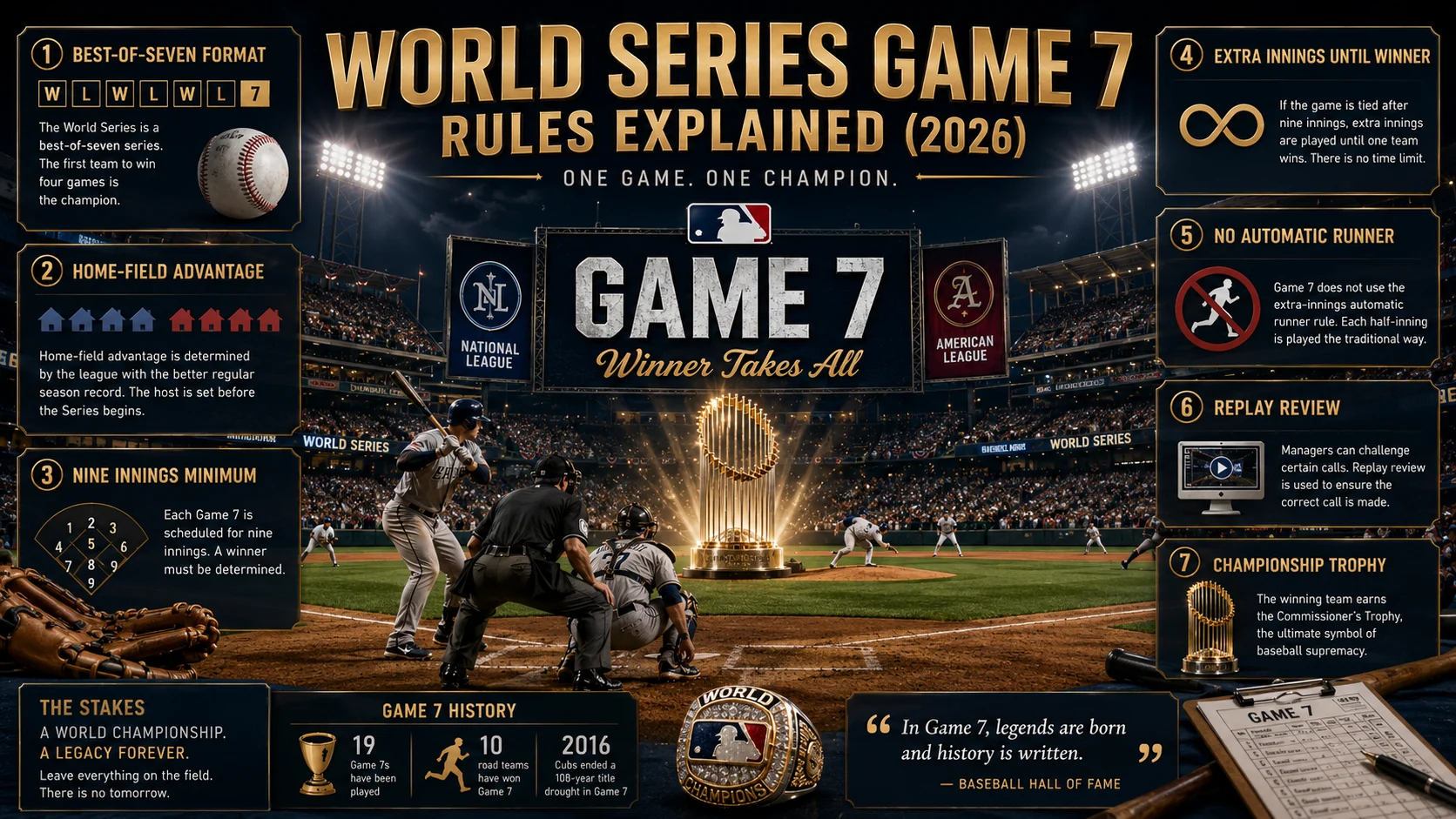
A World Series Game 7 is the decisive winner-take-all game played when two MLB teams split the first six games of the best-of-seven championship series. There are no special Game 7 rule changes the standard MLB and World Series rules apply but every pitch, substitution, and managerial decision carries championship-level importance. This guide explains how Game 7 works, who hosts it, what happens in extra innings, and why these games produce some of baseball’s greatest moments.
Quick Snapshot Table
| Category | Details |
|---|---|
| Event | World Series Game 7 |
| Sport | Major League Baseball (MLB) |
| Purpose | Decides the World Series Champion |
| Series Format | Best-of-Seven |
| When Played | If series is tied 3–3 |
| Length | Minimum 9 innings |
| Extra Innings | Yes, until a winner is determined |
| Home Team | Team with home-field advantage |
| Automatic Runner in Extras | No |
| Championship Trophy | Commissioner’s Trophy |
| Winner | First team to win Game 7 |
What Is a World Series Game 7?
Few sporting events carry as much pressure as a World Series Game 7. It represents the final game of the Major League Baseball season, where one team becomes champion and the other walks away just one victory short.
A Game 7 only happens when both teams win three games each during the first six games of the World Series. Since the championship follows a best-of-seven format, a seventh game becomes necessary to determine the winner.
Unlike regular-season games, there is no tomorrow. Every strategic decision, pitching change, defensive play, and at-bat can influence baseball history.
For players, coaches, and fans, Game 7 is the ultimate test of preparation, endurance, and composure.
Why Is Game 7 So Special?
Every baseball game matters, but Game 7 is different because there is no margin for error.
A team can recover from losing Game 1 or Game 2. They can even lose Game 6 and still have one final opportunity.
Game 7 removes every second chance.
The winning team lifts the Commissioner’s Trophy, celebrates a championship parade, and secures its place in MLB history. The losing team finishes as runner-up regardless of how dominant its season was.
That winner-take-all scenario creates an unmatched level of drama.
When Does a World Series Reach Game 7?
A World Series reaches Game 7 only if both clubs are tied after six games.
The series progression looks like this:
| Games Played | Series Score | Result |
|---|---|---|
| Game 1 | 1–0 | Continue |
| Game 2 | 1–1 or 2–0 | Continue |
| Game 3 | Various | Continue |
| Game 4 | Various | Continue |
| Game 5 | Possible Champion | Continue if necessary |
| Game 6 | 3–3 | Game 7 Required |
| Game 7 | Final Winner | Champion Crowned |
Many World Series end in four, five, or six games.
Game 7 is relatively uncommon, making each occurrence even more memorable.
Are There Special Rules for Game 7?
One of the biggest misconceptions among newer baseball fans is that Game 7 has unique rules.
It does not.
The official MLB playing rules remain exactly the same as every other World Series game.
That means:
- Nine scheduled innings
- Three outs per half inning
- No game clock
- Standard strike zone
- Regular substitution rules
- Same replay review system
- Same pitching regulations
- Same roster eligibility
The pressure changes.
The rulebook does not.
How Does a Team Win Game 7?
The objective is simple.
A team must score more runs than its opponent after at least nine innings.
If one club leads after the top and bottom of the ninth inning, that team wins both Game 7 and the World Series championship.
Example:
Team A: 6 Runs
Team B: 4 Runs
Final Result:
Team A wins the World Series.
If the score remains tied after nine innings, the game continues into extra innings until one team finishes an inning with more runs than the other.
Unlike some sports, baseball never uses penalty shootouts, overtime periods with clocks, or sudden-death scoring.
The championship must be earned through normal baseball play.
How Many Innings Does Game 7 Last?
The scheduled length is nine innings.
However, there is no maximum limit.
If the game remains tied:
- 10 innings
- 11 innings
- 12 innings
- 15 innings
- Even 18 innings
The game continues until someone wins.
Historically, several postseason games have lasted well beyond nine innings because neither team could gain an advantage.
Championship baseball demands a clear winner.
Are Extra Innings Different in the World Series?
Yes and this often surprises casual fans.
During the MLB regular season, an automatic runner is placed on second base at the start of each extra inning to help shorten games.
That rule is not used in the World Series.
Every extra inning begins exactly like the first inning:
- Bases empty
- No outs
- Pitcher starts normally
This preserves the traditional competitive integrity of the championship.
It also means marathon games remain possible.
Who Hosts Game 7?
Game 7 is always played in the stadium of the team that owns home-field advantage.
The current World Series schedule follows a 2–3–2 format.
That means:
- Games 1 and 2
- Games 6 and 7
are hosted by the same club.
The opposing team hosts:
- Games 3
- Game 4
- Game 5
If the series reaches Game 7, the higher-seeded team returns home for the deciding contest.
How Is Home-Field Advantage Determined?
Modern MLB determines home-field advantage using regular-season performance.
The team with the better regular-season record hosts Games 1, 2, 6, and 7.
This rewards consistency across the 162-game regular season.
For example:
Team A wins 104 games.
Team B wins 95 games.
If both reach the World Series, Team A receives home-field advantage.
Although home crowds create excitement, history has shown that visiting teams can still win Game 7 on the road.
Does Batting Order Change in Game 7?
No.
Managers submit a starting lineup before first pitch exactly as they would for any other game.
The batting order remains fixed throughout the game unless substitutions occur.
Managers often make lineup adjustments based on:
Starting Pitcher Matchups
A left-handed pitcher may encourage more right-handed hitters.
A right-handed ace may lead to different offensive choices.
Defensive Strength
Late in Game 7, preventing one run can matter more than scoring another.
Managers frequently replace offensive players with stronger defenders during the final innings.
Player Health
After six demanding games, fatigue becomes a major factor.
Small injuries often influence lineup decisions.
Pitching Strategy Changes Everything
Although the rules stay the same, Game 7 strategy changes dramatically.
Managers rarely think about tomorrow because there isn’t one.
That means pitchers are often used more aggressively.
Common Game 7 strategies include:
Starting the Ace on Short Rest
Some elite pitchers return with fewer days of rest than usual.
Although this increases fatigue risk, winning the championship outweighs long-term concerns.
Bullpen Games
Instead of relying on one starter for six innings, managers may combine several pitchers to create favorable matchups.
This approach has become increasingly common in modern postseason baseball.
Using the Closer Earlier
Normally, closers pitch only in the ninth inning.
Game 7 often changes that.
Managers may bring their best reliever into the seventh or eighth inning if the game’s biggest moment arrives earlier.
Saving the closer for a situation that never happens could cost the championship.
Pitch Counts Become Flexible
Regular-season pitch limits become less important.
Managers are willing to let experienced pitchers throw deeper into games if they continue performing well.
At the same time, struggling pitchers are removed much more quickly than usual.
Every Decision Carries More Weight
A stolen-base attempt.
A sacrifice bunt.
An intentional walk.
A replay challenge.
A pinch hitter.
A defensive replacement.
These are routine baseball decisions during the regular season.
In Game 7, they can define an entire franchise’s history.
Because every mistake is magnified, managers prepare detailed contingency plans before first pitch.
They evaluate every possible matchup, bullpen scenario, and substitution long before the game begins.
Historic World Series Game 7 Moments
World Series Game 7s have produced some of the most unforgettable moments in baseball history. While the rules remain the same as any other World Series game, the pressure often leads to legendary performances that are remembered for decades.
Here are several Game 7s that helped define Major League Baseball.
1924 World Series
The Washington Senators defeated the New York Giants in a dramatic 12-inning Game 7.
A bad hop over the third baseman’s head helped Washington score the winning run, giving the franchise its first and only World Series championship while based in Washington, D.C.
1960 World Series
Perhaps the most famous Game 7 ever played.
The Pittsburgh Pirates defeated the New York Yankees 10–9 after Bill Mazeroski hit the first walk-off home run in World Series Game 7 history.
Even decades later, it remains one of baseball’s most iconic championship finishes.
1991 World Series
Often considered one of the greatest baseball games ever played.
The Minnesota Twins defeated the Atlanta Braves 1–0 in 10 innings.
Jack Morris pitched 10 complete shutout innings, one of the greatest pitching performances in postseason history.
1997 World Series
The Florida Marlins defeated the Cleveland Indians in 11 innings.
Edgar Rentería delivered the championship-winning hit, earning the Marlins their first World Series title.
2001 World Series
The Arizona Diamondbacks faced the defending champion New York Yankees.
Trailing entering the bottom of the ninth inning, Arizona mounted an incredible comeback against Mariano Rivera, one of baseball’s greatest closers.
Luis Gonzalez’s game-winning single secured Arizona’s first championship in franchise history.
2016 World Series
One of the most emotional championships in sports history.
The Chicago Cubs defeated the Cleveland Indians 8–7 in 10 innings.
The victory ended the Cubs’ famous 108-year World Series championship drought, making it one of the most celebrated Game 7 victories ever.
What Makes Game 7 Different From Other World Series Games?
Although the official rulebook does not change, nearly everything else does.
Maximum Urgency
Managers know there is no future game to prepare for.
Every available pitcher can be used.
Every defensive substitution matters.
Every replay challenge becomes critical.
Emotional Pressure
Players often describe Game 7 as the most mentally demanding experience of their careers.
A single mistake may become part of baseball history.
Likewise, one outstanding play can define a player’s entire legacy.
Aggressive Decision-Making
Managers become much more aggressive by:
- Pulling struggling pitchers earlier
- Using elite relievers before the ninth inning
- Calling sacrifice bunts
- Attempting stolen bases
- Playing for one run rather than multiple runs
Common Strategic Decisions During Game 7
Pinch Hitters
Managers frequently substitute a stronger hitter in a critical late-game situation.
Even if that player starts on the bench, one at-bat can decide the championship.
Defensive Replacements
When protecting a narrow lead, teams often replace offensive players with superior defenders.
One outstanding catch can preserve a championship.
Bullpen Management
Unlike regular-season games, bullpen management in Game 7 is based entirely on winning today not preserving pitchers for tomorrow.
It is common to see:
- Starting pitchers relieved earlier than usual
- Multiple relief pitchers used
- Closers pitching more than one inning
- Former starters appearing in relief
Can There Be Rain Delays in Game 7?
Yes.
Weather does not eliminate the possibility of a Game 7.
If rain, lightning, or unsafe conditions develop, umpires can temporarily suspend play.
Once conditions improve, the game resumes from the exact point where it stopped.
Unlike some sports, the score does not reset.
Can a Game 7 End in a Tie?
No.
There are no ties in postseason baseball.
If the score remains tied after nine innings, teams continue playing extra innings until one team wins.
Whether that requires:
- 10 innings
- 12 innings
- 15 innings
- or even longer
a champion must eventually be determined.
Does the Automatic Runner Rule Apply?
No.
This is one of the most misunderstood World Series rules.
During the MLB regular season, each extra inning begins with a runner on second base.
However, postseason baseball including the World Series does not use this rule.
Every extra inning starts with:
- Bases empty
- No outs
- Standard baseball rules
This preserves the traditional nature of championship baseball.
Can Position Players Pitch in Game 7?
Technically, yes.
MLB rules allow a position player to pitch if the manager chooses.
However, it is extremely rare in a competitive World Series Game 7 because every run is so valuable.
Managers almost always rely on their available pitchers instead.
Can a Starting Pitcher Return Later in Game 7?
No.
Once a pitcher is removed from the game, they cannot return.
This rule applies to every MLB game, including the World Series.
Because of this, managers carefully choose the right moment to make a pitching change.
World Series Game 7 Records
Most Famous Walk-Off
Bill Mazeroski (1960)
Still the only walk-off home run that ended a World Series Game 7.
Longest Game 7
Several Game 7s have extended into extra innings, demonstrating just how evenly matched championship teams can be.
The 1991 and 1997 World Series both required extra innings before a champion was crowned.
Greatest Pitching Performance
Jack Morris
1991 World Series
10 shutout innings in Game 7.
Many baseball historians consider it one of the greatest postseason pitching performances ever.
Biggest Championship Drought Ended
Chicago Cubs
2016
Ended a 108-year championship drought after defeating Cleveland in 10 innings.
Biggest Myths About World Series Game 7
Myth 1: Game 7 Has Different Rules
False.
The official MLB rulebook remains the same.
Myth 2: There Is Sudden Death
False.
Teams continue playing complete innings until someone leads after an inning ends.
Myth 3: Home Team Automatically Wins
False.
Although home-field advantage helps, many visiting teams have won Game 7.
Myth 4: Managers Save Pitchers for Tomorrow
False.
There is no tomorrow.
Managers use pitchers aggressively because the season ends after Game 7.
Myth 5: The Automatic Runner Starts on Second Base
False.
That rule applies during the regular season not in the World Series.
Frequently Asked Questions
How many innings is World Series Game 7?
Game 7 is scheduled for nine innings but continues into extra innings until one team wins.
Is Game 7 winner take all?
Yes.
The winner becomes World Series champion.
The loser finishes as runner-up.
Who hosts Game 7?
The team with home-field advantage hosts Games 6 and 7.
Can Game 7 end after nine innings?
Yes.
If one team leads after nine innings, the game ends immediately.
Can Game 7 last 15 innings?
Yes.
There is no maximum inning limit.
The game continues until a winner is determined.
Are replay reviews allowed?
Yes.
The same replay review system used throughout the postseason applies during Game 7.
Is there a mercy rule?
No.
Major League Baseball has no mercy rule in postseason play.
Does every World Series reach Game 7?
No.
Many World Series end in four, five, or six games.
Only a portion of championship series require a deciding seventh game.
Conclusion
World Series Game 7 represents baseball at its highest level. While the rulebook remains unchanged, the significance of every decision, pitch, and swing reaches its peak. There are no shortcuts, no alternate endings, and no second chances. Teams must earn every out, every run, and ultimately every championship.
For fans, Game 7 offers unmatched excitement because it combines strategy, history, pressure, and skill into one final contest. Whether it ends in a dominant victory or an extra-inning classic, the winning team forever becomes part of baseball history.

Emily Parker is a sports journalist at SportsOrbitX.com with a passion for covering cricket, tennis and major international sporting events. She is committed to producing clear, reliable and engaging content for sports enthusiasts worldwide.