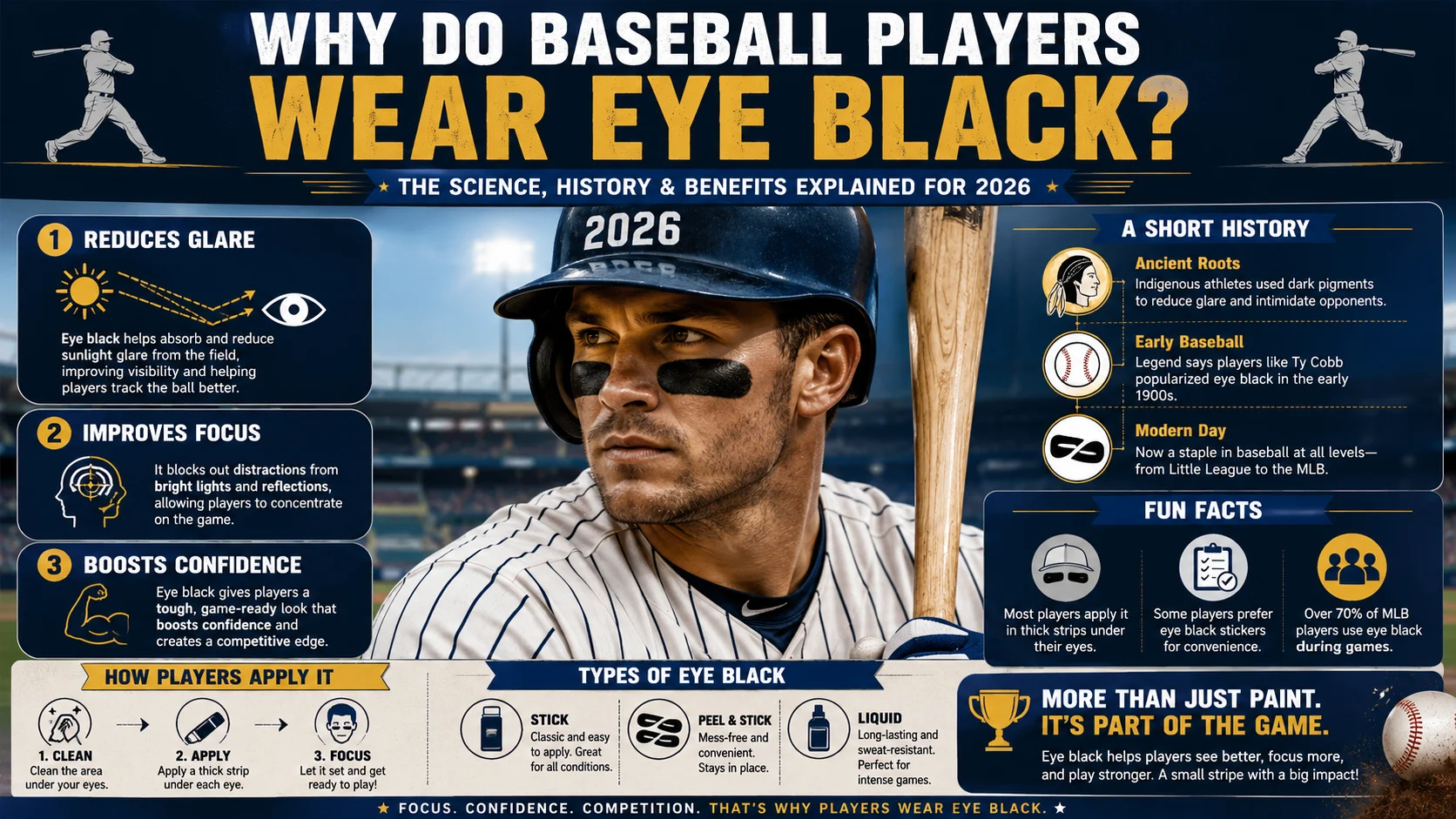
Quick Answer: Baseball players wear eye black primarily to reduce glare from sunlight and stadium lights, helping them track the ball more effectively, though scientific studies on its actual effectiveness have produced mixed results, with the practice also serving as a long-standing ritual tied to focus, confidence, and tradition.
Two thin black stripes beneath the eyes have become one of baseball’s most recognizable visual traditions, instantly signaling focus and intensity before a single pitch is thrown. But ask most fans why players actually wear it, and the answer usually stops at “it reduces glare” a claim that, according to actual peer-reviewed research, is considerably more complicated than the simple explanation most people assume to be settled fact.
This guide explains exactly why do baseball players wear eye black, what peer-reviewed science actually says about whether it works, where the tradition originated, and why so many players continue the practice regardless of the ongoing scientific debate surrounding its effectiveness.
The Basic Theory Behind Eye Black
The core idea behind eye black is straightforward: bright light from the sun or stadium floodlights can reflect off a player’s cheeks and bounce upward into their eyes, creating glare that interferes with tracking a fast-moving ball across the field of vision. Applying a dark substance beneath the eyes, whether black grease or an adhesive sticker, is intended to absorb more of that reflected light rather than allowing it to bounce back into the player’s line of sight. According to Adam Annaccone, a clinical associate professor in kinesiology at the University of Texas at Arlington, this makes eye black function essentially as a low-tech glare shield, distinct from equipment like a cap brim that blocks light directly rather than absorbing reflected light bouncing up from below.
What the Actual Science Says: Mixed Results
Despite eye black’s widespread use across multiple sports, scientific research into its actual effectiveness has produced genuinely mixed findings rather than a clear, settled verdict. A study conducted by researchers Brian M. DeBroff and Patricia J. Pahk at Yale School of Medicine tested 46 young adults in unobstructed sunlight and found that black grease improved contrast sensitivity, the eye’s ability to distinguish an object from its background, compared to using no product at all or anti-glare stickers alone. However, a later study led by Fraser C. Horn found that eye black did not significantly improve low-contrast visual sharpness in bright outdoor conditions, with tinted contact lenses actually performing better in that particular controlled test. Taken together, these studies suggest eye black may offer a modest benefit in specific conditions, but it is far from a guaranteed, universally proven performance enhancer.
Why Players Still Wear It Despite Mixed Evidence
If the scientific evidence is inconclusive, why do so many players continue the tradition year after year? According to Professor Annaccone, the answer extends beyond pure optics into the realm of routine and psychology. Baseball is a sport deeply tied to superstition and consistent pre-game rituals, with many players maintaining identical routines before every game, from specific pre-game meals to the exact order in which they put on their equipment. Eye black fits naturally into this broader culture of ritual, offering players a sense of readiness and focus that may provide genuine performance benefits through confidence and mental preparation, even if the physical glare-reduction effect itself remains only modestly supported by the available research.
The Real Origins of Eye Black: Babe Ruth and Beyond
Eye black’s association with baseball traces back to the early-to-mid 20th century, with some accounts suggesting legendary player Babe Ruth used burned cork beneath his eyes around the 1930s in an attempt to reduce sun glare during afternoon day games. The practice gained broader popularity through the 1940s and 1950s, with prominent players of that era, including Ruth and later Joe DiMaggio, helping normalize the look among a wider range of professional players across the league. Some historical accounts trace the underlying concept even further back, suggesting ancient civilizations and various indigenous groups used dark substances beneath the eyes for similar sun-glare-reducing purposes long before organized baseball ever existed as a sport.
Eye Black Formats: Grease vs. Stickers
Modern players typically choose between two main eye black formats, each with distinct advantages depending on personal preference, playing conditions, and comfort level. Traditional black grease, applied directly with fingers or an applicator, offers a customizable amount of coverage and tends to be favored by players who prioritize the glare-reduction function itself over convenience. Adhesive eye black stickers, a more modern alternative, provide a mess-free, consistent application that some players prefer for convenience and ease of use, though the Yale study specifically found grease outperformed anti-glare stickers in its contrast sensitivity testing, suggesting a potential meaningful performance difference between the two available formats.
Eye Black in Other Sports
While closely associated with baseball, the practice extends well beyond the diamond into several other outdoor sports facing similar glare challenges under variable lighting. American football players commonly wear eye black, particularly at positions requiring sustained tracking of a ball against bright skies or intense stadium lighting during games. Softball and lacrosse players have similarly adopted the practice, reflecting how the underlying glare-reduction rationale applies broadly across any sport played outdoors under variable lighting conditions, rather than being a tradition exclusive to baseball alone.
The Psychological Dimension: Intimidation and Confidence
Beyond the debated optical benefits, eye black carries a distinct psychological dimension that researchers and sports psychologists have increasingly studied in recent years. The dark, warrior-like appearance created by the stripes is often described by players and coaches as contributing to an intimidating on-field presence, potentially affecting how opponents perceive a player’s readiness and aggression before a single pitch is thrown at the plate. Sports psychology research into athletic rituals more broadly suggests that pre-performance routines, even those without a proven direct physical benefit, can meaningfully reduce anxiety and increase a sense of control heading into a competitive situation. This aligns with how many players describe their relationship with eye black: less about measurable glare reduction and more about entering a focused, competition-ready mental state before stepping onto the field for warmups.
How Players Choose to Apply Eye Black
The specific application of eye black varies considerably from player to player, reflecting both practical considerations and individual personal style. Some players apply thin, precise lines directly beneath each eye, focused purely on maximizing the glare-reduction function in the specific area where reflected light is most likely to interfere with vision during play. Others apply broader, more pronounced stripes extending further across the cheekbone, a style choice that leans more heavily into the intimidation and visual identity aspect of the tradition rather than pure functional optimization alone. Youth and amateur players often experiment with different styles throughout their playing careers, gradually settling into a personal application method that balances comfort, functionality, and individual preference over time.
Should Every Player Wear Eye Black?
Given the mixed scientific evidence, whether a player should adopt the practice ultimately comes down to personal preference rather than any universal recommendation from coaches or sports medicine professionals. Players who frequently compete in bright, sunny day games or under intense stadium floodlights may find even a modest glare-reduction benefit meaningfully helpful for tracking pitches and fly balls consistently. Others, particularly those who already wear sunglasses or find eye black uncomfortable or distracting, may reasonably choose to skip the practice entirely without any clear performance disadvantage, especially given that Fraser Horn’s research found tinted contact lenses outperformed eye black in certain visual sharpness testing conditions.
Notable Eye Black Traditions and Personal Styles
Beyond the basic functional purpose, certain players have become closely associated with distinctive personal eye black styles that became part of their on-field identity over the course of their careers. Some players have historically extended their eye black into more elaborate designs, while others stick to a minimal, understated application consistent with a more traditional approach to the ritual. Youth players often look to professional role models when developing their own eye black habits, gradually settling into an application style that reflects both personal comfort and, in some cases, an intentional visual statement carried into every game throughout a season.
Frequently Asked Questions
Why do baseball players wear eye black? Players wear eye black primarily to reduce glare from sunlight and stadium lights, helping them track the ball more effectively, though it also serves as a pre-game ritual for many players.
Does eye black actually work scientifically? Research is mixed. A Yale study found black grease improved contrast sensitivity compared to no product, while a separate study found no significant improvement in low-contrast visual sharpness.
Who is credited with starting the eye black tradition in baseball? Babe Ruth is often credited as an early adopter, reportedly using burned cork beneath his eyes around the 1930s to reduce sun glare during games.
Is black grease more effective than eye black stickers? According to Yale research, black grease outperformed anti-glare stickers in contrast sensitivity testing, though both remain widely used across different sports.
Do other sports besides baseball use eye black? Yes, American football, softball, and lacrosse players commonly wear eye black for similar glare-reduction purposes in outdoor playing conditions.
Is eye black required by MLB rules? No, wearing eye black is entirely optional and based on individual player preference rather than any league requirement or regulation enforced by MLB.
Does eye black have a psychological benefit beyond glare reduction? Yes, many players and sports psychologists point to eye black’s role in pre-game routines and rituals, which can help reduce anxiety and increase focus regardless of its measurable optical effect.
How should a player decide whether to wear eye black? The decision comes down to personal preference and playing conditions, since players in bright, sunny environments may find modest benefits, while others may prefer sunglasses or no additional product at all.
Conclusion
So, why do baseball players wear eye black? The honest answer sits somewhere between hard science and deeply ingrained tradition, with peer-reviewed research offering only modest, sometimes contradictory support for its glare-reducing claims, while the ritual itself continues to serve players through routine, focus, and confidence regardless of what the studies ultimately conclude.
From Babe Ruth’s burned cork to today’s precisely applied stripes and adhesive stickers, understanding both sides of this science-versus-tradition debate makes the two simple black stripes feel like a far more interesting story than a straightforward performance hack. Want to explore more baseball equipment and traditions? Check out our guide on What Does Drop 10 Mean on a Baseball Bat for another practical gear explainer.

Daniel Brooks is a sports writer at SportsOrbitX.com, specializing in football, basketball and global sports news. He focuses on delivering accurate reporting, match analysis and timely updates that keep fans informed.