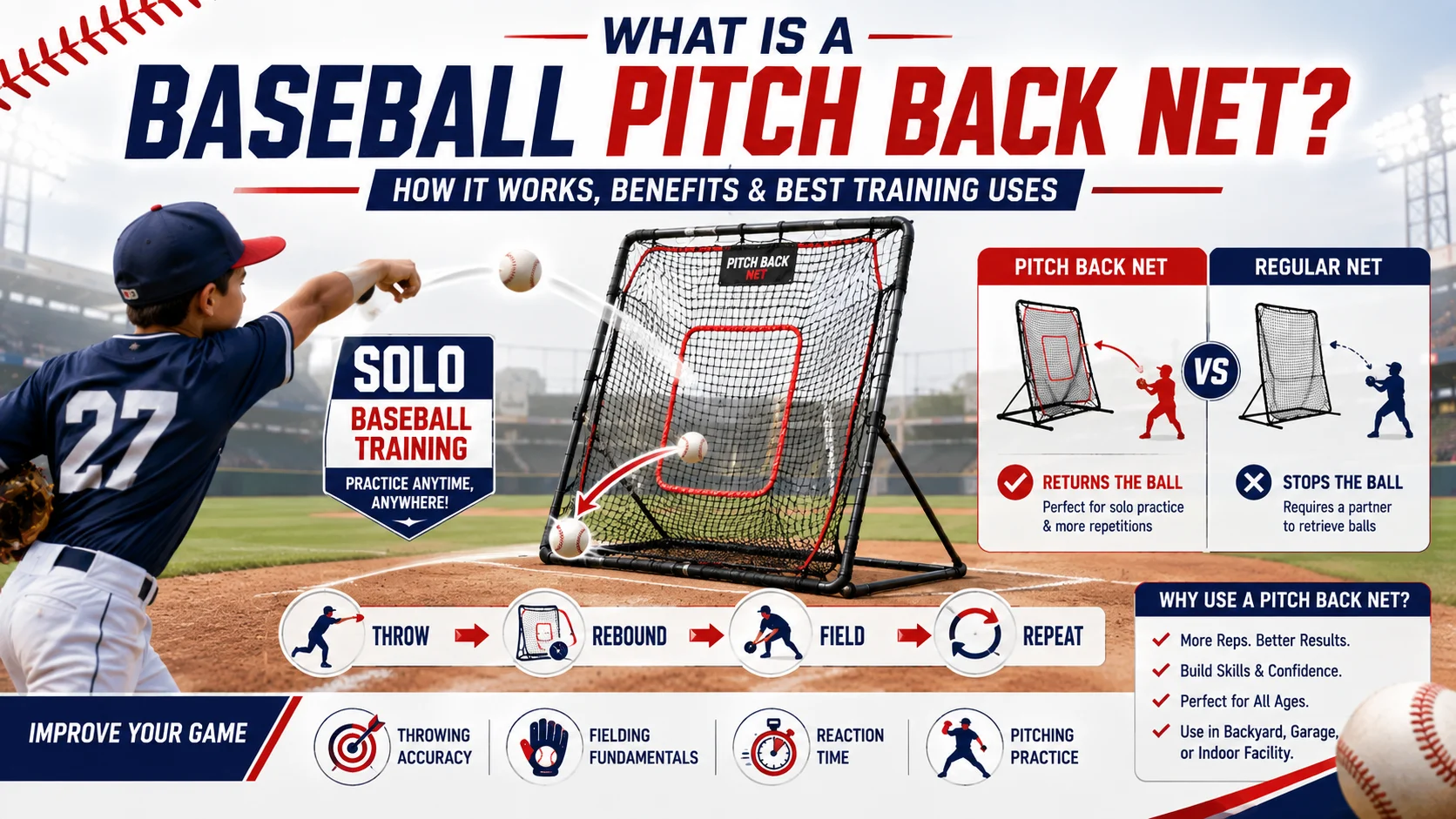
A baseball pitch back net is a rebound net designed to return a thrown or hit baseball back toward the player, allowing them to practice throwing, fielding, pitching, and reaction skills without needing a partner. Its angled, tightly tensioned netting turns ordinary backyard practice into a repeatable solo training session.
What Is a Baseball Pitch Back Net?
A baseball pitch back net is a training tool that catches a baseball and quickly rebounds it back toward the player. Unlike a standard baseball net that is primarily designed to stop balls, a pitch back net is built specifically to return the ball.
That difference is what makes it useful.
A player can throw a baseball into the net, field the rebound, and immediately throw again. There is no need for a coach, catcher, or teammate to retrieve every ball.
For young players especially, this creates more repetitions in less time.
A typical pitch back net consists of:
- A sturdy metal or fiberglass frame
- Tight rebound netting
- An angled or adjustable frame
- Ground anchors or stabilizing feet
- A target area for throwing
- A large enough surface to catch and return baseballs
Depending on the design, the net can be used for throwing drills, pitching practice, fielding, reaction training, and even certain hitting exercises.
How Does a Baseball Pitch Back Net Work?
The concept is simple: throw the baseball into the net, and the net sends it back.
When the baseball strikes the tensioned netting, the net absorbs some of the ball’s energy and redirects the rest back toward the player. The angle of the frame determines where the ball travels.
This is why pitch back nets are usually positioned at an angle rather than standing completely vertical.
A properly positioned net can produce a rebound that feels more like a real fielding opportunity than simply catching a ball thrown directly at you.
Simple Training Cycle
Throw → Rebound → Field → Reset → Repeat
That repeatability is the biggest advantage of a pitch back net.
Instead of spending half of a practice session chasing baseballs, a player can concentrate on the actual skill being developed.
What Is a Pitch Back Net Used For?
A pitch back net is much more versatile than its name suggests.
It can help baseball players practice several fundamental skills.
Throwing Accuracy
Players can throw at a specific target on the net and work on accuracy without a partner.
This is particularly useful for younger players learning to make consistent throws.
Fielding Ground Balls
When the ball rebounds downward or toward the player, it can create quick fielding opportunities.
A player can work on:
- Getting into a proper fielding position
- Moving toward the ball
- Soft hands
- Quick transfers
- Throwing after fielding
Reaction Training
A good rebound net can return the ball at different angles and speeds, forcing players to react rather than simply waiting for a predictable throw.
That makes it useful for developing hand-eye coordination and reaction time.
Pitching Practice
Pitchers can use a pitch back net to work on throwing mechanics and target accuracy.
A player can practice:
- Arm path
- Balance
- Release point
- Throwing direction
- Repetition
However, a pitch back net is not a substitute for a catcher when practicing complete pitching mechanics at game intensity.
Solo Baseball Practice
This may be the biggest benefit.
A player doesn’t always have a teammate available. A pitch back net allows practice to continue in the backyard, driveway, garage, or training area, provided there is enough safe space.
Pitch Back Net vs. Regular Baseball Net
These two products are often confused, but they serve different purposes.
| Feature | Pitch Back Net | Regular Baseball Net |
|---|---|---|
| Main Purpose | Rebound the ball | Stop and contain the ball |
| Ball Return | Yes | Usually no |
| Solo Practice | Excellent | Good |
| Throwing Drills | Excellent | Good |
| Fielding Practice | Excellent | Limited |
| Pitching Practice | Good | Good |
| Ball Retrieval | Reduced | More frequent |
| Best For | Repetition and reaction drills | Hitting and ball containment |
If your primary goal is solo throwing and fielding practice, a pitch back net is usually the more useful option.
If you mainly want to hit baseballs into a net and prevent them from traveling across the yard, a standard practice net may make more sense.
What Size Pitch Back Net Should You Get?
There is no single perfect size for every player.
The right size depends on the player’s age, skill level, available practice space, and the drills being performed.
Smaller Pitch Back Nets
Smaller nets are generally:
- Easier to transport
- Easier to store
- Suitable for younger players
- Useful for focused throwing drills
The trade-off is a smaller target area.
Larger Pitch Back Nets
Larger nets provide:
- More forgiveness for developing players
- A larger throwing target
- More room for different drills
- Better versatility for multiple players
For a family baseball setup, a larger, sturdy net can be more practical because it can accommodate different ages and skill levels.
What Makes a Good Baseball Pitch Back Net?
Not every rebound net performs the same way.
When choosing one, pay attention to the frame, net tension, stability, portability, and rebound consistency.
1. Strong Frame
A quality frame should remain stable when baseballs repeatedly hit the net.
Look for construction that doesn’t flex excessively or feel unstable during normal use.
2. Durable Netting
The net is going to take thousands of impacts over its lifetime.
Look for tightly woven, weather-resistant netting designed for baseball use.
3. Consistent Rebound
This is one of the most important factors.
A good pitch back net should return the baseball predictably rather than producing random rebounds every time.
4. Stable Base
A net that moves every time a baseball hits it quickly becomes frustrating.
Ground stakes, wide feet, or another reliable anchoring system can help keep the frame in place.
5. Adjustable Angle
An adjustable net gives players more training options.
Changing the angle can alter the direction of the rebound, making the net useful for different fielding and throwing drills.
Can You Use a Pitch Back Net for Hitting?
Some pitch back nets can be used for hitting, but not every model is designed for it.
This distinction matters.
A net designed primarily for throwing and fielding may not have the frame strength, netting configuration, or dimensions required for repeated baseball impacts from a hitter.
Before using a bat with a pitch back net, check the manufacturer’s intended use.
If hitting is a major part of your training, a dedicated baseball hitting net or multi-purpose practice net may be a better choice.
Best Pitch Back Net Drills for Baseball Players
The real value of a pitch back net comes from how you use it.
Here are several simple drills that can turn a backyard net into a serious training tool.
Drill 1: Throw and Field
Stand several feet away from the net.
Throw the baseball firmly into the target area and prepare immediately for the rebound.
Field the ball cleanly, reset your feet, and throw again.
Goal: Improve throwing accuracy, fielding fundamentals, and reaction time.
Drill 2: Quick Hands
Stand closer to the net and make controlled throws.
As the ball rebounds, focus on catching it quickly and transferring it into throwing position.
Goal: Develop faster hands and cleaner transfers.
Drill 3: Forehand and Backhand
Adjust your position so the rebound moves slightly to either side.
Practice fielding:
- Forehand balls
- Backhand balls
- Short hops
- Moving ground balls
Goal: Become comfortable fielding balls outside the center of your body.
Drill 4: Throwing Accuracy
Choose a small target on the net.
Make a series of controlled throws while trying to hit the same area repeatedly.
Goal: Improve throwing consistency rather than simply throwing hard.
Drill 5: Pitching Mechanics
Use the net as a target while focusing on mechanics rather than maximum velocity.
Work through the same motion repeatedly and pay attention to balance, direction, and release.
Goal: Build repeatable mechanics.
Is a Pitch Back Net Good for Beginners?
Yes.
In fact, beginners can benefit significantly from rebound training because it allows them to practice fundamental movements without needing a full team around them.
A younger player can start with simple catches and short throws.
As skills improve, the same net can be used for:
- Faster throws
- More difficult rebounds
- Ground-ball drills
- Reaction exercises
- More advanced throwing patterns
That makes a quality pitch back net a useful piece of equipment that can grow with the player.
Is a Pitch Back Net Good for Kids?
Yes, but safety and supervision matter.
A pitch back net should be placed in an open area away from windows, vehicles, roads, pets, and people who aren’t participating in the drill.
Young players should also use age-appropriate baseball equipment.
For beginners, start with controlled throws rather than maximum-effort throws. As the player’s technique improves, intensity can gradually increase.
Can One Person Practice Baseball With a Pitch Back Net?
Absolutely.
That’s arguably the biggest reason to own one.
A player can complete a productive solo session without waiting for a teammate to arrive.
A simple 20-minute session might look like:
| Time | Drill |
|---|---|
| 5 minutes | Easy throws and catches |
| 5 minutes | Ground-ball reactions |
| 5 minutes | Throwing accuracy |
| 5 minutes | Advanced reaction drills |
Twenty focused minutes of repetitive practice can be more valuable than an unfocused hour of simply throwing a baseball around.
Pitch Back Net Benefits
A quality pitch back net can provide several advantages.
More Repetitions
The ball comes back to you instead of requiring someone else to retrieve it.
Convenient Practice
You can practice at home without needing a full baseball field.
Better Reaction Skills
Unpredictable rebounds can force players to react quickly.
Improved Throwing
Repeated target throwing helps develop accuracy and consistency.
Affordable Training Tool
Compared with organized private training sessions, a reusable net can provide a large number of practice repetitions over time.
Great for Solo Players
The player doesn’t always need a coach or teammate available.
Limitations of a Pitch Back Net
A pitch back net isn’t a complete baseball training system.
It cannot fully replace:
- Live pitching
- Defensive situations
- Base running
- Team practices
- Game experience
- Coach feedback
- Catching a variety of real game throws
It should be viewed as a practice tool, not a replacement for playing baseball.
The best results come from combining rebound-net training with live practice and proper instruction.
How Far Away Should You Stand From a Pitch Back Net?
The ideal distance depends on the drill, player’s age, throwing strength, and the net’s design.
Start closer with controlled throws.
Once the player understands how the net rebounds the ball, gradually increase distance and throwing intensity.
The goal isn’t to stand as far away as possible.
The goal is to create useful, repeatable rebounds that challenge the player without creating unnecessary risk.
How to Set Up a Pitch Back Net Safely
Before starting practice, inspect the surrounding area.
Make sure:
- The net is fully assembled.
- The frame is properly locked.
- Stakes or anchors are installed when needed.
- There are no people directly behind the net.
- Windows and vehicles are out of the throwing zone.
- The ground is reasonably level.
- The player has enough room to move safely.
A net that is technically strong can still be unsafe if it’s positioned poorly.
Pitch Back Net Buying Guide
If you’re buying your first baseball pitch back net, don’t choose based only on price.
Consider these questions:
Does it rebound baseballs consistently?
Is the frame sturdy enough for repeated use?
Can the angle be adjusted?
Is it easy to assemble and store?
Is the net designed for outdoor use?
Does it suit the player’s age and skill level?
Can replacement netting or parts be obtained if necessary?
Answering these questions can prevent a cheap purchase from becoming an expensive replacement later.
Frequently Asked Questions
What is a baseball pitch back net used for?
A baseball pitch back net is primarily used for solo throwing, fielding, reaction, and pitching practice. It rebounds baseballs back toward the player after they hit the net.
Is a pitch back net the same as a baseball net?
No. A regular baseball net is generally designed to stop and contain baseballs, while a pitch back net is specifically designed to return them.
Can you practice pitching with a pitch back net?
Yes. Players can use one to practice throwing mechanics, accuracy, and repetition. However, it does not replace live pitching practice with a catcher.
Can you hit into a pitch back net?
Only if the specific net is designed and rated for hitting. Always follow the manufacturer’s intended use.
Are pitch back nets good for beginners?
Yes. They allow beginners to practice throwing, catching, and fielding with simple drills and can become more challenging as the player develops.
How long should a baseball player use a pitch back net?
There is no required session length. Even 15–30 minutes of focused practice can be productive when the drills have a clear purpose.
What should I look for in a pitch back net?
Focus on durable netting, a stable frame, consistent rebound, appropriate size, reliable anchoring, and an adjustable angle if you want greater versatility.
Final Verdict
A baseball pitch back net is one of the simplest ways to turn solo practice into productive baseball training. Instead of throwing a ball and waiting for someone to return it, players can create a continuous cycle of throwing, reacting, fielding, and repeating.
That’s what makes the equipment valuable.
For beginners, it can build basic confidence and coordination. For developing players, it can increase repetitions and sharpen fielding skills. For more experienced athletes, it can become a convenient tool for throwing accuracy, reaction work, and mechanical repetition.
The key is choosing a net that is stable, durable, appropriately sized, and designed for the type of practice you intend to do.
If your goal is to get more meaningful repetitions without needing a partner every time, a pitch back net can be a surprisingly powerful addition to a baseball training setup.
Key Takeaways
- A pitch back net rebounds baseballs toward the player.
- It is especially useful for solo baseball practice.
- Players can work on throwing, fielding, reactions, and pitching mechanics.
- A pitch back net is different from a standard baseball net because it is designed to return the ball.
- Not every pitch back net is designed for batting, so always check its intended use.
- Look for durable netting, a strong frame, stable anchoring, and consistent rebound.
- The best results come from combining pitch-back training with live baseball practice and coaching.

Daniel Brooks is a sports writer at SportsOrbitX.com, specializing in football, basketball and global sports news. He focuses on delivering accurate reporting, match analysis and timely updates that keep fans informed.