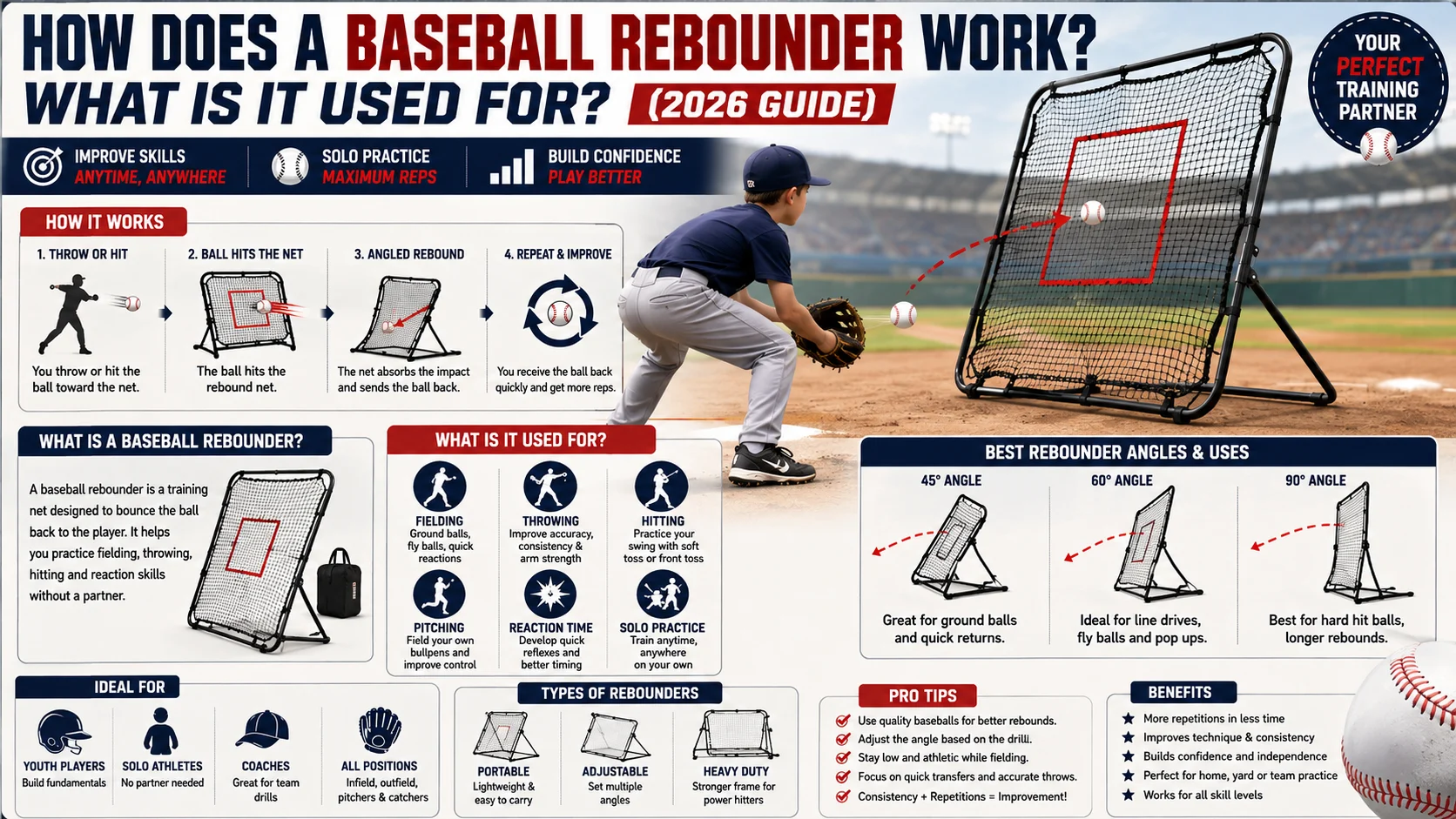
Quick Answer: A baseball rebounder works by using a tightly stretched net or mesh surface, mounted on an angled frame, that returns a thrown or hit ball back toward the player. It’s used primarily for solo fielding, throwing, and pitching practice, allowing players to train accuracy, reaction time, and hand-eye coordination without needing a partner to feed or retrieve balls.
An energetic young infielder wants extra reps, but there’s no coach, parent, or teammate free to hit them ground balls for another hour. This exact problem is what turned a simple angled net into one of the most common pieces of equipment in backyards, driveways, and training facilities across the country, letting a single player generate hundreds of quality repetitions entirely on their own without waiting for anyone else to be available.
This guide explains exactly how does a baseball rebounder work, what it’s used for, the different types available, and how to choose and use one effectively for different training goals and skill levels across a full season.
How a Baseball Rebounder Actually Works
At its core, a baseball rebounder consists of a sturdy frame, typically constructed from steel or heavy-duty aluminum, with a tensioned net or mesh screen stretched tightly across it. When a ball is thrown or hit into the net, the tension in the mesh causes it to spring back toward the player at a predictable angle and speed, mimicking a thrown or batted ball returning from a live opponent or teammate. The angle of the net relative to the ground is the single most important factor determining how the ball rebounds, with steeper angles typically producing higher-bouncing returns useful for practicing fly balls, and shallower angles producing lower, ground-ball-style returns better suited for infield fielding drills and quick-reaction training.
What Is a Baseball Rebounder Used For?
Rebounders serve several distinct training purposes, making them genuinely versatile tools rather than single-use equipment limited to one specific skill. The most common applications include:
- Fielding practice — Infielders can simulate ground balls, short hops, and backhand plays by adjusting throwing angle and distance from the net
- Throwing accuracy — Players can work on hitting specific targets and developing consistent arm mechanics through repetition
- Pitching practice — Pitchers can use a rebounder as a stationary target to refine control and command without needing a catcher present
- Catching and reaction drills — The unpredictable nature of certain rebound angles helps develop faster hand-eye coordination and reflexes
- First-base scoop training — First basemen can specifically practice scooping low throws using rebounder returns simulating in-the-dirt throws
Fixed-Angle vs. Adjustable Rebounders
Rebounders generally fall into two broad categories based on their design flexibility. Fixed-angle models feature a single, non-adjustable net angle, typically offering a simpler, more budget-friendly option well-suited to players focused on one specific type of repetition, such as straightforward ground ball fielding. Adjustable-angle models allow the net’s angle to be changed, letting a single piece of equipment simulate ground balls, line drives, and fly balls depending on how it’s configured for a given training session. This added versatility generally comes with a higher price point, but many coaches and serious players consider it worthwhile given how much more training variety a single adjustable unit can provide compared to a fixed alternative.
Rebounder Setup: What Affects the Return
Getting consistent, useful returns from a rebounder depends on more than just the equipment itself. Several setup factors directly influence how the ball comes back:
- Distance from the net — Standing closer produces a faster, more reactive return, while greater distance allows more time to track and react to the ball’s path
- Throwing or hitting angle — Hitting the net dead-center typically produces the most predictable return, while off-center contact creates more unpredictable, game-like bounces
- Net tension — A properly tensioned net produces a livelier, more consistent rebound, while a loose or worn net can absorb too much energy and produce inconsistent returns
- Surface underneath — Using a rebounder on grass versus a hard surface can meaningfully change how a ground-ball-style return behaves once it hits the ground
Rebounder vs. Pitch Back Net: Is There a Difference?
These terms are frequently used interchangeably in baseball equipment marketing, and functionally, there’s little meaningful distinction between them. Both describe the same basic category of equipment: an angled net or screen designed to return a ball to the thrower. Some manufacturers use “pitchback” specifically to describe smaller, lighter-weight nets marketed toward younger players or backyard use, while “rebounder” is sometimes used more broadly to describe both smaller consumer models and larger, more heavy-duty units used in structured team training environments, though this distinction isn’t consistently applied across the industry.
Choosing the Right Rebounder: Key Considerations
Selecting an appropriate rebounder depends on a player’s specific training goals, available space, and budget. Younger players or those focused primarily on basic fielding fundamentals may only need a smaller, fixed-angle model, while more advanced players working on multiple skills across pitching, fielding, and throwing accuracy will likely benefit more from a larger, adjustable-angle unit. Portability and storage also matter considerably for players without dedicated training space, since some larger rebounder models can be genuinely difficult to disassemble, transport, or store when not actively in use, a common complaint noted by longtime reviewers of various rebounder products.
Maintaining a Rebounder for Long-Term Use
Like any piece of frequently used training equipment, a baseball rebounder requires basic maintenance to continue performing consistently over time. Net tension naturally loosens with repeated impact over hundreds or thousands of throws, meaning periodic tightening or adjustment is often necessary to maintain a lively, predictable rebound quality. Steel-framed models generally offer better long-term durability against bending or warping compared to lighter aluminum alternatives, though weather exposure remains a genuine concern for any rebounder left outdoors for extended periods, making powder-coated or weather-resistant frame finishes a meaningful consideration for players who plan to leave their equipment set up outside between training sessions.
Common Mistakes Players Make When Using a Rebounder
Several recurring mistakes can limit how effectively a player benefits from rebounder training, even with quality equipment. Standing too close to the net without adjusting for the increased return speed can lead to poor reaction habits or even injury risk, particularly for younger players still developing their reflexes and fielding fundamentals. Using excessive throwing power simply to “test” the equipment, rather than practicing game-realistic velocity and accuracy, tends to produce less useful training value despite feeling more physically demanding in the moment. Additionally, neglecting to vary target zones, distance, and angle throughout a training session can lead to repetitive, narrow skill development rather than the well-rounded fielding and throwing improvement a rebounder is genuinely capable of providing when used thoughtfully.
Building an Effective Solo Practice Routine With a Rebounder
Getting the most value from a rebounder typically involves structuring sessions around specific, progressively challenging goals rather than simply throwing balls at it randomly. Many coaches recommend starting with basic, close-range fielding reps to build clean mechanics before gradually increasing distance and introducing more unpredictable angles that better simulate live game situations. Combining rebounder work with footwork drills, such as fielding a return and immediately executing a throwing motion toward an imaginary base, helps bridge the gap between simple repetition and game-speed decision-making, ensuring solo practice sessions translate more directly into improved performance during actual games and team practices.
Frequently Asked Questions
How does a baseball rebounder work? A baseball rebounder uses a tensioned net stretched across an angled frame, which springs a thrown or hit ball back toward the player at a predictable angle and speed.
What is a baseball rebounder used for? It’s primarily used for solo fielding, throwing accuracy, and pitching practice, allowing players to get repetitive training reps without needing a partner to feed or retrieve balls.
What is the difference between a rebounder and a pitchback net? There’s little functional difference; both describe angled nets that return a ball to the player, though “pitchback” sometimes refers to smaller, lighter models.
Can a baseball rebounder help with pitching accuracy? Yes, pitchers can use a rebounder as a stationary target to work on control and consistent mechanics without needing a catcher present for every repetition.
Does the angle of a rebounder net matter? Yes, steeper angles typically produce higher, fly-ball-style returns, while shallower angles produce lower, ground-ball-style returns better suited to infield fielding drills.
Are adjustable rebounders worth the extra cost over fixed-angle models? For players working on multiple skills, an adjustable rebounder generally offers considerably more training versatility, though a fixed-angle model can be sufficient for more focused, single-skill practice.
How often should a rebounder net be checked for tension? Net tension naturally loosens with repeated use, so periodic checks and adjustments are recommended to maintain consistent, predictable rebound quality over time.
What is the safest way for young players to use a rebounder? Younger players should maintain adequate distance from the net to allow reaction time and avoid throwing at excessive velocity purely to test the equipment’s limits.
Conclusion
So, how does a baseball rebounder work, and what is it actually used for? At its core, it’s a simple mechanical principle, a tensioned net returning energy from a thrown or hit ball, but that simplicity is exactly what makes it one of the most practical, accessible training tools available to players who need to practice without a partner. From fielding ground balls to refining pitching accuracy, and building a structured solo practice routine around progressive challenges, understanding how angle, distance, and net tension affect the return helps players get genuinely productive repetitions out of every training session.

Emily Parker is a sports journalist at SportsOrbitX.com with a passion for covering cricket, tennis and major international sporting events. She is committed to producing clear, reliable and engaging content for sports enthusiasts worldwide.