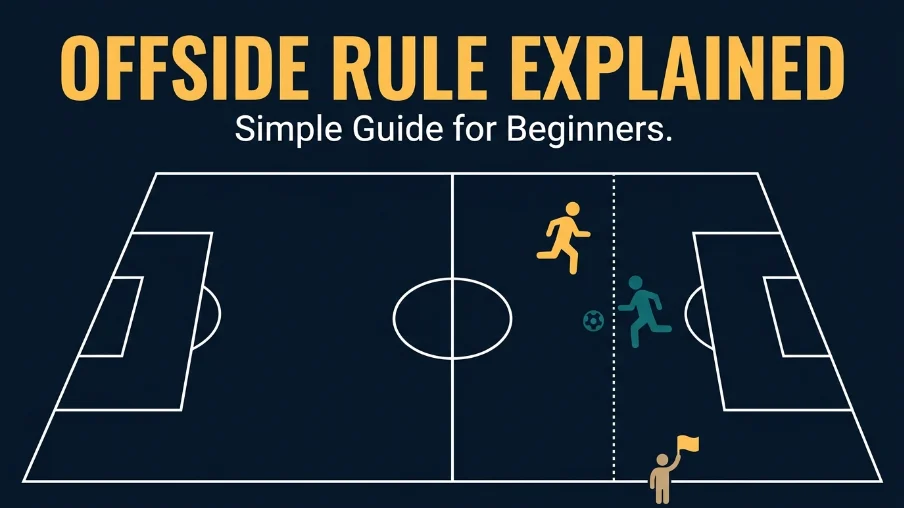
Quick Answer: A player is offside if they are nearer to the opponent’s goal line than both the ball and the second-last opponent (usually the last defender) at the moment the ball is played to them, and they are involved in active play.
A striker races through, slots the ball into the net, the crowd erupts and then everyone stops celebrating because a small flag has gone up on the sideline. For new football fans, few moments are as confusing as watching a perfectly good-looking goal get wiped off the board because of a rule that seems to require a physics degree to fully understand, even though the underlying concept is genuinely simple once broken down properly.
This guide breaks down what is the offside rule in the simplest possible terms, with clear examples and common scenarios, so you can watch any match and immediately understand why that flag went up.
The Offside Rule in One Sentence
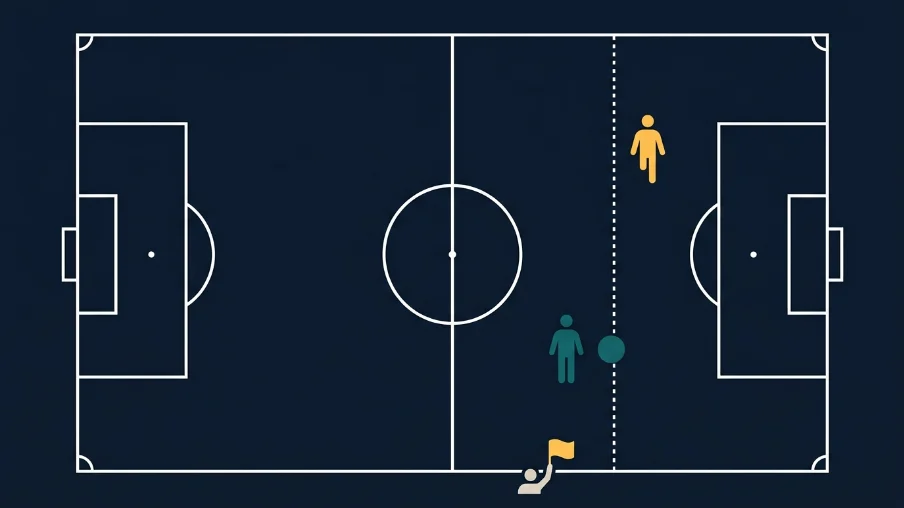
If an attacking player is standing closer to the opponent’s goal than the last defender (and the ball) at the exact moment a teammate passes to them, they’re offside. That’s genuinely the entire concept everything else in this guide is just clarifying the specific situations, exceptions, and edge cases where confusion tends to happen among newer fans.
Breaking Down the Offside Rule Step by Step
Step 1: The Moment That Matters
Offside is judged at the exact moment the ball is played by a teammate, not when the attacking player receives it. A player can be in an onside position when the ball is passed, then run past the defender before receiving it, and still be perfectly legal timing at the moment of the pass is everything.
Step 2: Where the Player Must Be
To be offside, an attacking player must be in the opponent’s half of the pitch, and positioned closer to the opponent’s goal line than both the ball and the second-last opponent. In most cases, the “second-last opponent” is simply the last outfield defender, since the goalkeeper is almost always the last player on the line, though this isn’t strictly required by the rule.
Step 3: Being “Involved in Play”
Simply standing in an offside position isn’t a punishable offense by itself. A player must also be judged to be “involved in active play” meaning they interfere with an opponent, play or touch the ball, or gain an advantage from being in that position. A player standing offside but not interacting with the play in any way is not penalized, which is why a player can occasionally be seen standing in a clearly advanced position without the referee stopping play at all.
Common Offside Misconceptions
- Any player ahead of the ball is offside.” False a player can be ahead of the ball and still onside if they’re not ahead of the second-last defender.
- “Offside applies anywhere on the pitch.” False offside can only occur in the opponent’s half of the field.
- A player is offside the moment they receive the ball.” False offside is judged at the moment the ball is played by a teammate, not when it’s received.
- “Being offside always results in a penalty against the team.” False an offside offense simply results in an indirect free-kick for the opposing team from the spot of the offense.
Why Does Offside Exist in Football?
The offside rule exists to prevent a tactic sometimes called “goal-hanging,” where an attacking player could otherwise simply stand next to the opponent’s goal for the entire match, waiting for a long ball forward with no defender anywhere near them. Without this rule, football would likely reduce much of its midfield build-up play and teamwork into a series of long balls aimed at a permanently stationed forward, fundamentally changing the character and flow of the sport as it’s played and enjoyed today.
When Is a Player NOT Offside?
There are several specific situations where a player is not penalized for offside, even if their positioning might look suspicious to a casual viewer:
- Receiving the ball directly from a goal kick
- Receiving the ball directly from a throw-in
- Receiving the ball directly from a corner kick
- Being in their own half of the pitch, regardless of position relative to defenders
- Being level with the second-last defender, rather than clearly ahead of them
How VAR and Technology Have Changed Offside Decisions
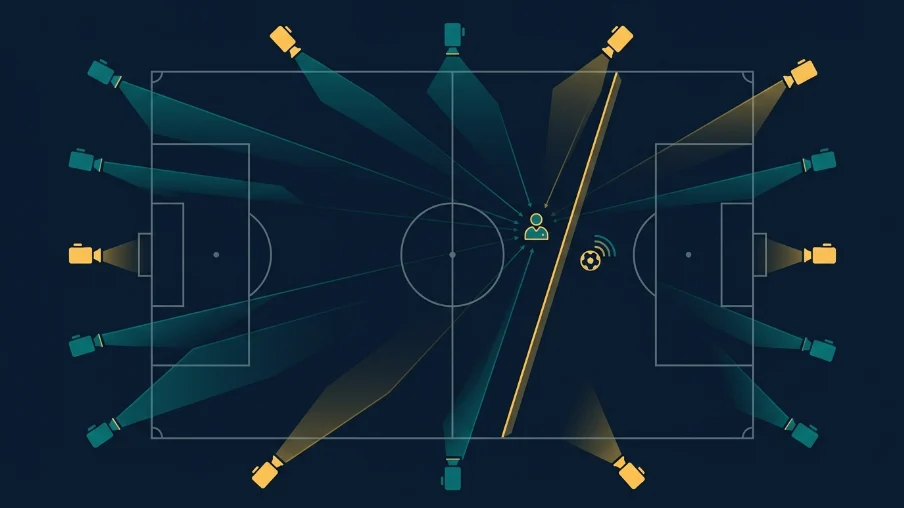
Since the introduction of semi-automated offside technology, first used at the 2022 FIFA World Cup and now standard at the 2026 tournament, offside decisions have become significantly more precise than relying solely on an assistant referee’s eye. The system uses multiple tracking cameras alongside a sensor inside the match ball to generate a 3D representation of a player’s exact position at the moment the ball is played, drawing a virtual offside line that can determine calls down to a matter of centimeters. While this precision has made offside decisions more accurate overall, it has also sparked debate, since razor-thin offside calls decided by a shoulder or a toe can feel disconnected from the rule’s original, more intuitive purpose.
Offside Rule: Quick Reference Table
| Scenario | Offside? |
| Player ahead of the ball but behind the last defender | No |
| Player ahead of both the ball and the last defender when a teammate passes | Yes |
| Player in their own half of the pitch | No |
| Player receiving directly from a throw-in | No |
| Player level with the last defender | No |
| Player in an offside position but not touching or affecting play | No |
A Simple Way to Watch for Offside Yourself
New fans can train their eye by focusing on two things during an attack: where the last defender is standing, and where the ball is at the exact moment a pass is made. If an attacking teammate is ahead of both of those reference points when the ball leaves the passer’s foot, there’s a good chance the assistant referee’s flag is about to go up. With practice, most fans develop a fairly reliable instinct for spotting close offside situations well before the official confirmation arrives.
A Practical Example to Make Offside Click
Imagine a striker standing near the halfway line while their team builds an attack in midfield. As a teammate prepares to pass forward, the striker suddenly sprints toward the opponent’s goal. If the striker times their run so they’re still level with or behind the last defender at the exact moment the ball is kicked, they remain onside, even if they end up well ahead of that defender by the time they actually receive the pass. This is why commentators often praise a striker’s “offside trap timing” the skill isn’t just speed, it’s precisely timing the run to exploit that single moment the ball is played, rather than simply being the fastest player on the pitch.
Conversely, if that same striker had already drifted ahead of the last defender before the pass was even made, the assistant referee would flag the position as offside the instant the ball leaves the passer’s foot, regardless of how the move develops afterward.
A Brief History of the Offside Rule
Offside-style rules have existed in various forms since football’s earliest formalized version in 1863, though the specific requirements have been adjusted numerous times over the decades. Early versions of the rule required three defenders (rather than the current two, including the goalkeeper) between an attacker and the goal line, making it considerably harder for attacking players to stay onside. This stricter version was significantly loosened in 1925, a change credited with immediately increasing goal-scoring across English football, as attacking players suddenly found it much easier to receive the ball in advanced positions. The rule has been refined further since then, particularly around the definitions of “interfering with play” and “gaining an advantage,” as football’s governing bodies have worked to reduce ambiguity in marginal decisions.
Why Offside Remains Football’s Most Debated Rule
Even with modern technology reducing genuine errors, offside continues to generate more debate among fans and pundits than almost any other law in the sport. Much of this comes down to the rule’s inherent complexity compared to something like a foul, which is usually visually obvious even to a casual viewer. Offside instead requires judging the exact synchronized positions of multiple players at a single frozen moment, something the human eye alone was never particularly well-suited to do with total accuracy, which is precisely why semi-automated technology has become such a significant addition to how the rule is now enforced at the highest level.
Frequently Asked Questions
What is the offside rule in football explained simply? A player is offside if they are ahead of both the ball and the second-last defender in the opponent’s half when a teammate passes to them, and they are involved in active play.
Can a player be offside in their own half? No, offside can only occur in the opponent’s half of the pitch.
Does being in an offside position always result in a foul? No, a player must also be involved in active play, such as touching the ball or interfering with an opponent, to be penalized for offside.
Is a player offside if they are level with the last defender? No, a player must be clearly ahead of the second-last defender to be offside; being exactly level is not penalized.
How has VAR changed offside decisions? Semi-automated offside technology now uses tracking cameras and ball sensors to determine offside calls with much greater precision than a human assistant referee alone, though this has led to very tight, centimeter-level decisions.
Can you be offside directly from a throw-in? No, offside cannot be called if a player receives the ball directly from a throw-in, corner kick, or goal kick.
Why was the offside rule created? The offside rule was introduced to prevent attacking players from simply waiting near the opponent’s goal for long passes, encouraging teamwork and structured build-up play instead.
Has the offside rule always required just two defenders between an attacker and the goal? No, early versions of the rule required three defenders, a stricter requirement that was loosened to the current two-defender standard in 1925, immediately increasing goal-scoring across English football.
Why do offside decisions sometimes take so long with VAR? Semi-automated offside technology requires processing multiple camera angles and ball-tracking data to generate a precise 3D position, which can take a moment longer than a traditional assistant referee’s instant visual judgment, though it delivers far greater accuracy.
Conclusion
So, what is the offside rule explained simply? At its core, it comes down to one moment: where an attacking player is standing relative to the ball and the last defender exactly when a pass is made. Once you understand that single reference point, along with the exceptions around throw-ins, goal kicks, and corners, the rule stops feeling like a mystery and starts becoming one of the more satisfying parts of following a match closely, especially now that semi-automated technology has made the decisions themselves more precise than ever before.
Want to understand more of the officiating side of football? Check out our guide on What Does VAR Stand For in Football to see how technology now supports these exact decisions.