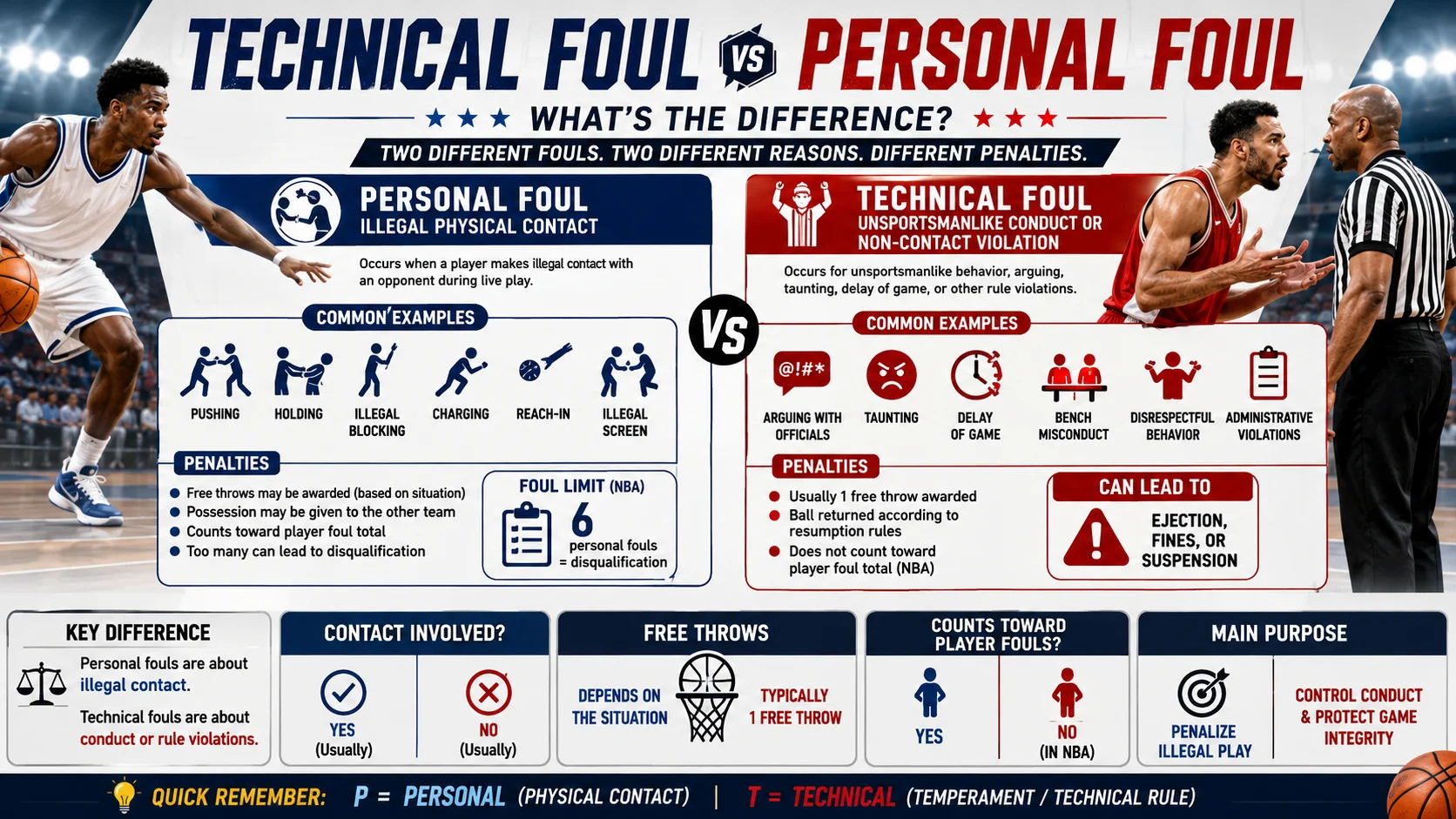
A personal foul in basketball usually involves illegal physical contact with an opponent, such as pushing, holding, blocking, or illegal contact during a play. A technical foul generally involves unsportsmanlike conduct, arguing with officials, taunting, delay of game, or certain non-contact rule violations. The penalties and foul limits vary by league, but both can give the opposing team an advantage.
Technical Foul vs Personal Foul
The easiest way to remember the difference is:
Personal foul = illegal physical contact.
Technical foul = improper conduct or certain non-contact violations.
For example, if a defender pushes an opponent while fighting for position, that is generally a personal foul. If the same player aggressively argues with the referee or taunts an opponent, the official may call a technical foul.
However, basketball rules are not identical across the NBA, college, high school, and international competitions. The basic distinction remains useful, but the exact penalties can differ.
| Feature | Personal Foul | Technical Foul |
|---|---|---|
| Main issue | Illegal physical contact | Conduct or non-contact violation |
| Typical example | Holding, pushing, blocking | Arguing, taunting, delay of game |
| Can involve contact? | Yes | Usually not; some rules have exceptions |
| Player foul count | Usually charged | Depends on competition |
| Free throws | Depends on situation | Often awarded |
| Can cause ejection? | Yes in certain circumstances | Yes, especially after repeated or severe violations |
| Main purpose | Penalize illegal play | Control conduct and protect game integrity |
The NBA defines a common personal foul as illegal physical contact with an opponent, while a technical foul is a penalty for unsportsmanlike conduct or certain violations by players or team personnel.
What Is a Personal Foul in Basketball?
A personal foul occurs when a player makes illegal physical contact with an opponent.
Basketball is a physical sport, so not every collision is automatically a foul. Officials judge whether the contact was illegal and whether it affected the opponent’s movement, position, balance, or ability to play legally.
Common examples include:
- Pushing an opponent
- Holding an opponent
- Illegal blocking
- Charging
- Illegal hand-checking
- Certain illegal screens
- Reaching in and making illegal contact
- Hitting or impeding an opponent
The NBA rulebook specifically prohibits actions such as holding, pushing, charging into, or impeding an opponent through illegal body positioning.
Example of a Personal Foul
Imagine a guard drives toward the basket.
The defender moves into position late and uses their body to knock the offensive player off their path.
The referee blows the whistle.
That’s a personal foul because the key issue is illegal physical contact during live play.
What Is a Technical Foul in Basketball?
A technical foul is generally associated with unsportsmanlike behavior, misconduct, administrative issues, or certain non-contact violations.
Technical fouls exist for a different reason than ordinary personal fouls. They’re not primarily about whether one player physically fouled another.
Examples can include:
- Disrespectfully addressing an official
- Taunting an opponent
- Excessive arguing
- Certain profanity or misconduct
- Delay of game
- Illegal bench conduct
- Certain equipment or administrative violations
- Hanging on the basket in situations covered by the rules
The NBA specifically lists conduct such as disrespectfully addressing officials, taunting, and certain delay-of-game situations among technical-foul situations.
Example of a Technical Foul
A player is called for a foul.
Instead of moving away, the player aggressively confronts the referee, continues arguing, and uses unsportsmanlike language.
The official assesses a technical foul.
The original physical contact and the later misconduct can be separate fouls.
The Biggest Difference Between Technical and Personal Fouls
Here’s the simplest mental shortcut:
Personal fouls are primarily about illegal contact. Technical fouls are primarily about conduct or certain rule violations outside ordinary physical play.
That’s why you can have a personal foul without saying anything and a technical foul without touching another player.
Think of It This Way
Personal foul:
“You played the opponent illegally.”
Technical foul:
“You behaved or acted in a way the rules prohibit.”
This distinction makes most foul calls much easier to understand.
Technical Foul vs Personal Foul Examples
Let’s make the difference practical.
Scenario 1: Defender Pushes a Shooter
A defender pushes an opponent while the player is attempting a shot.
Likely call: Personal foul.
The violation involves illegal physical contact.
Scenario 2: Player Argues With Referee
A player repeatedly argues with an official after a call.
Possible call: Technical foul.
The issue is the player’s conduct, not ordinary basketball contact.
Scenario 3: Player Holds an Opponent
A defender grabs an opponent’s jersey to prevent them from cutting toward the basket.
Likely call: Personal foul.
The illegal action is physical contact that impedes the opponent.
Scenario 4: Player Taunts an Opponent
A player scores and then deliberately taunts the opposing player.
Possible call: Technical foul.
The concern is unsportsmanlike conduct.
Scenario 5: Dead-Ball Contact
Two players make unnecessary contact after the whistle.
Depending on the nature and severity of the action, officials may assess a technical, flagrant, or another applicable foul under the competition’s rules.
This is one reason it’s dangerous to assume that every physical foul is automatically a personal foul.
What Happens After a Personal Foul?
The penalty for a personal foul depends on who committed it, where the contact occurred, whether the player was shooting, and the team’s foul situation.
Possible outcomes include:
- The offended team receives the ball.
- The shooter receives free throws.
- A made basket counts and an additional free throw is awarded.
- The defending team enters a penalty situation.
- The offensive player is charged with an offensive foul.
For example, under NBA rules, a defensive personal foul against a shooter can result in free throws, while an offensive foul can result in possession being awarded to the other team.
So there isn’t one universal “personal foul penalty.”
What Happens After a Technical Foul?
A technical foul generally carries a free-throw penalty, although the exact administration varies by competition.
In the NBA, one free throw is awarded when a single technical foul is assessed. The ball is then returned according to the applicable resumption rules.
Technical fouls can also have consequences beyond one free throw.
Depending on the league and the circumstances, repeated or severe technical fouls can lead to:
- Ejection
- Additional penalties
- Team consequences
- Suspensions or fines in professional basketball
For example, NBA rules state that certain repeated unsportsmanlike technical fouls can result in ejection.
Does a Technical Foul Count as a Personal Foul?
Not necessarily.
This is one of the most confusing parts of basketball because foul accounting differs between competitions.
A technical foul is a separate foul classification, but whether it counts toward a player’s personal-foul total, team-foul total, disqualification threshold, or ejection threshold depends on the rules being used.
That’s why an NBA game, NCAA game, and high school game can handle the same-looking incident differently.
The NFHS and NCAA rules, for example, distinguish different technical and personal foul categories and have their own foul-counting procedures.
Bottom line: Don’t assume that every technical automatically equals one personal foul.
How Many Personal Fouls Can a Basketball Player Get?
This depends on the level of basketball.
In the NBA, a player is disqualified after receiving six personal fouls.
College and high school basketball use different foul limits and classifications.
This is important because a player watching an NBA game might see a player stay on the court after a foul count that would cause a different result in another competition.
Can a Technical Foul Get You Ejected?
Yes.
A technical foul does not automatically mean ejection in every situation, but repeated or especially serious technical-foul situations can result in a player or coach being removed from the game.
In the NBA, for example, players and team personnel can be ejected for certain technical-foul circumstances, including reaching the applicable limit for unsportsmanlike technical fouls.
The important point is:
Technical foul ≠ automatic ejection.
The number, type, and circumstances matter.
Technical Fouls Are Not Always About Arguing
This is another common misconception.
Fans often associate technical fouls with players yelling at referees, but technical fouls can arise from several other situations.
They may involve:
- Delaying the game
- Improper bench behavior
- Certain administrative violations
- Unsportsmanlike actions
- Taunting
- Illegal conduct toward officials
The NBA rulebook contains numerous technical-foul categories beyond simply arguing with referees.
At the high-school level, NFHS rules also contain specific technical-foul procedures and classifications. The 2026-27 NFHS rules include clarifications concerning technical fouls occurring during the same dead-ball period.
Personal Foul vs Technical Foul vs Flagrant Foul
Don’t confuse these three.
| Foul | Basic Idea | Typical Concern |
|---|---|---|
| Personal | Illegal physical contact | Normal illegal play |
| Technical | Conduct/non-contact violation | Unsportsmanlike or administrative behavior |
| Flagrant | Serious unnecessary/excessive contact | Safety and severity |
A flagrant foul is different from an ordinary personal foul because of the nature of the contact.
Under NBA rules, unnecessary contact can be classified as a Flagrant 1, while unnecessary and excessive contact can be classified as a Flagrant 2, which carries ejection.
Why Technical Fouls Matter So Much
A technical foul may seem like “just one free throw,” but the psychological effect can be much bigger.
One unnecessary technical can:
- Give the opponent free points.
- Change momentum.
- Energize the opposing crowd.
- Frustrate teammates.
- Put a key player at risk of further penalties.
- Potentially lead to an ejection.
In a close game, giving away a free point because of an avoidable technical can be the difference between winning and losing.
That’s why experienced players learn to control their emotions after controversial calls.
Why Personal Fouls Matter More Strategically
Personal fouls influence how aggressively a player can defend.
A player with several personal fouls may become more cautious because another foul could lead to disqualification.
This creates a strategic problem for coaches:
Keep the player in the game and risk another foul or sit them and lose their production?
That’s why foul trouble can change rotations, defensive schemes, and even the outcome of a game.
Do Basketball Rules Treat Fouls the Same Everywhere?
No.
This is extremely important when researching basketball rules online.
NBA, NCAA, NFHS, FIBA, and youth basketball organizations can use different terminology, foul limits, penalties, and enforcement procedures.
For example, the NBA has its own rules for personal and technical fouls, while NFHS publishes separate high-school basketball rules and updates its interpretations annually.
So when someone says, “A technical foul always means X,” the statement may be incomplete.
Always check the rulebook for the competition you’re watching or playing in.
Quick Memory Trick
If you keep mixing up the two, remember:
P = Personal = Physical
If the main problem is illegal physical contact with another player, think personal foul.
T = Technical = Temperament/Technical Rule
If the problem is conduct, arguing, taunting, delay, bench behavior, or another applicable non-contact violation, think technical foul.
It’s not a perfect rule for every situation, but it’s an excellent starting point.
FAQ
Is a technical foul worse than a personal foul?
Not automatically. They are different types of fouls with different purposes and penalties. A technical can become extremely costly because it may give the opponent free throws and, in repeated or serious cases, lead to ejection.
Can you get a technical and personal foul on the same play?
Yes. Separate actions can result in separate fouls. The exact administration depends on the competition’s rules and the sequence of events.
Is arguing with the referee a technical foul?
It can be. Excessive or disrespectful conduct toward an official is a technical-foul situation under NBA rules.
Does a personal foul always give free throws?
No. Free throws depend on the type and circumstances of the foul and the applicable team-foul situation.
Can a technical foul be called without physical contact?
Yes. Many technical fouls involve conduct or administrative violations rather than physical contact.
What is the easiest way to tell them apart?
Ask one question: Was the main problem illegal physical contact during play? If yes, you’re likely dealing with a personal foul. If the issue is conduct or a non-contact rule violation, it may be a technical foul.
Final Verdict
The difference between a technical foul vs personal foul comes down to what caused the violation.
A personal foul is primarily about illegal physical contact such as pushing, holding, charging, or illegal defensive contact. A technical foul is generally about unsportsmanlike conduct or certain non-contact and administrative violations, such as taunting, arguing with officials, or delaying the game.
The distinction becomes especially important because the penalties are not identical and the rules can vary between the NBA, college, high school, and other levels of basketball.
If you’re watching a game and hear the referee call a personal foul, think illegal contact.
If you hear technical foul, think conduct or a technical rule violation.
Once you understand that simple difference, foul calls become much easier to follow and you’ll also understand why a seemingly small technical can have a surprisingly big impact on a close basketball game.
Rule of thumb: Personal fouls punish illegal play; technical fouls control conduct and other rule violations.

Daniel Brooks is a sports writer at SportsOrbitX.com, specializing in football, basketball and global sports news. He focuses on delivering accurate reporting, match analysis and timely updates that keep fans informed.