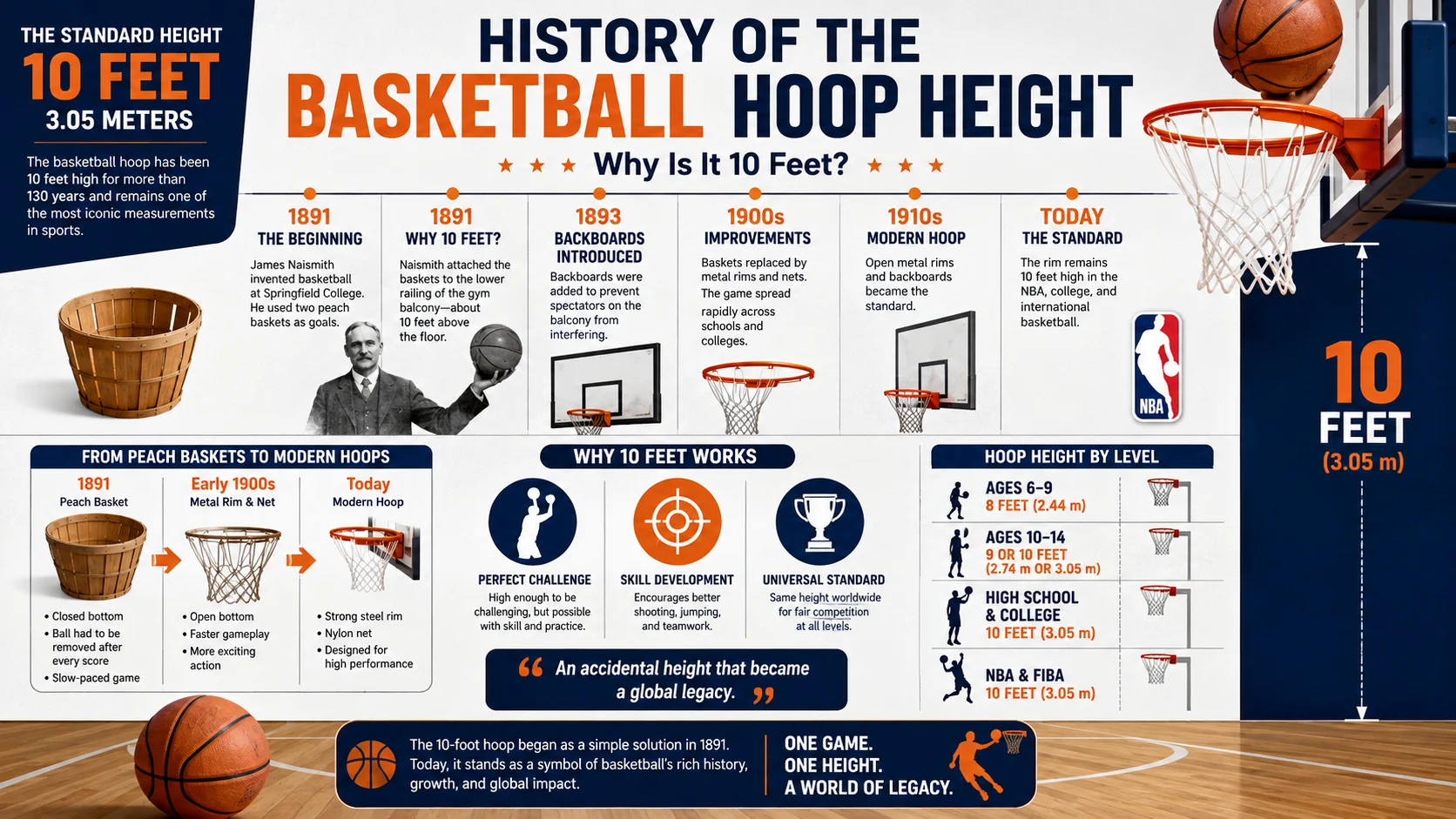
The standard basketball hoop height is 10 feet (3.05 meters) from the floor to the top of the rim. Surprisingly, James Naismith did not originally choose 10 feet after testing different heights the first peach baskets were attached to a gym balcony railing that happened to be about 10 feet high. That accidental measurement became the standard as basketball spread around the world.
Why Is a Basketball Hoop 10 Feet High?
A regulation basketball hoop is 10 feet above the playing floor.
The story goes back to December 1891, when James Naismith invented basketball at what is now Springfield College in Massachusetts. Naismith needed a target for his new indoor game and asked for two boxes. Instead, the janitor brought him two peach baskets.
Naismith attached the baskets to the lower railing of the gymnasium balcony. That railing was approximately 10 feet above the floor.
In other words, the famous 10-foot basketball hoop was not originally the result of a scientific calculation. It was largely a matter of what was already available in the gym.
And somehow, that accidental height became one of the most recognizable measurements in sports history.
The Beginning: Basketball in 1891
To understand the history of basketball hoop height, you have to go back to the winter of 1891.
James Naismith was a physical education instructor and graduate student at the International YMCA Training School in Springfield, Massachusetts, now known as Springfield College.
His students were restless during the cold New England winter. Outdoor sports such as football were not practical inside the gym, so Naismith was given a challenge: create an indoor game that would keep students active without becoming excessively rough.
After experimenting with different ideas, Naismith developed a game based partly on sports and games he already knew.
He wanted players to throw a ball toward a target rather than simply crash into one another.
The result was basketball.
The first game was played on December 21, 1891, with 18 students divided into two teams of nine. The equipment was remarkably simple by modern standards: a soccer ball and two peach baskets.
Why Did James Naismith Choose 10 Feet?
This is where the history gets interesting.
Naismith did not sit down and decide that basketball needed a 10-foot hoop.
According to Springfield College’s historical account, he asked the school’s janitor for two 18-inch square boxes to use as goals. The janitor couldn’t find boxes, so he brought back two peach baskets.
Naismith nailed the baskets to the lower rail of the gymnasium balcony.
That rail happened to be 10 feet high.
So the height that eventually became basketball’s worldwide standard was essentially inherited from the architecture of the gym.
The original setup looked very different from today’s hoop
There was:
- No modern steel rim
- No nylon net
- No glass backboard
- No shot clock
- No three-point line
- No dunking
- No 24-second offense
- No professional basketball league
There were simply two peach baskets mounted high above the players.
Yet the 10-foot height survived.
Was the First Basketball Hoop Really 10 Feet?
Yes, but there is an important historical detail.
The original peach baskets were mounted to a balcony railing that Springfield College describes as 10 feet above the gym floor. Some historical accounts describe the first setup as being approximately 10 feet rather than presenting it as a carefully measured regulation specification.
That’s an important distinction.
The modern 10-foot requirement is precise, but the original 10-foot height was not created as a formal engineering standard.
Today, the NBA specifies that the upper edge of the basket ring must be 10 feet above and parallel to the floor.
So the sport went from an approximate architectural measurement to an exact competitive standard.
The Peach Basket Era
The first basketball “hoop” wasn’t actually a hoop.
It was a peach basket.
The basket had a solid bottom, meaning the ball couldn’t simply fall through after a successful shot.
Every time someone scored, the ball had to be retrieved.
Imagine playing a modern basketball game where someone had to climb up and remove the ball after every made basket.
That’s exactly the problem early basketball faced.
Springfield College notes that the bottoms of the original baskets were eventually cut out so the ball could fall through, making the game much faster.
The height didn’t need to change.
The equipment around it did.
1893: Basketball Begins Moving Toward the Modern Hoop
As basketball became more popular, players and organizers began improving the equipment.
Iron rims and netting appeared in the early years of the sport, while backboards were introduced to deal with another problem: spectators could interfere with shots from nearby balconies.
Historical records from the Naismith Basketball Hall of Fame collection indicate that backboards were introduced into the rules in 1893.
This was an important development because it gradually transformed the peach-basket setup into something recognizable as a basketball goal.
But the basic height remained.
Ten feet stayed.
Why Didn’t Basketball Simply Lower the Hoop?
You might wonder:
If the 10-foot height was originally accidental, why didn’t basketball officials eventually lower it?
There are several reasons.
First, the game spread quickly using the existing setup. Schools, YMCA facilities, colleges, and other organizations copied the basic structure of the original game.
Second, players adapted their skills to the height.
Shooting became a specialized skill.
Passing and positioning evolved around it.
Rebounding developed around it.
As basketball matured, the 10-foot rim became part of the game’s identity.
Changing it would have meant changing the way generations of players learned the sport.
So an accidental starting point gradually became a permanent competitive standard.
The Evolution of the Basketball Hoop
The height stayed remarkably consistent, but the hoop itself changed dramatically.
| Era | Basketball Goal | Approximate Height |
|---|---|---|
| 1891 | Peach basket | About 10 feet |
| Early 1890s | Improved baskets and early rims | About 10 feet |
| 1893 | Backboards begin appearing | About 10 feet |
| Early 1900s | Metal rims and improved nets | About 10 feet |
| 1910s | Modern-style open basket develops | About 10 feet |
| Modern era | Steel rim, net and backboard | 10 feet |
The equipment evolved around the player.
The height largely stayed where Naismith had placed it.
When Did the Modern Basketball Hoop Become Standard?
The transition took years.
According to the U.S. Census Bureau’s historical account, peach baskets were eventually replaced by open-bottomed wood, wire, or cast-iron rims around 1906, while the metal-rimmed, open-net hoop attached to a backboard became the standard design by about 1913.
That means the modern basketball goal was not created overnight.
The sport went through a long period of experimentation.
But throughout these equipment changes, the basic target height remained close to the original level.
Did the NBA Change the Basketball Hoop Height?
No.
The NBA’s regulation basket remains 10 feet high.
The current NBA rule specifies an 18-inch inside-diameter ring with its upper edge positioned 10 feet above the floor.
The NBA also describes the rims as hanging 10 feet from the floor in its official FAQ.
That consistency matters.
A player practicing a jump shot today is aiming at essentially the same vertical target that basketball players have been using for more than a century.
Is the Hoop Height the Same in College Basketball?
Yes, the standard competitive height is also 10 feet.
The same basic height is used across major forms of adult basketball, although exact rules and equipment specifications can vary between organizations.
FIBA publishes the international rules for basketball, while the NBA maintains its own rulebook.
So whether you’re watching professional basketball, college basketball, or international competition, that familiar 10-foot rim remains the benchmark.
What About Youth Basketball?
This is where things become different.
A 10-foot hoop can be extremely challenging for young children. That’s why youth basketball organizations may use lower baskets depending on age and developmental level.
USA Basketball’s current 3×3 guidance, for example, lists:
| Age Group | Suggested Basket Height |
|---|---|
| Ages 6–9 | 8 feet |
| Ages 10–14 | 9 or 10 feet |
| Grades 9–12 | 10 feet |
These recommendations are designed to make the game more appropriate for players’ physical development rather than forcing every child to play on a regulation-height rim.
This is an important distinction:
10 feet is the standard adult competitive height, but it isn’t necessarily the best learning height for every child.
Why Is a 10-Foot Hoop Still Used Today?
The continued use of 10 feet is about much more than tradition.
It provides a consistent target for generations of players.
A fixed height allows coaches and players to develop:
- Consistent shooting mechanics
- Repeatable practice routines
- Standardized competition
- Comparable statistics
- Familiar offensive strategies
- Predictable rebounding angles
Imagine if one professional league used an 8-foot rim and another used a 12-foot rim.
A player’s statistics, shooting percentages, dunking ability, and style of play would become much harder to compare.
The 10-foot basket gives basketball a common reference point.
Has Anyone Ever Suggested Raising the Hoop?
Yes.
As basketball players have become taller, stronger, and more athletic, discussions about raising the rim have occasionally appeared.
Modern players can dunk with extraordinary ease compared with the athletes of basketball’s early years.
That has led to an interesting question:
Should professional basketball still use a 10-foot rim when elite athletes are so much more powerful than they were in 1891?
There is no change to the NBA’s current 10-foot standard.
For now, the traditional height remains part of the game’s structure.
Does a Taller Hoop Make Basketball Harder?
Absolutely.
Changing the rim height would affect almost every part of scoring.
A higher rim would likely make:
- Jump shots more difficult
- Layups more demanding
- Dunks less common
- Rebounding more challenging
- Shooting percentages lower
A lower rim would have the opposite effect.
That’s one reason hoop height is such an important part of basketball’s competitive balance.
The Most Interesting Part of Basketball Hoop History
The remarkable thing about the history of basketball hoop height isn’t that someone calculated the perfect height.
Nobody did.
The first 10-foot target was largely a consequence of where a peach basket could be attached inside the gym.
But basketball players adapted.
Coaches built systems around it.
Manufacturers designed equipment around it.
Leagues standardized it.
And fans came to recognize it as an essential part of the sport.
An architectural detail from an 1891 gymnasium became a worldwide sporting standard.
Basketball Hoop Height: Then vs. Now
Here’s the simplest way to understand the entire history:
1891:
James Naismith attaches peach baskets to a gym balcony railing about 10 feet above the floor.
1890s:
Basketball spreads rapidly, and improved baskets, rims, and backboards begin appearing.
Early 1900s:
Peach baskets give way to more practical metal rims and nets.
1910s:
The modern-style basket and backboard system becomes increasingly standardized.
1936:
Basketball becomes an Olympic sport, helping cement international competition.
Modern era:
Major adult competitions continue to use a 10-foot basket.
The equipment changed.
The technology changed.
The athletes changed.
The 10-foot target stayed.
Frequently Asked Questions
How tall is a basketball hoop?
A regulation basketball hoop is 10 feet (3.05 meters) from the playing floor to the top of the rim. The NBA’s official rules specify this height.
Why was the first basketball hoop 10 feet?
The first peach baskets were attached to the lower railing of the gymnasium balcony where James Naismith invented basketball. The railing was about 10 feet above the floor.
Did James Naismith choose 10 feet on purpose?
Not in the sense of selecting it after testing different heights. Historical accounts indicate that the 10-foot height came from the existing balcony railing where he mounted the baskets.
Was the first basketball hoop a real metal hoop?
No. The first goals were peach baskets. Metal rims and improved basket designs appeared later as the sport developed.
When did basketball start using backboards?
Backboards began appearing in basketball during the 1890s. Historical records identify 1893 as an important early milestone for their introduction into the rules.
Is every basketball hoop 10 feet high?
No. Adult regulation basketball generally uses a 10-foot rim, but youth basketball may use lower heights to match players’ ages and abilities. USA Basketball, for example, recommends 8-foot baskets for ages 6–9 in its 3×3 guidance.
Is the NBA hoop still 10 feet high?
Yes. The NBA’s current equipment rules specify that the top edge of the rim is 10 feet above the floor.
Final Verdict
The history of basketball hoop height is a story of accident turning into tradition.
When James Naismith invented basketball in 1891, he wasn’t trying to establish a permanent 10-foot standard. He needed somewhere to place his goals, and the gym’s balcony railing happened to be about 10 feet above the floor. He attached two peach baskets there, and basketball began.
As the game spread, the equipment evolved from peach baskets to metal rims, open nets, backboards, and today’s highly engineered basketball systems. Yet the basic target height survived.
More than 130 years later, the professional basketball rim is still 10 feet high.
So the next time you watch a player rise for a dunk or knock down a three-pointer, remember the strange little detail behind that familiar target: one of basketball’s most important measurements started with a balcony railing and two peach baskets.
- The regulation basketball hoop is 10 feet (3.05 m) high.
- Basketball was invented by James Naismith in 1891.
- The original goals were peach baskets, not metal rims.
- The baskets were attached to a gym balcony railing about 10 feet above the floor.
- The 10-foot height was therefore largely accidental rather than scientifically calculated.
- Backboards, metal rims, and open nets were introduced later.
- Modern NBA basketball still uses a 10-foot rim.
- Youth basketball may use lower hoops to support age-appropriate skill development.

Daniel Brooks is a sports writer at SportsOrbitX.com, specializing in football, basketball and global sports news. He focuses on delivering accurate reporting, match analysis and timely updates that keep fans informed.