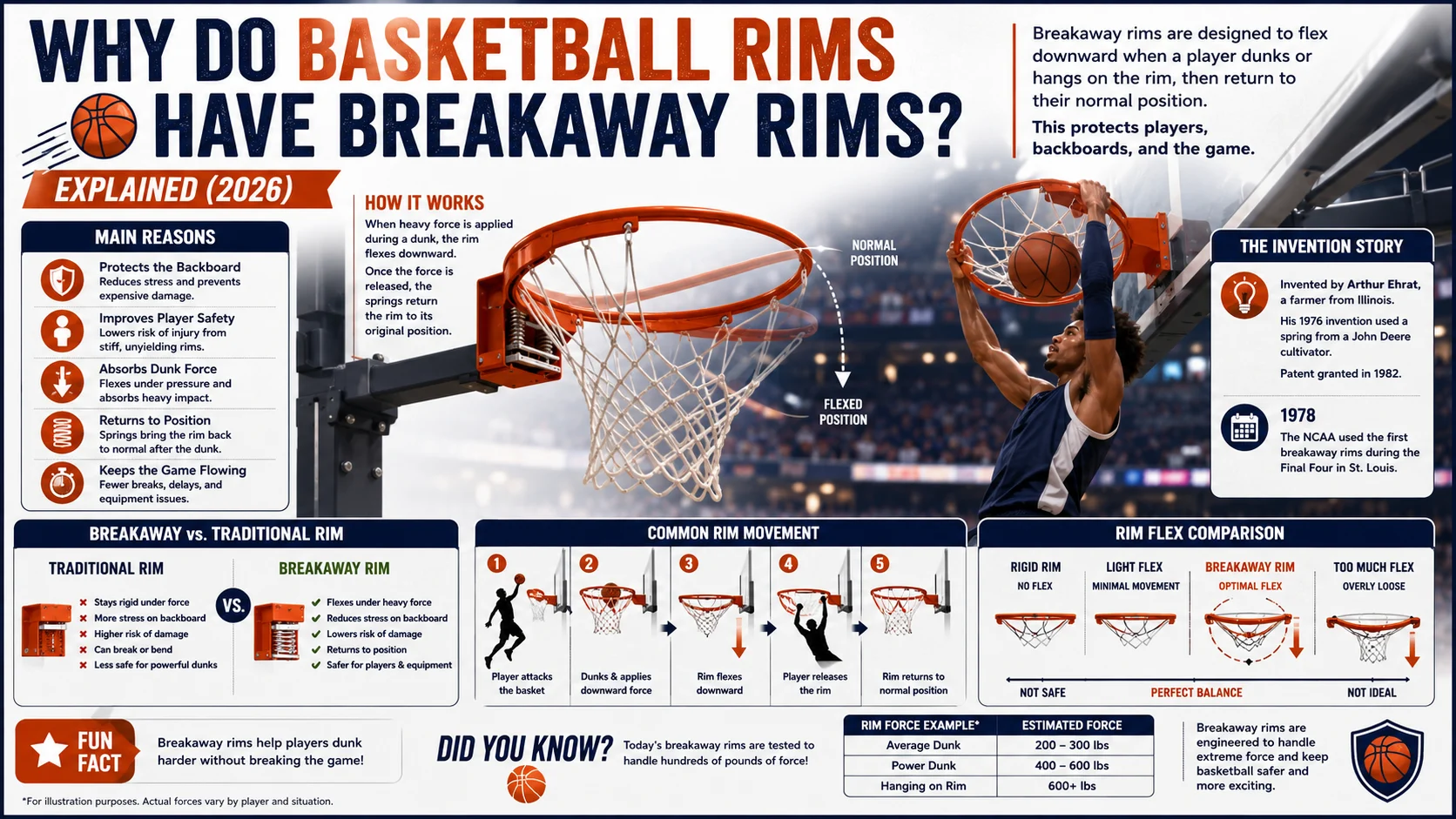
Basketball rims have breakaway rims so they can flex downward when a player applies heavy force during a dunk or hangs on the rim, then return to their normal position afterward. This design helps reduce stress on the rim and backboard, lowers the risk of certain injuries, and prevents costly game interruptions caused by damaged equipment. The modern breakaway rim traces back to Arthur Ehrat’s 1970s invention, which used a spring mechanism to allow the rim to give under pressure.
Why Are Basketball Rims Breakaway?
A breakaway rim is designed to bend or flex downward when enough force is applied to it.
Instead of staying completely rigid when a player dunks, grabs, or hangs on the rim, the mechanism allows the hoop to temporarily move. Once the force is released, the rim returns toward its original horizontal position.
The main reasons basketball uses breakaway rims are:
- Protecting the backboard
- Reducing stress on the rim and mounting structure
- Improving player safety
- Allowing powerful dunks without permanently bending the hoop
- Reducing equipment damage and game delays
In simple terms, the rim is supposed to give instead of breaking.
That small amount of movement is one of the most important pieces of engineering in modern basketball.
What Is a Breakaway Basketball Rim?
A breakaway rim is a basketball hoop designed with a flexible mounting mechanism, typically involving springs or other load-absorbing components.
A traditional rigid rim is firmly attached to the backboard or support structure. If a player puts substantial downward force on it, that force has nowhere to go.
A breakaway design changes that.
When excessive downward force is applied, the rim can move downward instead of transferring all of that force directly into the backboard and mounting system. After the force is released, the mechanism helps return the rim to its playing position.
That’s why you may see a rim visibly dip when a powerful player finishes a dunk.
It isn’t broken. It’s doing its job.
Why Do Basketball Rims Bend During Dunks?
A dunk isn’t simply a basketball passing through the hoop.
When a player jumps toward the basket and grabs or contacts the rim, their body can apply a substantial downward and sometimes sideways load to the hoop.
With a rigid rim, that force can be transferred into:
Player → Rim → Mounting Structure → Backboard
A breakaway mechanism allows some of that force to be absorbed through controlled movement.
The basic idea is similar to other safety engineering systems: controlled movement can be better than uncontrolled failure.
The rim gives temporarily, absorbs or redirects some of the load, and then returns to position.
What Happens When You Dunk on a Breakaway Rim?
Imagine a player attacking the basket at full speed.
They jump.
They slam the basketball through the hoop.
Their hand grabs the rim.
Their body continues moving downward.
Instead of the rim remaining completely rigid, the breakaway mechanism allows it to move downward.
The sequence looks like this:
1. Force is applied
The player’s weight and momentum create downward force on the rim.
2. The mechanism responds
The breakaway system allows controlled flexing or movement.
3. Some stress is dissipated
The movement helps reduce the amount of force transferred directly into the backboard and mounting structure.
4. The player releases the rim
The downward force decreases.
5. The rim returns
The spring or mechanical system brings the rim back toward its normal playing position.
This controlled response is the entire purpose of a breakaway rim.
Why Were Breakaway Rims Invented?
The answer begins with a problem that basketball eventually had to solve:
Players were becoming powerful enough to damage the equipment.
As athleticism improved, dunking became a major part of basketball. Powerful players could put enough force on traditional rigid rims to bend them or damage the backboard.
Broken backboards weren’t just expensive.
They were dangerous.
A shattered backboard could send glass onto the court and create a lengthy interruption while the equipment was replaced and the playing surface was cleaned.
The problem became particularly visible during the 1970s as above-the-rim basketball became increasingly prominent.
Who Invented the Breakaway Basketball Rim?
The Smithsonian recognizes Arthur Ehrat as the inventor of the breakaway basketball rim.
And the story behind the invention is surprisingly unconventional.
Ehrat was a farmer and grain elevator manager from Illinois rather than a major sports-equipment engineer.
In the 1970s, his nephew, who was an assistant basketball coach at Saint Louis University, wanted a solution to the problem of players bending rims and getting hurt while dunking.
Ehrat began experimenting in his workshop.
His breakthrough came from an unexpected source: a spring from a John Deere cultivator.
He incorporated the spring into a basketball rim mechanism that could give under pressure and then return to position. Ehrat filed for a patent in 1976, and the patent was granted in 1982.
It’s one of those sports inventions that sounds almost too simple after you know the answer:
A farmer saw a basketball problem and solved it with farm equipment.
How Did Breakaway Rims Change Basketball?
The invention didn’t merely improve basketball equipment.
It helped make modern dunking more practical.
Before breakaway rims became standard, a powerful dunk could potentially turn into an equipment failure.
That meant players, coaches, officials, and arena operators had to worry about what would happen when someone attacked the rim with enormous force.
Breakaway technology changed the equation.
Players could play above the rim while the equipment had a mechanism specifically designed to handle those loads.
The NCAA first used Ehrat’s breakaway rim during the 1978 Final Four in St. Louis, according to the Smithsonian.
The NBA subsequently moved toward breakaway-rim systems as part of the broader transition to stronger, safer basket structures. NBA history also records the famous backboard-breaking incidents involving Darryl Dawkins in 1979 and the equipment changes that followed.
Breakaway Rim vs. Traditional Rim
The difference is easiest to understand visually.
| Feature | Traditional Rigid Rim | Breakaway Rim |
|---|---|---|
| Flexes under heavy force | No/minimal | Yes |
| Designed for powerful dunks | Limited | Yes |
| Helps reduce stress on backboard | Limited | Yes |
| Returns after flexing | N/A | Yes |
| Better suited to modern high-level play | No | Yes |
| Can help reduce equipment damage | Limited | Yes |
A rigid rim doesn’t necessarily mean it will immediately break when someone touches it. The key difference is that it isn’t designed to intentionally yield in the same controlled way as a breakaway system.
Do Breakaway Rims Prevent Backboards From Breaking?
They help reduce the risk, but they don’t make backboards impossible to break.
That’s an important distinction.
A breakaway rim is designed to reduce damaging loads transferred through the rim assembly and into the backboard. However, basketball forces aren’t always straight downward.
Dunks can create:
- Downward force
- Forward force
- Side-to-side force
- Twisting forces
Modern breakaway systems are engineered to handle these stresses, but extreme or unusual impacts can still damage equipment. Patent literature on breakaway-rim designs specifically notes that lateral forces can create challenges that aren’t handled exactly like a straight downward load.
So if someone tells you “a breakaway rim can never break a backboard,” that’s simply too absolute.
Do Breakaway Rims Make Dunking Safer?
They can make the equipment interaction safer, particularly by allowing the rim to yield under heavy loads instead of remaining completely rigid.
The Smithsonian’s historical description specifically notes that Ehrat’s invention was developed in response to rim damage and player injuries associated with dunking.
However, a breakaway rim doesn’t eliminate all dunk-related injuries.
A player can still:
- Land awkwardly
- Fall after losing balance
- Hit the backboard
- Twist a wrist
- Get injured during contact with another player
So the best way to describe breakaway rims is:
They are a safety-oriented equipment design, not a guarantee against injury.
Why Does the Rim Return to Its Original Position?
If the rim simply bent downward and stayed there, it wouldn’t be useful.
The basket would no longer be properly aligned for the next shot.
That’s why breakaway rims use a mechanical return system.
In Ehrat’s original design, coil springs provided the necessary tension to bring the rim back after it flexed.
Modern designs use more sophisticated engineering, but the basic principle remains familiar:
Give under excessive force → release the force → return to position.
Are Breakaway Rims Actually “Weak”?
No.
This is a common misconception.
A breakaway rim is not designed to be weak. It’s designed to be strong enough for normal basketball while having a controlled response when unusually high force is applied.
Think of the difference between:
Weak:
Bends because it cannot handle normal use.
Breakaway:
Moves intentionally when a specific load threshold is reached.
That’s a major engineering difference.
A good breakaway rim needs to remain stable during ordinary shots, passes, rebounds, and contact while still being capable of controlled movement during powerful dunks.
Why Don’t All Rims Move the Same Amount?
If you’ve played on different courts, you may have noticed that some rims feel noticeably more flexible than others.
That’s because breakaway systems can differ in:
- Spring design
- Mounting system
- Load settings
- Rim construction
- Manufacturing specifications
- Intended level of play
A recreational outdoor rim may feel different from a professional competition rim.
So there isn’t one universal “bend” that every breakaway rim produces.
Can You Hang on a Breakaway Rim?
This is where players should be careful.
A breakaway rim is designed to tolerate the forces associated with basketball play, including dunking, but that does not mean players should deliberately hang on it whenever they want.
Whether hanging is allowed during play depends on the circumstances and applicable rules.
From an equipment perspective, excessive or repeated loading can still damage the rim, mounting hardware, backboard, or support structure.
The invention was designed to absorb certain loads—not to turn the basketball hoop into playground equipment.
Why Do Basketball Hoops Use Breakaway Rims Instead of Flexible Backboards?
The goal is to control where the movement occurs.
The rim is the point where players commonly apply force during a dunk.
Allowing the rim assembly to move provides a controlled mechanism for dealing with that force while the backboard remains comparatively stable.
If the entire backboard moved significantly every time someone dunked, the basket would become difficult to play on and could create additional structural problems.
So engineers essentially gave the force a controlled escape route:
Let the rim move instead of forcing the backboard to absorb everything.
Are Breakaway Rims Used in Professional Basketball?
Yes. Breakaway-style rims are now a standard feature of high-level basketball equipment.
The technology became especially important as professional basketball developed a faster, more athletic style of play featuring powerful dunks and above-the-rim action. The NBA’s equipment evolution followed the era of dramatic backboard-breaking dunks in the 1970s and early 1980s.
Today, watching a professional dunk without seeing the rim flex slightly can actually be unusual when the player applies substantial force.
The Darryl Dawkins Connection
If you’re wondering why basketball history contains so many stories about shattered backboards, Darryl Dawkins is a major part of the answer.
In 1979, Dawkins famously shattered two backboards within a short period.
The incidents were spectacular for fans but created obvious safety and operational problems.
The NBA’s response included stronger basket construction, shatter-resistant backboards, and breakaway-rim technology. NBA historical material describes how today’s collapsible rims and stronger backboards evolved in response to those incidents.
In other words, some of the equipment hanging above today’s basketball court was shaped by the era of players who were simply too powerful for the old equipment.
What Makes a Breakaway Rim Different From a Regular Rim?
The most important difference isn’t the orange paint, the net, or even the steel hoop itself.
It’s the mounting mechanism.
A standard rim is designed primarily to remain rigid.
A breakaway rim incorporates a mechanism that allows controlled movement under heavy loading.
That’s why two hoops can look almost identical from the court while behaving very differently when a player attacks the basket.
Frequently Asked Questions
Why do basketball rims have breakaway rims?
Basketball rims use breakaway mechanisms to allow controlled movement when heavy force is applied, especially during dunks. This helps reduce stress on the rim, backboard, and mounting structure while improving equipment safety.
What happens when someone dunks on a breakaway rim?
The rim can flex downward under sufficient force. When the player releases the rim, the mechanism returns it toward its normal position.
Are breakaway rims safer than regular rims?
They are designed with safety and equipment protection in mind, particularly for high-force plays such as dunks. However, they cannot prevent every basketball injury or equipment failure.
Who invented the breakaway basketball rim?
The Smithsonian identifies Arthur Ehrat as the inventor. He developed his prototype in the 1970s using a coil spring from a John Deere cultivator.
When were breakaway rims invented?
Arthur Ehrat developed his prototype in 1976 and filed for a patent that year. The patent was ultimately granted in 1982.
Why don’t basketball rims just stay completely rigid?
A completely rigid rim would transfer more of the force from powerful dunks into the rim, mounting hardware, and backboard. A breakaway system provides controlled movement to help manage those forces.
Can a breakaway rim still break?
Yes. Breakaway technology reduces certain types of damaging loads, but extreme impacts, lateral forces, structural problems, or equipment failure can still cause damage.
Why does a basketball rim bounce back after a dunk?
The breakaway mechanism uses spring or related mechanical components to return the rim toward its normal position after the applied force is removed.
Final Verdict
So, why do basketball rims have breakaway rims?
Because basketball became too powerful for completely rigid hoops.
As dunking evolved from an occasional spectacle into one of the game’s defining skills, players began putting enormous forces onto the rim. Traditional rigid rims could bend, damage mounting structures, or contribute to backboard failures.
The breakaway rim solved that problem with a beautifully simple idea:
Don’t fight the force—control it.
When a player delivers a powerful dunk, the rim can give way rather than forcing all that energy into the backboard. Once the force disappears, the rim returns to its normal position.
The technology traces back to Arthur Ehrat’s 1976 invention, which used an ingenious spring mechanism adapted from agricultural equipment. The Smithsonian recognizes his invention as a major development in basketball equipment, and breakaway rims eventually became standard across high-level basketball.
And that’s why the next time you see a rim bend during a monster dunk, don’t think “the hoop is breaking.”
Think:
That’s exactly what the hoop was designed to do.