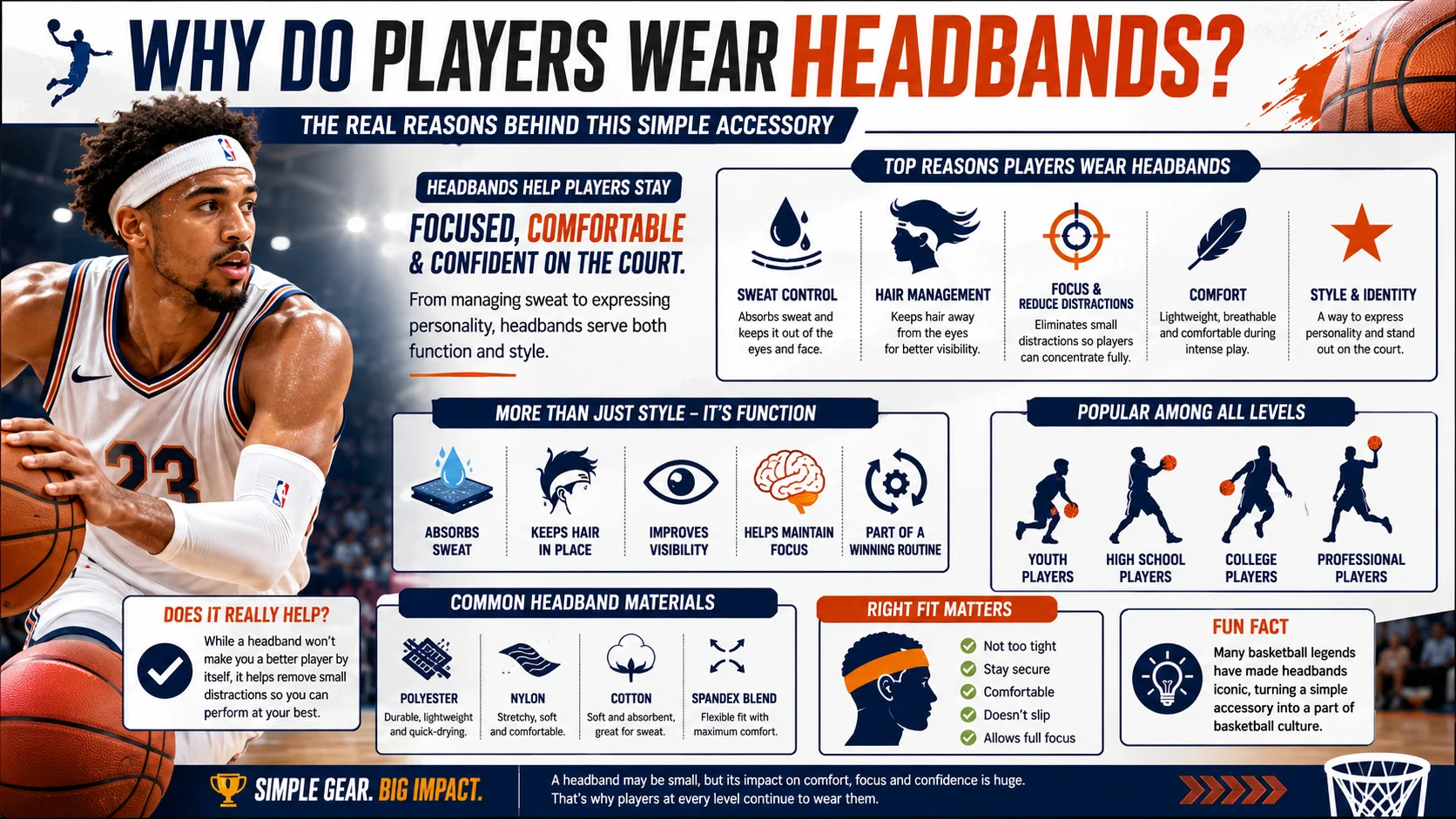
Basketball players wear headbands primarily to control sweat, keep hair away from their eyes, improve comfort, and maintain focus during games. While headbands have become part of basketball culture and personal style, their practical purpose is simple: keeping sweat and distractions away from the face without interfering with movement.
Why do basketball players wear headbands?
Players wear headbands mainly to absorb sweat, keep hair out of their eyes, reduce distractions, and stay comfortable during intense play. For some athletes, a headband also becomes part of their identity or pre-game routine.
Unlike protective equipment such as shoes or mouthguards, a headband isn’t essential to playing basketball. But during a fast-paced game where players are constantly running, jumping, defending, and sweating, even a small comfort advantage can matter.
| Reason | Why It Helps |
|---|---|
| Sweat control | Keeps perspiration away from the eyes and face |
| Hair management | Prevents hair from falling into the eyes |
| Focus | Reduces small distractions during play |
| Comfort | Helps players feel dry and comfortable |
| Style | Adds personality and recognizable appearance |
| Routine | Can become part of a player’s game-day habit |
Why Do Basketball Players Wear Headbands?
The simplest explanation is sweat.
Basketball is played at a high intensity. Players sprint up and down the court, defend, jump, battle for rebounds, and repeatedly change direction. That physical effort produces sweat, particularly around the forehead and hairline.
Without something to absorb or redirect that sweat, perspiration can eventually run down the player’s forehead and into their eyes.
That’s where a headband becomes useful.
A properly fitted basketball headband sits around the forehead and absorbs moisture before it becomes a distraction.
But sweat control is only part of the story.
1. Headbands Keep Sweat Out of the Eyes
This is probably the biggest practical reason players wear them.
Sweat dripping into the eyes can be surprisingly distracting. A player doesn’t have time to stop during a fast possession and wipe their face.
Imagine trying to:
- Track a defender
- Read a passing lane
- Dribble at speed
- Shoot a jumper
- Contest a shot
while sweat is running into your eyes.
A headband provides a simple solution by absorbing perspiration around the forehead.
For players who sweat heavily, this can make a noticeable difference during long practices and games.
2. They Keep Hair Out of the Face
Headbands aren’t only for sweat.
Players with medium or long hair may use them to keep hair from falling forward while running or jumping.
Loose hair can become particularly annoying during:
- Fast breaks
- Defensive slides
- Rebounding
- Shooting
- Diving for loose balls
A headband keeps the hairline more controlled and reduces the need to adjust hair during play.
For some players, this is just as important as sweat absorption.
3. Headbands Reduce Distractions
Basketball requires constant visual attention.
Players need to watch the ball, teammates, defenders, the rim, and the developing play all while moving at high speed.
Small distractions can become irritating over the course of a game.
A headband helps eliminate some of those distractions by keeping sweat and hair under control.
That’s why the benefit isn’t necessarily about making a player better at basketball. It’s about removing something that could interfere with concentration.
4. They’re Comfortable During Intense Games
A good basketball headband is lightweight and designed to stay in place.
Once properly fitted, many players barely notice they’re wearing one.
That matters because basketball players don’t want equipment that requires constant adjustment.
A headband that slips down every few minutes creates the exact problem it was supposed to solve.
The best headbands therefore need to provide a combination of:
- Secure fit
- Sweat absorption
- Stretch
- Breathability
- Lightweight comfort
5. Headbands Have Become Part of Basketball Style
There’s also a cultural reason.
Basketball has always had a strong connection between performance and personal style. Shoes, socks, sleeves, wristbands, hairstyles, and headbands can all become part of a player’s appearance.
Over time, certain players have made headbands especially recognizable.
As a result, wearing one can be about more than function. It can become part of how a player presents themselves on the court.
For some athletes, the headband is simply part of their basketball identity.
Do Headbands Actually Help Basketball Players Perform Better?
Not directly.
A headband doesn’t increase shooting accuracy, jumping ability, speed, or strength.
However, it can provide an indirect performance benefit by reducing distractions.
Think of it this way:
A headband doesn’t make you shoot better.
But if you’re constantly wiping sweat from your forehead or moving hair away from your eyes, eliminating that irritation can help you stay focused on the game.
This is particularly useful during long, intense games when sweat becomes increasingly difficult to manage.
Why Do Some Basketball Players Wear Headbands Even When They Don’t Sweat Much?
This is where comfort, habit, and personal style come into play.
Some players simply like the way a headband feels.
Others may have worn one for years and consider it part of their routine.
Sports routines can become surprisingly important. A player may have a particular way of tying their shoes, putting on wristbands, adjusting their socks, or wearing a headband before every game.
The equipment itself may have little physical impact, but the routine can help a player feel prepared.
Do Headbands Help With Hair?
Yes.
This is particularly useful for players with longer or thicker hair.
During a basketball game, repeated movement can cause hair to fall toward the face. A headband provides light compression around the hairline and helps keep it away from the eyes.
Some players combine a headband with other hair-management methods, depending on hair length and playing style.
The goal is simple:
Keep the player’s vision clear without constantly adjusting their hair.
Why Do Basketball Players Wear Headbands Under Their Hair?
Some players position the headband directly around the forehead, while others use it closer to the hairline.
The exact placement depends on:
- Hair length
- Head shape
- Personal preference
- Headband design
- How much sweat the player produces
There isn’t one universally correct position.
The important thing is that the headband remains comfortable and doesn’t interfere with vision or movement.
Are Basketball Headbands Made for Sweat?
Most performance-oriented basketball headbands are designed with moisture management in mind.
Common materials include:
- Polyester
- Nylon
- Spandex or elastane blends
- Cotton
- Moisture-wicking synthetic fabrics
Cotton can feel comfortable and absorbent, while modern synthetic fabrics are often designed to move moisture away from the skin and dry quickly.
For competitive players, a lightweight moisture-wicking material can be particularly useful.
Why Do Basketball Players Wear Different Colored Headbands?
Color is usually a matter of team uniform rules and personal style.
Some players prefer neutral colors such as black, white, or navy. Others choose colors that match their team’s uniform.
In organized basketball, however, players may have to follow league or team equipment regulations.
That means a player can’t always wear whatever color or design they want.
Can You Wear Any Headband in a Basketball Game?
Not necessarily.
Rules can vary by:
- League
- Competition
- School
- Tournament
- Age group
Some organizations regulate the color, size, or appearance of headbands and other accessories.
Players should therefore check their specific competition’s rules before wearing a particular headband in an official game.
Headband vs. Sweatband: What’s the Difference?
The terms are sometimes used interchangeably, but they can refer to slightly different products.
A headband is generally designed to sit around the head and may primarily be used for hair management, sweat control, or style.
A sweatband is specifically designed around moisture absorption.
In basketball, however, many headbands perform both jobs.
That’s why you’ll often hear players use the terms almost interchangeably.
Why Do Some Players Wear Headbands During Practice?
If a player finds a headband useful during games, there’s a good reason to wear it during practice too.
Practice can be just as physically demanding as competition.
Using the same equipment during training can also help a player become accustomed to:
- Fit
- Position
- Sweat absorption
- Comfort
- Hair management
There is little value in waiting until game day to discover that a headband constantly slips or feels uncomfortable.
Are Headbands Only for Professional Basketball Players?
No.
Headbands can be useful for players at virtually any level, including:
- Youth basketball
- Middle school
- High school
- College
- Amateur leagues
- Professional basketball
The reason for wearing one doesn’t change much: comfort, sweat management, hair control, and personal preference.
A young player doesn’t need a headband simply because professional players wear them.
If it helps them stay comfortable and focused, however, there’s nothing unusual about wearing one.
Can a Headband Be Too Tight?
Yes.
A headband should be secure enough to remain in place but not so tight that it causes discomfort.
A headband that’s too tight may lead to:
- Pressure around the forehead
- Headaches or discomfort
- Irritated skin
- Constant awareness of the headband
The player should be able to focus on basketball rather than thinking about the equipment.
A good rule is simple:
Secure, but comfortable.
Do Headbands Prevent Concussions?
No.
This is an important distinction.
A standard basketball headband is not protective headgear and should not be considered concussion protection.
Its purpose is primarily sweat management, hair control, comfort, and style.
Players should never rely on a normal headband as protection against head impacts.
Why Are Headbands So Popular in Basketball?
Basketball culture has helped turn the headband from a simple sweat-control accessory into a recognizable part of the sport.
Iconic players have worn headbands throughout different eras, and fans often associate certain looks with particular basketball generations.
That cultural influence continues today.
A player might wear a headband because:
It works.
It feels comfortable.
It looks good.
Or simply:
It’s part of their game.
Often, all four reasons are true at once.
Are Headbands Better Than Wristbands for Sweat?
They serve different purposes.
A headband helps manage sweat around the forehead and hairline, while a wristband can help a player wipe sweat from their face or manage moisture around the hands and wrists.
Some players use both.
The choice depends on how much a player sweats and where they prefer to manage moisture.
Frequently Asked Questions
Why do NBA players wear headbands?
NBA players may wear headbands to manage sweat, keep hair away from their eyes, improve comfort, reduce distractions, or simply as part of their personal style and routine.
Do basketball headbands help with sweat?
Yes. Many basketball headbands are designed to absorb or manage perspiration around the forehead, helping keep sweat from running into the eyes.
Do headbands make you better at basketball?
Not directly. A headband doesn’t improve athletic ability, but it can reduce distractions caused by sweat or loose hair.
Why do basketball players wear headbands around their forehead?
The forehead is one of the main areas where sweat accumulates. Positioning the headband there allows it to absorb perspiration and help keep it away from the eyes.
Can girls wear basketball headbands?
Absolutely. Headbands are used by basketball players of all genders and at all playing levels.
Can kids wear headbands while playing basketball?
Yes, provided the headband complies with the rules of their league or competition and fits comfortably.
What is the best material for a basketball headband?
For active play, lightweight moisture-wicking synthetic fabrics can be a good choice because they are designed to manage sweat and dry relatively quickly. Cotton is another comfortable option, although it can retain more moisture.
Should a basketball headband cover the ears?
Not necessarily. Most players position the headband according to comfort and hair/sweat management. It should stay secure without interfering with hearing, vision, or movement.
Final Verdict
So, why do basketball players wear headbands?
The answer is much simpler than the culture surrounding them might suggest.
Players primarily wear headbands to control sweat, keep hair away from their eyes, stay comfortable, and reduce distractions during intense play. Over time, the headband has also become a recognizable part of basketball fashion and player identity.
The most important benefit isn’t that a headband makes someone faster, stronger, or a better shooter. It’s that it removes a small but annoying problem from the game.
When you’re playing at full speed, small distractions matter.
A drop of sweat in your eye. Hair falling across your vision. A constant need to wipe your forehead.
A simple headband can take those distractions out of the equation.
And that’s why, despite being one of the simplest pieces of basketball equipment, the headband has remained popular across generations of players.
Key Takeaways
- Sweat control is the main practical reason players wear headbands.
- They help keep hair away from the eyes.
- They can reduce distractions during intense play.
- Headbands provide comfort and moisture management.
- They’re also an important part of basketball style and player identity.
- A normal headband does not provide concussion protection.
- League and tournament rules may regulate which headbands players can wear.
In short: players don’t wear headbands because they make them better athletes—they wear them because they make playing basketball a little easier, cleaner, and more comfortable.

Daniel Brooks is a sports writer at SportsOrbitX.com, specializing in football, basketball and global sports news. He focuses on delivering accurate reporting, match analysis and timely updates that keep fans informed.