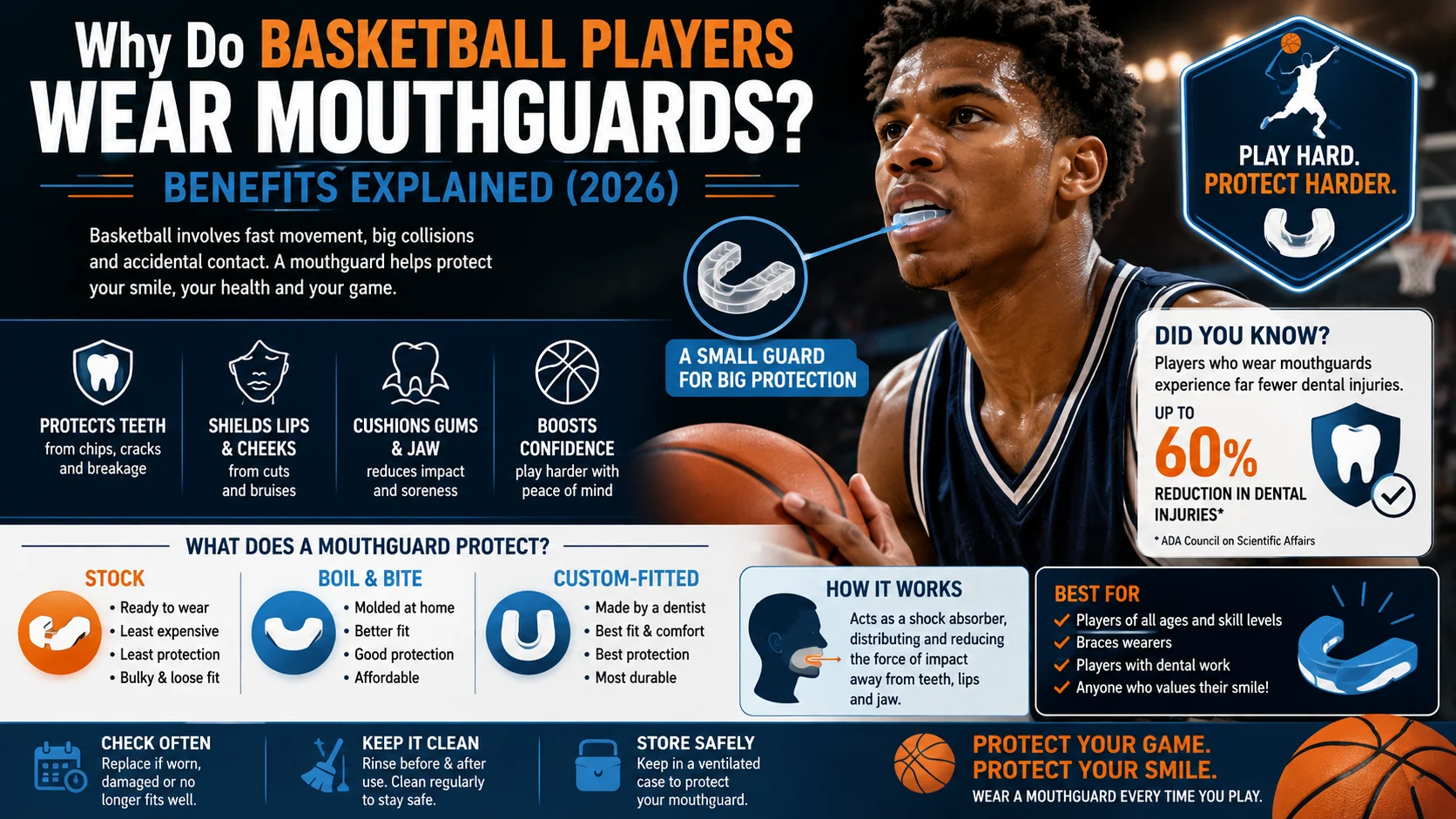
Basketball players wear mouthguards primarily to reduce the risk and severity of dental and mouth injuries caused by collisions, elbows, falls, and accidental contact. A properly fitted mouthguard cushions the teeth and soft tissues, helping protect against chipped, fractured, loosened, or knocked-out teeth. The American Dental Association recommends properly fitted mouthguards for sports with a meaningful risk of oral injury, and specifically lists basketball among the sports where mouthguard use is recommended.
Why Do Basketball Players Wear Mouthguards?
Basketball players wear mouthguards because basketball involves more physical contact than it sometimes appears.
Players collide while fighting for rebounds, drive aggressively toward the basket, fall to the floor, and can accidentally take an elbow, shoulder, or head to the face.
A mouthguard creates a protective layer between the teeth and surrounding tissues and the force of that impact.
The main reasons players wear them are to:
- Protect teeth from chips, fractures, and displacement
- Reduce the risk of knocked-out teeth
- Protect lips, cheeks, and gums from cuts
- Cushion some impact to the mouth and jaw
- Reduce the severity of certain oral injuries
- Protect expensive dental work, braces, or other orthodontic appliances
The key point is simple: a mouthguard is not just for football players. Basketball players can benefit from one too.
Why Is a Mouthguard Important in Basketball?
Basketball isn’t usually classified in the same way as football or boxing, but that doesn’t mean players are protected from facial injuries.
The court is crowded, movement is fast, and players frequently jump, reach, change direction, and make contact.
A player can take an unexpected blow to the mouth without committing a foul or doing anything unusual.
Consider a typical rebound.
Two players jump for the ball. One turns in the air. An elbow rises. Another player’s mouth is suddenly in the wrong place at the wrong time.
The entire event can happen in less than a second.
That’s where a mouthguard can make a difference.
The American Dental Association identifies basketball as a sport in which mouthguard use is recommended because of the risk of dental and orofacial injuries.
What Does a Basketball Mouthguard Protect?
A good mouthguard isn’t designed only to protect the front teeth.
It can help protect several areas of the mouth.
Teeth
The most obvious benefit is protecting the teeth from direct impact.
Depending on the force and location of an impact, dental trauma can include:
- Chipped teeth
- Cracked or fractured teeth
- Loosened teeth
- Displaced teeth
- Knocked-out teeth
Dental treatment after a serious sports injury can also be expensive and may require multiple appointments.
A mouthguard is relatively simple protection compared with dealing with a major dental injury.
Lips and Cheeks
Basketball players don’t only collide with other players.
Their own teeth can injure the inside of their lips or cheeks when the jaw closes suddenly during an impact.
A mouthguard provides a cushioning barrier between the teeth and soft tissue.
The ADA notes that an appropriate mouthguard should also help protect the lips and cheeks from soft-tissue injuries.
Gums and Other Oral Tissues
A forceful impact can cause cuts or bruising inside the mouth.
The resilient material of a mouthguard can help reduce direct contact between teeth and surrounding oral tissues.
It doesn’t make an athlete injury-proof, but it can reduce the likelihood or severity of some injuries.
Can Basketball Players Get Dental Injuries Without a Mouthguard?
Absolutely.
In fact, basketball is specifically recognized by dental organizations as a sport where athletes can experience oral trauma.
The ADA cites research involving college basketball players in which the dental injury rate was substantially lower among players wearing custom-fitted mouthguards than among those who weren’t wearing them.
This is important because many players assume:
Basketball isn’t a contact sport, so I don’t need one.
That’s not a safe assumption.
Basketball has limited rules around physical contact, but actual games involve frequent player-to-player contact.
Do Mouthguards Prevent Concussions?
This is where it’s important to separate fact from popular sports advice.
You may hear people say that a mouthguard prevents concussions. The evidence isn’t strong enough to make that claim confidently.
Mouthguards are well supported for reducing dental and orofacial injuries, but evidence about their ability to prevent concussions remains mixed and inconsistent. The ADA specifically notes that more research is needed regarding concussion prevention.
So the best way to think about it is:
Wear a mouthguard primarily to protect your mouth and teeth not as a guaranteed concussion-prevention device.
If a basketball player experiences a significant blow to the head, they should still follow appropriate concussion protocols and be evaluated when necessary.
A mouthguard does not replace proper medical assessment.
Do NBA Players Wear Mouthguards?
Yes, mouthguards are commonly seen among professional basketball players, although not every player chooses to wear one.
You may notice players chewing on or adjusting their mouthguards during games.
For professionals, the decision can come down to:
- Personal preference
- Previous dental injuries
- Comfort
- Position and playing style
- Fit
- Confidence
- Dental or orthodontic needs
Some players wear them almost every time they play, while others don’t.
At the youth and recreational level, however, parents and coaches should focus less on what professional players choose and more on the individual player’s injury risk and proper protective equipment.
Do Basketball Mouthguards Help With Braces?
Yes, and this is particularly important.
Players wearing braces can benefit from properly fitted mouth protection because a collision can cause the lips or cheeks to press against brackets and wires.
A mouthguard can create a protective barrier between orthodontic hardware and soft tissues.
However, athletes with braces shouldn’t simply buy the smallest mouthguard available.
Ask the orthodontist or dentist which type is appropriate.
As teeth move during orthodontic treatment, fit can change. A mouthguard that fits perfectly at one point may become uncomfortable or ineffective later.
Types of Mouthguards for Basketball
Not all mouthguards are created equal.
There are three basic categories commonly discussed in sports dentistry.
Stock Mouthguards
These are ready-made mouthguards available in predetermined sizes.
They’re inexpensive and require little preparation.
The downside is fit.
Because they’re not adapted specifically to the player’s mouth, they may feel loose and can require the athlete to keep their jaw closed to hold them in position. The ADA considers stock mouthguards the least effective type because of their generic fit and retention.
Boil-and-Bite Mouthguards
These are widely available and can be molded at home using heat.
They generally provide a better fit than stock mouthguards when molded correctly.
For many recreational and youth players, a properly fitted boil-and-bite model can be a practical option.
Look for products that meet recognized safety and performance requirements; the ADA’s Seal of Acceptance is one useful quality indicator for accepted athletic mouthguards.
Custom-Fitted Mouthguards
A dentist creates a custom mouthguard using an impression or digital scan of the athlete’s mouth.
This generally provides the most personalized fit.
Potential advantages include:
- Better retention
- Improved comfort
- Easier breathing and speaking
- Personalized thickness
- Better adaptation to the player’s mouth
Custom mouthguards are usually more expensive, but they can be especially worthwhile for athletes with braces, extensive dental work, a history of dental trauma, or demanding competition schedules.
Which Mouthguard Is Best for Basketball?
For most players, fit is more important than simply choosing the thickest or most expensive mouthguard.
A good basketball mouthguard should:
- Stay securely in place
- Feel comfortable
- Allow normal breathing
- Make communication reasonably easy
- Cover the teeth adequately
- Not interfere significantly with performance
- Be easy to clean
The ADA recommends a properly fitted mouthguard that stays comfortably and securely in place.
A mouthguard sitting loose in the mouth isn’t doing the athlete much good if they’re constantly pushing it back into position.
How Should a Basketball Mouthguard Fit?
A properly fitted mouthguard should remain in position without constant biting or clenching.
It shouldn’t:
- Fall out while talking
- Make breathing unnecessarily difficult
- Cause excessive gagging
- Rub painfully against the gums
- Prevent the player from communicating normally
If an athlete keeps removing the mouthguard because it feels uncomfortable, the protective equipment isn’t being used consistently.
And consistency matters.
The ADA emphasizes that mouthguards need to actually be worn to provide their intended protective benefit.
Why Some Basketball Players Don’t Wear Mouthguards
If mouthguards are useful, why doesn’t every basketball player wear one?
Usually, it’s not because players don’t care about their teeth.
Common reasons include:
- They feel uncomfortable
- Difficulty speaking
- Poor fit
- Difficulty breathing
- Players aren’t required to wear them
- They forget to put them in
- They believe basketball isn’t dangerous enough
- They dislike the feeling of something in their mouth
This is why fit matters so much.
A comfortable mouthguard is much more likely to stay in the player’s mouth throughout practice and competition.
Are Mouthguards Required in Basketball?
In many basketball leagues, mouthguards are not universally mandatory.
Rules can vary by:
- Age group
- School association
- League
- Tournament
- State or local regulations
The ADA notes that mouthguard mandates are more common in certain sports, while basketball requirements vary.
So don’t assume a mouthguard is required or prohibited based solely on what you see professional players doing.
Check the rules of the specific league or competition.
Should Kids Wear Mouthguards for Basketball?
For young basketball players, a properly fitted mouthguard can be a smart piece of protective equipment.
Children are still developing physically, and their sports participation can involve plenty of accidental contact.
The American Academy of Pediatric Dentistry supports properly fitted mouthguards for organized sports that carry a risk of orofacial injury.
Parents should pay particular attention if a child:
- Has braces
- Has a history of dental injury
- Plays aggressive, high-contact basketball
- Frequently falls
- Competes at a high level
- Has dental restorations that need protection
A dentist or pediatric dentist can help determine what type of mouthguard makes the most sense.
How to Clean a Basketball Mouthguard
A mouthguard spends a lot of time in a warm, moist environment, so hygiene matters.
After practice or a game:
- Rinse it thoroughly with cool or lukewarm water.
- Gently clean it according to the manufacturer’s instructions.
- Allow it to dry before storing.
- Keep it in a ventilated protective case.
- Inspect it regularly for damage or excessive wear.
Avoid exposing the mouthguard to excessive heat unless the manufacturer’s instructions specifically call for it, because heat can distort its shape.
Replace it if it becomes damaged, uncomfortable, excessively worn, or no longer fits properly.
For children and teenagers, fit should also be reassessed as the mouth develops.
Basketball Mouthguard vs. Football Mouthguard
The basic protective purpose is similar, but the equipment doesn’t necessarily have to be identical.
Football generally involves much more frequent high-impact contact, while basketball has a different pattern of collisions.
For basketball, players should prioritize:
- Secure fit
- Comfortable breathing
- Clear communication
- Adequate tooth protection
- Compatibility with braces or dental appliances
The best mouthguard is not necessarily the one marketed for the most aggressive sport. It’s the one that fits the athlete properly and is appropriate for the activity.
Frequently Asked Questions
Why do basketball players wear mouthguards?
Basketball players wear mouthguards mainly to reduce the risk and severity of dental and oral injuries caused by collisions, falls, elbows, shoulders, and accidental contact.
Do mouthguards make basketball safer?
They can reduce the risk of dental and orofacial injuries, but they cannot prevent every injury. They should be considered one part of an athlete’s overall safety equipment.
Do basketball mouthguards prevent concussions?
There isn’t enough consistent evidence to say that mouthguards reliably prevent concussions. Their strongest established benefit is protection against dental and oral injuries.
Should basketball players with braces wear mouthguards?
Yes, properly fitted mouth protection can help protect the lips, cheeks, and mouth from orthodontic hardware during contact. Players with braces should ask their orthodontist or dentist which mouthguard is appropriate.
Are expensive custom mouthguards worth it?
They can be, especially for competitive athletes, players with braces, or people with a history of dental injuries. However, a properly fitted non-custom mouthguard can also provide useful protection.
Can you talk while wearing a basketball mouthguard?
A well-fitted mouthguard should allow reasonable communication. If a player struggles to speak or constantly has to adjust it, the fit may need improvement.
Final Verdict
Basketball players wear mouthguards because one unexpected collision can turn a normal play into a serious dental injury.
Basketball may not look as physically demanding as football or hockey, but players routinely jump, fall, collide, and compete for space around the basket. A properly fitted mouthguard provides a protective barrier around the teeth and soft tissues, helping reduce the risk and severity of many sports-related oral injuries. The ADA specifically includes basketball among the sports where mouthguard use is recommended.
The biggest takeaway isn’t that every player needs the most expensive mouthguard available.
It’s this:
The best mouthguard is one that fits properly, feels comfortable, stays securely in place, and is actually worn.
For recreational players, a properly fitted boil-and-bite mouthguard may be sufficient. For serious competitors, athletes with braces, or players with specific dental concerns, a dentist-fitted option may be worth considering.
And remember: a mouthguard is designed primarily to protect the mouth and teeth. It should not be treated as a guarantee against concussion or other head injuries.
For a piece of equipment that is small enough to fit in your pocket, its potential value is enormous especially when the alternative could be a broken, displaced, or lost tooth.

Daniel Brooks is a sports writer at SportsOrbitX.com, specializing in football, basketball and global sports news. He focuses on delivering accurate reporting, match analysis and timely updates that keep fans informed.