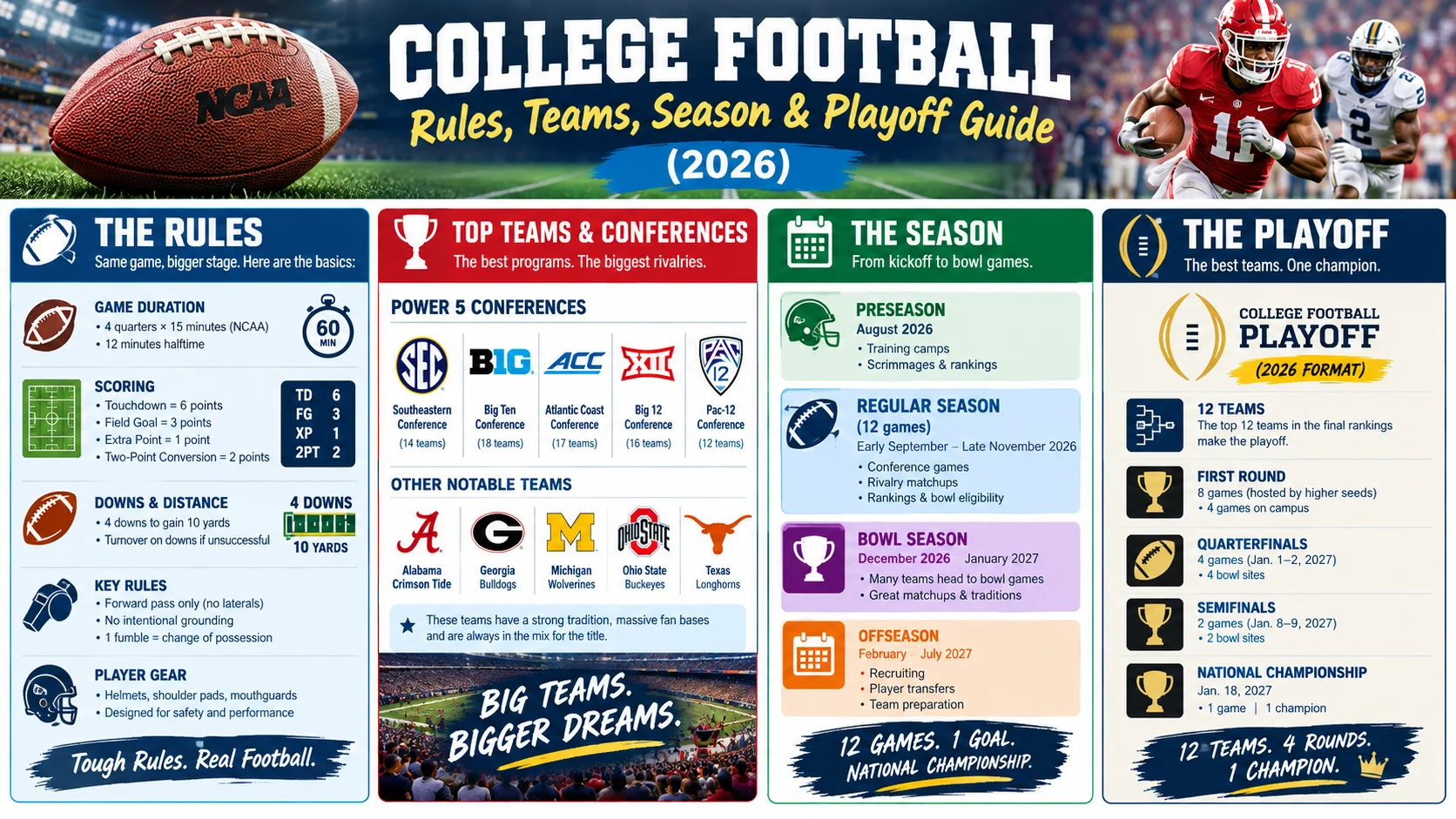
College football combines fierce rivalries, passionate fans, and a season-long race for the national championship. Learn how the game works, how teams qualify for the College Football Playoff, and what makes every Saturday exciting.
College football is more than a game played between universities. It is a tradition built around legendary rivalries, packed stadiums, marching bands, rising stars, and unforgettable finishes. Every season, teams compete for conference titles and a chance to win the national championship.
Whether you’re a new fan or a longtime supporter, this guide explains everything you need to know about college football in 2026, from the basic rules to conference standings, bowl games, and the expanded playoff system.
What Is College Football?
College football is American football played by teams representing colleges and universities. Most programs compete under the National Collegiate Athletic Association (NCAA), although other governing organizations also oversee college-level football.
The highest-profile level is NCAA Division I Football Bowl Subdivision (FBS), which includes many nationally recognized programs. FBS teams compete throughout the regular season, pursue conference championships, and seek places in the College Football Playoff.
Another major level is the Football Championship Subdivision (FCS). Unlike FBS, FCS determines its national champion through a separate NCAA playoff tournament.
College football is especially popular in the United States because university traditions and local rivalries can connect generations of fans.
How Does College Football Work?
The basic objective is simple: score more points than the opposing team before the game ends.
Each team uses its offense to move the ball and score, while its defense tries to stop the opponent. Special teams handle kickoffs, punts, field goals, and extra-point attempts.
A standard college football game has four quarters of 15 minutes each. Because the clock stops and starts according to specific rules, games typically last considerably longer than 60 minutes in real time.
How Teams Score Points
| Scoring play | Points |
|---|---|
| Touchdown | 6 |
| Extra point after touchdown | 1 |
| Two-point conversion | 2 |
| Field goal | 3 |
| Safety | 2 |
A touchdown is scored when a player carries the ball into the opponent’s end zone or catches a legal pass there. Afterward, the scoring team can attempt a one-point kick or a two-point play.
A field goal is worth three points when the ball successfully passes between the uprights. A safety usually occurs when the offense is tackled or commits a qualifying foul in its own end zone.
What Is a First Down?
The offense generally has four downs, or attempts, to advance the ball at least 10 yards. If it succeeds, it earns a new set of four downs.
For example, if a team gains six yards on first down, it needs four more yards over the next attempts to reach the line to gain.
If the offense fails to make the required progress, possession can change. Teams often punt on fourth down to move the opponent farther away from the end zone, although they may choose to attempt a conversion in certain situations.
When Does the College Football Season Start?
The college football season generally begins in late August or early September and continues through the regular season in November. Conference championship games and postseason competitions follow.
The 2026 college football season is scheduled to begin during Week Zero on August 27, with most Division I programs starting the following week. The season then builds toward conference titles, bowl games, and the College Football Playoff.
A typical season includes:
- Regular season: Teams play scheduled opponents, including conference rivals and nonconference teams.
- Conference championship games: Eligible teams compete for their conference titles.
- Bowl season: Selected teams compete in postseason bowl games.
- College Football Playoff: Qualifying teams compete for the national championship.
Exact schedules vary by team, conference, and postseason qualification.
What Are College Football Conferences?
A conference is a group of universities that organize competition, schedules, and championship opportunities. Conference membership matters because teams compete for standings, titles, and postseason access.
Major FBS conferences include:
| Conference | Commonly associated programs |
|---|---|
| Southeastern Conference (SEC) | Alabama, Georgia, LSU |
| Big Ten Conference | Ohio State, Michigan, Oregon |
| Atlantic Coast Conference (ACC) | Clemson, Miami, Florida State |
| Big 12 Conference | BYU, Utah, Kansas State |
| American Conference | Programs including Tulane and Memphis |
| Mountain West Conference | Programs including Boise State and Fresno State |
| Sun Belt Conference | Programs including James Madison and Appalachian State |
| Mid-American Conference (MAC) | Programs including Toledo and Miami (Ohio) |
Conference membership can change, so fans following a particular school should check its current official athletics schedule.
Why Are Conferences Important?
Conference games can determine who wins a league title and can influence national rankings and playoff selection. A team’s conference affiliation also shapes its annual rivalries and schedule.
However, winning a conference championship does not mean every team has the same postseason path. The College Football Playoff uses a defined selection and seeding system, and its rules determine which conference champions receive automatic places.
How Does the College Football Playoff Work in 2026?
The College Football Playoff (CFP) determines the FBS national champion. For the 2026–27 postseason, the CFP is scheduled to retain its 12-team format.
The field combines automatic qualifiers with additional teams selected through the final CFP rankings.
Under the 2026–27 format:
- The champions of the ACC, Big Ten, Big 12, and SEC receive automatic bids.
- The highest-ranked team from the American, Conference USA, MAC, Mountain West, Pac-12, or Sun Belt receives another automatic bid.
- Notre Dame can earn an automatic bid if it finishes among the top 12 teams in the final rankings.
- The remaining places are filled by the next-highest-ranked eligible teams under the selection rules.
The selection committee evaluates teams using factors such as results, strength of schedule, head-to-head outcomes, and other relevant performance information.
How the 12-Team Playoff Bracket Works
The four highest-ranked teams receive the top four seeds and a first-round bye. Teams seeded fifth through 12th compete in the opening round.
| Playoff stage | What happens |
|---|---|
| First round | Seeds 5–12 play at the higher-seeded team’s home site or another designated site |
| Quarterfinals | Eight teams remain |
| Semifinals | Four teams compete for championship-game places |
| National championship | The final two teams compete for the title |
Quarterfinals and semifinals are played at designated bowl sites. The 2026–27 national championship game is scheduled for January 25, 2027, at Allegiant Stadium in Las Vegas, Nevada.
The 12-team structure gives more programs a realistic postseason opportunity than the former four-team format, while making late-season games and conference championships especially important.
What Are College Football Bowl Games?
Bowl games are postseason contests that traditionally feature teams from different conferences. Many have long histories, distinctive traditions, and major audiences.
Six prominent bowl sites used in the CFP rotation are:
- Rose Bowl
- Sugar Bowl
- Orange Bowl
- Cotton Bowl
- Peach Bowl
- Fiesta Bowl
These bowls host CFP quarterfinals and semifinals on a rotating basis. Bowl games outside the playoff also provide postseason opportunities for eligible teams.
Not every bowl game determines the national champion. In the modern system, the national title is decided by the College Football Playoff final.
College Football Rankings: How Do They Work?
Rankings help fans compare teams and follow the championship race. Two ranking systems often discussed are the Associated Press (AP) Top 25 poll and the official CFP rankings.
The AP poll is a media poll that ranks teams during the season. The CFP rankings are released by the selection committee and are used in determining the playoff field and seeds.
A high ranking can strengthen a team’s playoff position, but ranking alone does not guarantee qualification. Conference results, automatic-bid rules, and the final selection process also matter.
For fans, the biggest question is often not simply, “Who is ranked first?” but, “Which teams are positioned to reach the playoff?”
Why Is College Football So Popular?
College football stands out because the game connects athletic competition with school identity and regional pride.
Historic rivalries: Annual matchups can carry decades of history, making a single game feel like an entire season’s defining moment.
Game-day traditions: Tailgating, marching bands, school songs, student sections, and team colors create an atmosphere unlike most professional sporting events.
Future NFL stars: College football gives fans the chance to watch talented players develop before they potentially enter the NFL.
Unexpected upsets: Smaller programs can challenge nationally recognized teams, and one surprising result can reshape the rankings.
High-stakes finishes: Conference championships and playoff qualification often come down to the final weeks, keeping fans invested throughout the season.
College Football vs. NFL: What’s the Difference?
College football and the NFL share the same basic objective, but their rules, players, and competition structures differ.
| Feature | College football | NFL |
|---|---|---|
| Players | University-level athletes | Professional athletes |
| Governing structure | NCAA and other college governing bodies | National Football League |
| Main season goal | Conference success and national championship opportunities | NFL playoff qualification and Super Bowl |
| Rankings | AP poll and CFP rankings are prominent | Standings and playoff seeding |
| Postseason | Bowl games and division-specific championships | NFL playoffs |
| Rules | NCAA playing rules | NFL playing rules |
Some details, including catch requirements, clock procedures, and overtime rules, differ between the two levels. Fans switching between college football and the NFL should not assume every rule is identical.
How Can Beginners Follow College Football?
You don’t need to know every team or rule to enjoy the season. Start with a few practical steps:
- Choose a team or conference. Following one program makes schedules and rivalries easier to understand.
- Learn the scoring system. Touchdowns, field goals, and extra points explain most score changes.
- Watch the standings. Conference results help show which games have championship implications.
- Follow the CFP rankings. These provide a useful view of the playoff race as the season develops.
- Pay attention to rivalry games. These matchups often have extra meaning beyond the standings.
To check current schedules, results, rankings, and official rules, visit NCAA.com Football, the College Football Playoff website, and the relevant university’s athletics website.
Frequently Asked Questions
How many players are on a college football team?
Each team has 11 players on the field during a standard play. The full roster is much larger because teams need substitutes and specialists for different situations.
How long is a college football game?
The game clock is divided into four 15-minute quarters, totaling 60 minutes of regulation time. Actual viewing time is much longer because of stoppages, halftime, reviews, and other delays.
How many teams make the College Football Playoff in 2026?
The 2026–27 CFP format includes 12 teams, with automatic qualifiers and additional selections based on the final rankings and applicable rules.
Is the College Football Playoff the same as bowl season?
No. Bowl season includes multiple postseason games, while the CFP is the tournament that determines the FBS national champion. Some major bowl games host playoff rounds.
What is the difference between FBS and FCS?
FBS and FCS are two subdivisions of NCAA Division I football. FBS teams compete for CFP places and other bowl opportunities, while FCS teams compete in a separate NCAA championship playoff.
When is the 2026–27 College Football Playoff championship game?
The national championship game is scheduled for January 25, 2027, at Allegiant Stadium in Las Vegas, Nevada.
Why do college football rankings change every week?
Rankings can change because of wins, losses, strength of schedule, head-to-head results, and the committee’s assessment of team performance. A major upset can quickly affect the playoff picture.
Final Thoughts
College football delivers a unique mix of competition, tradition, rivalries, and championship drama. Understanding the scoring rules, conference system, rankings, bowl games, and playoff format makes every matchup more meaningful.
In 2026, the 12-team College Football Playoff gives fans another season of high-stakes football, with teams chasing conference titles and a place in the national championship race. Whether you follow a powerhouse program or root for an underdog, the best part of college football is that one game can change everything.

Daniel Brooks is a sports writer at SportsOrbitX.com, specializing in football, basketball and global sports news. He focuses on delivering accurate reporting, match analysis and timely updates that keep fans informed.