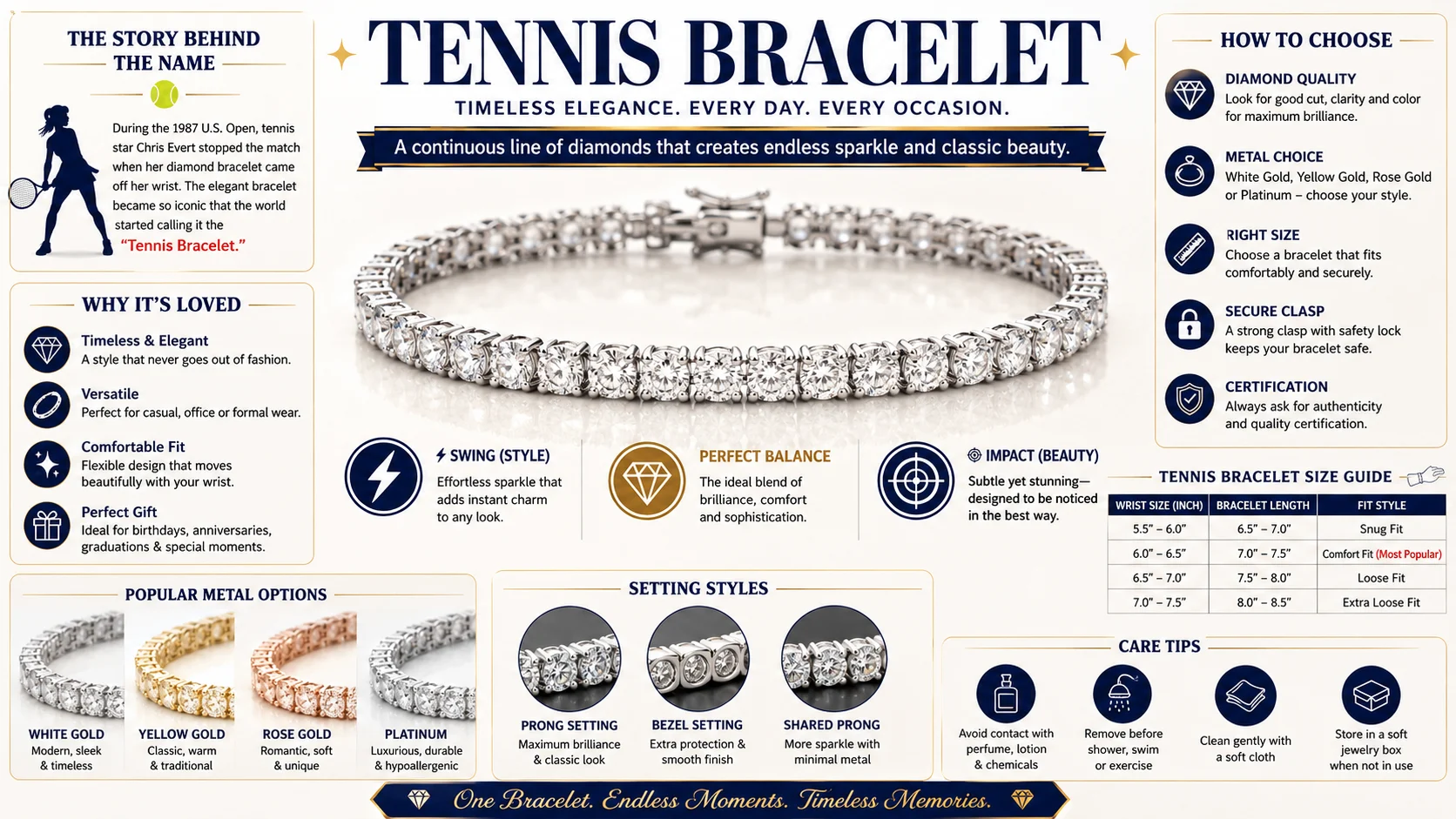
A tennis bracelet is a flexible bracelet featuring a continuous row of diamonds or other gemstones set closely together. It is known for its elegant, timeless appearance and can be worn with casual outfits, business clothing, or formal wear. When choosing one, focus on diamond quality, metal, bracelet length, setting, comfort, and overall craftsmanship rather than size alone.
What Is a Tennis Bracelet?
A tennis bracelet is a delicate, flexible bracelet made with a continuous line of diamonds or gemstones around the wrist. The stones are usually arranged in individual settings that allow the bracelet to move naturally while maintaining a consistent, sparkling appearance.
The classic tennis bracelet is made with round brilliant diamonds, although modern designs can feature oval, emerald, princess, pear, or other diamond shapes.
What makes a tennis bracelet different from an ordinary diamond bracelet is its signature look: instead of one large centerpiece, the diamonds create an uninterrupted line of sparkle.
That simplicity is exactly why the style has remained popular for decades.
| Feature | Tennis Bracelet |
|---|---|
| Design | Continuous row of gemstones |
| Most Popular Stone | Diamond |
| Common Diamond Shape | Round brilliant |
| Common Metals | White gold, yellow gold, rose gold, platinum |
| Style | Elegant and minimalist |
| Wearability | Everyday or formal |
| Typical Closure | Box clasp with safety mechanism |
Why Is It Called a Tennis Bracelet?
The name tennis bracelet became famous because of tennis champion Chris Evert.
During a match at the 1987 U.S. Open, Evert reportedly asked officials to pause play after her diamond bracelet came off her wrist. The incident received attention, and the phrase “tennis bracelet” became associated with this type of flexible diamond bracelet.
The design itself existed before that famous moment, but the tennis connection helped turn it into one of the most recognizable names in fine jewelry.
That story also explains why the bracelet’s original concept makes sense for active movement: its flexible construction allows the diamonds to follow the shape of the wrist rather than behaving like a rigid bangle.
What Does a Tennis Bracelet Look Like?
A traditional tennis bracelet has a relatively simple visual formula:
diamond + diamond + diamond + diamond = continuous sparkle
There is usually no oversized centerpiece. Instead, each stone contributes to the overall appearance.
From a distance, the individual settings can almost disappear, making the bracelet look like a continuous stream of light around the wrist.
That is one reason tennis bracelets are so versatile.
You can wear one with:
- A little black dress
- A wedding outfit
- Office clothing
- Jeans and a simple blouse
- A watch
- Other bracelets
- Eveningwear
The same bracelet can look understated during the day and luxurious at night.
Diamond Tennis Bracelet vs. Gemstone Tennis Bracelet
Although diamonds are the traditional choice, tennis bracelets are not limited to diamonds.
Diamond Tennis Bracelet
Diamond tennis bracelets remain the classic option.
They offer:
- Maximum sparkle
- Timeless appeal
- Easy styling
- Strong luxury association
- Long-term versatility
For someone buying their first tennis bracelet, a diamond design is usually the safest choice if they want something that will remain fashionable for years.
Gemstone Tennis Bracelet
Modern versions may use:
- Sapphires
- Rubies
- Emeralds
- Moissanite
- Lab-grown diamonds
- Other colored gemstones
Colored gemstones can create a completely different personality.
A sapphire tennis bracelet, for example, can look sophisticated and distinctive without relying on the traditional all-diamond appearance.
Natural Diamonds vs. Lab-Grown Diamonds
One of the biggest decisions when buying a modern tennis bracelet is whether to choose natural or lab-grown diamonds.
Natural Diamonds
Natural diamonds form naturally beneath the Earth’s surface over extremely long geological periods.
They are traditionally associated with:
- Luxury
- Natural rarity
- Traditional fine jewelry
- Long-established diamond grading systems
Lab-Grown Diamonds
Lab-grown diamonds have essentially the same chemical composition and crystal structure as natural diamonds but are produced using controlled technological processes.
They can be an attractive option for buyers who want a diamond appearance while prioritizing a different budget or purchasing philosophy.
The important thing is to understand exactly what you’re buying and compare specifications rather than assuming a higher price automatically means better quality.
What Makes a Tennis Bracelet Expensive?
The price of a tennis bracelet can vary dramatically.
The biggest factors include diamond quality, total carat weight, metal, craftsmanship, setting, brand, and whether the diamonds are natural or lab-grown.
1. Total Carat Weight
Total carat weight refers to the combined weight of all the diamonds in the bracelet.
A bracelet containing many small diamonds can have a high total carat weight even though no individual stone is particularly large.
2. Diamond Quality
The traditional 4Cs remain important:
- Cut
- Color
- Clarity
- Carat
For a tennis bracelet, cut is especially important because the bracelet’s visual appeal depends heavily on how the stones interact with light.
A bracelet with well-cut diamonds can appear more lively and brilliant than one with larger but poorly cut stones.
3. Metal
Common choices include:
| Metal | Appearance | Character |
|---|---|---|
| White Gold | Bright, modern | Contemporary |
| Yellow Gold | Warm, classic | Traditional |
| Rose Gold | Pinkish tone | Romantic |
| Platinum | Naturally white | Premium and durable |
The best metal is largely a matter of personal style, skin-tone preference, durability needs, and budget.
How Should a Tennis Bracelet Fit?
Fit is more important than many first-time buyers realize.
A tennis bracelet should be secure enough that it doesn’t slide excessively but loose enough to move comfortably around the wrist.
A bracelet that is too tight can feel restrictive and may put unnecessary stress on the clasp.
One that is too loose can rotate constantly or increase the risk of catching on clothing and objects.
How to Measure Your Wrist
Wrap a flexible measuring tape around your wrist where you normally wear a bracelet.
If you don’t have measuring tape, use a piece of string and measure the string against a ruler.
Then consider the desired amount of movement.
For a comfortable everyday fit, many people prefer a little extra room rather than an extremely tight fit.
What Size Tennis Bracelet Should You Buy?
There isn’t one universal bracelet length that works for everyone.
A useful approach is:
Wrist measurement + comfortable allowance = bracelet length
The ideal allowance depends on how you want the bracelet to sit.
If you prefer a closer, elegant fit, choose less additional room. If you want more movement, choose a slightly longer bracelet.
For a gift, measuring the recipient’s existing bracelet is often more reliable than guessing based on height or body size.
Which Tennis Bracelet Setting Is Best?
The setting determines how the diamonds are held in place and can influence both appearance and security.
Prong Setting
Prongs hold each diamond individually.
Advantages:
- Excellent light exposure
- Strong sparkle
- Classic appearance
- Individual stones are clearly visible
Bezel Setting
A bezel surrounds the stone with metal.
Advantages:
- Protective design
- Smooth appearance
- Less likely to snag
- Modern aesthetic
Shared-Prong Setting
Neighboring stones can share prongs.
This reduces the amount of visible metal and can create the illusion of a nearly continuous line of diamonds.
The best setting depends on whether your priority is maximum sparkle, protection, appearance, or everyday practicality.
Is a Tennis Bracelet Good for Everyday Wear?
Yes, but “everyday” doesn’t mean “wear it through everything.”
A well-made tennis bracelet can be worn regularly, but it is wise to remove it during activities that could damage the bracelet or stress the clasp.
Consider taking it off when:
- Exercising
- Swimming
- Showering
- Doing heavy manual work
- Playing sports
- Working with harsh chemicals
Fine jewelry is designed to be worn, but thoughtful care can significantly reduce unnecessary wear.
Can You Wear a Tennis Bracelet With a Watch?
Absolutely.
A tennis bracelet and watch can create a sophisticated combination.
For a balanced look, consider:
- Keeping the bracelet relatively slim beside a large watch.
- Matching or intentionally contrasting metals.
- Wearing the bracelet on the opposite wrist for a cleaner appearance.
- Layering several delicate bracelets if you prefer a more fashion-forward style.
A diamond tennis bracelet can soften the visual heaviness of a metal watch and add subtle sparkle without overpowering the outfit.
Can You Stack Tennis Bracelets?
Yes. Tennis bracelets can be stacked, although the classic style is often worn alone.
For a layered look, combine:
- One diamond tennis bracelet
- A thin gold chain bracelet
- A delicate bangle
- A gemstone bracelet
The easiest way to keep the combination elegant is to vary the textures and widths rather than wearing several nearly identical pieces.
How to Tell if a Tennis Bracelet Is Well Made
Don’t judge quality only by how much the bracelet sparkles under jewelry-store lighting.
Before buying, inspect:
The Clasp
The clasp should close securely and feel substantial.
A safety mechanism is especially valuable for a bracelet containing numerous diamonds.
The Settings
Look closely at the settings.
They should appear even and properly finished, without visibly loose or poorly aligned stones.
The Flexibility
A tennis bracelet should move naturally around the wrist.
It should not feel stiff, awkward, or excessively rigid.
The Back of the Bracelet
Quality craftsmanship should also be visible from the underside.
Clean finishing, consistent settings, and smooth edges are positive signs.
Tennis Bracelet Buying Checklist
Before purchasing, ask these questions:
1. What is the total carat weight?
Don’t compare bracelets based only on the number of diamonds.
2. Are the diamonds natural or lab-grown?
This can make a substantial difference in pricing.
3. What are the diamond color and clarity grades?
Ask for documentation when appropriate.
4. What metal is used?
Confirm whether it is platinum, gold, or another material.
5. Is the clasp secure?
A beautiful bracelet is not a good investment if the closure is unreliable.
6. Does it fit correctly?
Comfort and security should be considered together.
7. Can the bracelet be professionally serviced?
Ask about resizing, repairs, cleaning, and stone replacement.
Tennis Bracelet vs. Diamond Bangle
These two styles are sometimes confused, but they are quite different.
| Feature | Tennis Bracelet | Diamond Bangle |
|---|---|---|
| Construction | Flexible | Usually rigid |
| Design | Continuous gemstone row | Solid circular structure |
| Movement | High | Limited |
| Comfort | Flexible around wrist | More structured |
| Style | Classic and delicate | Bold or architectural |
If you want something that follows the natural movement of your wrist, a tennis bracelet is usually the better option.
If you prefer a stronger, sculptural appearance, a diamond bangle may be more suitable.
How to Clean a Tennis Bracelet
Regular cleaning helps restore the sparkle that naturally becomes less noticeable when oils, lotion, dust, and everyday residue accumulate.
For routine care:
- Use a soft jewelry cloth.
- Follow the manufacturer’s cleaning instructions.
- Avoid harsh household chemicals.
- Don’t scrub aggressively around delicate settings.
- Have valuable pieces professionally inspected periodically.
For an expensive tennis bracelet, professional cleaning and inspection can be worthwhile because a jeweler can also check whether any stones or settings have become loose.
Is a Tennis Bracelet a Good Gift?
A tennis bracelet is one of those rare jewelry gifts that can work for many occasions.
It can be given for:
- Anniversaries
- Weddings
- Birthdays
- Graduations
- Valentine’s Day
- Mother’s Day
- Major milestones
- Personal achievements
Its biggest advantage as a gift is versatility. Unlike highly trend-driven jewelry, a classic tennis bracelet can remain relevant for many years.
Is a Tennis Bracelet Still in Style?
Yes.
The tennis bracelet has survived changing jewelry trends because its design is fundamentally simple.
It doesn’t depend on an oversized logo, a temporary color trend, or a particular fashion era.
A classic diamond tennis bracelet can look just as appropriate with today’s minimalist fashion as it can with traditional formalwear.
That timeless quality is arguably its biggest strength.
Frequently Asked Questions
What is the main purpose of a tennis bracelet?
A tennis bracelet is primarily a fashion and fine-jewelry accessory designed to provide a continuous line of sparkle around the wrist.
Why are tennis bracelets so popular?
Their popularity comes from their combination of elegance, flexibility, versatility, and timeless design. They can be worn alone or layered with other jewelry.
Are tennis bracelets only made with diamonds?
No. Diamonds are the traditional choice, but modern tennis bracelets can also feature sapphires, rubies, emeralds, moissanite, lab-grown diamonds, and other gemstones.
Can I wear a tennis bracelet every day?
You can wear one regularly, but removing it during sports, swimming, showering, heavy work, and exposure to harsh chemicals can help protect the bracelet.
Should a tennis bracelet be tight or loose?
It should be secure and comfortable, with enough room for natural movement without sliding excessively around the wrist.
Is a tennis bracelet a good investment?
It can be a valuable fine-jewelry purchase, but it should not automatically be treated as a financial investment. Price and resale value depend on diamond quality, metal, craftsmanship, brand, market conditions, and other factors.
What is the most popular tennis bracelet style?
A classic design featuring round brilliant diamonds in a white-metal setting remains one of the most recognizable versions.
Final Verdict
A tennis bracelet is much more than a row of diamonds around the wrist. Its flexible construction, continuous sparkle, and understated design have made it one of the most enduring styles in fine jewelry.
The famous connection to tennis player Chris Evert helped give the bracelet its modern name, but its appeal goes far beyond the tennis court.
If you’re buying one, don’t focus only on diamond size. Look at the 4Cs, total carat weight, metal, setting, clasp quality, bracelet length, comfort, and craftsmanship. A smaller bracelet with beautifully cut stones and excellent construction can be far more attractive than a larger piece chosen without considering quality.
The best tennis bracelet is ultimately the one that feels comfortable, looks balanced on your wrist and fits the way you actually plan to wear it.
Classic enough to last. Elegant enough to notice. Simple enough to wear again and again that is the real appeal of a tennis bracelet.

Emily Parker is a sports journalist at SportsOrbitX.com with a passion for covering cricket, tennis and major international sporting events. She is committed to producing clear, reliable and engaging content for sports enthusiasts worldwide.