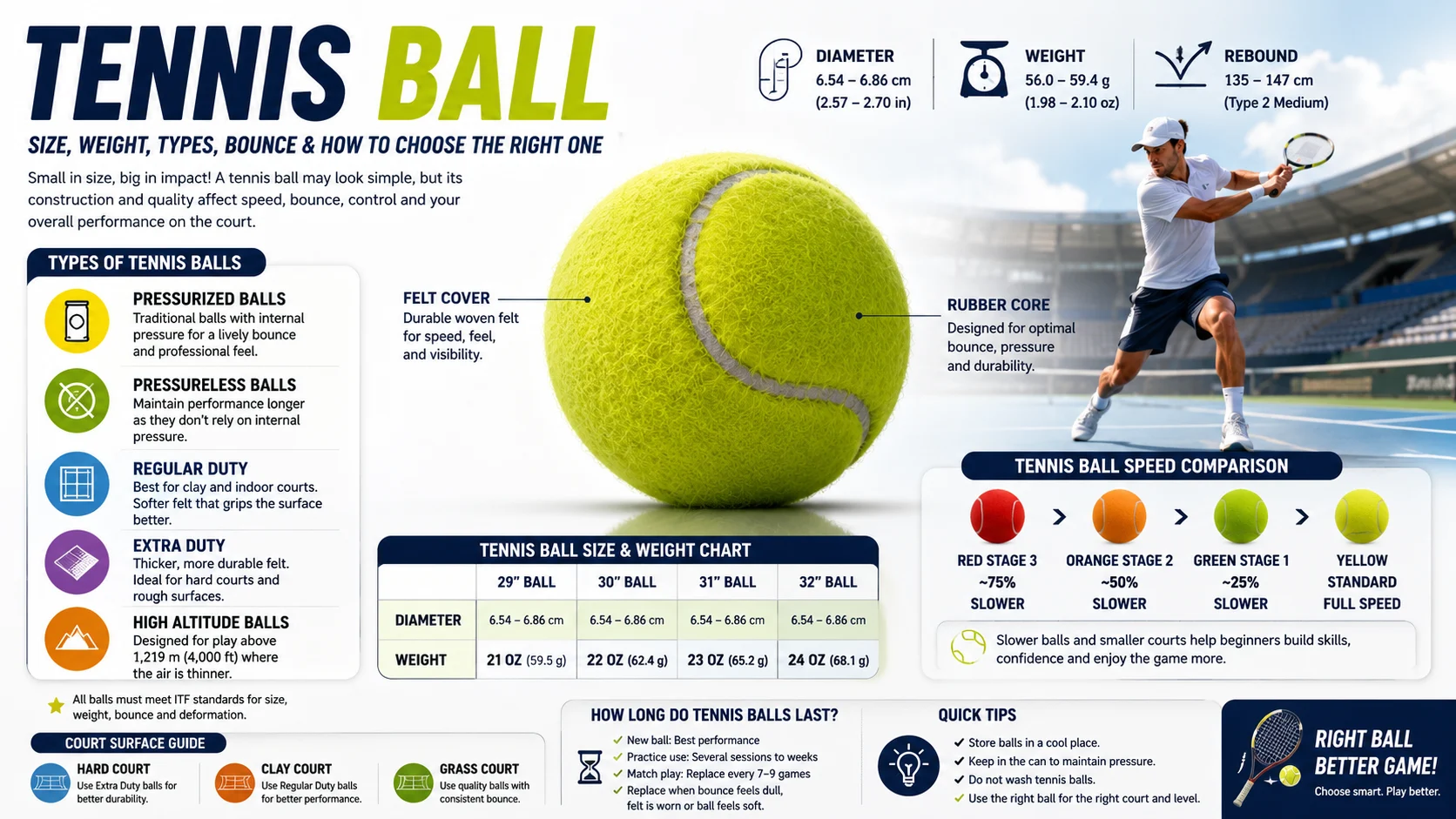
A tennis ball is a pressurized or pressureless ball covered with felt and designed to meet specific standards for weight, size, bounce, and deformation. A standard approved tennis ball weighs 56.0–59.4 grams and is typically 6.54–6.86 cm (2.57–2.70 inches) in diameter.
The right tennis ball depends on your playing level, court conditions, altitude, and age. Regular yellow balls are used for standard play, while slower red, orange, and green balls help younger players learn technique and control.
What Is a Tennis Ball?
A tennis ball may look simple, but its construction has a major effect on how the game feels.
Inside a traditional tennis ball is a rubber core designed to create the required bounce. The outside is covered with a woven felt material that affects aerodynamics, durability, speed, and how the ball reacts to the racket and court.
That combination is what gives a tennis ball its familiar characteristics:
- Predictable bounce
- Controlled flight
- Visible yellow color
- Grip on the racket strings
- Felt interaction with the court surface
The International Tennis Federation (ITF) sets specifications for approved tennis balls so that competitive players can expect consistent performance. The ITF maintains an official list of approved balls for 2026.
How Big Is a Tennis Ball?
A standard Type 1, Type 2, or high-altitude tennis ball must have a diameter of approximately 6.54–6.86 cm, or 2.57–2.70 inches.
However, not every approved tennis ball is exactly the same size.
For example, the ITF’s Type 3 slow ball is larger, measuring approximately 7.00–7.30 cm (2.76–2.87 inches).
Tennis Ball Size at a Glance
| Ball Type | Approx. Diameter |
|---|---|
| Type 1 Fast | 6.54–6.86 cm |
| Type 2 Medium | 6.54–6.86 cm |
| Type 3 Slow | 7.00–7.30 cm |
| High Altitude | 6.54–6.86 cm |
The larger Type 3 ball is designed to slow the game down, giving players more time to react.
How Much Does a Tennis Ball Weigh?
A standard approved tennis ball weighs between 56.0 and 59.4 grams, or roughly 1.98–2.10 ounces. This weight range applies to the standard Type 1, Type 2, Type 3, and high-altitude categories under the current ITF specifications.
That may seem like a very small difference, but consistency matters. A professional player expects the ball to behave predictably when serving at high speed or striking a heavy forehand.
Does Every Tennis Ball Weigh the Same?
No.
Approved balls must fall within specified limits, but different categories can have different sizes, bounce characteristics, and playing speeds even when their weight range is similar.
That’s why simply weighing a ball doesn’t tell you how fast or lively it will feel.
Types of Tennis Balls
Not all tennis balls are designed for the same player or conditions.
The main categories include:
- Pressurized tennis balls
- Pressureless tennis balls
- Regular-duty balls
- Extra-duty balls
- High-altitude balls
- Red, orange, and green junior balls
Understanding the differences can save you from buying the wrong ball for your court or playing level.
Pressurized Tennis Balls
Pressurized tennis balls are the classic choice for competitive and recreational tennis.
They contain internal pressure that helps create a lively bounce and responsive feel.
Advantages
- Lively bounce
- Faster response
- Familiar professional feel
- Excellent for competitive play
Disadvantages
Their biggest weakness is that they gradually lose internal pressure.
A ball may still look perfectly fine while playing noticeably slower or softer than when it was new.
This is why serious players often replace pressurized balls regularly.
Pressureless Tennis Balls
Pressureless tennis balls generate their playing characteristics primarily through the construction of the rubber core rather than internal air pressure.
They are generally known for lasting longer because they don’t depend on maintaining internal pressure.
Advantages
- Long-lasting
- Good for practice
- Useful for ball machines
- Consistent durability
Disadvantages
They can feel different from traditional pressurized balls and may not provide exactly the same lively response that competitive players expect.
For serious match play, players generally choose balls approved for the relevant competition rather than simply choosing the longest-lasting option.
What Is the Difference Between Regular-Duty and Extra-Duty Tennis Balls?
This is one of the most important buying decisions for recreational players.
The difference primarily concerns the felt covering, which affects how the ball performs on different court surfaces.
Regular-Duty Tennis Balls
Regular-duty balls are commonly associated with clay and indoor courts.
Their felt is designed to work well in conditions where the court itself doesn’t cause as much wear on the ball.
Extra-Duty Tennis Balls
Extra-duty balls have a more durable felt construction and are commonly preferred for hard courts, where the abrasive surface can wear down the covering faster.
Quick Comparison
| Feature | Regular Duty | Extra Duty |
|---|---|---|
| Best suited to | Clay/indoor | Hard courts |
| Felt | Less resistant to abrasion | More durable |
| Hard-court durability | Lower | Higher |
| Clay-court suitability | Excellent | Can pick up more clay |
Choosing the correct felt can make a noticeable difference in how long a can of balls remains playable.
What Makes a Tennis Ball Bounce?
A tennis ball’s bounce is influenced by several factors:
- Internal pressure
- Rubber core
- Ball temperature
- Court surface
- Ball condition
- Altitude
- Impact speed
The ITF measures rebound as part of its approval process. For example, the current specifications list a rebound range of 135–147 cm for Type 2 medium balls, while Type 1 fast balls have a higher specified rebound range of 138–151 cm.
So when someone says one tennis ball feels “bouncier” than another, they’re not imagining it. Construction and specifications genuinely change the ball’s response.
Why Do Tennis Balls Lose Their Bounce?
The biggest reason is loss of internal pressure in pressurized balls.
Every time the ball is struck, it experiences:
- Compression
- Impact
- Friction
- Heat
- Deformation
Over time, the ball’s performance declines.
You may notice that an older ball:
- Doesn’t jump off the racket as quickly
- Feels softer
- Travels differently
- Produces less consistent bounce
- Requires more effort to hit deep
Interestingly, a tennis ball can look almost new while already performing like an old ball.
That’s why appearance alone isn’t a reliable way to judge ball condition.
How Long Does a Tennis Ball Last?
There is no single lifespan that applies to every tennis ball.
A competitive player who hits hard for several hours each week will wear balls out much faster than someone who plays casually once a week.
As a general rule, a new can of pressurized balls is best when you want maximum consistency. Practice balls can remain useful for much longer.
Replace Your Tennis Balls When:
- The bounce noticeably drops
- The felt becomes flat or fuzzy
- The ball feels unusually soft
- Shots become inconsistent
- The ball stops responding normally off the strings
For match play, fresh balls matter much more than they do during casual practice.
What Are Red, Orange and Green Tennis Balls?
Junior tennis balls are designed to make tennis easier for children to learn.
Instead of giving a young player a full-speed adult ball on a full-size court, the ITF’s Tennis Play and Stay pathway uses slower balls and appropriately sized courts.
Red Tennis Ball
The red Stage 3 ball is designed for the youngest players.
The ITF describes it as approximately 75% slower than a traditional yellow ball, helping beginners develop basic control and technique.
Orange Tennis Ball
The orange Stage 2 ball is approximately 50% slower than a yellow ball, providing a useful transition toward normal tennis.
Green Tennis Ball
The green Stage 1 ball is closer to the speed and size of a standard tennis ball, making it an important step toward full-court tennis.
Under the 2026 Rules of Tennis, specific red, orange, and green balls are permitted for 10-and-under competition.
Junior Tennis Ball Comparison
| Ball | Purpose | Approx. Speed |
|---|---|---|
| Red | Beginner/youngest players | 75% slower |
| Orange | Developing players | 50% slower |
| Green | Transition to full tennis | Slower than standard |
| Yellow | Standard tennis | Full speed |
The exact ball should be matched to the player’s development rather than simply their age.
What Is a High-Altitude Tennis Ball?
Playing tennis at high altitude changes how a ball travels through the air.
At higher elevations, air density is lower, which can affect flight and ball behavior.
That’s why the ITF recognizes a specific high-altitude tennis ball category for play above 1,219 meters (4,000 feet).
A high-altitude ball has the same approved weight range as the standard categories but a different specified rebound range.
If you’re playing regularly at significant elevation, using the appropriate ball can make the game feel much more predictable.
Does the Court Surface Affect Tennis Ball Choice?
Absolutely.
The three most common court surfaces are:
- Hard court
- Clay court
- Grass court
Each interacts differently with the felt and rubber construction of a tennis ball.
Hard Court
Hard courts are abrasive, so extra-duty balls are commonly preferred because their felt is designed for greater durability.
Clay Court
Clay can cause the felt to pick up court material and become heavier or fuzzier. Regular-duty balls are often preferred.
Grass Court
Grass produces a different combination of speed and bounce, making ball selection and court conditions important for players who compete on the surface.
How to Choose the Right Tennis Ball
If you’re standing in a sports store looking at several cans of tennis balls, don’t choose based only on price.
Use this simple checklist.
For Competitive Match Play
Choose an ITF-approved ball that meets the competition’s requirements.
For Hard Courts
Consider an extra-duty ball designed for greater felt durability.
For Clay Courts
A regular-duty ball is often the better choice.
For Practice
Pressureless balls can be useful when durability matters more than the exact feel of a new pressurized ball.
For Children
Choose the appropriate red, orange, or green ball based on the player’s stage of development.
For High Altitude
Look for a ball specifically designed and approved for high-altitude play.
Tennis Ball vs Pickleball: Are They the Same?
No.
A tennis ball and pickleball are completely different pieces of equipment.
A tennis ball is:
- Soft and felt-covered
- Rubber-based
- Designed for bouncing
- Used with a tennis racket
A pickleball is:
- Hollow
- Made from plastic
- Perforated with holes
- Designed for pickleball paddles
They should never be treated as interchangeable.
Frequently Asked Questions
What is a standard tennis ball?
A standard approved tennis ball is generally a yellow or white felt-covered rubber ball weighing 56.0–59.4 grams and measuring about 6.54–6.86 cm in diameter, depending on its approved category.
Why are tennis balls yellow?
The bright yellow color provides strong visibility against many backgrounds, helping players track the ball during fast rallies.
Are all tennis balls the same size?
No. Standard categories have a diameter of about 6.54–6.86 cm, while the ITF’s Type 3 slow ball is larger at approximately 7.00–7.30 cm.
Are new tennis balls better?
For competitive play, fresh balls generally provide more predictable bounce, speed, and feel. Older balls may still be perfectly useful for practice.
How often should you replace tennis balls?
It depends on how frequently and intensely you play. Competitive players may replace them much sooner than casual players because performance declines with use.
Can children use regular tennis balls?
They can, but junior balls are usually better for developing players because they are designed to slow the game down and make technique easier to learn.
What tennis ball should I use on a hard court?
An extra-duty tennis ball is generally a strong choice for hard courts because its felt is designed to withstand greater abrasion.
What tennis ball should I use on clay?
A regular-duty tennis ball is commonly preferred on clay because its felt construction is better suited to the surface.
Final Verdict
The tennis ball may be one of the simplest pieces of sports equipment, but its construction can dramatically change how the game feels. Weight, diameter, internal pressure, felt, rebound, court surface, and altitude all influence how the ball behaves after it leaves the racket.
For standard competitive tennis, an approved ball typically weighs 56.0–59.4 grams, while different categories are engineered for different speeds and playing conditions.
The smartest choice isn’t necessarily the most expensive tennis ball. It’s the ball that matches your court, playing level, age, and purpose.
For hard-court matches, look for a suitable extra-duty ball. For clay, regular-duty options are often more appropriate. For children, red, orange, and green balls can make learning tennis considerably easier. And if you’re playing at high altitude, choosing the appropriate ball can help compensate for the different playing environment.
Once you understand those differences, buying a tennis ball stops being a guessing game and becomes part of playing better tennis.

Emily Parker is a sports journalist at SportsOrbitX.com with a passion for covering cricket, tennis and major international sporting events. She is committed to producing clear, reliable and engaging content for sports enthusiasts worldwide.