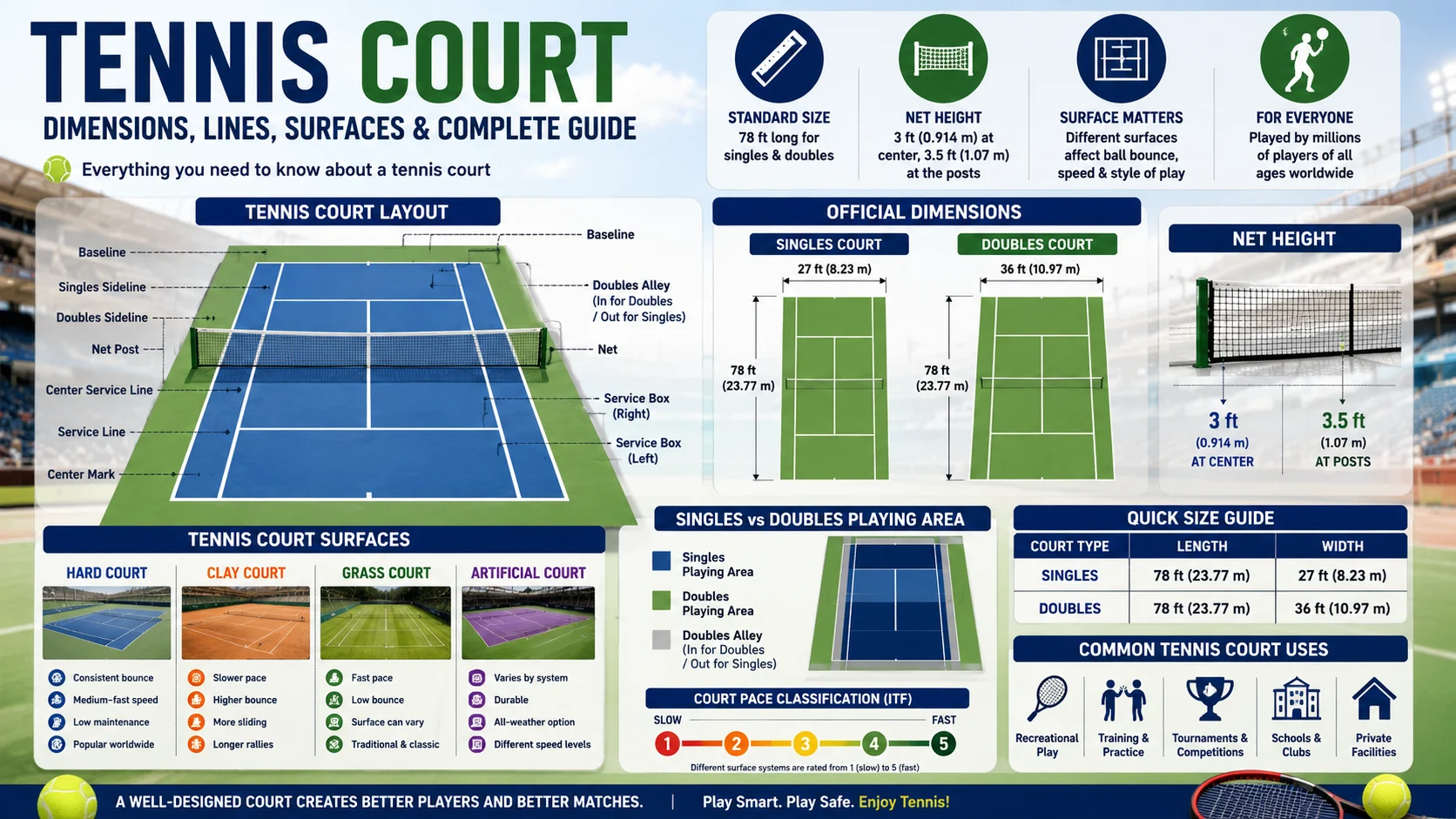
A tennis court is a rectangular playing area measuring 78 feet (23.77 m) long, with a width of 27 feet (8.23 m) for singles and 36 feet (10.97 m) for doubles. A net divides the court in half, standing 3 feet (0.914 m) high at the center and 3.5 feet (1.07 m) at the posts.
Tennis courts can be made from hard court, clay, grass, and other approved surface systems. The surface affects ball bounce, movement, traction, and the overall style of play.
What Is a Tennis Court?
A tennis court is the marked playing area where tennis is played in singles or doubles. Although every standard court follows the same basic dimensions, the experience can feel completely different depending on the surface.
The court is divided by a net and contains several lines that determine where players serve, where they can hit the ball, and whether a shot is considered in or out.
At first glance, a tennis court may look simple: a rectangle, a net, and a few white lines. But every line has a purpose.
The International Tennis Federation (ITF) establishes the international rules and technical standards governing tennis courts and the game itself.
Tennis Court Dimensions
A regulation tennis court is 78 feet long, or 23.77 meters.
The width depends on whether the match is singles or doubles.
| Court Type | Length | Width |
|---|---|---|
| Singles | 78 ft (23.77 m) | 27 ft (8.23 m) |
| Doubles | 78 ft (23.77 m) | 36 ft (10.97 m) |
The extra width in doubles comes from the doubles sidelines, which are outside the singles sidelines.
Why Is a Doubles Court Wider?
Doubles tennis has four players instead of two, so the court needs additional width to give players enough space to cover the court.
The length remains the same, but the doubles court adds 9 feet of width compared with the singles playing area.
That difference becomes especially important when players are moving toward the net or covering cross-court shots.
Tennis Court Layout Explained
Understanding the court layout makes tennis rules much easier to follow.
A standard court includes:
- Baselines
- Singles sidelines
- Doubles sidelines
- Service lines
- Center service line
- Center mark
- Net
- Service boxes
- Playing area
Each section has a specific purpose.
Baseline
The baseline is the line at the back of each side of the court.
Players generally serve from behind the baseline, and many rallies are played from around this area.
The baseline also helps define the back boundary of the court.
Singles Sideline
The singles sidelines are the narrower set of sidelines.
They mark the width of the court used during a singles match.
Doubles Sideline
The doubles sidelines are farther apart than the singles sidelines.
The area between the singles and doubles sidelines is commonly called the doubles alley.
This area is in play during doubles but out of play during singles.
Service Line
The service line runs parallel to the net on each side of the court.
It marks the back edge of the service boxes.
A legal serve must land in the appropriate service box on the opposite side.
Center Service Line
The center service line divides each side’s service area into two service boxes.
This creates the left and right targets used during serving.
Center Mark
The small center mark on each baseline helps identify the correct serving position.
It divides the baseline into two sides.
Tennis Court Net Height
The net is one of the most important parts of the tennis court.
According to the ITF specifications, the net is:
- 3.5 feet (1.07 m) high at the posts
- 3 feet (0.914 m) high at the center
The net is held down at the center by a strap, creating the characteristic slight dip players see during a match.
This difference in height matters because a player hitting over the center of the net has slightly less clearance than a shot directed closer to the net posts.
Tennis Court Surfaces
Not all tennis courts play the same.
The surface is arguably one of the biggest factors affecting how a tennis match feels.
The major traditional surfaces are:
Hard Court
Hard courts are usually constructed with a rigid base and a specialized surface coating.
They are widely used because they provide a relatively consistent playing environment and can be used for both recreational and professional tennis.
The exact speed and playing characteristics can vary depending on construction and surface system.
Clay Court
Clay courts use an unbound mineral aggregate surface.
They are associated with slower play and longer rallies because the ball generally loses more speed after bouncing compared with faster surfaces.
Clay also allows players to slide into shots, making movement technique particularly important.
The ITF recognizes clay as one of the standardized tennis surface types.
Grass Court
Grass is the traditional natural grass tennis surface.
It generally produces a faster style of tennis with a lower, more variable bounce compared with many hard and clay courts.
Grass courts also require significant maintenance because the playing surface is living turf.
Artificial and Other Surfaces
Modern tennis facilities can also use artificial clay, artificial grass, carpet, asphalt, concrete-based systems, and other surface constructions.
The ITF maintains technical classifications for different surface types and evaluates playing characteristics separately from the basic construction material.
How Court Surface Changes Tennis
The same player can look completely different on different court surfaces.
| Surface | Typical Playing Character | Movement |
|---|---|---|
| Clay | Slower, longer rallies | Sliding is common |
| Hard | Balanced and consistent | Quick changes of direction |
| Grass | Fast, lower bounce | Shorter reactions |
| Artificial | Depends on construction | Varies by system |
The ITF’s Court Pace Classification categorizes surfaces from 1 (slow) to 5 (fast), helping describe the pace characteristics of classified surface products.
This is important because saying a court is simply “hard” does not tell the entire story. Two hard courts can have noticeably different playing speeds.
Singles Court vs Doubles Court
The easiest way to remember the difference is:
Same length, different width.
A singles court is 27 feet wide, while a doubles court is 36 feet wide.
During singles, the ball must land inside the singles sidelines.
During doubles, the wider doubles sidelines become part of the playing area.
What Is the Doubles Alley?
The doubles alley is the strip between the singles sideline and doubles sideline.
It is:
- Out during singles
- In during doubles
This is one of the most common court-layout questions for new tennis players.
How Tennis Court Lines Work
Tennis lines aren’t simply decoration—they determine whether a ball is in play.
A ball landing on a boundary line is considered in, because the lines form part of the playing area they define.
This is why a shot that appears extremely close to the edge can still be legal.
Modern professional tournaments may also use electronic line-calling technology. The ITF classifies electronic line-calling systems according to accuracy, reliability, practicality, and suitability for different court settings and surfaces.
Tennis Court for Beginners
If you’re new to tennis, you don’t need to memorize every measurement immediately.
Start by understanding these five areas:
- Baseline — back boundary of each side.
- Singles sideline — singles width.
- Doubles sideline — wider doubles boundary.
- Service box — target area for a legal serve.
- Net — divides the two sides of the court.
Once these become familiar, scoring and positioning become much easier to understand.
What Makes a Good Tennis Court?
A quality tennis court is more than a correctly sized rectangle.
Important characteristics include:
- Accurate dimensions
- Consistent surface
- Proper drainage
- Good traction
- Controlled slope
- Even playing surface
- Clearly visible lines
- Correct net installation
- Adequate surrounding space
Court quality matters because small construction problems can affect ball bounce, player movement, safety, and long-term durability.
The ITF’s court recognition program considers factors such as installation quality, evenness, slope, planarity, dimensions, and court pace.
Tennis Court Construction
Building a tennis court requires careful planning.
A typical project may involve:
Site Preparation
The ground must be prepared and stabilized before the playing surface is installed.
Foundation
The foundation supports the court and helps maintain its shape and performance over time.
Drainage
Proper drainage is essential, especially for outdoor courts.
Standing water can damage surfaces and interfere with play.
Playing Surface
The selected surface system is then installed according to the requirements of that material.
Court Lines
Once the surface is ready, accurately measured playing lines are applied.
Net and Equipment
Finally, the net posts, center strap, net, and other court equipment are installed.
The exact construction process varies considerably between clay, grass, hard, and synthetic systems. The ITF publishes technical resources covering court construction and surface assessment.
How Much Space Do You Need for a Tennis Court?
The playing court itself measures 78 feet by either 27 or 36 feet, but a real tennis facility needs additional space around the court.
Players need room behind the baselines and outside the sidelines for:
- Running
- Recovering after shots
- Officials
- Ball movement
- Safety
- Spectators or equipment
Therefore, the physical footprint of a tennis facility is considerably larger than the marked playing rectangle.
This is especially important when designing a backyard or private tennis court.
Indoor vs Outdoor Tennis Courts
Tennis can be played indoors or outdoors.
Outdoor Courts
Outdoor courts provide natural conditions but are affected by:
- Sun
- Wind
- Rain
- Temperature
- Humidity
Indoor Courts
Indoor courts provide greater environmental control.
Players don’t have to deal with rain or strong wind, and facilities can maintain a more consistent playing environment.
However, indoor courts require a suitable building structure, lighting, ventilation, and additional operating costs.
How to Maintain a Tennis Court
Regular maintenance protects both the playing surface and the investment behind it.
Basic maintenance includes:
- Removing leaves and debris
- Keeping drainage systems clear
- Inspecting cracks and surface damage
- Maintaining court lines
- Checking the net and posts
- Cleaning the playing surface appropriately
- Repairing damage before it spreads
Maintenance requirements depend heavily on the court surface.
Clay, for example, requires different care from an acrylic hard court or natural grass.
Can Children Play on a Full-Size Tennis Court?
Yes, but a full-size court is not always the best starting point for young beginners.
The ITF’s Tennis Play and Stay program uses slower balls and smaller courts for children aged 10 and under, helping young players develop technique and tactics without immediately requiring them to cover a full adult court.
This is an important point for parents: younger players don’t necessarily need to start by playing the exact same game as adults.
Smaller courts can make rallies easier to sustain and help children learn movement and control more naturally.
Frequently Asked Questions
What is the official size of a tennis court?
A standard tennis court is 78 feet (23.77 m) long. It is 27 feet (8.23 m) wide for singles and 36 feet (10.97 m) wide for doubles.
How high is a tennis net?
A tennis net is 3 feet (0.914 m) high at the center and 3.5 feet (1.07 m) at the posts.
What are the 4 main types of tennis courts?
The four traditional court categories most commonly discussed are hard, clay, grass, and carpet, although modern facilities can use additional artificial and specialized surface systems. The ITF maintains a broader technical classification of surface types.
Is a tennis court bigger for doubles?
Yes. Both singles and doubles courts are 78 feet long, but a doubles court is wider: 36 feet compared with 27 feet for singles.
What is the best tennis court surface?
There is no universally “best” surface. Hard, clay, and grass courts produce different playing characteristics. The best choice depends on the player’s style, climate, budget, maintenance requirements, and intended use.
What is the fastest tennis court surface?
Court speed depends on the specific surface system rather than simply its broad category. The ITF uses a Court Pace Rating from 1 to 5, ranging from slow to fast, to classify surface products.
What is the difference between the singles and doubles lines?
The singles sidelines create the narrower 27-foot playing width. The doubles sidelines create the wider 36-foot court. The area between them is the doubles alley, which is used in doubles but not singles.
Can a tennis ball hit the line?
Yes. A ball that lands on a boundary line is considered in because the line forms part of the court it defines.
Final Thoughts
A tennis court is much more than a rectangle with a net. Its dimensions, lines, surface, net height, drainage, and construction all influence how the game is played.
The official court is 78 feet long, with a width of 27 feet for singles and 36 feet for doubles. The net is lower in the center at 3 feet, rising to 3.5 feet at the posts.
But the most interesting part is what happens underneath those measurements. A clay court can reward patience and movement, a grass court can accelerate the game, and a hard court can provide a more balanced playing experience. Surface classification itself can vary in pace, which is why two courts that look similar may play very differently.
Whether you’re learning tennis, designing a private court, choosing a facility, or simply trying to understand the game better, knowing the court’s layout gives you a much clearer picture of why tennis is played the way it is.

Daniel Brooks is a sports writer at SportsOrbitX.com, specializing in football, basketball and global sports news. He focuses on delivering accurate reporting, match analysis and timely updates that keep fans informed.