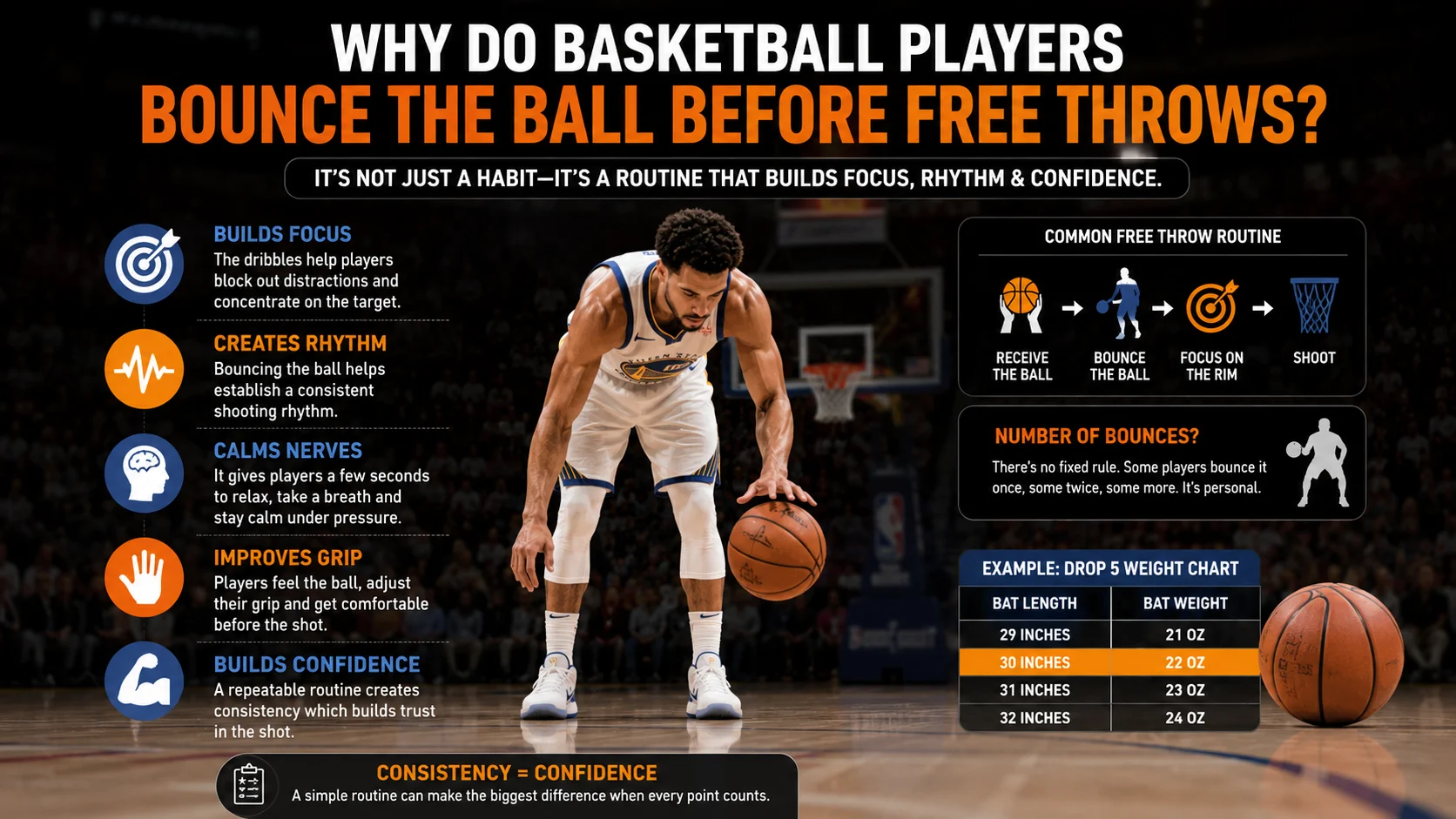
Basketball players bounce the ball before a free throw because it helps create a consistent pre-shot routine. The repeated dribbles can help a player settle their breathing, focus their attention, establish rhythm, and prepare the same way before every attempt. The number of bounces is usually a personal habit rather than a requirement of the rules.
Players bounce the ball before free throws mainly to create rhythm and focus. The routine gives them a few seconds to slow down, control their breathing, settle their nerves, and mentally prepare for the shot.
It is not the bouncing itself that makes a free throw more accurate. The value comes from making the pre-shot routine repeatable and familiar.
What Does Bouncing the Ball Before a Free Throw Do?
A free throw looks simple: stand behind the line, receive the ball, shoot.
But mentally, it can be one of the most demanding moments in basketball.
There is no defender rushing toward the shooter. There is no teammate creating a passing option. Thousands of spectators may be watching. The entire gym can suddenly feel quiet.
That is where a routine becomes useful.
When a player catches the ball and begins bouncing it, they are essentially telling themselves:
This is my routine. Slow down. Focus. Shoot.
The dribbles provide a familiar sequence between receiving the ball and releasing the shot.
1. It Creates a Consistent Routine
One of the biggest reasons basketball players bounce the ball before free throws is consistency.
Great shooters don’t want every free throw to feel completely different.
Instead, they try to repeat the same sequence:
- Receive the basketball.
- Set the feet.
- Take a breath.
- Bounce the ball.
- Focus on the target.
- Shoot.
The exact routine varies from player to player.
Some players bounce the ball twice. Others may bounce it three, four, or more times.
The important part isn’t the number.
The important part is repetition.
When the same routine is practiced hundreds or thousands of times, it becomes familiar. That familiarity can make the moment feel more controlled.
2. Bouncing Helps Players Find Their Rhythm
Shooting a basketball involves rhythm.
The legs, hips, arms, wrists, and release need to work together in a coordinated sequence.
The dribbles before a free throw can act as a small rhythmic reset.
Instead of immediately catching the ball and shooting, the player has a brief moment to establish their tempo.
Think of it like a batter’s routine before stepping into the box or a baseball pitcher preparing before delivering a pitch.
The routine doesn’t magically improve mechanics.
It helps the athlete enter the same mental and physical state before performing the skill.
3. It Helps Calm Nerves
Free throws can become especially stressful late in games.
Imagine the situation:
Your team is down by one.
There are five seconds left.
You are fouled.
You walk to the free-throw line.
Suddenly, everyone is watching.
A player who rushes the shot may allow that pressure to affect their breathing, timing, and mechanics.
Bouncing the ball gives the player a few controlled moments to slow everything down.
A player can:
- Take a breath
- Relax the shoulders
- Focus on the rim
- Ignore distractions
- Reset mentally
This is one reason experienced players often look remarkably calm at the free-throw line.
Their routine gives them something familiar to focus on.
4. It Helps With Focus
Free throws require concentration.
Unlike a normal jump shot, there is usually no immediate defensive pressure forcing the player to react.
That sounds easier but it can actually create a different kind of challenge.
The shooter has time to think.
And thinking too much can become a problem.
A player might start wondering:
“What if I miss?”
“The game is tied.”
“Everyone is watching.”
“I missed my last free throw.”
A consistent routine helps replace those thoughts with something controllable.
Bounce. Breathe. Focus. Shoot.
The goal is to keep attention on the process rather than the outcome.
5. It Gives Players Time to Set Their Breathing
Breathing is another important part of a free-throw routine.
When athletes become nervous, they may unintentionally breathe faster or tense their muscles.
That tension can interfere with a smooth shooting motion.
A few controlled bounces give the player time to settle.
A typical routine may look like:
Receive → breathe → bounce → focus → shoot
The player isn’t bouncing the ball because the basketball requires it.
They are using those seconds to prepare their body and mind.
6. It Helps Establish Proper Hand Position
There is also a practical reason for bouncing the ball.
The player has an opportunity to feel the basketball before shooting.
The hands can settle into a comfortable position, and the shooter can establish their normal grip.
This matters because consistent shooting depends partly on repeating the same setup.
A player doesn’t want to catch the ball and immediately release a free throw without establishing their normal shooting position.
The short routine creates a transition from receiving the ball to shooting the ball.
7. It Can Become Part of Muscle Memory
You’ve probably heard the phrase muscle memory in sports.
While the term is somewhat simplified, the basic idea is useful: repeated practice helps athletes perform familiar movements more automatically.
If a player uses the same free-throw routine during practice and games, the sequence becomes increasingly familiar.
For example:
Three bounces → breath → eyes on rim → shooting motion
After repeating that sequence thousands of times, it can feel natural.
The player doesn’t have to consciously plan every step.
That is especially valuable under pressure.
Is There a Specific Number of Times Players Should Bounce the Ball?
No.
There is no universal number of bounces that every basketball player should use.
One player may bounce the ball once.
Another may use three bounces.
Another might have a longer routine involving several dribbles and breaths.
The best routine is usually one that is:
- Comfortable
- Repeatable
- Not unnecessarily long
- Easy to maintain under pressure
The goal is consistency, not counting.
Why Do Some Players Bounce It 3 Times?
Three bounces are common because they provide a simple, repeatable rhythm.
For example:
Bounce 1 → settle
Bounce 2 → breathe
Bounce 3 → focus
Shoot
But this is not a basketball requirement.
A player who prefers two bounces can use two. A player who prefers four can use four.
What matters is that the routine doesn’t become so long or complicated that it interferes with the shot.
Does Bouncing the Ball Actually Make Free Throws More Accurate?
Indirectly, it can help but the bounce itself doesn’t improve shooting accuracy.
There is nothing about the basketball hitting the floor that makes the next shot more accurate.
The benefit comes from what the routine can accomplish:
- Better concentration
- Reduced rushing
- Consistent timing
- More controlled breathing
- Familiar preparation
- Improved confidence
The actual free throw still depends on shooting fundamentals such as:
- Foot positioning
- Balance
- Shooting alignment
- Elbow position
- Release
- Follow-through
- Practice
So the dribble is best understood as a mental and physical preparation tool, not a secret shooting technique.
Why Don’t Players Just Catch the Ball and Shoot?
They could.
A player isn’t required to bounce the basketball a certain number of times before taking a free throw.
But immediately shooting can remove an important preparation step.
Imagine a golfer standing over a putt without taking a moment to settle.
Or a baseball pitcher rushing through their normal delivery.
Athletes often use routines because routines reduce unnecessary variation.
The free throw is no different.
A short routine helps the player transition from game mode into shooting mode.
Do All Basketball Players Have the Same Free-Throw Routine?
Definitely not.
This is one of the interesting things about free throws.
Watch different players and you’ll notice that their routines can be completely different.
Some:
- Bounce the ball several times.
- Spin it before shooting.
- Take a deep breath.
- Look at the rim for several seconds.
- Adjust their feet.
- Use a short verbal cue.
- Perform a combination of these actions.
The routine becomes part of the player’s individual shooting identity.
What Happens If a Player Changes Their Routine?
Changing a free-throw routine isn’t necessarily bad, but it can temporarily feel uncomfortable.
A player who has practiced one sequence thousands of times has developed familiarity with that process.
If they suddenly change from:
Three bounces → shoot
to:
One bounce → pause → shoot
the new sequence may initially feel strange.
That’s why players should practice their routine not just their actual shots.
The objective is to make the entire sequence automatic and comfortable.
Why Free-Throw Routines Matter More Under Pressure
A routine becomes especially valuable when the stakes are high.
During a normal practice session, missing a free throw isn’t a big deal.
During the final minute of a close game, the same shot can feel completely different.
Pressure can cause athletes to:
- Rush
- Overthink
- Tighten their muscles
- Change their mechanics
- Lose concentration
A familiar routine gives the player something they can control.
They cannot control the crowd.
They cannot control the scoreboard.
They cannot control whether the defender is talking.
But they can control their breathing, routine, focus, and shooting mechanics.
That’s why free-throw routines are more than superstition for many players.
Is Bouncing the Ball Before a Free Throw a Habit or a Strategy?
It can be both.
For some players, it begins as a simple habit.
Over time, that habit becomes a deliberate pre-shot strategy.
The player learns:
“When I do this routine, I’m ready to shoot.”
That psychological connection can be powerful.
The routine becomes a signal that tells the brain to transition into a familiar performance state.
Common Free-Throw Routine Mistakes
A routine is helpful only when it remains simple.
Making the Routine Too Long
A complicated routine can become distracting.
Changing It Constantly
Using a different routine every game makes it harder to develop consistency.
Focusing on the Crowd
The routine should help the player block out distractions rather than pay attention to them.
Thinking About the Result
Thinking “I have to make this” can create unnecessary pressure.
It’s usually better to focus on the process:
Routine → target → mechanics → release
The Ideal Free-Throw Routine
There isn’t one perfect routine for every player, but a simple sequence can work well:
Step 1: Get Comfortable
Place the feet in the normal shooting position.
Step 2: Take a Breath
Relax the shoulders and slow the breathing.
Step 3: Bounce the Ball
Use the player’s preferred number of dribbles.
Step 4: Find the Target
Focus on the intended target on the rim.
Step 5: Shoot
Use the same mechanics practiced in training.
Step 6: Hold the Follow-Through
Don’t immediately look away after releasing the basketball.
The entire process should feel natural rather than forced.
Frequently Asked Questions
Why do basketball players bounce the ball before free throws?
Players bounce the ball to establish a consistent routine, settle their nerves, focus their attention, control their breathing, and prepare for the shot.
How many times should you bounce the ball before a free throw?
There is no required number. Players commonly use different routines, and consistency matters more than the exact number of bounces.
Does bouncing the ball help you make free throws?
The bouncing itself doesn’t improve accuracy. However, a consistent routine can help a player stay calm, focused, and mechanically consistent.
Is bouncing the ball before a free throw a rule?
No. Players are not required to bounce the ball a specific number of times before shooting a free throw.
Why do NBA players have different free-throw routines?
Free-throw routines are personal. Players develop routines that help them feel comfortable, focused, and consistent before shooting.
Can beginners use a free-throw routine?
Yes. Developing a simple routine early can help young players learn to approach every free throw consistently.
What is the best free-throw routine?
There is no single best routine. A good routine is short, repeatable, comfortable, and helps the shooter focus on the shot instead of the pressure surrounding it.
Final Thoughts
So, why do basketball players bounce the ball before free throws?
Because those few dribbles are about much more than bouncing a basketball.
They create a repeatable pre-shot routine that can help the player slow down, control breathing, establish rhythm, focus on the target, and block out distractions.
The number of bounces isn’t the important part. One player may bounce twice, another three times, and another may use a completely different routine.
What matters is consistency.
A free throw is one of the rare moments in basketball where the player has complete control over the timing of the shot. A good routine takes advantage of that moment.
Bounce. Breathe. Focus. Shoot.
That’s why something as simple as bouncing the ball has become such a recognizable part of basketball’s most pressure-filled shot.