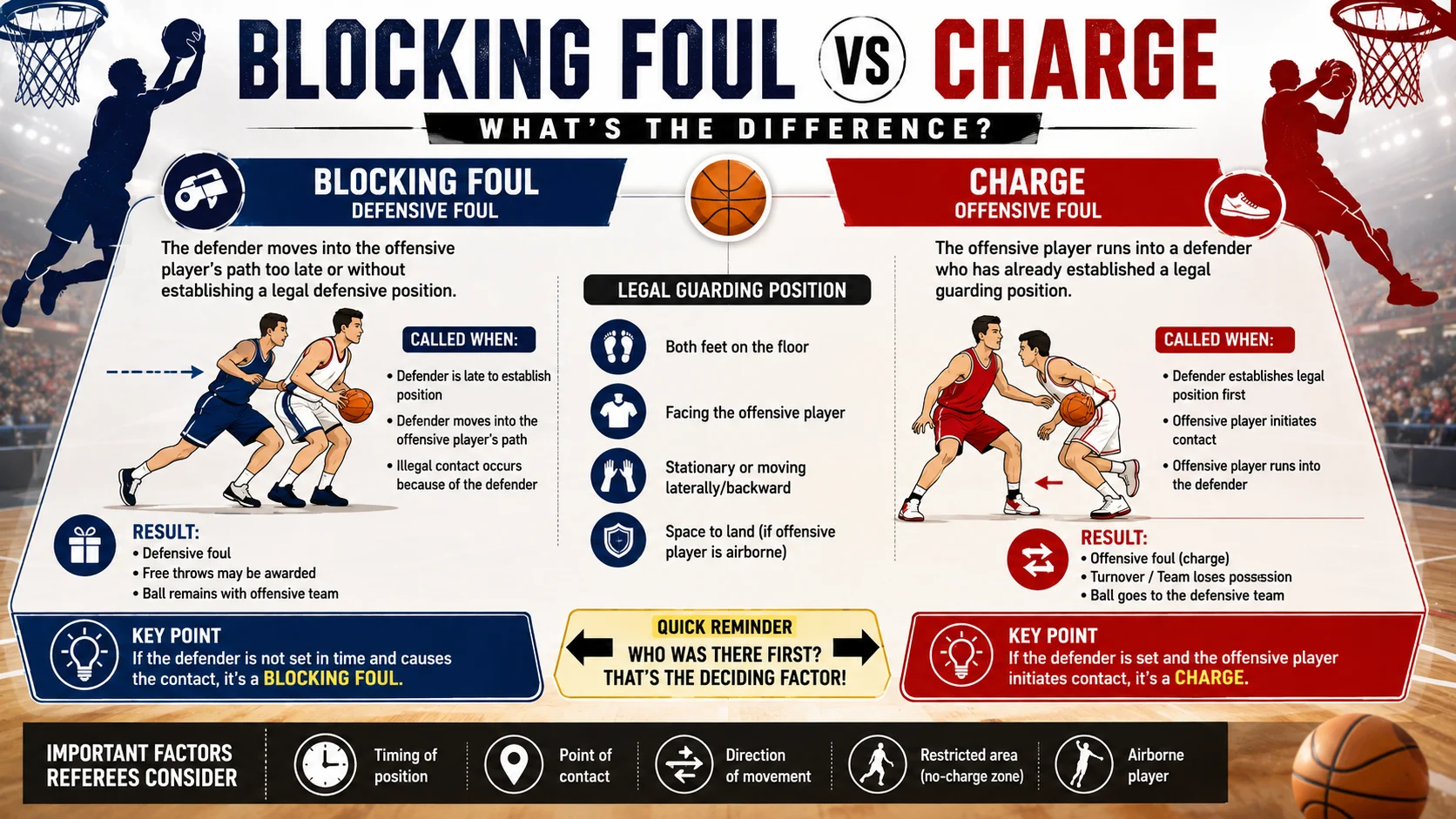
A blocking foul is usually called on the defender when they fail to establish a legal defensive position before contact. A charge is an offensive foul that occurs when the ball-handler illegally moves into a defender who has already established legal guarding position. The key question is simple: Who was responsible for the illegal contact?
Blocking Foul vs Charge
The easiest way to remember the difference is:
Defender moves into the offensive player’s path too late → Blocking foul.
Offensive player runs into a defender who legally established position → Charge.
| Blocking Foul | Charge |
|---|---|
| Defensive foul | Offensive foul |
| Defender is responsible for illegal contact | Offensive player is responsible |
| Defender fails to establish legal guarding position in time | Defender establishes legal position before contact |
| Usually benefits the offense | Usually benefits the defense |
| May result in free throws depending on the situation | Usually results in a turnover/team-control foul |
| Often occurs when a defender slides into the path late | Often occurs when a ball-handler drives through a set defender |
But there’s an important catch: not every collision is automatically a block or a charge. Referees have to consider position, timing, direction of movement, the restricted/no-charge area, and where the contact occurs.
What Is a Blocking Foul?
A blocking foul occurs when a defensive player illegally impedes an opponent’s progress.
Under FIBA’s rules, blocking is defined as illegal personal contact that impedes an opponent, with or without the ball.
In a typical block-charge play, imagine a guard driving toward the basket.
The defender sees the drive and tries to step in front of the ball-handler. If the defender gets there too late and has not established a legal guarding position before contact, the defender can be called for a blocking foul.
Simple Example
A guard drives from the wing toward the basket.
The defender is several steps away.
The defender suddenly slides across the lane and gets in front of the guard just before impact.
Collision happens → defender wasn’t legally established in time → blocking foul.
That’s the basic idea.
What Is a Charge?
A charge is an offensive foul.
It occurs when an offensive player creates illegal contact with a defender who has established a legal guarding position.
Under FIBA’s rules, charging is illegal personal contact, with or without the ball, caused by pushing or moving into an opponent’s torso.
Simple Example
A player drives hard toward the basket.
The defender gets into position early, faces the ball-handler, and establishes a legal guarding position.
The offensive player continues into the defender and makes significant contact with the defender’s torso.
Offensive player creates the illegal contact → charge.
The defense has successfully taken the offensive player’s driving lane away.
The Biggest Difference Between a Block and a Charge
The biggest factor is legal defensive positioning before the contact occurs.
It’s not simply:
“Who fell down?”
And it’s not:
“Who was moving faster?”
Referees have to determine whether the defender was legally positioned and whether the offensive player was responsible for the contact.
FIBA’s charge/block principles require the defender to establish an initial legal guarding position by facing the player with the ball and having both feet on the court. Once established, the defender may remain stationary, jump vertically, or move laterally or backward to maintain that position.
That’s why a defender can still be moving and draw a charge.
The defender does not necessarily have to stand completely still.
What Is a Legal Guarding Position?
This is one of the most important concepts in understanding blocking fouls and charges.
A defender generally needs to establish a legal guarding position before the contact occurs.
In FIBA basketball, the defender must initially face the opponent with the ball and have both feet on the court. After establishing that position, the defender can maintain it by staying still, moving laterally, moving backward, or jumping vertically.
Think of It Like This
Defender gets there first + establishes legal position + offensive player creates torso contact = charge.
Offensive player has already committed to the path + defender moves into that path too late = block.
This is why timing is so important.
Block vs Charge: The “Beat Him to the Spot” Rule
You may hear coaches or commentators say:
“The defender beat him to the spot.”
That’s a simple way of describing a successful charge-taking position.
The defender doesn’t necessarily need to predict the entire drive. They need to establish a legal guarding position before the relevant contact occurs.
The NBA’s official explanation similarly emphasizes that the defender must establish legal guarding position before contact.
So when watching a replay, don’t just look at the collision.
Watch what happened immediately before it.
That’s often where the real answer is.
Blocking Foul vs Charge in the Restricted Area
This is where the block-charge decision gets much more complicated.
The restricted area is the semicircular area underneath the basket used to limit certain charge calls against secondary defenders.
In the NBA, a secondary defender generally cannot establish a legal guarding position inside the restricted area to draw a charge when the offensive player receives the ball outside the lower defensive box, subject to exceptions.
FIBA uses a no-charge semi-circle under the basket and has its own specific exceptions.
Why Does the Restricted Area Exist?
Without this rule, defenders could simply stand directly underneath the basket and wait for driving players to crash into them.
That would make driving lanes extremely difficult to attack.
The restricted/no-charge area gives offensive players some protection when attacking the rim while still allowing legitimate defensive plays.
Does Standing Inside the Restricted Area Always Mean It’s a Blocking Foul?
No.
This is a common misunderstanding.
The restricted area does not mean:
“Defender’s feet are inside the arc = automatic block.”
There are exceptions.
For example, the NBA explains that a secondary defender inside the restricted area can still make a legal defensive play when jumping vertically to defend a shot.
FIBA also has exceptions to its no-charge semi-circle rule, including certain situations involving where possession was established and how the play developed.
That’s why simply looking at a defender’s feet isn’t always enough.
What About Verticality?
Verticality is another major factor.
A defender has the right to occupy their vertical space and jump vertically to contest a shot.
If the defender jumps straight upward and the offensive player creates the contact, the defender may still be legal even in situations near the restricted area.
The NBA specifically notes that a defender inside the restricted area can make a legal vertical defensive play if they jump straight up rather than moving into the offensive player.
Illegal Example
Defender jumps forward into the offensive player.
Potentially Legal Example
Defender jumps straight upward while maintaining vertical alignment.
That distinction can completely change the call.
What If the Offensive Player Is Already in the Air?
This is another situation that can confuse viewers.
An airborne offensive player needs appropriate space to land.
The NBA rules specifically state that defenders must allow an airborne offensive player space to land in relevant block-charge situations.
So a defender cannot simply slide underneath an airborne player at the last moment and expect to draw a charge.
The timing and location of the defender’s position matter.
Why Some Block-Charge Calls Look Wrong on TV
This is where slow-motion replay can be misleading.
Basketball happens incredibly quickly.
A defender may appear stationary in one camera angle but actually be moving into the offensive player’s path.
Likewise, an offensive player may appear to have simply “run over” the defender when the defender was actually still establishing position.
Officials must evaluate:
- Who initiated the contact?
- Where was the defender?
- Was the defender legally positioned?
- When was that position established?
- Was the defender moving toward the offensive player?
- Where did the contact occur?
- Was the defender inside a restricted/no-charge area?
- Was the offensive player already airborne?
- Was the contact on the torso or elsewhere?
That’s why block-charge decisions can be among the most debated calls in basketball.
What Part of the Body Matters?
The location of the contact can matter significantly.
Under FIBA’s charge/block principles, contact involving the defender’s torso is particularly important when determining whether the defender established legal position and was at the place of contact first.
But this doesn’t mean:
“Chest contact = automatic charge.”
Other factors still matter.
An offensive player cannot simply create illegal contact with a knee, leg, arm, or other body part and expect the defender to be penalized.
FIBA specifically recognizes situations where an offensive player extends a leg or otherwise leaves their normal cylinder and creates contact.
Blocking Foul vs Charge: Real-World Examples
Example 1: Defender Arrives Late
The ball-handler drives right.
The defender sees the drive and quickly steps across the lane.
Contact occurs immediately.
The defender wasn’t legally established before the contact.
Call: Blocking foul.
Example 2: Defender Sets Up Early
The defender anticipates the drive, establishes legal position, and faces the ball-handler.
The offensive player continues driving and makes torso contact.
Call: Charge/offensive foul.
Example 3: Defender Slides Backward
The defender has already established legal guarding position and moves backward to maintain it.
The offensive player continues forward and makes illegal contact.
Potential call: Charge.
A defender doesn’t necessarily have to freeze like a statue.
Example 4: Defender Slides Into the Driver
The offensive player has already committed to the driving path.
The defender moves directly forward into the offensive player’s path and creates the contact.
Potential call: Blocking foul.
The exact ruling depends on the applicable league rules and the full play.
How to Tell a Block or Charge While Watching Basketball
Want to make the call yourself before the referee does?
Use this 5-question test:
1. Who was moving toward whom?
Look at the direction of movement immediately before contact.
2. Did the defender establish position first?
This is one of the biggest questions.
3. Was the defender moving forward, sideways, or backward?
Lateral and backward movement can be legal when maintaining an established guarding position under FIBA rules.
4. Where did the contact happen?
Torso, arm, leg, hip, and other contact points can affect the interpretation.
5. Was the defender in the restricted/no-charge area?
If yes, special rules may apply.
If you answer those five questions, most block-charge plays become much easier to understand.
NBA vs FIBA: Are the Rules Exactly the Same?
No.
This is important if you’re reading basketball content online.
FIBA states that its official rules are the international standard, but its rules can differ from NBA, WNBA, and NCAA rules.
The basic concept remains similar:
Legal defender + offensive player creates illegal contact = charge.
Defender illegally impedes the offensive player = block.
But details involving restricted areas, defensive positioning, lower defensive boxes, and specific exceptions can differ between competitions.
So always check the rules for the league you’re watching or playing in.
Who Gets the Ball After a Blocking Foul?
The exact penalty depends on the situation, including whether the offensive player was shooting and whether the defending team is in the penalty.
A defensive blocking foul can result in:
- Free throws
- A throw-in
- Continuation of a shooting play
- Other penalties depending on the circumstances
The important point is that a blocking foul is a defensive personal foul.
Who Gets the Ball After a Charge?
A charge is an offensive foul.
In a typical team-control situation, the offensive team loses possession and the defense receives the ball.
The key difference is that the offensive player’s team is penalized for creating the illegal contact.
That’s why drawing a charge can be such a valuable defensive play: the defender can turn an aggressive offensive drive into a turnover.
Why Do Players Take Charges?
Taking a charge is one of the most physically demanding defensive plays in basketball.
A defender essentially says:
“I’m going to get into position and absorb this contact legally.”
A successful charge can:
- Stop a scoring opportunity
- Force a turnover
- Change momentum
- Energize the defense
- Get an opponent into foul trouble
But smart defenders don’t simply throw themselves in front of every driver. Positioning, timing, anticipation, and awareness are critical.
Blocking Foul vs Charge: The Easiest Way to Remember
Here’s the simplest memory trick:
BLOCK
The defender gets in the way illegally.
CHARGE
The offensive player runs into a legally positioned defender.
Or remember:
Late defender = block.
Legal defender established first = charge.
There are exceptions, especially around the restricted/no-charge area, so this isn’t a substitute for the complete rulebook but it’s an excellent starting point.
Frequently Asked Questions
Is a block a defensive foul?
Yes. A blocking foul is generally a defensive personal foul caused by the defender illegally impeding an opponent’s progress.
Is a charge an offensive foul?
Yes. A charge is an offensive foul in which the offensive player creates illegal contact with a legally positioned defender.
Does the defender have to be completely stationary to draw a charge?
No. Under FIBA principles, after establishing an initial legal guarding position, a defender can remain stationary, move laterally or backward, or jump vertically while maintaining that position.
Can you take a charge in the restricted area?
It depends on the league and the specific circumstances. Special no-charge/restricted-area rules can prevent certain charge calls, although exceptions exist.
Is every collision between a driver and defender a foul?
No. Officials must determine whether the contact is illegal, who caused it, and whether the players were legally positioned. Incidental or negligible contact does not automatically mean a foul.
Can a defender move while taking a charge?
Yes, depending on the direction and circumstances. Moving laterally or backward while maintaining an established legal guarding position can be permitted under FIBA rules. Moving toward the offensive player can make the defender responsible for the contact.
Why is a charge called an offensive foul?
Because the offensive player is judged to have created illegal contact with the defender rather than the defender illegally impeding the offensive player.
Final Verdict
The difference between a blocking foul and a charge comes down to one central question:
Who was responsible for the illegal contact?
If the defender fails to establish a legal guarding position and illegally impedes the offensive player’s path, the result is generally a blocking foul.
If the defender establishes a legal position first and the offensive player then creates illegal contact, the result is generally a charge.
But don’t judge the play solely by the collision. The referee must consider timing, positioning, movement, contact location, verticality, and the restricted/no-charge area. NBA and FIBA rules also contain important differences, so the exact ruling can depend on the competition.
The one-line rule to remember:
Block = defender is responsible. Charge = offensive player is responsible.
Once you start watching who established position first rather than simply who knocked whom over, those controversial block-versus-charge calls become much easier to understand.