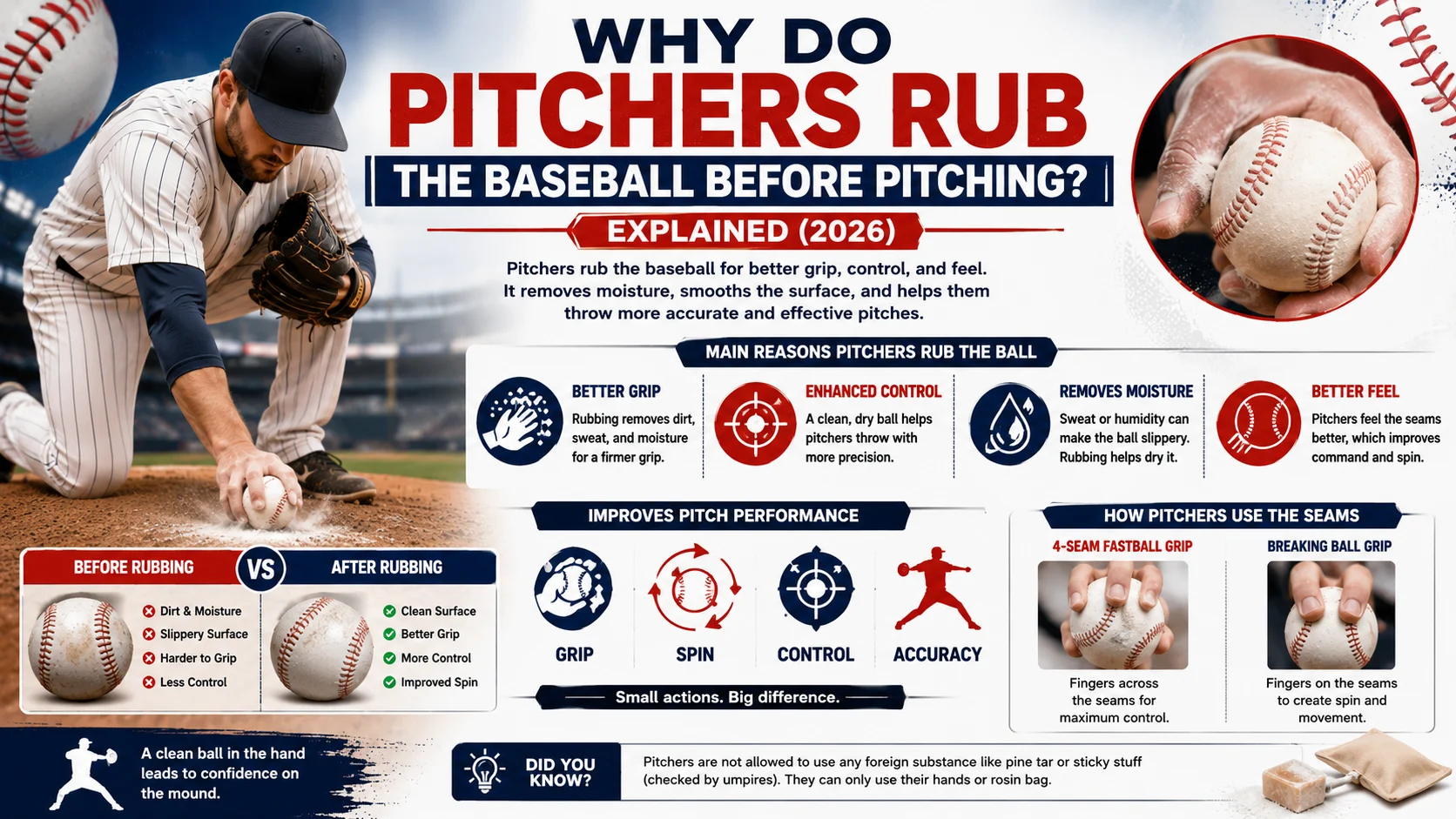
Quick Answer: Pitchers rub the baseball before pitching primarily to remove the factory-applied shine and slickness from a new ball, improving their grip and control. At the professional level, every new baseball is also treated beforehand with a specialized product called Lena Blackburne Baseball Rubbing Mud, a step required by official MLB rules before any ball can be used in a game.
Every single baseball used in a Major League game passes through the hands of one man’s century-old family recipe before it ever reaches the pitcher’s mound. That’s not an exaggeration or a quirky bit of trivia, it’s an actual MLB rule, and it explains why you’ll see a pitcher rolling a brand-new ball between his palms before nearly every single pitch of the season, from spring training through the World Series.
This guide explains exactly why do pitchers rub the baseball before pitching, the surprising history behind MLB’s official rubbing mud, and the strict rules governing what pitchers are and aren’t allowed to do to the ball during a game.
The Basic Reason: New Baseballs Are Too Slick
Brand-new baseballs, straight from the factory, have a notably smooth, glossy surface that makes them genuinely difficult to grip securely during a game. This slickness creates a real safety concern, since a pitcher who can’t properly control the ball is considerably more likely to lose command of a pitch, increasing the risk of hitting a batter or bouncing a wild pitch past the catcher. Rubbing the ball, either between the palms or against a treated glove, roughs up this glossy surface just enough to create the friction needed for a secure, controlled grip without damaging or noticeably altering the ball’s overall shape or weight.
MLB’s Secret Weapon: Lena Blackburne Baseball Rubbing Mud
At the professional level, this process goes well beyond simply rubbing a ball between bare hands before a game. Every single baseball used in an MLB game is required to be treated beforehand with Lena Blackburne Baseball Rubbing Mud, a specially prepared mud product that has been the official standard since the 1930s. According to MLB rules, every new “pearl,” the term used for a fresh baseball, must be rubbed with this mud for at least 30 seconds until it reaches the desired texture and slightly off-white color before ever entering game play. A 2024 scientific study examining the mud’s composition found it contains an ideal mixture of clay and water that coats the ball with an adhesive residue, while suspended sand grains within the mixture enhance friction and meaningfully improve a pitcher’s grip on the surface.
Where Does This Mud Actually Come From?
The mud’s origin traces back to a specific, still-secret location along a tributary of the Delaware River in South Jersey, first discovered and marketed by Lena Blackburne, a former MLB player and coach, in the 1930s. The exact harvesting location has remained a closely guarded family secret for nearly a century, passed down through subsequent owners of the Lena Blackburne Baseball Rubbing Mud company across multiple generations. This single source has supplied the mud used to prep baseballs across the entire MLB, making it one of the more unusual, low-tech monopolies in professional sports, with no widely recognized substitute product ever gaining comparable acceptance at the game’s highest level of competition.
What Pitchers Are Legally Allowed to Do
Beyond the pre-treated mud application, official MLB rules place strict limits on what a pitcher is personally allowed to do to the ball during a game. A pitcher is permitted to rub the ball between his bare hands but cannot spit on the ball, his hands, or his glove at any point during play. Pitchers are also prohibited from rubbing the ball against their uniform, glove, or any body part other than their bare hands, and cannot pitch while wearing an attachment such as tape, a bandage, or a bracelet on either hand or wrist. Additionally, while in contact with the pitching rubber, a pitcher cannot touch his mouth or lips at all, and must fully dry his hand before touching the ball again if he does so elsewhere on the mound.
The History of “Doctoring” the Ball
The strict rules governing ball rubbing exist largely because of baseball’s long, colorful history of pitchers attempting to illegally alter the ball for a competitive advantage, a practice known as “doctoring” the baseball. The most famous example is the spitball, which reportedly originated by accident in 1902 when a group of outfielders spitting on balls as a joke discovered that a significant amount of saliva applied to the ball created an unpredictable, difficult-to-hit flight path. The technique spread quickly through the majors by 1908, with pitcher Ed Walsh famously winning 40 games in a single season partly thanks to his mastery of the spitball, before the pitch was eventually banned as the league moved to legislate against increasingly creative methods of altering the ball’s surface and flight characteristics.
Why Ball Rubbing Matters for Player Safety
Beyond simple grip and performance, MLB’s rules around ball preparation and rubbing exist specifically to protect player safety on both sides of the plate. A pitcher with a secure, well-controlled grip is significantly less likely to lose command of a pitch in a way that could seriously injure a batter, making the entire ball-treatment process as much a safety measure as a competitive one. This is also why umpires frequently swap out baseballs throughout a game, even mid-at-bat, ensuring pitchers always have access to a properly treated ball rather than being forced to use one that has become excessively worn, scuffed, or otherwise compromised during play.
The Science Behind Grip and Ball Movement
Beyond simply preventing a ball from slipping out of a pitcher’s hand, the surface texture created by rubbing directly influences how a ball moves once it leaves the pitcher’s fingers. A properly gripped baseball allows a pitcher to apply precise, consistent spin, which is the fundamental mechanism behind every type of pitch movement, from a fastball’s slight rise to a curveball’s dramatic downward break. Even minor inconsistencies in grip, caused by an improperly treated or overly slick ball, can meaningfully affect a pitch’s spin rate and resulting trajectory, explaining why professional pitchers are often notably particular about ball feel and will request a replacement if a ball doesn’t feel adequately prepared during a game.
How Youth and Amateur Baseball Handle Ball Preparation
While MLB’s official mud treatment process is standardized and rule-mandated, youth and amateur baseball leagues generally take a far less formal approach to preparing new baseballs for play. Coaches at these levels often simply have players rub new balls between their hands before a game or practice, without access to specialized rubbing mud products used at the professional level. Some more dedicated youth programs and travel teams have begun sourcing consumer versions of baseball rubbing mud, recognizing that even at lower levels of competition, a properly prepared ball can meaningfully improve a young pitcher’s grip, control, and overall confidence on the mound during games.
Notable Moments Involving Ball Doctoring Controversies
Baseball’s history includes several high-profile controversies involving pitchers accused of illegally altering the baseball beyond standard rubbing and grip preparation. These incidents have periodically prompted MLB to tighten enforcement and increase scrutiny of foreign substances on the mound, particularly following concerns in recent years about pitchers using enhanced grip substances that also increase spin rate beyond what natural ball preparation alone could achieve. This ongoing tension between legitimate grip improvement and illegal performance enhancement remains one of the more actively debated rules enforcement issues in modern professional baseball, with periodic rule clarifications and stricter mound inspections introduced specifically to address it.
Frequently Asked Questions
Why do pitchers rub the baseball before pitching? Pitchers rub the baseball primarily to remove its factory-applied slickness, improving grip and control, which also reduces the risk of an errant, dangerous pitch.
What is Lena Blackburne Baseball Rubbing Mud? It’s a specially prepared mud product that MLB requires every new baseball to be treated with before use in a game, reducing shine and improving pitcher grip since the 1930s.
Can pitchers legally spit on the baseball? No, pitchers are prohibited from spitting on the ball, their hands, or their glove at any point during play under official MLB rules.
What happens if a pitcher illegally doctors the baseball? Intentionally damaging, defacing, or discoloring the baseball with a foreign substance results in ejection and an automatic 10-game suspension under current MLB rules.
Where does MLB’s official baseball rubbing mud come from? The mud is harvested from a still-secret location along a tributary of the Delaware River in South Jersey, a source that has remained undisclosed for nearly a century.
Is the spitball still legal in baseball today? No, the spitball was banned after being widely used in the early 1900s, following growing concern about pitchers gaining an unfair, difficult-to-defend advantage.
Do youth and amateur leagues use the same rubbing mud as MLB? Not typically. Most youth leagues rely on simple hand-rubbing without specialized products, though some dedicated travel teams have started sourcing consumer versions of baseball rubbing mud.
How does grip affect a pitch’s movement, not just control? A properly gripped baseball allows a pitcher to apply consistent spin, the fundamental mechanism behind pitch movement, meaning even minor grip inconsistencies can noticeably affect a pitch’s trajectory.
Conclusion
So, why do pitchers rub the baseball before pitching? What looks like a simple, almost absent-minded habit is actually the final step in a surprisingly specific, century-old process involving secret family mud recipes, strict safety-driven rules, and a long history of pitchers pushing those rules to their limit through doctoring controversies.
Understanding this ritual, and the genuine science behind grip and pitch movement, makes it much easier to appreciate just how much preparation goes into something as seemingly small as the ball itself before a single pitch is ever thrown. Want to explore more baseball equipment and traditions? Check out our guide on Why Do Baseball Players Wear Eye Black for another pre-game ritual worth understanding.

Daniel Brooks is a sports writer at SportsOrbitX.com, specializing in football, basketball and global sports news. He focuses on delivering accurate reporting, match analysis and timely updates that keep fans informed.