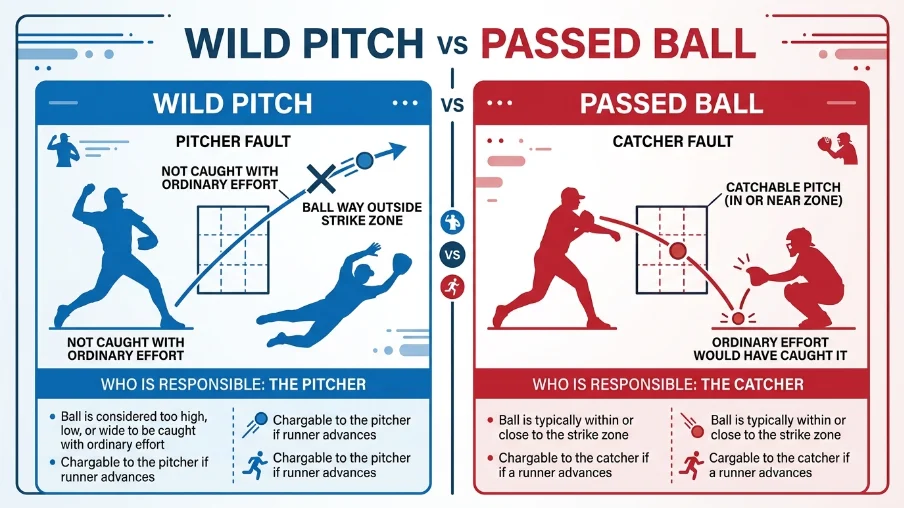
A passed ball occurs when a catcher fails to stop a pitch that should have been caught with ordinary effort, allowing runners to advance. A wild pitch is a pitch that is too high, low, or wide for the catcher to reasonably handle, even with a good effort. The official scorer decides whether the responsibility belongs to the catcher (passed ball) or the pitcher (wild pitch).
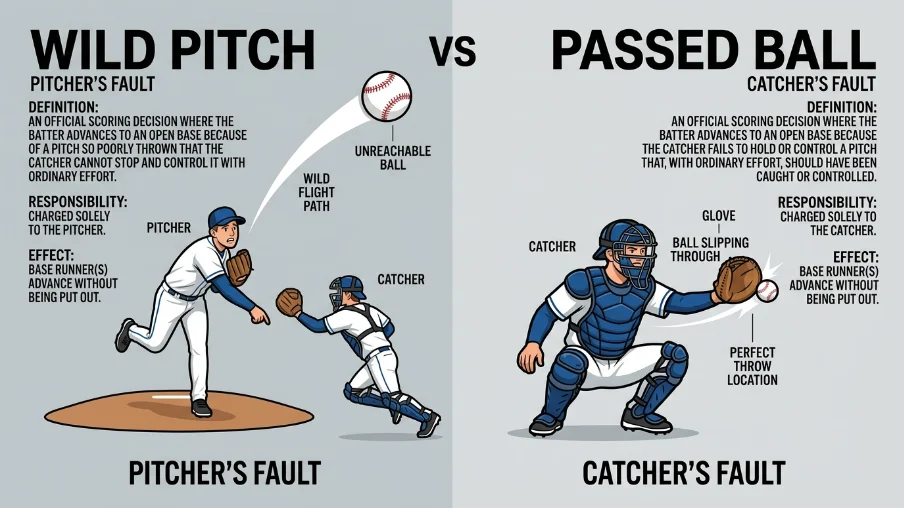
The easiest way to remember the difference is:
- Passed Ball (PB): The catcher should have stopped the pitch but didn’t.
- Wild pitch (WP): The pitcher threw a pitch that was too difficult for the catcher to control.
Although both allow runners to advance, they are charged to different players and recorded differently in the official scorebook.
Passed Ball vs Wild Pitch at a Glance
| Feature | Passed Ball | Wild Pitch |
|---|---|---|
| Responsibility | Catcher | Pitcher |
| Cause | Missed catchable pitch | Uncatchable pitch |
| Charged To | Catcher | Pitcher |
| Runner Can Advance | Yes | Yes |
| Counts as Error? | No official fielding error, but charged as Passed Ball | No |
| Official Abbreviation | PB | WP |
| Common Situation | Ball slips through catcher’s glove | Pitch bounces or sails far outside strike zone |
Why People Confuse Passed Balls and Wild Pitches
To many fans, both plays look almost identical.
The catcher misses the ball.
The baseball rolls away.
Runners advance.
The crowd reacts.
Because the outcome appears the same, many people assume they’re scored the same way. In reality, Major League Baseball’s Official Scoring Rules make a clear distinction based on one key question:
Should the catcher have been expected to stop the pitch with ordinary effort?
If the answer is yes, it’s a passed ball.
If the answer is no, it’s a wild pitch.
This single judgment determines which player is held responsible.
What Is a Passed Ball?
A passed ball occurs when a catcher fails to catch or block a pitch that could reasonably have been handled with ordinary effort, allowing one or more runners to advance.
In simple terms:
The pitcher made an acceptable pitch.
The catcher failed to secure it.
The responsibility belongs to the catcher.
Official Definition
A passed ball is charged when the catcher fails to control a legally pitched ball that should have been caught or blocked using ordinary skill and effort.
The emphasis is on ordinary effort, not spectacular defensive plays.
Example of a Passed Ball
Imagine this situation:
- Runner on third base
- Two outs
- Pitch is a normal fastball down the middle
- The catcher lets the ball slip through the glove
- The runner scores
Because the pitch was catchable, the official scorer records:
Passed Ball (PB)
The run still counts unless another rule applies, but the responsibility for the missed pitch falls on the catcher.
Common Causes of Passed Balls
Passed balls often result from:
- Poor glove positioning
- Losing sight of the baseball
- Slow reaction time
- Incorrect blocking technique
- Taking the pitch for granted
- Equipment mishandling
Even professional catchers occasionally allow passed balls, especially during long games or when catching pitchers with exceptional movement.
What Is a Wild Pitch?
A wild pitch occurs when a pitcher throws a ball that is too difficult for the catcher to stop with ordinary effort.
Unlike a passed ball, the catcher may do everything correctly and still be unable to prevent runners from advancing.
The responsibility belongs to the pitcher because the pitch itself created the problem.
Official Definition
A wild pitch is charged when a legally delivered pitch is so high, low, wide, or otherwise difficult that the catcher cannot reasonably control it with ordinary effort.
The scorer evaluates whether an average Major League catcher would have been expected to stop the pitch.
If not, it’s ruled a wild pitch.
Example of a Wild Pitch
Consider this scenario:
- Runner on second base
- Pitch bounces several feet before reaching home plate
- The ball skips past the catcher despite a diving attempt
- The runner advances to third
Because the pitch was not reasonably catchable, the official scorer records:
Wild Pitch (WP)
The catcher is not blamed for the advance.
Common Causes of Wild Pitches
Wild pitches often happen because of:
- Breaking balls with excessive movement
- Sliders that break sharply into the dirt
- Curveballs thrown too low
- Splitters diving unexpectedly
- Fastballs sailing high
- Loss of grip in wet conditions
- Miscommunication on pitch selection
Pitchers who rely on high-velocity or high-spin pitches sometimes record more wild pitches due to the increased movement.
The Biggest Difference Between a Passed Ball and a Wild Pitch
The difference comes down to one simple question:
Could the catcher reasonably have stopped the pitch?
If yes, it’s a passed ball.
If no, it’s a wild pitch.
Everything else the runner advancing, the ball getting away, or even a run scoring—is secondary.
Think of It This Way
Imagine two pitches:
Situation One
The pitcher throws a fastball directly into the catcher’s glove.
The catcher drops it.
That’s a Passed Ball.
Situation Two
The pitcher throws a curveball that bounces three feet in front of home plate and kicks sideways.
The catcher dives but cannot stop it.
That’s a Wild Pitch.
Who Gets Charged?
One of the most important scoring differences involves responsibility.
| Situation | Charged To |
|---|---|
| Passed Ball | Catcher |
| Wild Pitch | Pitcher |
Neither is recorded as a standard defensive error, but both become part of the player’s season statistics.
For catchers, passed balls are tracked as a defensive statistic.
For pitchers, wild pitches are tracked alongside walks, strikeouts, and hit batters.
How Official Scorers Make the Decision
Official scorers do not rely solely on where the ball ends up.
Instead, they evaluate several factors:
Pitch Location
Was the pitch close enough for a catcher to block?
Pitch Movement
Did the baseball break sharply at the last moment?
Catcher’s Position
Was the catcher set up correctly before receiving the pitch?
Difficulty of the Play
Would an average professional catcher normally stop the ball?
Weather and Field Conditions
Rain, mud, poor visibility, or unusual bounces may also influence the judgment.
Ultimately, the scorer uses experience and MLB scoring guidelines to decide whether responsibility belongs to the pitcher or catcher.
Do Both Allow Runners to Advance?
Yes.
Both passed balls and wild pitches can allow runners to:
- Advance one base.
- Advance multiple bases.
- Score from third.
- Move into scoring position.
- Avoid double plays.
- Change the momentum of an inning.
However, the reason for the advance determines how the play is scored.
Does Either Count as an Error?
This is one of baseball’s most misunderstood rules.
A passed ball is not recorded as a standard fielding error, even though the catcher is charged with the passed ball. Similarly, a wild pitch is not scored as an error against the pitcher.
Instead, each has its own official statistic:
- PB for Passed Ball
- WP for Wild Pitch
These statistics help evaluate defensive catching and pitching performance without using the standard error category.
Real-Game Examples of Passed Balls and Wild Pitches
Sometimes the easiest way to understand the difference is by looking at realistic game situations.
Example 1: Passed Ball
Situation
- Runner on first base
- One out
- The pitcher throws a normal fastball over the plate.
- The catcher closes the glove too late, and the ball slips between the legs.
- The runner advances to second base.
Official Scoring
Passed Ball (PB)
Why?
The pitch was considered catchable with ordinary effort. The catcher failed to secure it, so the responsibility belongs to the catcher.
Example 2: Wild Pitch
Situation
- Runner on third base
- Two outs
- The pitcher throws a curveball that bounces well before home plate.
- The catcher blocks it but cannot keep it in front.
- The runner scores.
Official Scoring
Wild Pitch (WP)
Why?
The pitch itself was difficult to handle. Even a skilled catcher would have struggled to stop it completely.
Example 3: Breaking Ball in the Dirt
Imagine a slider breaks sharply at the last second and lands several feet in front of the plate.
The catcher dives but the ball skips away.
Although the catcher touched the baseball, the scorer may still rule it a wild pitch because the pitch required extraordinary effort.
This highlights an important point:
Touching the ball doesn’t automatically prevent a wild pitch ruling.
How Official Scorers Decide Close Calls
Not every play is obvious.
Some pitches fall into a gray area where either ruling seems possible.
In these situations, the official scorer considers several questions:
- Was the pitch located where catchers normally expect it?
- Did the pitch have unusual movement?
- Did the catcher react correctly?
- Could an average professional catcher have blocked it?
- Did the catcher misplay an otherwise routine pitch?
Because these decisions involve judgment, different scorers may occasionally rule similar plays differently.
Does a Passed Ball Affect the Pitcher’s ERA?
This question often confuses new baseball fans.
Usually, No
If a runner advances only because of a passed ball, the pitcher is generally not penalized for that advancement.
However, earned run calculations depend on the entire sequence of the inning.
Official scorers reconstruct the inning as if the passed ball had not occurred to determine whether a run should be earned or unearned.
Does a Wild Pitch Affect the Pitcher?
Yes.
Since a wild pitch is charged to the pitcher, it becomes part of the pitcher’s statistical record.
A wild pitch can:
- Move runners into scoring position.
- Extend innings.
- Increase pitch count.
- Lead to earned runs if the scoring sequence warrants it.
While one wild pitch is rarely a major concern, repeated wild pitches may indicate command or control issues.
Why Catchers Aren’t Always Blamed
From the stands, it can look like the catcher simply “missed the ball.”
But catching professional pitches is one of the most difficult defensive jobs in sports.
Catchers routinely handle:
- 95+ mph fastballs
- Sharp sliders
- Splitters that dive late
- Curveballs with heavy break
- Knuckleballs with unpredictable movement
Even excellent technique cannot stop every difficult pitch.
That’s why official scorers distinguish between a catcher’s mistake and a pitch that was nearly impossible to control.
Can a Strike Also Be a Wild Pitch?
Yes.
This surprises many new fans.
A pitch can be ruled:
- A strike
- Strike three
- A wild pitch
all on the same play.
For example:
A batter swings and misses at a slider in the dirt.
The catcher cannot control the pitch.
If first base is unoccupied (or there are two outs), the batter may attempt to run to first on the dropped third strike.
If the scorer determines the pitch was too difficult to handle, it is recorded as:
- Strikeout
- Wild Pitch
Both events can occur simultaneously.
Can a Passed Ball Happen on Strike Three?
Absolutely.
Suppose:
- The batter swings and misses.
- The pitch is catchable.
- The catcher drops it.
If the batter is eligible to run under the dropped third strike rule, the scorer records:
- Strikeout
- Passed Ball
Again, multiple scoring events can happen on the same pitch.
Common Myths About Passed Balls and Wild Pitches
Myth 1: Every Ball That Gets Past the Catcher Is a Passed Ball
False.
Many balls that get past the catcher are ruled wild pitches because the pitch itself was difficult to stop.
Myth 2: Every Pitch in the Dirt Is a Wild Pitch
False.
Experienced catchers are expected to block many pitches that bounce before reaching home plate.
If the scorer believes the catcher should have stopped it, the play can still be ruled a passed ball.
Myth 3: Passed Balls Count as Defensive Errors
False.
A passed ball is tracked as its own statistic rather than a standard fielding error.
Myth 4: Wild Pitches Always Result in Runs
False.
Many wild pitches simply allow runners to advance one base without leading to a run.
Myth 5: Official Scoring Is Automatic
False.
Scorers evaluate each play individually using MLB scoring rules and their own judgment.
Tips for New Baseball Fans
If you’re watching a game and aren’t sure whether a play is a passed ball or a wild pitch, ask yourself these questions:
✅ Was the pitch reasonably catchable?
✅ Did the catcher use proper technique?
✅ Did the pitch bounce unusually?
✅ Did the ball break sharply at the last moment?
If the catcher should have stopped it, think Passed Ball.
If almost no catcher could have handled it cleanly, think Wild Pitch.
This simple approach works in most situations.
Frequently Asked Questions
Is a passed ball the catcher’s fault?
Generally, yes. A passed ball is charged when the catcher fails to stop a pitch that should have been handled with ordinary effort.
Is a wild pitch always the pitcher’s fault?
Yes. A wild pitch is charged to the pitcher because the pitch was considered too difficult for the catcher to control.
Can runners advance on both?
Yes. Runners may advance one or more bases on either a passed ball or a wild pitch.
Which happens more often in baseball?
Wild pitches are generally more common than passed balls because modern pitchers throw with greater velocity and movement, making some pitches extremely difficult to catch cleanly.
Can a run score on a passed ball?
Yes. If a runner advances home because of a passed ball, a run can score.
Can a run score on a wild pitch?
Yes. Wild pitches frequently allow runners from third base to score.
Is blocking pitches part of a catcher’s job?
Absolutely. One of a catcher’s primary responsibilities is blocking pitches to prevent runners from advancing. However, some pitches are too difficult to stop, which is why wild pitches are charged to the pitcher instead.
Final Verdict
The difference between a passed ball and a wild pitch comes down to who is responsible for the ball getting past the catcher.
If the catcher should have stopped a reasonably catchable pitch, the play is scored as a passed ball and charged to the catcher. If the pitch is too high, too low, too wide, or has such sharp movement that it cannot be controlled with ordinary effort, it is ruled a wild pitch and charged to the pitcher.
Although both can allow runners to advance or score, they are separate official statistics and play an important role in evaluating player performance. Learning this distinction not only helps you understand baseball’s scoring rules but also gives you a deeper appreciation for the skill required from both pitchers and catchers.

Daniel Brooks is a sports writer at SportsOrbitX.com, specializing in football, basketball and global sports news. He focuses on delivering accurate reporting, match analysis and timely updates that keep fans informed.