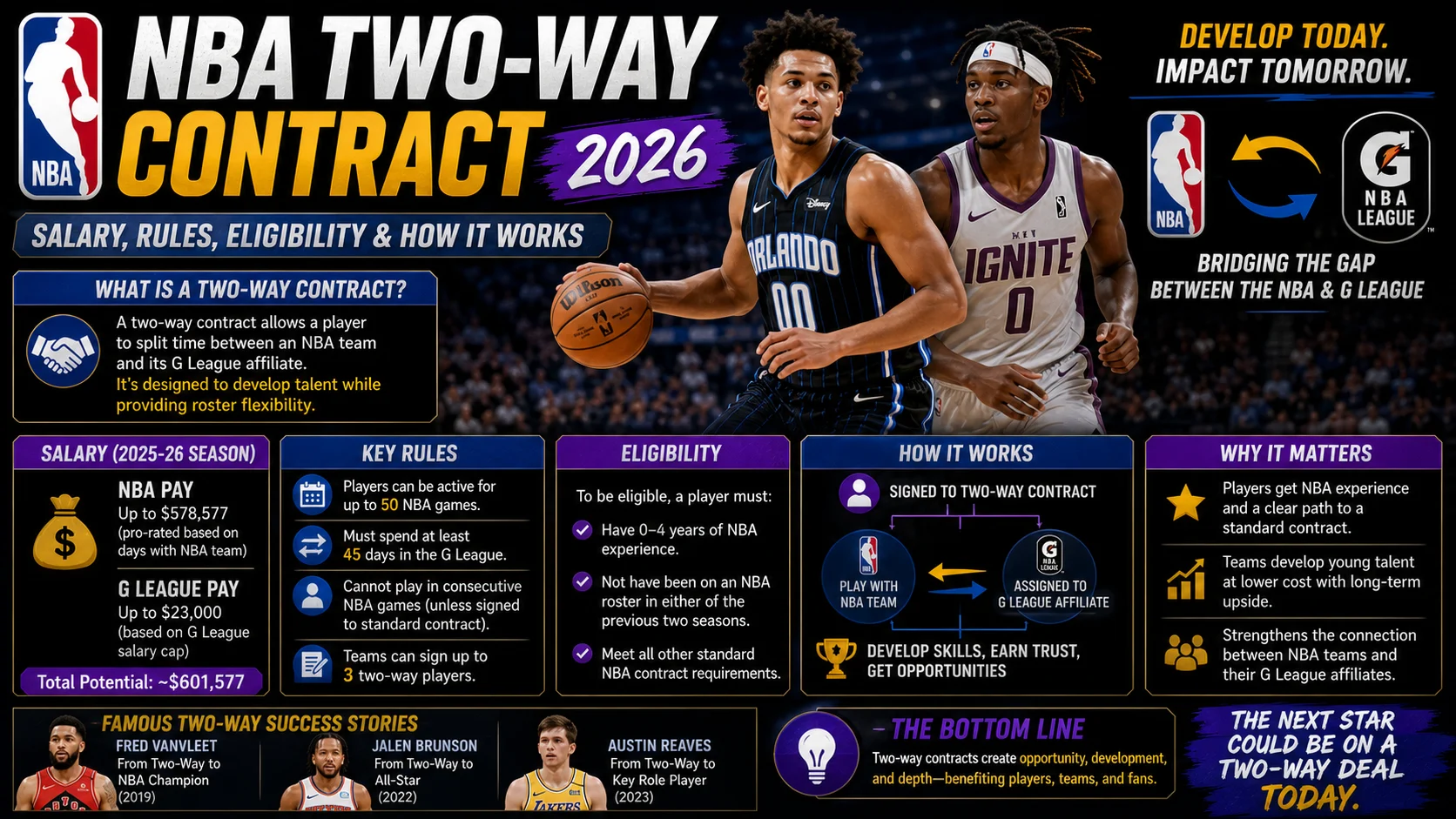
An NBA two-way contract gives a developing player a chance to compete in both the NBA and the G League. It offers an opportunity to earn NBA-level experience and move toward a standard roster spot without immediately taking up a regular NBA roster position.
What Is an NBA Two-Way Contract?
An NBA two-way contract is a special agreement that allows an eligible player to play for an NBA team and its affiliated NBA G League team during the same season. The player can be assigned to the G League for development while remaining connected to the NBA club.
In simple terms, a two-way contract creates a bridge between the G League and the NBA. It gives teams a way to evaluate young or developing talent, while players get access to NBA coaching, facilities, practices, and opportunities to appear in regular-season games.
Quick answer: A two-way player can play for both an NBA team and its G League affiliate, subject to league rules. The contract has specific eligibility, salary, service-time, and game-availability restrictions.
How Does an NBA Two-Way Contract Work?
A two-way player is officially under contract with an NBA team, but spends time between the NBA roster environment and the G League.
Here is how the arrangement generally works:
- The NBA team signs the player: The player receives a two-way contract rather than a standard NBA contract.
- The player develops in the G League: The team can assign the player to its affiliated G League team to get playing time and improve specific skills.
- The player gets NBA opportunities: The NBA club can bring the player into its lineup when needed, within applicable two-way rules.
- The team evaluates progress: Coaches and management assess performance, consistency, fit, and readiness for a larger NBA role.
- The player may earn a standard contract: If the team wants to give the player a bigger role, it can convert the deal into a standard NBA contract, subject to roster and salary-cap rules.
A two-way deal is not a guarantee of NBA playing time. It is an opportunity to develop and compete for a more permanent place.
How Much Does an NBA Two-Way Player Make?
NBA two-way players earn a salary determined by the league’s collective bargaining agreement (CBA). Their compensation is tied to the NBA minimum salary structure and the applicable season’s rules.
Unlike a standard NBA contract, a two-way contract uses a specific salary arrangement. A player’s actual earnings can depend on the season, contract terms, and time spent under the agreement.
It is important not to assume every two-way player earns the same amount as a veteran on a standard NBA roster. Two-way compensation is a separate category.
Key point: Two-way salaries can change from season to season. For an exact 2026–27 figure, use the current NBA CBA salary rules rather than an older salary estimate.
How Many Two-Way Players Can an NBA Team Have?
NBA teams have a limited number of two-way contract slots. Under the current roster framework, teams can carry up to three two-way players in addition to their standard roster players.
This gives franchises extra flexibility to develop talent without using one of their standard roster positions for every prospect.
A team may use its two-way slots for:
- Undrafted rookies who need professional experience.
- Young players who are still developing.
- G League standouts who have earned an NBA opportunity.
- Players who can provide depth at a specific position.
Two-way slots are limited, so earning one can be a significant achievement for a player trying to establish an NBA career.
NBA Two-Way Contract Rules in 2026–27
The rules are especially important because a two-way contract is not identical to a standard NBA deal. The NBA and G League explain the main restrictions as follows:
| Rule | What it means |
|---|---|
| Team limit | Up to 3 two-way players per NBA team |
| NBA service requirement | Generally, players with 4 or fewer years of NBA service may qualify |
| Contract length | 1 or 2 seasons |
| NBA availability | Up to 50 regular-season games on the NBA team’s active list |
| G League role | Players can spend much of the season with their G League affiliate |
| Signing deadline | Two-way contracts cannot be signed after March 4 of the season |
The 50-game restriction is about being on the NBA team’s active list, not simply the number of minutes or appearances a player receives. If a player signs after the regular season begins, the applicable limit is prorated. gleague.nba.com+2
Who Is Eligible for an NBA Two-Way Contract?
Two-way contracts are designed primarily for developing players who are still early in their professional NBA careers.
In general, an eligible player must:
- Have no more than four years of NBA service, subject to the CBA’s specific eligibility conditions.
- Be eligible to sign an NBA player contract.
- Agree to the two-way contract terms offered by an NBA team.
- Meet the league’s applicable roster and contract requirements.
This makes two-way deals particularly useful for undrafted players, young prospects, and G League performers who have shown that they may be ready for NBA competition.
Important: NBA service time is not always the same as a player’s age or the number of years since he turned professional. Eligibility is determined under the NBA’s CBA rules. The NBA G League+2
Can a Two-Way Player Play in the NBA Playoffs?
A two-way contract does not automatically give a player postseason eligibility. Under the standard two-way arrangement, players are not eligible to participate in the NBA playoffs while remaining on that contract.
If a team wants a two-way player to contribute in the postseason, it must address the player’s contract status under the applicable NBA rules. This is one reason a strong late-season performance can matter: a team may decide to convert a two-way deal into a standard contract if it wants to use that player in a larger role.
What Is the Difference Between a Two-Way Contract and a Standard NBA Contract?
Both agreements make a player part of an NBA organization, but they offer different levels of roster status, compensation, and playing opportunities.
| Feature | Two-Way Contract | Standard NBA Contract |
|---|---|---|
| Main purpose | Player development and evaluation | Regular NBA roster role |
| Team roster position | Separate two-way slot | Standard roster spot |
| G League participation | Common part of the arrangement | Possible through assignment |
| NBA active-list limit | Up to 50 regular-season games | No equivalent two-way limit |
| Playoff eligibility | Not eligible under the standard two-way deal | Eligible if otherwise qualified |
| Salary structure | Special two-way salary | Contract-specific NBA salary |
| Experience | Generally limited to eligible early-career players | No comparable two-way service restriction |
The biggest difference is flexibility. A standard NBA contract gives a player a regular roster position, while a two-way contract gives the team a development option with specific limits.gleague.nba.com+2
NBA Two-Way Contract Salary for 2026–27
For the 2026–27 season, the annual two-way salary is based on 50% of the NBA minimum salary for a player with zero years of NBA service.
Using the 2026–27 zero-service minimum of $1,357,763, the full-season two-way salary works out to approximately:
Estimated full-season two-way salary · 2026–27
$678,882
Before any applicable proration for a midseason signing.
A player who signs after the regular season begins receives a prorated amount based on the time remaining in the season. The annual figure should not be confused with guaranteed money: the contract’s guarantee provisions and timing matter too. sports360news.com+2
Why Do NBA Teams Offer Two-Way Contracts?
For NBA teams, two-way deals are a practical way to find and develop talent without immediately committing a standard roster spot.
There are several reasons teams use them:
- Develop young players: Prospects can receive regular G League minutes and work on weaknesses.
- Evaluate potential: Coaches can assess whether a player can handle NBA speed, physicality, and defensive responsibilities.
- Add roster depth: Teams have another option when injuries or other availability issues affect the rotation.
- Manage roster flexibility: Two-way contracts use separate roster slots from standard NBA contracts.
- Discover overlooked talent: Players who were undrafted or previously overlooked can earn a chance to prove themselves.
For a developing player, the deal can be a valuable entry point. For a team, it is a way to evaluate potential while maintaining roster flexibility.
Can an NBA Team Convert a Two-Way Contract Into a Standard Contract?
Yes. An NBA team can convert a two-way contract into a standard NBA contract if it chooses to promote the player and satisfies the league’s roster and salary rules.
This usually happens when a player performs well enough to earn a larger role, the team needs additional depth, or the organization wants to make the player eligible for opportunities that a two-way deal does not provide.
The conversion can be a major career milestone. It moves the player from a limited development arrangement to a standard NBA roster position.
However, conversion is not automatic. A player can perform well in the G League and still remain on a two-way deal if the team does not have a suitable roster opening or decides not to make the move.
Two-Way Contract vs. G League Contract: What’s the Difference?
These two contracts are often confused, but they are not the same.
| Feature | NBA Two-Way Contract | Standard G League Contract |
|---|---|---|
| Contract relationship | NBA team | G League |
| NBA team rights | Held by the NBA team | Player may receive an NBA call-up |
| Main role | NBA and G League development | G League competition |
| NBA salary | Two-way salary under NBA rules | No NBA two-way salary |
| NBA appearances | Subject to two-way limits | Requires an NBA contract or call-up |
A two-way player already has an NBA contract with a specific NBA team. A standard G League player is generally signed through the G League system and may earn an NBA opportunity through a call-up. The NBA G League+2
Do Two-Way Players Count Against the NBA Salary Cap?
Two-way contracts have a different salary-cap treatment from standard NBA contracts. Teams can use two-way slots without needing ordinary salary-cap room in the same way they would for a standard contract.
That flexibility is one reason the system is useful for teams trying to develop additional players while managing their standard roster and payroll.
However, a two-way contract is still governed by NBA rules. It should not be treated as a completely unrestricted or rule-free roster spot. Memphis Hustle+1
How Can a Player Earn an NBA Two-Way Contract?
There is no single route to a two-way deal. Players can reach the NBA through different development paths, but a few routes are especially common:
- Go undrafted: A player finishes college or becomes draft-eligible but is not selected.
- Attend NBA Summer League: Strong performances can attract attention from NBA scouts and front offices.
- Join the G League: A player builds a professional résumé and demonstrates that he can compete against experienced talent.
- Impress during workouts or training camp: Teams may offer a two-way deal after evaluating a player’s skills and potential.
- Earn a roster opportunity: Consistent performance, professionalism, and a good fit can help a player secure an NBA contract.
Talent matters, but so do consistency, decision-making, defense, fitness, and the ability to contribute within a team’s system.
Frequently Asked Questions
How many two-way players can an NBA team have?
An NBA team can have up to three two-way players at a time, in addition to its standard NBA roster.
How many games can a two-way player play in the NBA?
A two-way player can be on his NBA team’s active list for up to 50 regular-season games. The limit is prorated for players who sign after the regular season begins.
Do NBA two-way players get paid?
Yes. They receive a special salary based on 50% of the zero-years-of-service NBA minimum salary. The amount is prorated for qualifying midseason signings.
Can a two-way player become a full NBA player?
Yes. An NBA team can convert a two-way contract into a standard NBA contract if it has the necessary roster flexibility and completes the required transaction.
Can two-way players play in the NBA playoffs?
Not while remaining on a standard two-way contract. A player generally needs to be converted to a standard NBA contract to become eligible for postseason participation, subject to NBA rules and deadlines.
Can a two-way player play for another NBA team?
No. The player’s NBA contract and rights belong to the team that signed him. Another NBA team cannot simply use him as its own two-way player.
Are two-way contracts guaranteed?
Not necessarily. The guaranteed amount depends on the contract terms and applicable league rules. A two-way deal should not automatically be treated as fully guaranteed for its entire value.
How long can an NBA two-way contract last?
A two-way contract can be for one or two seasons, depending on the agreement between the player and the team.
Can a two-way player be sent to the G League?
Yes. Playing for the affiliated G League team is a central part of the two-way system. The player remains under contract with the NBA team while assigned to the G League.
Final Verdict
Absolutely. An NBA two-way contract can be a career-changing opportunity for a player trying to establish himself in professional basketball. It provides access to an NBA organization, valuable G League playing time, and a chance to prove that he deserves a permanent roster position.
For teams, it offers a flexible way to develop talent and discover players who might otherwise be overlooked. For players, it can be the first major step toward a full NBA career.
The key takeaway: A two-way contract is more than a temporary basketball deal. It is a development pathway that connects the NBA and G League, giving emerging players a chance to turn potential into a lasting professional opportunity.

Daniel Brooks is a sports writer at SportsOrbitX.com, specializing in football, basketball and global sports news. He focuses on delivering accurate reporting, match analysis and timely updates that keep fans informed.