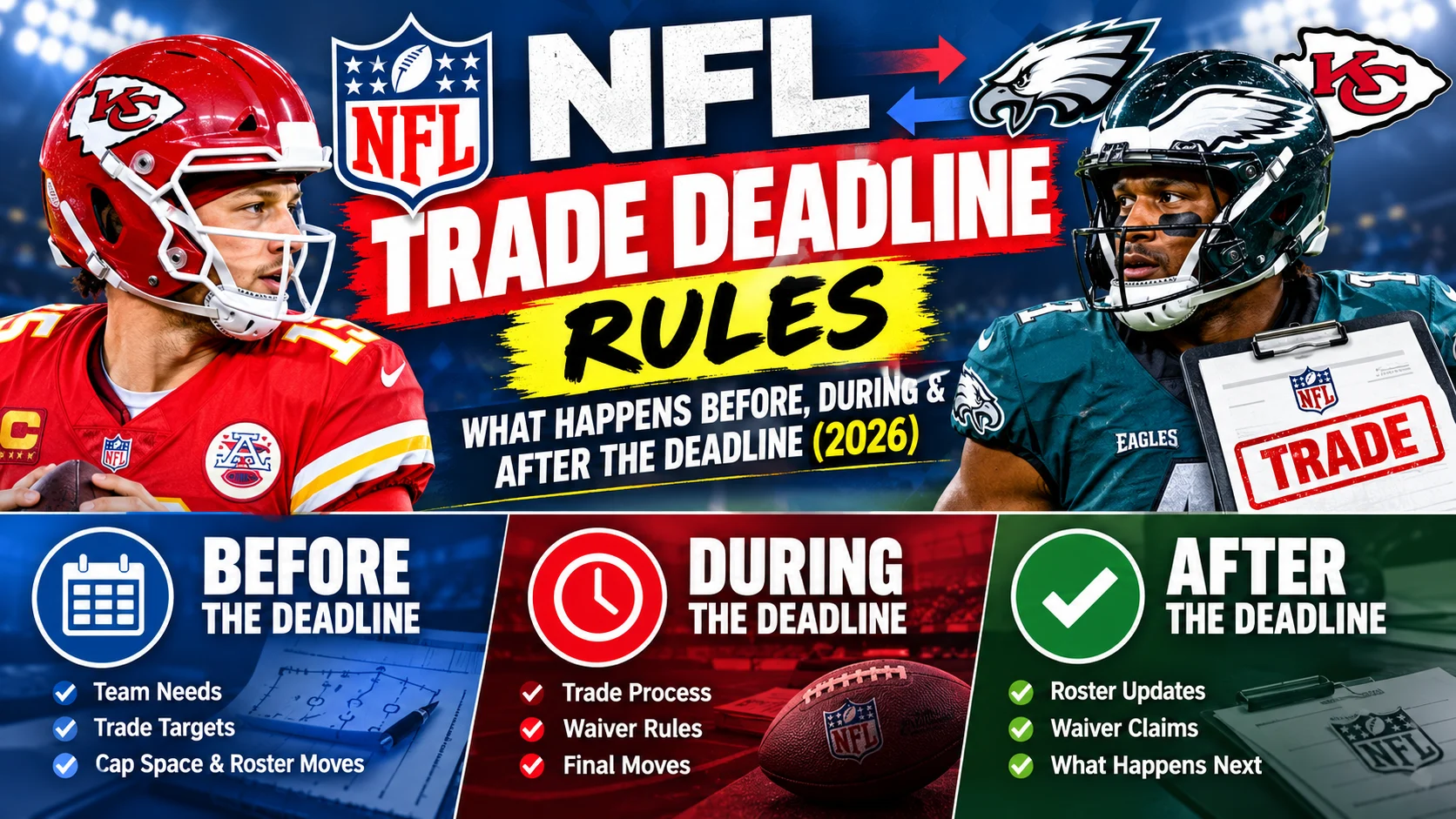
The NFL trade deadline is the point in the regular season when teams must stop trading players. For the 2026 season, all NFL trades must be completed by 4:00 p.m. ET on Tuesday, November 10. After the deadline, teams cannot acquire players through trades, but they can still add players through free agency and the waiver system.
What Is the NFL Trade Deadline?
The NFL trade deadline is the league’s cutoff for player trades during the regular season.
Before the deadline, teams can exchange players and draft picks as they try to improve their rosters, prepare for a playoff run, or build for future seasons.
Once the deadline passes, the trade market closes for the rest of that season.
That creates one of the most intense moments on the NFL calendar.
A contender might be looking for a wide receiver, pass rusher, cornerback, or offensive lineman. Meanwhile, a struggling team may decide to move a veteran and collect valuable draft capital for the future.
The clock is the same for everyone.
When the deadline hits, the trade window shuts.
When Is the NFL Trade Deadline in 2026?
The 2026 NFL trade deadline is Tuesday, November 10, at 4:00 p.m. Eastern Time.
The NFL’s official 2026 calendar states that all trading ends at 4:00 p.m., New York time, on November 10.
| NFL Trade Deadline | 2026 |
|---|---|
| Date | Tuesday, November 10 |
| Time | 4:00 p.m. ET |
| Applies To | NFL player trades |
| After Deadline | No player trades |
| Other Acquisition Options | Free agents and waivers |
This deadline is important because it arrives deep enough into the season for teams to understand what they are—and aren’t—but early enough for a new player to potentially contribute during the second half of the season.
What Are the NFL Trade Deadline Rules?
The basic rule is straightforward:
NFL teams cannot make trades after 4:00 p.m. ET on the trade deadline date.
Before that cutoff, eligible trades can be completed according to league transaction rules.
Afterward, teams must use other roster-building mechanisms if they want to add players.
The NFL’s 2026 calendar specifically identifies November 10 at 4:00 p.m. ET as the end of trading for the season.
The Key Rule to Remember
A team cannot simply agree to a trade after the deadline and complete it later.
The deadline is the cutoff for trading activity. That’s why the final hours can become a frenzy of negotiations, medical checks, contract work, and league processing.
Can NFL Teams Trade After the Deadline?
No.
Once the trade deadline passes, NFL teams cannot acquire players through trades for the remainder of that season.
However, this does not mean teams are completely locked out of improving their rosters.
They can still use other methods.
How Can NFL Teams Add Players After the Trade Deadline?
The end of the trade market does not mean the end of roster moves.
NFL teams can still acquire players through mechanisms such as free agency and the waiver system.
Free Agency
Teams can sign eligible free agents after the trade deadline, subject to the league’s roster and salary-cap rules.
This can become particularly important when injuries create unexpected holes.
For example, if a team loses a starting linebacker after the deadline, it cannot trade for a replacement—but it may be able to sign an available free agent.
Waiver Wire
The waiver system is another way teams can acquire players.
When a player is waived, other clubs may have an opportunity to claim that player’s contract or NFL rights, depending on the circumstances.
That means the roster-building game continues even after the trade market disappears.
Why Does the NFL Have a Trade Deadline?
The trade deadline exists to create a clear competitive cutoff.
Without a deadline, teams could continue making major roster changes deep into the season, potentially changing the competitive balance right before the playoffs.
The deadline encourages teams to make important decisions at roughly the same point in the season.
By this stage, front offices have more information about:
- Team performance
- Injuries
- Playoff chances
- Quarterback play
- Strength of schedule
- Roster weaknesses
- Salary-cap flexibility
- Future draft assets
That makes the deadline less about simply buying or selling players and more about deciding what a team believes its future looks like.
Why Are NFL Trades So Important at the Deadline?
The trade deadline can change the direction of a franchise.
A playoff contender may sacrifice future draft picks to acquire a player who can help immediately.
A rebuilding team may do the opposite.
It could trade a veteran for draft picks and focus on the next season.
This creates two basic strategies.
| Strategy | What the Team Wants |
|---|---|
| Buyer | Immediate talent |
| Seller | Future draft capital |
| Contender | Playoff reinforcement |
| Rebuilding Team | Young players and picks |
| Cap-Constrained Team | Financial flexibility |
The most aggressive teams are usually those that believe one missing piece could turn a good roster into a championship contender.
What Happens to a Player’s Contract When He Is Traded?
A trade does not simply erase a player’s existing contract.
The acquiring team generally takes on the player’s contract obligations that transfer under the applicable NFL rules, while salary-cap accounting can become complicated depending on the contract structure and timing.
Salary cap considerations are one reason some trades are easier to complete than others.
A team needs enough cap flexibility to remain compliant after acquiring a player.
The NFL has also noted that teams can negotiate financial arrangements as part of trades, including situations in which the team trading away a player agrees to pay some of the player’s remaining base salary.
Why Salary Cap Space Matters
Imagine Team A wants a veteran player from Team B.
Team A likes the player but does not have enough cap room to comfortably absorb the remaining salary.
The two teams may need to restructure the financial side of the deal before it can happen.
That’s why an NFL trade is much more complicated than:
Player + draft pick = new team.
Behind the scenes, general managers, agents, salary-cap personnel, and league officials may all be involved.
Can a Player Refuse an NFL Trade?
Sometimes.
A player’s contract may contain a no-trade clause or another provision that gives the player some control over where he can be traded.
The NFL explains that a player with a no-trade clause can veto a potential trade, although contract provisions can vary. Some clauses may allow a player to approve only certain destinations or waive the protection under specified circumstances.
So even when two teams agree on a trade, the transaction may still depend on the player’s contractual rights.
What Happens If a Trade Is Agreed to Before the Deadline?
The important distinction is between a trade being negotiated and the transaction being properly completed through the league’s process.
Teams can negotiate deals before the deadline, but the transaction must satisfy the NFL’s applicable procedures and deadlines.
That is why deadline day is often chaotic.
A trade can appear close to completion, but details involving:
- Contract terms
- Salary-cap accounting
- Medical information
- Draft-pick compensation
- Player approval rights
- League paperwork
can affect whether a deal actually gets completed.
Can Teams Trade Draft Picks at the NFL Trade Deadline?
Yes.
NFL teams can trade draft picks as part of deadline deals, subject to league rules.
A trade might involve:
Player + draft pick
or
Player + multiple draft picks
depending on the value the teams assign to the player.
Draft picks are especially important because they allow sellers to turn current roster assets into future opportunities.
That’s why rebuilding teams can become attractive trade partners for contenders.
What Is a Trade Deadline Buyer?
A buyer is generally a team that believes it has a realistic chance to compete for the playoffs or Super Bowl and wants to strengthen its roster.
A buyer might look for:
- Wide receivers
- Edge rushers
- Defensive tackles
- Cornerbacks
- Offensive linemen
- Running backs
- Tight ends
The goal is simple:
Give the current roster one more weapon before the postseason race gets serious.
What Is a Trade Deadline Seller?
A seller is usually a team that does not view itself as a serious contender and is willing to move players for future assets.
Instead of asking:
“How does this player help us win this season?”
the front office may ask:
“What can we get for this player that helps us win next season?”
That could mean draft picks or other players who better fit the team’s long-term plans.
What Happens Immediately After the NFL Trade Deadline?
Once 4:00 p.m. ET passes, the NFL trade market closes for the season.
Teams then turn their attention toward:
- Free-agent signings
- Waiver claims
- Practice-squad moves
- Internal roster adjustments
- Injury replacements
- Salary-cap management
The NFL’s calendar also specifies that, beginning November 11, players with at least four previous pension-credited seasons become subject to the waiver system for the remainder of the regular season and postseason.
The key point is that roster movement continues, but trades do not.
When Can NFL Teams Trade Again?
Teams can trade again when the next league year’s trading period opens.
For the 2027 league year, the NFL’s published calendar says the trading period begins at 4:00 p.m. ET on March 11, 2027, after the expiration of 2026 contracts.
So the annual cycle is essentially:
Offseason → Regular Season → Trade Deadline → No More Trades → New League Year → Trade Market Reopens
NFL Trade Deadline vs. Free Agency
These two roster-building methods are often confused.
| Feature | Trade Deadline | Free Agency |
|---|---|---|
| Player comes from | Another NFL team | Available free agent |
| Draft compensation | Often involved | Usually not |
| Contract | Existing contract may transfer | New contract |
| Deadline | November 10, 2026 | Different league calendar |
| After trade deadline | Trades prohibited | Eligible signings continue |
A team that misses out on a trade may therefore look toward free agency or the waiver wire instead.
Why the Final Hours Are So Chaotic
The NFL trade deadline is essentially a countdown.
As 4:00 p.m. approaches, teams must decide whether to:
Buy. Sell. Hold.
And those decisions can have enormous consequences.
A contender that refuses to make a move may regret missing an opportunity.
A rebuilding team that sells too aggressively may weaken its current roster.
And a general manager who gives up too much draft capital could face criticism for years.
That’s what makes the deadline fascinating: every trade is a bet on the future.
NFL Trade Deadline Rules: Quick Reference
| Question | Answer |
|---|---|
| What is the NFL trade deadline? | The cutoff for regular-season player trades |
| 2026 deadline? | November 10, 2026 |
| Deadline time? | 4:00 p.m. ET |
| Can teams trade afterward? | No |
| Can teams sign free agents afterward? | Yes, if eligible |
| Can teams use waivers afterward? | Yes |
| Can players have trade veto rights? | Yes, if their contracts provide them |
| Can draft picks be part of trades? | Yes |
| When does trading reopen? | At the start of the next league year |
The official NFL calendar should be treated as the final authority because league dates and procedures can change.
Frequently Asked Questions
What time is the NFL trade deadline?
For the 2026 NFL season, the trade deadline is 4:00 p.m. ET on Tuesday, November 10.
Can an NFL team trade a player after the deadline?
No. Once the deadline passes, teams cannot make player trades for the remainder of that season.
Can NFL teams sign players after the trade deadline?
Yes. Teams can still sign eligible free agents and make other permitted roster transactions after the trade deadline.
Can NFL teams claim players off waivers after the deadline?
Yes. The waiver system continues to provide a way for teams to acquire eligible players after the trade market closes.
Can an NFL player block a trade?
A player can have the ability to veto a trade when his contract contains a no-trade clause or similar contractual protection.
Why do NFL teams trade at the deadline?
Contenders generally trade to improve their chances of winning immediately, while sellers may trade veterans to acquire future draft capital or improve their long-term roster.
Can draft picks be traded at the deadline?
Yes. Draft picks can be included as compensation in NFL trades, subject to league rules.
When does the NFL trade market reopen?
Trading for the 2027 league year is scheduled to reopen at 4:00 p.m. ET on March 11, 2027.
Final Thoughts
The NFL trade deadline is the league’s final opportunity for teams to make trades during the season. For 2026, that window closes at 4:00 p.m. ET on November 10. After that moment, teams cannot trade players, but they can continue using free agency, waivers, and other permitted roster mechanisms.
The deadline isn’t just about transactions. It’s a strategic dividing line.
Contenders decide how much they’re willing to risk for a championship. Rebuilding teams decide what they’re willing to sacrifice for the future.
And when the clock reaches 4:00 p.m., the questions become much bigger than who got traded?
Did the buyers make the right move? Did the sellers get enough? And which team just changed its season?