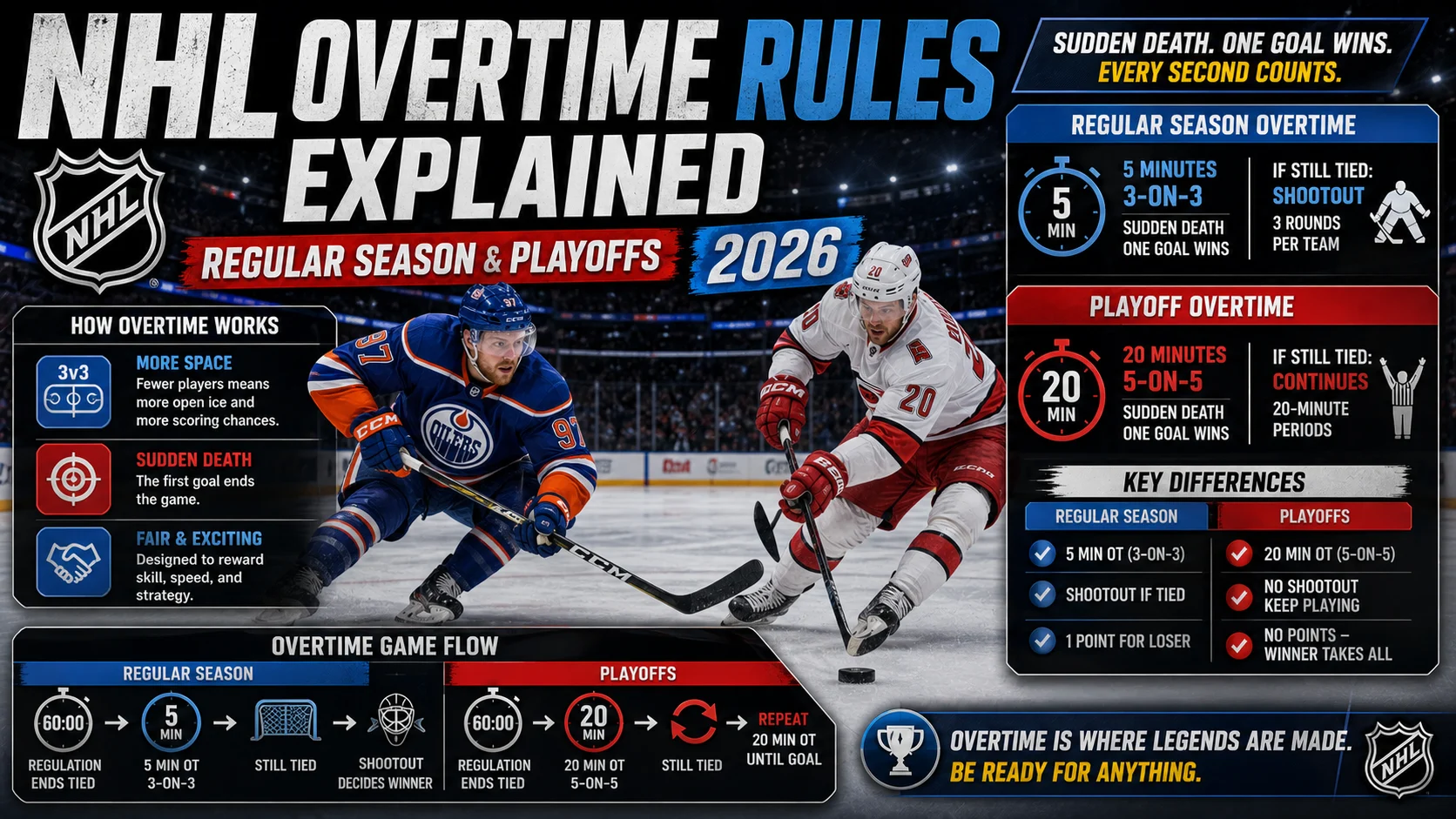
NHL overtime is different in the regular season and playoffs. Regular-season games use a five-minute, 3-on-3 sudden-death overtime, followed by a shootout if nobody scores. In the Stanley Cup Playoffs, there are no shootouts: teams play 20-minute, 5-on-5 sudden-death periods until someone scores.
Quick Answer: How Does NHL Overtime Work?
When an NHL regular-season game is tied after three 20-minute periods, the teams play a five-minute overtime with three skaters and one goaltender per side.
The first team to score wins.
If neither team scores during those five minutes, the game goes to a shootout.
The winner receives 2 standings points, while the losing team receives 1 point.
The biggest difference comes in the playoffs: there is no shootout. Playoff games continue through 20-minute sudden-death overtime periods until a goal decides the game.
NHL Overtime Rules at a Glance
| Rule | Regular Season | Stanley Cup Playoffs |
|---|---|---|
| Overtime length | 5 minutes | 20 minutes |
| Players | 3-on-3 + goalie | 5-on-5 + goalies |
| Sudden death | Yes | Yes |
| Shootout | Yes, if still tied | No |
| Overtime winner | Wins game | Wins game |
| Overtime loser | Gets 1 point | Gets no standings point |
| If still tied | Shootout | Another 20-minute OT |
| Ends after one goal? | Yes | Yes |
The NHL has used 3-on-3 regular-season overtime since 2015-16, while the shootout was introduced in 2005-06 to eliminate regular-season ties.
NHL Regular Season Overtime Rules
The regular-season format is designed to settle a tied game quickly while creating more open ice and scoring opportunities.
Step 1: Regulation Ends in a Tie
An NHL game consists of three 20-minute periods.
If the score is tied after regulation, each team has already secured one standings point.
The game then moves into overtime for a chance to earn the second point.
Step 2: Five-Minute Overtime Begins
Regular-season overtime lasts five minutes.
Each team normally has:
- 3 skaters
- 1 goaltender
That creates a 3-on-3 situation.
With fewer players on the ice, there is substantially more open space than during normal 5-on-5 hockey.
Step 3: First Goal Wins
Regular-season overtime is sudden death.
That means the first team to score ends the game immediately.
There is no remaining time to play after the winning goal.
Step 4: Shootout If Nobody Scores
If the five-minute overtime expires without a goal, the teams participate in a shootout.
The shootout determines the winner and prevents the regular-season game from ending in a tie.
Why Does the NHL Use 3-on-3 Overtime?
The purpose of 3-on-3 overtime is simple: create more space and encourage scoring chances.
With only three skaters per team, players have more room to attack, pass, carry the puck and create odd-man opportunities.
The format was introduced for the 2015-16 season after the NHL had already experimented with other overtime systems. The League wanted to reduce the number of games reaching a shootout while maintaining an exciting sudden-death finish.
The strategy can be fascinating because possession becomes extremely important.
A bad pass can immediately become a breakaway.
A missed shot can produce a counterattack.
One defensive mistake can end the game.
That’s what makes 3-on-3 overtime feel completely different from regulation hockey.
How Many Players Are on the Ice in NHL Overtime?
In normal regular-season overtime, there are three skaters and one goalie for each team.
So the basic setup is:
3 skaters + 1 goalie vs. 3 skaters + 1 goalie
The three skaters can be forwards, defensemen, or a combination of both.
Teams often select highly skilled players who can:
- Carry the puck
- Skate quickly
- Create scoring opportunities
- Defend in open space
- Make accurate passes under pressure
Because mistakes are so costly, coaches must balance offensive creativity with defensive awareness.
What Happens If a Team Takes a Penalty in Overtime?
Penalties can dramatically change the game.
If one team receives a penalty during 3-on-3 overtime, the teams generally play 4-on-3.
So instead of:
3 vs. 3
the situation becomes:
4 vs. 3
The team with the extra skater gains a major advantage because there is already so much open ice.
If penalties create a two-player advantage, the non-offending team can have five skaters while the penalized team remains at three. NHL rules also contain specific procedures for penalties that carry over from regulation into overtime.
At no point can a team have fewer than three skaters on the ice during regular-season overtime.
What Happens to the Standings Points in Overtime?
This is one of the most important NHL overtime rules for new fans.
A regular-season game that reaches overtime creates a three-point game.
If Team A Wins in Overtime
- Team A receives 2 points
- Team B receives 1 point
If Team A Wins in a Shootout
- Team A receives 2 points
- Team B receives 1 point
If Team A Wins in Regulation
- Team A receives 2 points
- Team B receives 0 points
That’s why an overtime loss isn’t treated the same way as a regulation loss in the NHL standings.
NHL Shootout Rules
If neither team scores during the five-minute regular-season overtime, the shootout begins.
Each team initially receives three attempts.
The teams alternate shooters, and the team with more goals after the initial three rounds wins.
If the score remains tied, the shootout continues in sudden-death rounds.
In those rounds, each team gets one attempt per round. If one team scores and the other doesn’t in the corresponding round, the game ends.
A player cannot shoot again until all eligible players have had an opportunity, subject to the NHL’s shootout rules.
Does a Shootout Goal Count as a Normal Goal?
No.
A shootout determines the winner, but the individual shootout scoring does not function like normal game scoring.
The NHL’s official rules specify that the final score recorded for the game gives the winning team one more goal than its opponent, based on the score at the end of overtime.
So if the game is tied 3-3 after overtime and Team A wins the shootout, the official final score is recorded as 4-3, rather than adding every shootout goal to the team’s statistics.
NHL Playoff Overtime Rules
This is where NHL overtime becomes completely different.
There are no shootouts in the Stanley Cup Playoffs.
If a playoff game is tied after regulation, the teams continue playing sudden-death overtime until someone scores.
The Basic Playoff Format
- 20-minute overtime period
- 5 skaters per team
- 1 goaltender per team
- Sudden death
- Intermission between overtime periods
- No shootout
If nobody scores during the first 20-minute overtime period, another 20-minute period is played.
This continues until a goal is scored.
Why Is Playoff Overtime 5-on-5?
The Stanley Cup Playoffs use a traditional 5-on-5 sudden-death format because playoff games cannot be decided by a shootout.
Every goal can determine the outcome of a game and potentially an entire playoff series.
That’s why playoff overtime is often viewed as one of the most intense situations in professional sports.
A single mistake can:
- End a game
- Change a series
- Eliminate a team
- Send a club one step closer to the Stanley Cup
Can an NHL Playoff Game Have Multiple Overtimes?
Yes.
There is no five-minute limit and no shootout.
If the score remains tied after one 20-minute overtime period, the teams play another.
For example:
3rd Period → 20-minute OT → still tied → another 20-minute OT → goal → game over
That means an NHL playoff game can technically last for several hours.
The game continues until one team scores.
Regular Season vs. Playoffs: The Biggest Difference
The easiest way to remember NHL overtime is:
Regular season = 5-minute 3-on-3 + shootout.
Playoffs = 20-minute 5-on-5 until someone scores.
That’s the key distinction every new NHL fan should know.
What Happens If a Playoff Game Is Still Tied?
There is no shootout.
Instead, the teams receive an intermission and return for another sudden-death overtime period.
The process repeats until a goal is scored.
This is why playoff overtime goals are so memorable.
There is no guaranteed endpoint.
No skills competition.
No artificial tiebreaker.
Just hockey until someone wins.
Can a Goalie Be Pulled During Overtime?
Yes, a team can remove its goaltender for an additional skater in regular-season overtime under the NHL rules.
However, there is an important risk.
If the team pulls its goalie and concedes a goal, it can lose the automatic standings point it had earned by reaching overtime. There are specific exceptions, including situations involving a delayed penalty.
Because of that risk, pulling the goalie in overtime is a strategic decision rather than a routine move.
What Is Sudden Death in Hockey?
Sudden death means the first team to score wins immediately.
There is no requirement to play the remaining time.
For example, if a team scores with:
4:59 remaining
the game ends.
If a team scores with:
0:01 remaining
the game also ends.
This is true for both regular-season overtime and playoff overtime, although the format surrounding sudden death is different.
Why NHL Overtime Is So Exciting
The beauty of NHL overtime comes from the combination of space, pressure and consequence.
In regular-season 3-on-3 overtime, one player can create a scoring chance almost instantly.
In playoff overtime, the pressure is even greater because every possession can potentially decide the game.
A defensive breakdown that would be recoverable during regulation can become fatal in overtime.
That’s why coaches often emphasize:
- Smart puck management
- Controlled entries
- Defensive positioning
- Patience
- Quick transitions
- Avoiding unnecessary turnovers
NHL Overtime Rules: Simple Example
Imagine the score is:
Toronto 3 — Boston 3
after the third period.
The game enters regular-season overtime.
Both teams start with:
3 skaters + 1 goalie
If Toronto scores during the five-minute period:
Toronto wins 4-3
Toronto gets 2 standings points, while Boston receives 1 point.
If nobody scores after five minutes, the game moves to a shootout.
Now imagine the same 3-3 score occurs during the Stanley Cup Playoffs.
There is no shootout.
The teams play a 20-minute 5-on-5 overtime period.
If nobody scores, they play another 20-minute period.
The game continues until the puck enters the net.
FAQs
How long is NHL overtime?
Regular-season NHL overtime lasts five minutes. Playoff overtime consists of 20-minute periods that continue until a goal is scored.
Is NHL overtime 3-on-3?
In the regular season, yes. The standard overtime format is 3-on-3 plus a goaltender for each team.
Does the NHL use shootouts?
Yes, but only during the regular season if the game remains tied after five-minute overtime. Stanley Cup Playoff games do not use shootouts.
How many points does an overtime winner get?
The winning team receives 2 standings points, while the team that loses in overtime or a shootout receives 1 point.
Does the NHL have ties?
No. Regular-season games are decided by overtime and, if necessary, a shootout. Playoff games continue through sudden-death overtime until a winner is determined.
How many players play in playoff overtime?
Playoff overtime uses the normal 5-on-5 format, with a goaltender for each team.
Can NHL playoff overtime go on forever?
There is no fixed number of overtime periods. If neither team scores, another 20-minute period is played until a goal decides the game.
What happens if a team gets a penalty in 3-on-3 overtime?
The teams generally move to 4-on-3, giving the non-penalized team an extra skater. More complicated penalty situations are handled according to the NHL’s overtime rules.
Final Thoughts
The NHL overtime rules are easy to understand once you separate the regular season from the playoffs.
During the regular season, a tied game goes to five minutes of 3-on-3 sudden-death overtime. If nobody scores, a shootout decides the winner. The winner earns two standings points, while the overtime or shootout loser gets one.
During the Stanley Cup Playoffs, there is no shootout. Teams return to 5-on-5 hockey for 20-minute sudden-death periods, and those periods continue until one team scores.
That difference is what makes NHL overtime so compelling: the regular season is built for speed and a decisive finish, while playoff overtime removes the safety net entirely. One goal can end the night or change the entire Stanley Cup race.

Daniel Brooks is a sports writer at SportsOrbitX.com, specializing in football, basketball and global sports news. He focuses on delivering accurate reporting, match analysis and timely updates that keep fans informed.