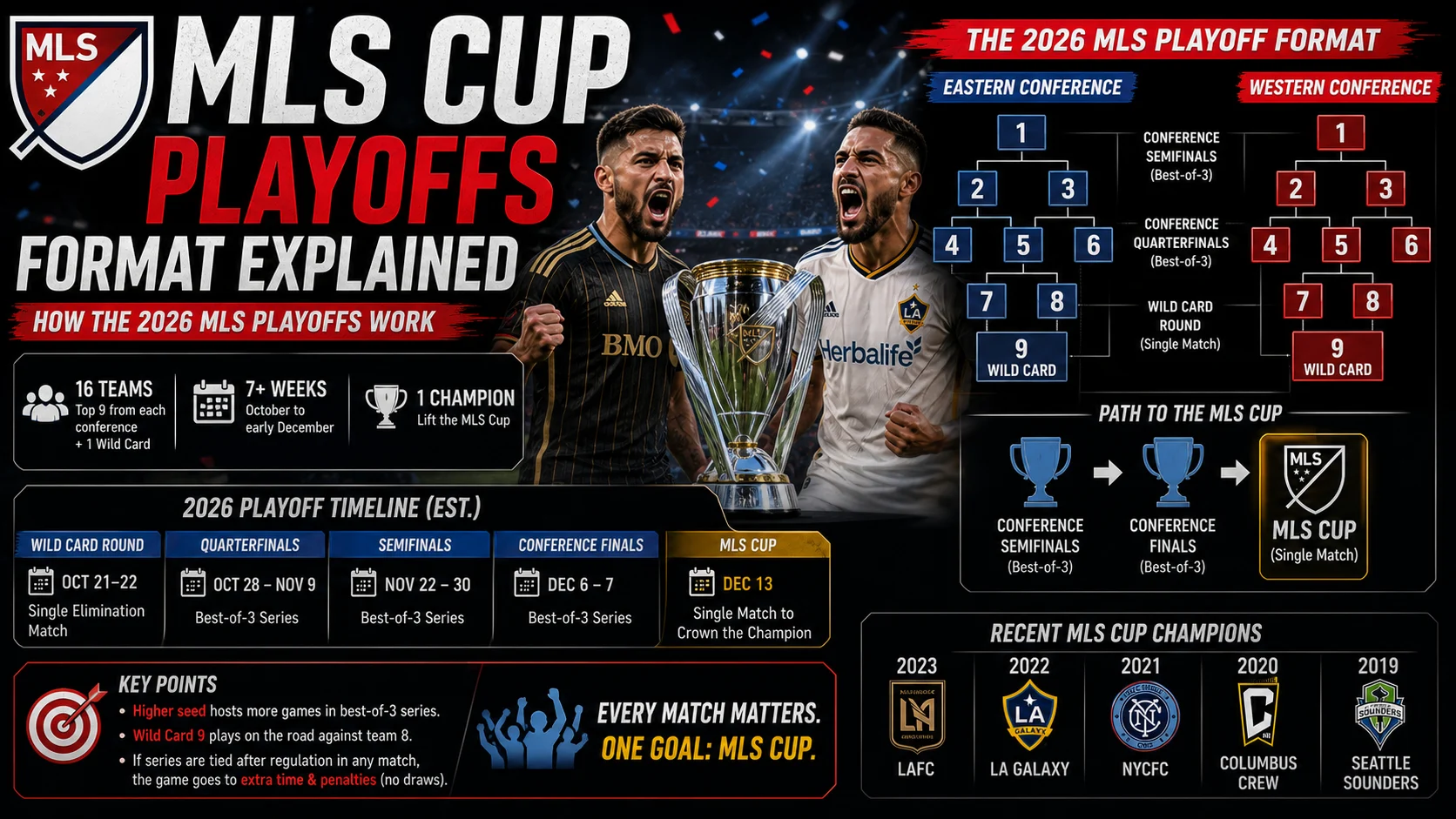
The MLS Cup Playoffs are a knockout tournament that determines Major League Soccer’s champion. In 2026, 18 teams qualify nine from the Eastern Conference and nine from the Western Conference with the postseason moving through Wild Card matches, a best-of-three Round One, Conference Semifinals, Conference Finals, and finally MLS Cup.
The unusual part? MLS does not use a traditional single-elimination format from the beginning. The first major round is a best-of-three series, while the later rounds become win-or-go-home matches. That combination makes the MLS postseason different from many other major North American sports playoffs.
MLS Cup Playoffs Format at a Glance
| Round | Teams | Format | Home Advantage |
|---|---|---|---|
| Wild Card | 4 | Single elimination | Higher seed |
| Round One | 16 | Best of 3 | Higher seed hosts Games 1 & 3 |
| Conference Semifinals | 8 | Single elimination | Higher seed |
| Conference Finals | 4 | Single elimination | Higher seed |
| MLS Cup | 2 | Single match | Higher-ranked finalist |
The 2026 playoffs begin after Decision Day on November 7, with Wild Card matches scheduled for November 18 and MLS Cup set for December 18.
How Many Teams Make the MLS Cup Playoffs?
A total of 18 MLS clubs qualify for the 2026 playoffs.
The qualification system is split evenly between the two conferences:
- 9 Eastern Conference teams
- 9 Western Conference teams
- Seeds 1–7 automatically enter Round One
- Seeds 8–9 enter the Wild Card round
That means the top seven teams in each conference avoid the sudden-death Wild Card match, while the eighth- and ninth-place teams have to win immediately just to reach Round One.
Why Are There 18 Playoff Teams?
MLS currently has 30 clubs. The league’s playoff system gives a large portion of the league a chance to compete for the championship while still rewarding teams that perform well during the regular season.
The regular-season standings determine seeding, so finishing higher can provide a meaningful advantage later in the tournament.
What Is the MLS Wild Card Round?
The Wild Card round is the opening stage of the 2026 MLS Cup Playoffs.
There are two Wild Card matches:
- Eastern Conference No. 8 vs. No. 9
- Western Conference No. 8 vs. No. 9
The higher seed hosts each match.
Unlike Round One, the Wild Card is one game only. Lose, and the season is over.
If the match is tied after 90 minutes, MLS does not play extra time in the Wild Card round. Instead, the teams go directly to a penalty shootout to determine the winner.
Who Does the Wild Card Winner Play?
This is where the format becomes particularly interesting.
The winner of each Wild Card match advances to Round One and faces the No. 1 seed in its conference.
So a No. 8 or No. 9 seed has a difficult path: first it must survive a knockout match, then it immediately faces the conference’s top seed in a best-of-three series.
How Does Round One Work?
Round One is the most distinctive part of the current MLS playoff format.
It is a best-of-three series, meaning the first team to win two games advances.
There is no aggregate score across the three games.
For example:
- Team A wins Game 1
- Team B wins Game 2
- Game 3 decides the series
If one team wins the first two games, Game 3 is unnecessary.
MLS’s official 2026 guidelines specify that every Round One game must produce a winner. If a game is tied after 90 minutes, there is no extra time; the match goes directly to a penalty shootout.
How Does Home Advantage Work in Round One?
The higher seed receives an unusual but valuable home-field advantage.
The three-game structure is:
Game 1: Higher seed hosts
Game 2: Lower seed hosts
Game 3: Higher seed hosts, if necessary
This is effectively a home-away-home format.
That means the higher seed can potentially win the series in front of its home supporters in Game 3.
Example of a Round One Series
Imagine:
No. 2 Seattle vs. No. 7 Dallas
The schedule would work like this:
- Game 1: Seattle hosts Dallas
- Game 2: Dallas hosts Seattle
- Game 3: Seattle hosts Dallas, if necessary
If Seattle wins Games 1 and 2, the series ends immediately.
If Dallas wins Game 2 after losing Game 1, the teams return to Seattle for a decisive Game 3.
What Are the MLS Conference Semifinals?
After Round One, eight teams remain—four from each conference.
The Conference Semifinals return to a single-elimination format.
That means there is no second chance.
Win and advance. Lose and go home.
The higher remaining seed hosts each semifinal.
How Are the Semifinal Matchups Determined?
The bracket follows the original conference seeding structure.
In each conference:
- Winner of No. 1 vs. No. 8/9 plays winner of No. 4 vs. No. 5
- Winner of No. 3 vs. No. 6 plays winner of No. 2 vs. No. 7
This creates a bracket in which the highest remaining seed receives the home-field advantage.
What Happens If a Conference Semifinal Is Tied?
Unlike Round One and the Wild Card round, Conference Semifinal matches do use extra time.
If the score is tied after 90 minutes:
- Two 15-minute extra-time periods are played.
- If the teams remain tied, a penalty shootout decides the winner.
That same extra-time procedure applies to the Conference Finals and MLS Cup.
What Are the MLS Conference Finals?
The Conference Finals determine the two teams that will play for the MLS championship.
There are only two matches:
- Eastern Conference Final
- Western Conference Final
Both are single-elimination games.
The higher seed hosts the Conference Final. Within each conference, the matchup is between the highest advancing seed and lowest advancing seed.
The winners become the Eastern and Western Conference champions and advance to MLS Cup.
How Does MLS Cup Work?
The MLS Cup is the championship match.
Unlike Round One, it is not a series. There is only one game.
The finalist with the better regular-season record earns the right to host MLS Cup. MLS’s 2026 competition guidelines specify that hosting is awarded based on the finalist’s rank in the Supporters’ Shield standings.
If MLS Cup is tied after 90 minutes:
- Two 15-minute extra-time periods are played.
- If the match is still tied, a penalty shootout determines the champion.
The winner lifts the Philip F. Anschutz Trophy and becomes MLS champion.
Does the Supporters’ Shield Winner Automatically Win MLS Cup?
No.
This is an important distinction.
The Supporters’ Shield recognizes the team with the best regular-season performance, while MLS Cup is decided through the postseason.
A team can therefore finish the regular season with the league’s best record but fail to win the championship.
The playoffs create a separate path to the title, where teams must perform under knockout pressure.
Why Is the MLS Playoff Format Different?
MLS’s format is designed to combine the excitement of elimination soccer with the benefits of a series.
The best-of-three Round One gives teams an opportunity to recover from one poor performance. At the same time, the later rounds become single-game elimination contests where every mistake can end a team’s season.
That creates two very different postseason environments:
Round One: Survive the series.
Semifinals onward: Win or go home.
This is one of the reasons the MLS playoffs can feel dramatically different from the regular season.
2026 MLS Cup Playoffs Schedule
For fans planning around the postseason, these are the key 2026 dates:
| Stage | Date |
|---|---|
| Decision Day | November 7, 2026 |
| Wild Card Matches | November 18 |
| Round One | November 20–December 2 |
| Conference Semifinals | December 5–6 |
| Conference Finals | December 11–12 |
| MLS Cup | December 18 |
MLS says the 2026 postseason will unfold across four consecutive weeks following the November FIFA international window.
How Are MLS Playoff Seeds Determined?
Teams are ranked within their respective conferences based primarily on regular-season points.
A win earns three points, a draw earns one point, and a loss earns zero.
If teams finish level on points, MLS uses a series of tiebreakers.
The first three are:
- Total wins
- Goal differential
- Goals scored
Additional tiebreakers are used if the teams remain level.
This means regular-season results matter beyond simply qualifying for the playoffs. A higher seed can mean more favorable matchups and home-field advantage.
Why Regular-Season Position Matters So Much
The MLS playoff system rewards teams for finishing higher.
A strong regular season can provide:
- Automatic entry into Round One
- A more favorable seed
- Home advantage in Round One Games 1 and 3
- Home advantage in later knockout rounds if the team remains the higher seed
- Potentially, home-field advantage in MLS Cup
In other words, the regular season isn’t just about making the playoffs. Where you finish can shape your entire route to the trophy.
MLS Cup Playoffs Format Example
Here’s a simple hypothetical path for a No. 1 seed.
Round One
No. 1 seed vs. Wild Card winner
The No. 1 seed hosts Game 1, travels for Game 2, and hosts Game 3 if necessary.
Conference Semifinal
If the No. 1 seed wins the series, it hosts its Conference Semifinal if it is the higher remaining seed.
Conference Final
Win again, and the team hosts the Conference Final if it has the better regular-season record than its opponent.
MLS Cup
Reach the championship match, and the finalist with the better regular-season record hosts.
So a top seed can potentially have home-field advantage throughout its playoff journey.
What Makes the MLS Playoffs Exciting?
The biggest attraction is simple: the margin for error keeps shrinking.
A team can dominate the regular season and still face a completely different challenge in November and December.
A lower seed can survive the Wild Card, steal a Round One game on the road, and suddenly become a serious championship contender.
Meanwhile, a top seed has pressure of its own. Home advantage is valuable, but it also creates expectations.
That’s what makes the MLS Cup Playoffs so unpredictable.
MLS Cup Playoffs Format vs. Regular Season
| Regular Season | MLS Cup Playoffs |
|---|---|
| 34 matches per club | Knockout postseason |
| Points accumulate | Winning advances you |
| Draws are possible | Shootouts decide tied knockout games when required |
| Long-term consistency matters | Immediate performance matters |
| Conference standings | Seeded playoff bracket |
| Goal difference can matter | Every elimination match has a winner |
MLS clubs play 34 regular-season matches in 2026, with the top nine teams in each conference reaching the postseason.
Frequently Asked Questions
How many teams make the MLS Cup Playoffs?
18 teams qualify in 2026: nine from the Eastern Conference and nine from the Western Conference.
Is the MLS first playoff round best of three?
Yes. The 2026 Round One is a best-of-three series, with the first team to win two games advancing.
Does MLS use aggregate score in the playoffs?
No. Round One is not decided by aggregate goals. Each game must produce a winner, with penalty kicks used if necessary.
What happens if an MLS playoff game is tied?
It depends on the round. Wild Card and Round One games go directly to a penalty shootout after a 90-minute tie. Conference Semifinals, Conference Finals, and MLS Cup use two 15-minute extra-time periods before a shootout if necessary.
Who hosts MLS Cup?
The finalist with the better regular-season record, based on Supporters’ Shield standings, hosts the 2026 MLS Cup.
How many games are in the MLS Cup Playoffs?
The exact number varies because Round One is best-of-three. There are two Wild Card matches, followed by up to 24 Round One games, four Conference Semifinals, two Conference Finals, and one MLS Cup.
Can the No. 9 seed win MLS Cup?
Yes. A No. 9 seed must first win its conference’s Wild Card match, then defeat the No. 1 seed in Round One and continue through the knockout rounds.
Final Verdict
The MLS Cup Playoffs format is built around one idea: survive the moment, then earn the next one.
In 2026, 18 teams enter the postseason. The No. 8 and No. 9 seeds must first survive a single-game Wild Card match. Round One then switches to a best-of-three home-away-home series, giving teams a little more room to recover. From the Conference Semifinals onward, the safety net disappears: every match is single elimination.
The result is a playoff system where regular-season success matters, but it doesn’t guarantee anything. Higher seeds earn valuable home-field advantages, while lower seeds have a difficult but very real route to the championship.
And when two conference champions finally meet in MLS Cup, there is no series, no aggregate score, and no tomorrow for the loser just 90 minutes, possible extra time, penalties if needed, and one champion.
That is what makes the MLS Cup Playoffs more than just the end of the MLS season. It’s the moment where a year’s worth of work is reduced to one question: Who can win when everything is on the line?

Daniel Brooks is a sports writer at SportsOrbitX.com, specializing in football, basketball and global sports news. He focuses on delivering accurate reporting, match analysis and timely updates that keep fans informed.