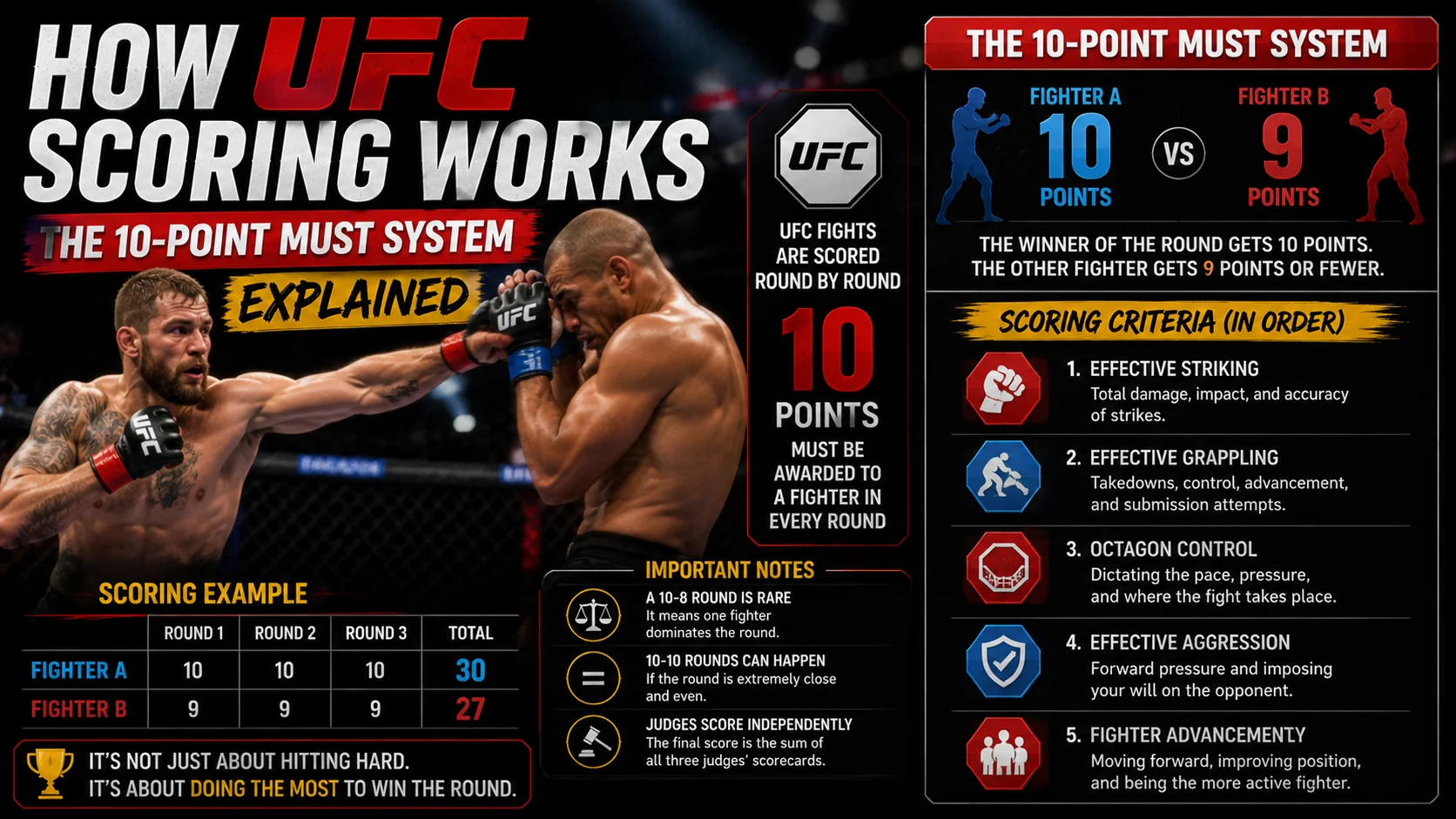
UFC scoring explained: damage first. UFC fights are scored round by round using the 10-point must system. Judges primarily evaluate effective striking and grappling, then consider effective aggression and fighting-area control when the first criteria are essentially even.
How Does UFC Scoring Work?
UFC fights are scored one round at a time by three judges using the 10-point must system. The fighter who wins a round normally receives 10 points, while the opponent receives 9 or fewer depending on how clearly they lost the round.
A close round is generally 10-9. A clearly dominant round can be 10-8, while an exceptionally one-sided round can reach 10-7. A truly even round may be scored 10-10, although it is uncommon.
The most important point for new UFC fans is this: judges do not simply count punches or takedowns. They evaluate how effective those actions are and how much they affect the fight.
UFC Scoring at a Glance
| Scoring Element | What It Means |
|---|---|
| Judges | 3 independent judges |
| Scoring system | 10-point must |
| Round winner | Normally receives 10 points |
| Close round | Usually 10-9 |
| Dominant round | Can be 10-8 |
| Extremely dominant round | Can be 10-7 |
| Even round | Can be 10-10 |
| Primary consideration | Effective striking and grappling |
| Secondary consideration | Effective aggression |
| Third consideration | Fighting-area control |
The Unified Rules of MMA provide the judging framework used across regulated MMA, including the criteria and scoring standards used for UFC bouts.
The 10-Point Must System Explained
The name sounds complicated, but the basic concept is simple.
The winner of each round is awarded 10 points.
The fighter who loses the round receives fewer points based on how competitive the round was.
For example:
Fighter A wins Round 1 → 10 points
Fighter B loses Round 1 → 9 points
That produces a 10-9 round.
The important detail is that UFC judges score each round independently. A fighter cannot win Round 3 simply because they lost Round 1 by a narrow margin. Each round starts with a fresh scoring evaluation.
What Does 10-9 Mean in UFC?
A 10-9 round is the standard score for a fighter who wins a round by a relatively close margin.
For example, imagine two fighters exchange strikes throughout five minutes. Fighter A lands more effective offense and controls the important exchanges, but Fighter B remains competitive and creates some meaningful offense.
That would typically be a 10-9 rather than a 10-8.
This is why a fighter can look noticeably better in a round without automatically receiving an eight from the judges.
What Does 10-8 Mean in UFC?
A 10-8 round represents a much clearer level of dominance.
The Unified Rules describe a 10-8 as a round in which one fighter overwhelmingly dominates through striking or grappling.
A 10-8 does not simply mean:
“The fighter got a knockdown.”
Instead, judges look at the overall effectiveness and dominance of the round.
A fighter might earn a 10-8 through a combination of:
- Significant damaging strikes
- Sustained offensive dominance
- Highly effective grappling
- Dangerous submission attempts
- Extended periods of dominant offense
The key is the gap between the fighters’ performances, not one isolated moment.
What Does 10-7 Mean in UFC?
A 10-7 round is extremely rare.
It represents a round in which one fighter is completely dominant, including situations involving near-fight-ending offense.
Think of the scale this way:
10-9 = clear but competitive advantage
10-8 = overwhelming dominance
10-7 = extraordinary, almost complete dominance
That distinction is important because not every spectacular round qualifies for a 10-8, and even fewer deserve a 10-7.
What Do UFC Judges Look For?
This is where UFC scoring becomes much more interesting.
Judges are not supposed to treat every statistic as equal. The Unified Rules establish a hierarchy for judging MMA. Effective striking and effective grappling carry the greatest weight, followed by effective aggression and fighting-area control.
1. Effective Striking
Effective striking is about the impact and effectiveness of legal offense, not simply throwing the largest number of punches.
Judges consider what a fighter accomplishes with their strikes.
For example:
A fighter lands 35 light punches with little effect.
Another fighter lands 20 clean, damaging shots that visibly affect the opponent.
The second fighter may have the stronger case for winning the striking battle because effectiveness matters more than raw volume alone.
This is one reason UFC scorecards cannot always be predicted by looking at significant-strike totals.
2. Effective Grappling
Effective grappling includes meaningful offensive grappling actions such as:
- Takedowns
- Reversals
- Advancing position
- Passing the guard
- Creating submission opportunities
- Maintaining dangerous offensive positions
The important word is effective.
A takedown that immediately leads to damaging ground-and-pound or a serious submission threat can be much more meaningful than a takedown that produces little offense.
Likewise, simply holding an opponent against the cage does not automatically guarantee a round win.
3. Effective Aggression
Aggression matters, but it is often misunderstood.
Moving forward does not automatically mean a fighter is winning the aggression category.
The official judging criteria describe effective aggression in terms of pursuing effective offensive action.
So a fighter repeatedly walking forward while getting hit is not necessarily demonstrating superior effective aggression.
Pressure must produce results.
4. Fighting-Area Control
Fighting-area control refers to who is effectively dictating:
- Pace
- Position
- Location
- Style of engagement
For example, a fighter may force the opponent into situations where they can repeatedly create meaningful offense.
But there is a critical distinction:
Cage control is not normally a substitute for effective offense.
The judging hierarchy places effective striking and grappling first. Aggression and control become more important when the higher-priority criteria do not separate the fighters clearly.
Does UFC Scoring Favor Striking or Grappling?
Neither striking nor grappling automatically wins a round.
The real question is:
Which fighter was more effective?
A fighter who spends four minutes on top but produces very little meaningful offense should not automatically beat an opponent who creates substantial damage or dangerous submission attempts.
Likewise, a fighter who lands many strikes but is repeatedly taken down and placed in dangerous positions can lose the round.
Judges evaluate the effectiveness and impact of the overall performance.
Do Takedowns Win UFC Rounds?
Not by themselves.
A takedown is an important grappling action, but it does not come with a fixed number of points.
For example:
Takedown + damaging ground strikes + submission threat
can be highly effective.
But:
Takedown + minimal offense + immediate return to the feet
may have less scoring impact.
This is why the question should not be “Who got more takedowns?”
Instead, ask:
“Who created more effective offense and meaningful impact?”
Does Damage Matter More Than Control?
In practical terms, effective offense and its impact are more important than simply holding position under the Unified Rules.
A fighter can control an opponent against the cage for a long period, but if that control produces little effective offense, it may not outweigh meaningful striking or grappling success by the opponent.
This is one of the biggest misconceptions among casual UFC viewers.
Control is not the same thing as dominance.
How Is a UFC Fight Decided?
If a UFC fight goes the distance, the three judges submit their individual scorecards.
The scores from each round are added together on each judge’s card.
The fighter who has the superior scorecard from at least two judges wins the decision.
Common decision results include:
| Decision | Meaning |
|---|---|
| Unanimous Decision | All 3 judges choose the same fighter |
| Split Decision | 2 judges choose one fighter, 1 chooses the other |
| Majority Decision | 2 judges choose one fighter, 1 scores a draw |
| Unanimous Draw | All 3 judges score the fight even |
| Majority Draw | 2 judges score a draw, 1 chooses a fighter |
| Split Draw | Judges are divided between a win and a draw |
The exact result depends on how the three individual scorecards are distributed.
How Many Judges Score a UFC Fight?
A standard UFC fight that reaches the judges is scored by three judges, each evaluating the fight independently.
The referee is not one of those judges. The referee’s role is different: they control the action inside the Octagon, enforce rules, stop fights when appropriate, and can administer penalties.
This separation is important because the person controlling the fight is not the same person deciding the scorecards.
Do UFC Judges Score the Whole Fight or Each Round?
Each round is scored separately.
This is one of the most important rules to understand.
If Fighter A dominates Round 1 but Fighter B dominates Round 2, the judge does not simply decide which fighter looked better over the first ten minutes.
Instead:
Round 1 → scored independently
Round 2 → scored independently
Round 3 → scored independently
And so on.
This creates situations where a fighter can lose the overall fight despite finishing very strongly because their opponent accumulated enough round wins earlier.
Can a UFC Fight Be a Draw?
Yes.
A UFC fight can end in a draw if the judges’ scorecards produce an overall tied result.
A 10-10 round is also technically possible when judges consider a round completely even, although it is uncommon.
Draws can also occur through combinations of different scorecards, such as a majority or split draw.
Why Do UFC Judges Sometimes Disagree?
Judging MMA is difficult because a fight can contain several different types of success.
One fighter might:
- Land more significant strikes.
The other might:
- Score multiple takedowns.
- Attempt submissions.
- Control dominant positions.
The judges must determine which performance was more effective, rather than simply adding every statistical category together.
Three judges can therefore watch the same five-minute round and reach different conclusions.
That does not necessarily mean they ignored the rules. It reflects the difficulty of evaluating complex, rapidly changing exchanges under a hierarchical scoring system.
The Biggest UFC Scoring Mistakes Fans Make
“More Punches Means You Won”
Not necessarily.
The effectiveness and impact of legal strikes matter, not just the raw number thrown.
“More Takedowns Means You Won”
Again, not automatically.
What happened after the takedown matters.
“Cage Control Wins Rounds”
Control can matter, but it sits behind effective striking and grappling in the judging hierarchy.
“A Knockdown Automatically Means 10-8”
A knockdown can be highly significant, but judges evaluate the whole round. A 10-8 requires the appropriate level of dominance; it is not an automatic score attached to one event.
“The Last Round Is Worth More”
No.
A third-round victory does not receive extra numerical value simply because it happened later. Each round is scored independently.
How to Score a UFC Fight Yourself
Want to understand a fight the way a judge does?
Try this simple process after every round.
Step 1: Ask Who Had the More Effective Offense
Look beyond volume.
Who landed the more meaningful strikes?
Who created greater damage?
Who produced the more dangerous grappling offense?
Step 2: Compare Effective Grappling
Look at:
- Takedowns
- Reversals
- Position advancement
- Submission attempts
- Ground offense
Step 3: Decide Whether the Round Was Close or Dominant
If one fighter had a narrow advantage, 10-9 is usually the starting point.
If one fighter clearly overwhelmed the other, consider whether the round meets the standard for 10-8.
Step 4: Use Aggression and Control Only When Necessary
Don’t automatically give a fighter a round because they were moving forward or controlling the center.
First determine whether effective striking and grappling separate the fighters.
UFC Scoring Example
Imagine a three-round fight:
| Round | Fighter A | Fighter B |
|---|---|---|
| Round 1 | 10 | 9 |
| Round 2 | 9 | 10 |
| Round 3 | 10 | 9 |
| Total | 29 | 28 |
Fighter A wins the fight 29-28 on that judge’s card.
Now imagine Round 2 was extremely dominant:
| Round | Fighter A | Fighter B |
|---|---|---|
| Round 1 | 10 | 9 |
| Round 2 | 8 | 10 |
| Round 3 | 10 | 9 |
| Total | 28 | 28 |
That’s a draw on that individual scorecard.
This demonstrates why a single 10-8 round can completely change the mathematics of a fight.
UFC Scoring vs. Boxing Scoring
UFC and boxing both use the 10-point must system, but MMA judging has to account for a much wider range of offense.
A UFC judge may evaluate:
- Striking
- Takedowns
- Ground-and-pound
- Submission attempts
- Positional advancement
- Reversals
- Effective aggression
- Fighting-area control
That makes MMA judging considerably more complex than simply comparing punch volume.
Final Verdict: How UFC Scoring Really Works
The easiest way to understand UFC scoring is to forget the idea that judges simply count everything a fighter does.
They don’t.
UFC rounds are judged using the 10-point must system, with the winner normally receiving 10 points and the loser receiving 9 or fewer. The most important judging consideration is effective striking and grappling, followed by effective aggression and fighting-area control when the higher-priority criteria are essentially even.
A close round is generally 10-9. A clearly dominant round can become 10-8, while a completely one-sided round can reach 10-7.
The biggest takeaway for UFC fans is simple:
Don’t ask only who did more. Ask who did more that actually mattered.
That’s the difference between watching a UFC fight and understanding how it is scored.
Frequently Asked Questions
What is the 10-point must system in UFC?
The 10-point must system means the fighter judged to have won a round normally receives 10 points, while the opponent receives 9 or fewer depending on the margin of the round.
What is a 10-8 round in UFC?
A 10-8 round is awarded when one fighter overwhelmingly dominates the other through effective striking or grappling.
What is a 10-7 round in UFC?
A 10-7 is an exceptionally rare score for a round in which one fighter is completely dominant, including situations involving near-fight-ending offense.
Do takedowns count more than strikes?
Not automatically. Judges evaluate effective striking and effective grappling as the primary judging criteria. The impact and effectiveness of the actions matter more than simply counting them.
Does UFC count significant strikes to determine the winner?
Significant-strike statistics can help describe what happened, but judges do not simply award the round to whoever has the higher statistical total. They evaluate the effectiveness and impact of the overall offense.
Does cage control matter in UFC scoring?
Yes, but it is lower in the judging hierarchy than effective striking and grappling. Fighting-area control becomes particularly relevant when the higher-priority criteria do not clearly separate the fighters.
Can UFC judges score a round 10-10?
Yes. A completely even round can be scored 10-10, although this is uncommon.
How many judges score a UFC fight?
Three judges independently score a UFC fight when it reaches the scorecards.
What does unanimous decision mean in UFC?
A unanimous decision means all three judges score the fight in favor of the same fighter.
What does split decision mean in UFC?
A split decision means two judges score the fight for one fighter while the third judge scores it for the opponent.
What does majority decision mean in UFC?
A majority decision occurs when two judges score the fight for one fighter while the third judge scores it a draw.
Why can a fighter lose despite having more strikes?
Because UFC judging is not a simple statistical contest. Judges evaluate the effectiveness and impact of striking and grappling, along with the other criteria when necessary. A fighter can have greater volume but still lose the more meaningful exchanges.
Is a knockdown automatically a 10-8?
No. A knockdown can strongly influence a round, but the judge must evaluate the entire round and determine whether the overall performance reaches the level of overwhelming dominance required for a 10-8.
Conclusion
Understanding how UFC scoring works becomes much easier once you look beyond punch counts and takedown numbers. Judges score each round independently using the 10-point must system, with effective striking and grappling carrying the most weight. Effective aggression and fighting-area control come into play when those primary criteria do not clearly separate the fighters.
A close round is usually 10-9, while overwhelming dominance can produce a 10-8 and exceptionally one-sided action can reach 10-7. That means a fighter does not need to throw the most strikes or land the most takedowns to win a round the quality, impact, and effectiveness of their offense matter most.
The next time you watch a UFC fight, don’t just ask, “Who did more?” Ask “Who was more effective?” That simple shift is the key to understanding why UFC judges score rounds the way they do and why a fight that looks close on the statistics can still produce a clear winner on the scorecards.

Daniel Brooks is a sports writer at SportsOrbitX.com, specializing in football, basketball and global sports news. He focuses on delivering accurate reporting, match analysis and timely updates that keep fans informed.