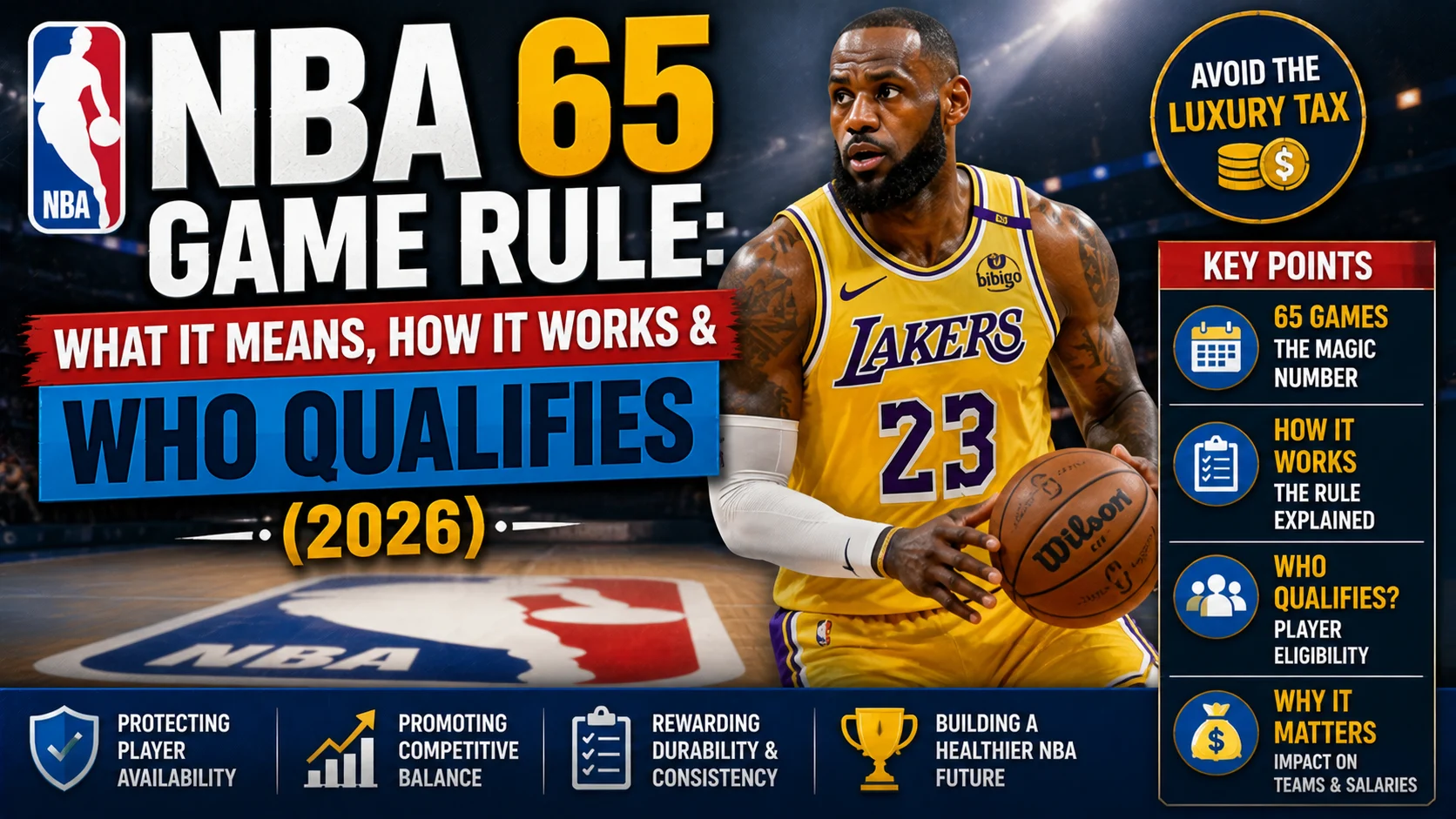
The NBA 65-game rule requires players to appear in at least 65 regular-season games to qualify for certain major awards, with a 20-minute minimum in qualifying games. Two games between 15 and 20 minutes can also count.
The rule was introduced through the NBA’s 2023 Collective Bargaining Agreement to encourage regular-season participation and reduce the impact of load management on award races.
What Is the NBA 65 Game Rule?
The NBA 65-game rule is an eligibility requirement for several major regular-season honors.
Under the current NBA-NBPA Collective Bargaining Agreement, a player generally must have 65 qualifying regular-season appearances to be eligible for:
- MVP
- Defensive Player of the Year
- Most Improved Player
- All-NBA
- All-Defensive Team
The rule became effective with the 2023-24 season as part of the new CBA.
The important word is qualifying.
Simply appearing in 65 games isn’t necessarily enough. The player must also meet the league’s playing-time requirement in those games.
NBA 65 Game Rule at a Glance
| Requirement | Current Rule |
|---|---|
| Regular-season games needed | 65 |
| Standard minutes per qualifying game | 20+ minutes |
| 15–19 minute games allowed | Maximum 2 |
| Season-ending injury exception | Possible at 62–64 games |
| Applies to MVP | Yes |
| Applies to DPOY | Yes |
| Applies to Most Improved | Yes |
| Applies to All-NBA | Yes |
| Applies to All-Defense | Yes |
| Applies to Rookie of the Year | No |
| Applies to Sixth Man | No |
The CBA also allows potential eligibility through an Award Eligibility Grievance or Extraordinary Circumstances Challenge, depending on the circumstances.
How Does the NBA 65 Game Rule Work?
The easiest way to understand the rule is to think of it as a 65-game checkpoint.
A player needs 65 qualifying games during the regular season.
But there is a second checkpoint: minutes played.
For the standard requirement, the player must play at least 20 minutes in a game for that appearance to count toward the 65-game total.
There is a small safety net: a player can have up to two games in which they play at least 15 but fewer than 20 minutes, and those games can still count.
Simple Example
Imagine a player appears in 70 games.
At first glance, it looks like there is no problem.
But suppose:
- 63 games = 20+ minutes
- 2 games = 15–19 minutes
- 5 games = fewer than 15 minutes
The player has 65 qualifying games because the two 15–19-minute appearances can count.
That’s why the NBA’s rule isn’t simply “play in 65 games.
It’s more accurately a 65 qualifying-games rule.
What Counts as a Game Under the NBA Rule?
This is where the rule becomes interesting.
A player doesn’t necessarily get credit simply because their name appears in the box score.
For award eligibility:
20 or more minutes = qualifying game
There is also a limited exception:
15–19 minutes = can count, but only for a maximum of two games
If a player participates for fewer than 15 minutes, that appearance does not satisfy the normal qualifying-game requirement.
The distinction can have major consequences late in the season.
A player might technically appear in enough games but still fall short because too many appearances came with limited playing time.
Why Did the NBA Create the 65 Game Rule?
The rule was introduced as part of the NBA’s 2023 CBA, which runs through the 2029-30 season unless an early opt-out is exercised after the 2028-29 season.
One major goal was to encourage star players to participate in more regular-season games.
For years, NBA teams increasingly managed player workloads. Stars might sit out games because of injuries, rest, scheduling, or strategic decisions.
That created a problem for awards.
Should the MVP be the player who performed at the highest level but played 55 games?
Or should award voters favor an elite player who maintained a high level over most of the season?
The 65-game requirement gives the league a clear participation standard.
In simple terms:
You can’t compete for some of the NBA’s biggest individual honors unless you are available for a substantial portion of the regular season.
Which NBA Awards Are Affected by the 65 Game Rule?
The rule directly affects five major categories of league honors:
Most Valuable Player
A player must satisfy the eligibility requirements to be considered for MVP.
That means an extraordinary statistical season can still become irrelevant to the MVP race if the player doesn’t reach the required qualifying-game threshold.
Defensive Player of the Year
The same requirement applies to DPOY.
This is particularly significant because defensive impact is often evaluated through a combination of statistics, film, matchup difficulty, team defense, and availability.
Most Improved Player
MIP is also subject to the 65-game eligibility requirement.
A player can make a huge statistical leap but lose award eligibility by falling short of the required number of qualifying games.
All-NBA
The rule has perhaps its biggest financial significance here.
All-NBA selections can influence player contract opportunities and earning potential, so missing the eligibility threshold isn’t simply about losing an award.
All-Defensive Team
Players must also meet the applicable games-played requirement to be eligible for All-Defensive recognition.
The CBA specifically identifies MVP, All-NBA, Defensive Player of the Year, All-Defense and Most Improved Player as the honors subject to this games-played requirement.
Which NBA Awards Are Not Affected?
The 65-game requirement does not apply to every NBA award.
For example, the rule does not apply to:
- Rookie of the Year
- Sixth Man of the Year
- All-Rookie Team
- Clutch Player of the Year
This distinction matters because people sometimes assume that every NBA award requires 65 games.
It doesn’t.
The CBA’s specific list is much narrower.
What Happens If a Player Plays 64 Games?
Normally, 64 qualifying games is not enough.
A player can have an MVP-level season, dominate statistically, and still be ineligible if they finish below the required threshold.
But there is an important exception for certain season-ending injuries.
Under the CBA, a player who:
- Appears in at least 62 regular-season games,
- Suffers a qualifying season-ending injury, and
- Had played in at least 85% of his team’s regular-season games before the injury
can still satisfy the eligibility requirement.
This prevents a player from being automatically punished for reaching the end of the season and then suffering a serious injury that prevents him from reaching 65 games.
The 62 Game Injury Exception Explained
Let’s make it simple.
Suppose an NBA player has appeared in 63 qualifying games.
Near the end of the season, he suffers an injury that ends his season.
Normally:
63 < 65
So he would fail the standard requirement.
However, if he satisfies the CBA’s season-ending injury conditions, he may still qualify.
The key is that the exception isn’t simply:
“If you’re injured, you get an automatic pass.”
The player has to meet the specific conditions in the CBA.
That distinction is important when discussing NBA award eligibility.
What Is the Extraordinary Circumstances Exception?
There is another route that can potentially help a player who falls short.
The CBA allows an Extraordinary Circumstances Challenge.
This gives the player an avenue to seek eligibility when unusual circumstances affected his ability to meet the standard requirement.
However, this is not an automatic exception.
The circumstances have to be evaluated under the procedures established by the CBA.
The 2025-26 season provided a clear example of how significant this provision can be.
The NBA and NBPA agreed that Cade Cunningham and Luka Dončić were eligible for the 2025-26 annual awards despite finishing with 63 and 64 qualifying games, respectively, after extraordinary-circumstances determinations. Anthony Edwards also filed a challenge, but his was denied.
That shows why the number “65” should not always be interpreted as an absolutely unbreakable line.
Why the NBA 65 Game Rule Is Controversial
The rule sounds straightforward.
But basketball isn’t played on spreadsheets.
A player can be one of the best players in the league and still miss award eligibility because of a handful of games.
That’s where the controversy begins.
Critics argue that the rule can sometimes turn awards into a competition between:
Who was the best player who played enough?
rather than simply:
Who was the best player?
Supporters argue that availability is part of value.
After all, a player can’t help his team from the bench, and fans expect star players to participate in a meaningful share of the regular season.
The debate became especially visible in recent seasons as prominent players approached or missed the threshold. The NBA’s own 2025-26 awards coverage reflects the importance of the requirement in determining which Most Improved candidates remained eligible.
Does the 65 Game Rule Help Prevent Load Management?
Yes, that is one of its major purposes.
Before the rule, a star could potentially miss a significant number of regular-season games and still win an award if his performance was dominant enough.
The new eligibility standard creates an incentive to remain available.
A player chasing MVP, All-NBA or DPOY now has another number to watch throughout the season:
65.
That changes the conversation around rest, injuries and late-season availability.
But it doesn’t eliminate load management entirely. Teams still have to balance player health, long-term performance and the demands of an 82-game schedule.
Does Missing One Game Ruin Award Eligibility?
No.
Missing one game does not automatically make a player ineligible.
The issue is the final qualifying-game total.
A player who reaches 65 qualifying games remains eligible under the standard rule even if he missed 17 regular-season games.
The danger comes when missed games accumulate to the point where the player cannot reach the required threshold.
For example:
82-game season − 17 missed games = 65 games
So, under the standard calculation, a player can miss up to 17 games and still reach 65 appearances.
But remember: the 20-minute requirement can make the calculation more complicated.
Why the 20-Minute Rule Matters So Much
Imagine a player appears in 66 games.
That sounds safely above 65.
But if several of those appearances are very short, they may not all qualify.
That’s why simply looking at Games Played (GP) in a box score isn’t always enough when evaluating award eligibility.
You also need to consider qualifying minutes.
This is one of the most important details for anyone trying to understand the NBA 65-game rule.
NBA 65 Game Rule Example
Consider this hypothetical player:
| Category | Games |
|---|---|
| 20+ minutes | 63 |
| 15–19 minutes | 2 |
| Under 15 minutes | 3 |
| Total appearances | 68 |
The player has:
63 + 2 = 65 qualifying games
Therefore, assuming all other requirements are satisfied, the player reaches the standard 65-game threshold.
Now change the numbers:
| Category | Games |
|---|---|
| 20+ minutes | 62 |
| 15–19 minutes | 2 |
| Under 15 minutes | 4 |
| Total appearances | 68 |
That’s only:
62 + 2 = 64 qualifying games
So the player falls short of the standard 65-game requirement.
That one-game difference can determine award eligibility.
How the Rule Can Affect NBA Contracts
This is the part many casual fans miss.
All-NBA selection isn’t just a trophy-case accomplishment.
Certain NBA contracts and maximum-salary opportunities can be connected to All-NBA honors and other performance-based criteria.
That means games missed during the regular season can potentially have financial consequences, not merely award-season consequences.
This is one reason the 65-game rule has attracted so much attention from players, agents and the NBPA.
The requirement was collectively bargained between the NBA and players’ union as part of the current CBA.
Is the NBA 65 Game Rule Fair?
There is no universally accepted answer.
The Case for the Rule
Supporters say it:
- Rewards availability.
- Discourages excessive resting.
- Gives award voting a consistent standard.
- Helps fans see stars more often.
- Makes regular-season participation more meaningful.
The Case Against the Rule
Critics argue it:
- Can punish injured players.
- Doesn’t account perfectly for individual circumstances.
- Can exclude elite players from awards.
- Places additional pressure on players to return from injuries.
- Treats games played as a relatively blunt measure of value.
The NBA has attempted to address some of these concerns through the season-ending injury provision and extraordinary-circumstances process.
NBA 65 Game Rule vs. Old System
The biggest difference is simple.
Before the 2023-24 season: award eligibility did not have this specific 65-game/20-minute standard in the current CBA.
Since 2023-24: certain major awards require players to meet the new participation criteria.
The change came through the NBA’s 2023 CBA, which was ratified in April 2023 and took effect on July 1, 2023.
What Fans Should Watch During the Season
If you’re following the MVP, DPOY or All-NBA race, don’t watch only points, rebounds and assists.
Keep an eye on:
Games played + qualifying minutes + remaining schedule.
A player sitting at 60 qualifying games with only a few contests left faces a very different situation from someone already at 68.
That’s why late-season award races can become as much about availability as performance.
Frequently Asked Questions
What is the NBA 65 game rule?
The NBA 65-game rule requires a player to reach 65 qualifying regular-season games to be eligible for MVP, DPOY, Most Improved Player, All-NBA and All-Defensive honors, subject to specific exceptions.
How many minutes count as a game for the NBA 65 game rule?
A player normally needs to play at least 20 minutes for the game to count. Up to two games between 15 and 20 minutes can also count.
Can a player qualify with 64 games?
Normally, no. However, certain players with 62–64 qualifying games can remain eligible if they suffer a qualifying season-ending injury or successfully receive an applicable extraordinary-circumstances determination.
Does the 65 game rule apply to MVP?
Yes. MVP is one of the awards specifically covered by the CBA’s games-played requirement.
Does the 65 game rule apply to All-NBA?
Yes. Players must satisfy the applicable eligibility requirement to be considered for All-NBA.
Does the rule apply to Rookie of the Year?
No. Rookie of the Year is not included in the five honors covered by the 65-game requirement.
Does the rule apply to Sixth Man of the Year?
No. Sixth Man is also outside the specific group of honors subject to the 65-game requirement.
Why did the NBA introduce the 65 game rule?
The rule was collectively bargained in 2023 and was designed in part to encourage regular-season participation and address concerns surrounding player availability and load management.
Can the NBA make exceptions to the 65 game rule?
Yes. The CBA provides specific pathways involving season-ending injuries and extraordinary-circumstances challenges. These are not automatic and depend on the requirements and procedures established by the agreement.
Final Verdict
The NBA 65-game rule has changed the way fans, players and teams think about individual awards. It isn’t enough for a player to produce spectacular numbers anymore; for several of the league’s biggest honors, availability has become part of the eligibility equation.
The basic formula is easy to remember:
65 qualifying games + 20 minutes per game
with up to two 15–19-minute games allowed to count. Certain season-ending injuries and extraordinary circumstances can create additional paths to eligibility.
The rule remains one of the NBA’s most debated modern policies because it sits directly between two competing ideas: rewarding the best player and rewarding the best player who was consistently available.
And that’s what makes the 65-game threshold so important. For an NBA star chasing MVP, DPOY or All-NBA recognition, the season isn’t only about what happens when the ball is in their hands. Every qualifying game can matter.

Daniel Brooks is a sports writer at SportsOrbitX.com, specializing in football, basketball and global sports news. He focuses on delivering accurate reporting, match analysis and timely updates that keep fans informed.