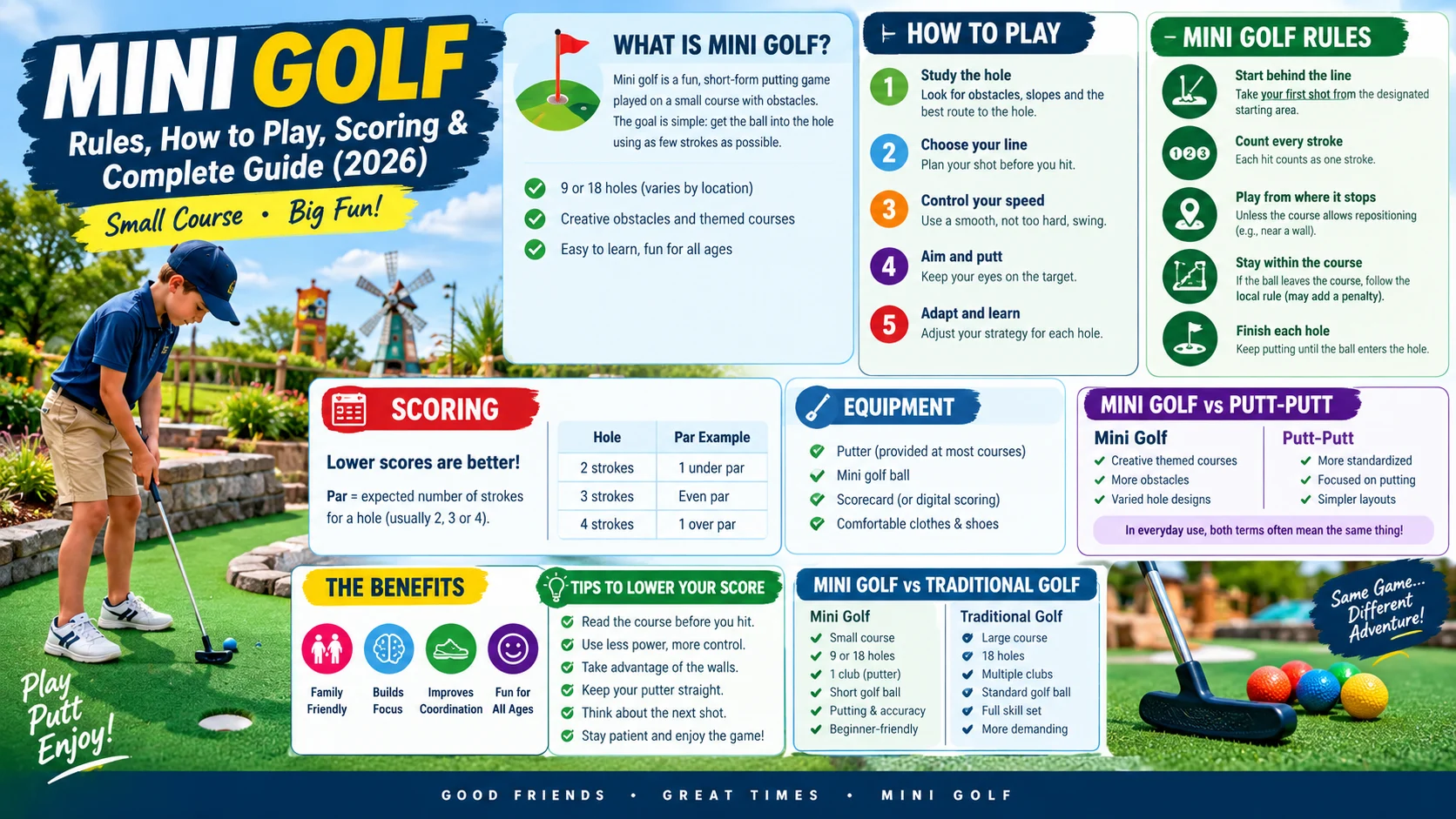
Mini golf is a short-form putting game played on a small course with obstacles, where players try to complete each hole in the fewest strokes. It is easy to learn, fun for all ages, and combines putting skill, strategy, accuracy, and creativity.
What Is Mini Golf?
Mini golf is a recreational version of golf played on a compact course with short holes, obstacles, ramps, tunnels, curves, and other creative features.
Unlike traditional golf, you do not need to walk across a large outdoor course or carry several clubs. Mini golf usually focuses on one club, one ball, and precise putting.
The objective is simple:
Get the ball into the hole using as few strokes as possible.
A typical mini golf course has 9 or 18 holes, although the exact number can vary by location. Each hole is designed differently, so players must adjust their speed, angle, and strategy from one hole to the next.
That simplicity is what makes mini golf so popular with children, families, friends, couples, and competitive players.
How Does Mini Golf Work?
The basic idea is similar to golf, but everything happens on a much smaller scale.
Players start each hole from a designated starting area and take turns hitting their balls toward the hole. Obstacles can make the route more challenging.
For example, a hole might include:
- Ramps
- Tunnels
- Walls
- Bridges
- Bank shots
- Curved barriers
- Moving obstacles
- Water features
- Narrow passages
- Windmills or other themed structures
After everyone completes the hole, the player records their score and moves to the next one.
The winner is generally the player with the lowest total score after all holes are completed.
Mini Golf Rules
Mini golf rules are generally straightforward, which is one reason beginners can start playing almost immediately.
1. Start Behind the Designated Line
Your first shot is normally taken from the marked starting area.
The ball should remain within the boundaries of the course unless a specific local rule says otherwise.
2. Count Every Stroke
Every time you hit the ball with the club, it counts as one stroke.
For example:
- First shot → 1 stroke
- Second shot → 2 strokes
- Ball reaches the hole → 3 strokes
Your score for that hole would be 3.
3. Play the Ball From Where It Stops
If the ball comes to rest somewhere on the course, you normally play the next shot from that position.
Some courses allow limited repositioning when the ball becomes extremely close to a wall or obstacle.
4. Stay Within the Course
If the ball leaves the playing surface, it may need to be returned to a designated position or the previous location depending on the course rules.
A penalty stroke may also apply.
5. Finish Each Hole
Players continue putting until the ball enters the hole.
Many recreational courses also set a maximum number of strokes per hole, such as six or seven. If a player reaches that limit, the maximum score is recorded.
How to Play Mini Golf
You do not need advanced golf skills to play mini golf. The key is controlling direction and speed.
Step 1: Study the Hole
Before hitting the ball, look at the entire layout.
Ask yourself:
- Where is the hole?
- What obstacles are between the ball and the hole?
- Is there a bank or wall that can help?
- How hard should the ball be hit?
- Is the surface sloped?
Taking a few seconds to read the hole can prevent unnecessary strokes.
Step 2: Choose Your Line
Decide where you want the ball to travel before making your shot.
The shortest route is not always the easiest route.
Sometimes a controlled bank shot against a wall provides a better angle than trying to go directly toward the hole.
Step 3: Control Your Speed
Power is often less important than control.
A ball hit too hard can bounce off an obstacle and travel far away from the hole. A softer, controlled shot can leave you with an easy second putt.
Step 4: Aim for the Hole
Keep your eyes on your target and use a smooth putting motion.
Avoid making unnecessary movements with the club.
Step 5: Learn From Every Hole
Mini golf rewards adaptation.
If your first shot on a hole is too strong, use less power on the next attempt. If the ball consistently moves left, adjust your starting angle.
Mini Golf Scoring
Mini golf scoring is one of the easiest parts of the game.
Lower scores are better.
For example:
| Hole | Player A | Player B |
|---|---|---|
| 1 | 3 | 4 |
| 2 | 2 | 3 |
| 3 | 4 | 3 |
| 4 | 3 | 5 |
| Total | 12 | 15 |
Player A has the lower score after four holes.
Many mini golf courses assign a par to each hole. A hole might have a par of 2, 3, or 4 depending on its design.
If you complete a par-3 hole in 2 strokes, you are 1 under par.
If you take 4 strokes, you are 1 over par.
What Is Par in Mini Golf?
Par is the expected number of strokes needed to complete a hole.
For example, if a hole is listed as Par 3:
- 2 strokes = 1 under par
- 3 strokes = even par
- 4 strokes = 1 over par
Par gives players a simple way to understand their performance, although casual mini golf is usually more about fun than maintaining a perfect score.
Mini Golf vs Putt-Putt
The terms mini golf and putt-putt are often used interchangeably, but they can describe slightly different styles of the game.
Traditional mini golf often emphasizes creative course design, elaborate obstacles, themes, and challenging layouts.
Putt-Putt is associated with a more standardized style of putting course in which players navigate specific types of obstacles and focus heavily on controlled putting.
In everyday conversation, however, many people simply use “mini golf” and “putt-putt” to mean the same recreational activity.
Mini Golf vs Golf
The biggest difference is scale and equipment.
| Feature | Mini Golf | Traditional Golf |
|---|---|---|
| Course size | Small | Large |
| Typical holes | 9 or 18 | 18 |
| Clubs | Usually one putter | Multiple clubs |
| Ball | Small golf-style ball | Standard golf ball |
| Main skill | Putting & accuracy | Full golf skill set |
| Walking | Limited | Often extensive |
| Obstacles | Common | Natural hazards |
| Learning curve | Beginner-friendly | More demanding |
Mini golf concentrates on putting, while traditional golf involves driving, iron shots, chipping, pitching, putting, course management, and more.
What Equipment Do You Need for Mini Golf?
One of the biggest advantages of mini golf is that you need very little equipment.
Most commercial courses provide:
- A putter
- A mini golf ball
- Scorecard or digital scoring system
You generally do not need to bring your own golf clubs.
Comfortable clothing and shoes are usually enough for a casual round.
How Long Does Mini Golf Take?
A typical 18-hole mini golf round can take approximately 30 to 90 minutes, depending on the course, number of players, difficulty, and how crowded the venue is.
A small group can take longer because players usually take turns at each hole.
The pace is also affected by course design. A simple putting course can move quickly, while a highly themed course with complicated obstacles may take considerably longer.
Is Mini Golf Hard?
Mini golf is easy to learn but can become surprisingly difficult to master.
Beginners can understand the basic concept within minutes, but advanced players can spend years improving their ability to judge:
- Distance
- Speed
- Angles
- Rebounds
- Slopes
- Bank shots
- Ball control
That combination makes mini golf suitable for both casual players and people who enjoy competition.
Mini Golf Tips for Beginners
Want to lower your score? Start with these simple techniques.
Read the Course Before You Hit
Don’t immediately swing.
Look at the slope, barriers, corners, and hole position first.
Use Less Power
New players often hit too hard.
A controlled shot is usually easier to manage than a powerful one.
Use the Walls
Walls are not always obstacles. They can also become useful tools.
A carefully planned bank shot can redirect the ball toward the hole.
Keep Your Putter Straight
A consistent putting motion helps improve accuracy.
Try to keep the clubface square to your intended line at impact.
Think About the Second Shot
Do not focus only on getting the ball near the hole.
Think about where the ball will stop.
A shot that leaves the ball close to the hole with a simple angle can be better than a risky shot that could potentially reach the hole immediately.
Stay Patient
One bad hole does not ruin the entire round.
Mini golf is a cumulative scoring game, so focus on the next hole rather than the previous mistake.
Why Is Mini Golf So Popular?
Mini golf succeeds because it combines competition and entertainment without requiring a high level of athletic ability.
It works well for:
- Family outings
- Birthday parties
- First dates
- Group activities
- School events
- Corporate gatherings
- Casual weekends
- Friendly competitions
The themed obstacles also make the experience more entertaining than simply practicing putting on a conventional golf green.
Is Mini Golf Good for Kids?
Yes. Mini golf can help children develop basic skills such as:
- Hand-eye coordination
- Distance judgment
- Focus
- Patience
- Turn-taking
- Basic strategy
It also introduces children to the concept of golf without requiring a full-size golf course.
Younger children may need shorter clubs or extra supervision, particularly around crowded courses.
Is Mini Golf Good for Adults?
Absolutely.
Adults can enjoy mini golf as a relaxed social activity, but the game also has enough strategy to create serious competition.
A well-designed course can challenge experienced players through precise angles, speed control, and increasingly difficult obstacles.
That is why mini golf works equally well as family entertainment and competitive recreation.
How to Get Better at Mini Golf
Improvement comes down to repetition and observation.
Instead of simply hitting the ball harder, focus on learning how the course behaves.
Practice:
- Straight putts
- Short-distance control
- Long-distance speed control
- Bank shots
- Angled shots
- Reading slopes
- Stopping the ball near the hole
The more you understand how speed and angle interact, the easier difficult holes become.
Mini Golf Course Design
Modern mini golf courses are often designed around a specific theme.
Popular themes include:
- Pirates
- Dinosaurs
- Space
- Adventure
- Tropical environments
- Fantasy
- Sports
- Famous landmarks
Good course design balances challenge and entertainment.
If a hole is too easy, players lose interest. If it is excessively difficult, the game can become frustrating.
The best holes create a clear challenge while still giving players a realistic path to success.
Frequently Asked Questions
What is the main goal of mini golf?
The goal is to complete all holes using the fewest total strokes.
How many holes are in mini golf?
Many courses have 9 or 18 holes, but the number can vary by venue.
Do you need golf experience to play mini golf?
No. Mini golf is designed to be beginner-friendly and can be played without previous golf experience.
Is mini golf the same as putt-putt?
The terms are often used interchangeably, although traditional mini golf and Putt-Putt can refer to different course styles.
What club is used in mini golf?
Players typically use a putter supplied by the course.
Is mini golf difficult?
The basic game is easy to learn, but advanced courses can require considerable accuracy, speed control, and strategy.
How long does an 18-hole mini golf game take?
A typical round can take around 30–90 minutes, depending on group size, course design, and crowd levels.
What is a good mini golf score?
There is no universal “good” score because course difficulty and par vary. In general, a lower score is better.
Final Thoughts
Mini golf takes one of golf’s simplest skills—putting—and turns it into a complete recreational game filled with obstacles, strategy, creativity, and competition.
Its biggest strength is accessibility. You don’t need expensive equipment, extensive golf experience or hours of practice to enjoy a round.
But once you start paying attention to angles, speed, slopes, rebounds, and ball position, mini golf becomes much more than simply hitting a ball toward a hole.
Whether you’re playing with family, competing with friends, planning a date, or trying to beat your personal best, mini golf offers a simple challenge with plenty of room to improve.

Daniel Brooks is a sports writer at SportsOrbitX.com, specializing in football, basketball and global sports news. He focuses on delivering accurate reporting, match analysis and timely updates that keep fans informed.