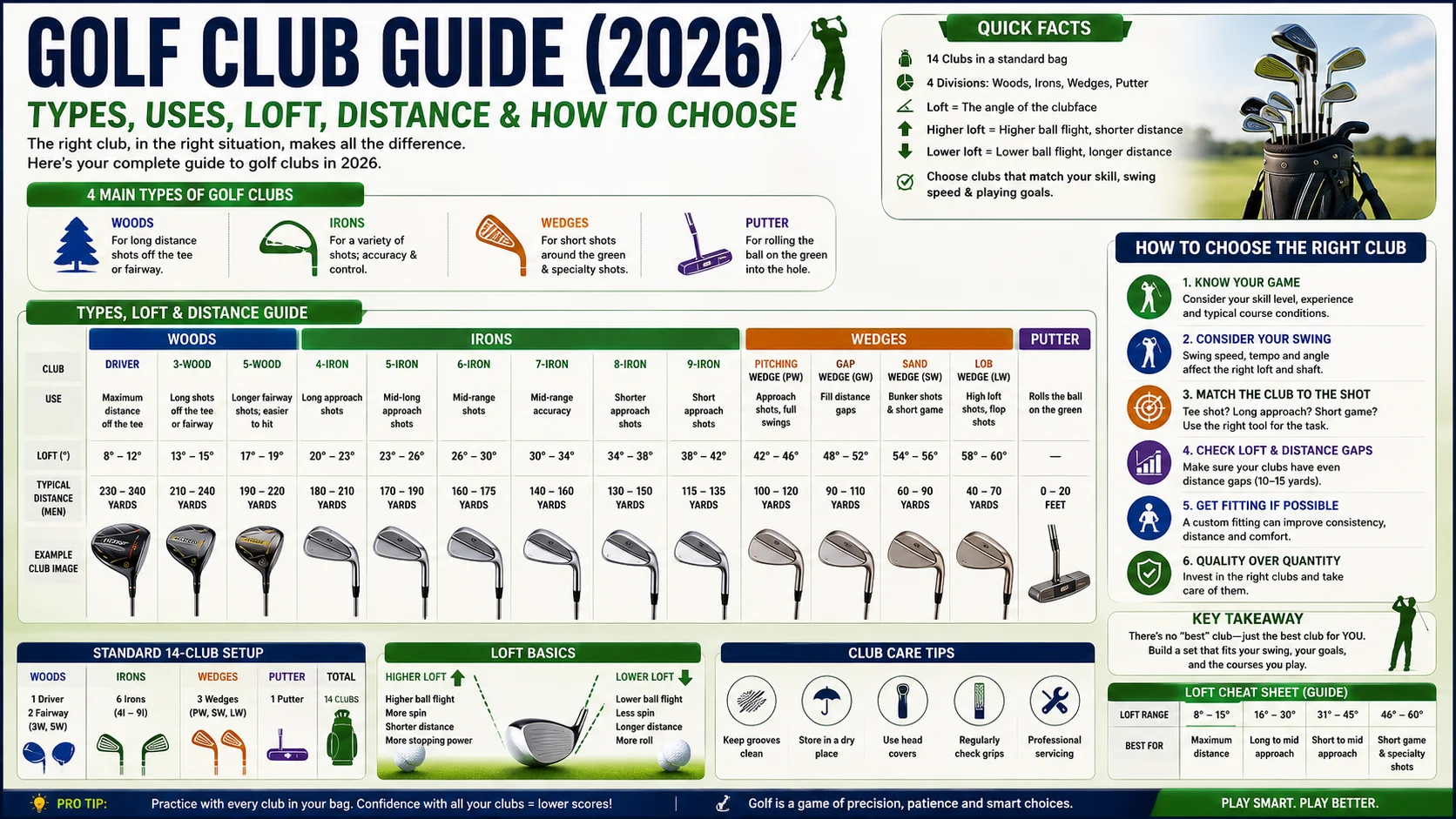
A golf club is designed for a specific shot, from powerful tee shots with a driver to precise putting on the green. Understanding club types, loft, distance, forgiveness, and fit helps golfers build a more effective bag. A good golf club can change the way a shot feels but choosing the right one is about much more than buying the newest model. The right club should match your swing, skill level, distance needs, and typical course situations.
Quick Answer: What Is a Golf Club?
A golf club is a piece of equipment used to strike a golf ball toward the hole. Modern golf clubs generally fall into four major categories: woods, irons, wedges, and putters.
Each category has a different purpose. Woods are designed primarily for longer shots, irons provide distance and control, wedges handle short-game shots, and putters are designed for shots on or around the putting green.
Under the Rules of Golf, players can carry no more than 14 clubs during a round. You can carry fewer, but exceeding the 14-club limit is not permitted.
Golf Club Types at a Glance
| Golf Club | Main Purpose | Typical Shot |
|---|---|---|
| Driver | Maximum distance | Tee shot |
| Fairway Wood | Long shots from fairway or tee | Long approach |
| Hybrid | Easier alternative to long irons | Long approach |
| Irons | Distance and accuracy | Approach shots |
| Wedges | Short shots and greenside control | Pitch, chip, bunker |
| Putter | Rolling the ball into the hole | Green |
The important thing is not simply knowing the names. Knowing when to use each club is what actually improves your golf.
1. Driver: The Distance Machine
The driver is usually the longest club in a golfer’s bag and is primarily used for tee shots on longer holes.
Its large clubhead and relatively low loft are designed to produce distance when the ball is struck correctly.
A driver is not automatically the best club for every tee shot, however. On a tight hole, a fairway wood or hybrid may provide a more controlled option.
When Should You Use a Driver?
Use a driver when:
- You have enough room to use its extra distance.
- The hole favors a long tee shot.
- You can control your driver reasonably well.
- Hazards do not make a shorter, safer club more practical.
Key point: Maximum distance is useful only when you can keep the ball in play.
2. Fairway Woods: Long Distance With More Control
Fairway woods sit between the driver and irons in terms of design and intended use.
Common examples include the 3-wood and 5-wood.
They can be useful from:
- The fairway
- The tee
- Long par-5 approaches
- Certain light rough situations
A fairway wood generally has more loft than a driver, making it easier to launch the ball from the ground.
3. Hybrid Golf Clubs: The Long-Iron Alternative
Hybrids combine characteristics of woods and irons.
For many golfers, a hybrid is easier to hit than a traditional long iron because its larger head and broader sole can make launch and turf interaction more forgiving.
A hybrid can replace clubs such as:
- 3-iron
- 4-iron
- 5-iron
The exact replacement depends on loft and the player’s individual distances.
Why Are Hybrids So Popular?
The biggest attraction is versatility.
A hybrid can be useful when you need distance without demanding the same level of precision as a long iron.
For recreational golfers who struggle with long irons, hybrids can simplify the long-game portion of the bag.
4. Irons: The Accuracy Specialists
Irons are numbered according to their loft and intended distance.
Traditional sets commonly include:
4, 5, 6, 7, 8, 9 irons + pitching wedge
Modern iron sets can vary significantly in loft, so a 7-iron from one set may not produce the same distance as a 7-iron from another.
Long, Mid and Short Irons
Long irons:
Usually 3–5 irons. Designed for longer shots but generally require more skill to strike consistently.
Mid irons:
Usually 6–7 irons. They offer a useful balance between distance and control.
Short irons:
Usually 8–9 irons. Designed for shorter approach shots and greater precision.
The goal isn’t simply to hit an iron as far as possible. Consistent distance control is usually more valuable than a single impressive shot.
5. Wedges: Where Scoring Happens
Wedges are specialized irons designed for shorter shots and higher trajectories.
Common wedges include:
- Pitching wedge
- Gap wedge
- Sand wedge
- Lob wedge
Wedges are used for approaches around the green, bunker shots, pitches, chips, and other short-game situations.
What Is Loft?
Loft is the angle of the clubface that helps determine launch and trajectory.
Generally, more loft produces a higher launch and shorter distance, while less loft tends to produce a lower launch and greater distance although actual results depend on swing speed, strike quality, shaft characteristics, and other factors.
Wedge loft gaps are particularly important because large gaps between clubs can leave awkward distance ranges in the short game.
6. Putter: The Most Used Club in the Bag
The putter is designed primarily for shots on the putting green.
Unlike a driver or iron, the objective isn’t maximum distance. The goal is distance control and direction.
A good putter should give you confidence at address and allow you to repeatedly start the ball on your intended line.
Common putter styles include:
- Blade putters
- Mallet putters
- High-MOI putters
- Face-balanced putters
- Toe-hang putters
There isn’t one putter design that automatically works for every golfer.
Golf Club Loft Explained Simply
Loft is one of the most important specifications to understand when comparing golf clubs.
A simplified example:
| Club | General Loft Trend | Main Purpose |
|---|---|---|
| Driver | Low | Maximum tee-shot distance |
| Fairway wood | Higher than driver | Long-distance shots |
| Hybrid | Moderate | Long approach shots |
| Mid iron | Moderate-high | Approach shots |
| Wedge | High | Short, controlled shots |
| Putter | Very low | Rolling the ball |
The exact loft varies by manufacturer and model.
That’s why club number alone doesn’t tell you everything.
A modern 7-iron may have a substantially different loft from another manufacturer’s 7-iron.
How Far Does Each Golf Club Go?
There is no universal distance chart that applies perfectly to every golfer.
Distance depends on:
- Swing speed
- Strike quality
- Loft
- Shaft
- Launch angle
- Ball speed
- Spin
- Weather
- Course conditions
- Player ability
Instead of asking, “How far should a 7-iron go?” a better question is:
“How consistently can I hit this club a predictable distance?”
For scoring, predictable distance is extremely valuable.
How Many Golf Clubs Can You Carry?
The Rules of Golf allow a player to have up to 14 clubs during a round. You may carry fewer, and if you start with fewer than 14, you can generally add clubs during the round up to the limit without unreasonably delaying play.
A typical 14-club setup might include:
- Driver
- 3-wood
- Hybrid
- 4-iron
- 5-iron
- 6-iron
- 7-iron
- 8-iron
- 9-iron
- Pitching wedge
- Gap wedge
- Sand wedge
- Lob wedge
- Putter
But this is only one possible setup.
A golfer who rarely uses a 4-iron may benefit more from another hybrid or wedge.
How to Choose the Right Golf Club
Buying a golf club should start with your game, not the marketing on the box.
1. Consider Your Skill Level
Beginners often benefit from clubs designed around forgiveness and easier launch.
More experienced golfers may prioritize:
- Shot shaping
- Trajectory control
- Feel
- Workability
- Specific launch and spin characteristics
2. Look at Your Misses
Your bad shots can reveal more than your best shots.
If you frequently:
- Slice the driver
- Hit irons thin
- Struggle to launch long irons
- Leave wedge distances between clubs
- Three-putt because of poor distance control
then your equipment setup may need attention.
3. Check Shaft Fit
The shaft influences how a club feels and behaves.
Factors include:
- Flex
- Weight
- Length
- Kick point/profile
- Material
The correct shaft isn’t simply “the stiffest one you can swing.” It should suit your swing characteristics and desired ball flight.
4. Don’t Ignore Club Length and Lie
Club length and lie can influence setup, strike location, and consistency.
Professional fitting can help identify whether standard specifications are appropriate or whether adjustments may be useful.
5. Test Before Buying
If possible, test multiple clubs rather than choosing based solely on appearance.
Pay attention to:
- Carry distance
- Dispersion
- Launch
- Spin
- Strike consistency
- Feel
A club that produces one spectacular shot but inconsistent results may not improve your scores.
Golf Club Materials: Steel vs Graphite
Shaft material is another important consideration.
Steel shafts are widely used in irons and can provide a heavier, stable feel.
Graphite shafts are often lighter and are common in drivers, fairway woods, hybrids, and many iron sets.
Neither material is automatically “better.” The appropriate choice depends on the golfer and the club.
What Is a Forgiving Golf Club?
A forgiving golf club is designed to reduce the performance loss from less-than-perfect strikes.
This is especially useful for recreational golfers who don’t consistently hit the center of the clubface.
Forgiveness can come from design elements such as:
- Larger clubheads
- Perimeter weighting
- High moment of inertia
- Wider soles
- Low center of gravity
- Face technology
But forgiveness shouldn’t be confused with magic.
No golf club can completely replace a repeatable swing.
Do Expensive Golf Clubs Make You Better?
Not automatically.
Modern golf equipment can provide meaningful differences in launch, distance, forgiveness, and feel, but the most expensive club isn’t necessarily the correct club for every player.
The better approach is to ask:
Does this club solve a problem in my game?
If the answer is yes, the equipment may be worth considering.
If not, lessons, practice, fitting, or better course management may have a greater effect.
What Makes a Golf Club “Legal”?
Golf clubs used in competition must conform to the applicable Equipment Rules.
The USGA explains that clubs must meet equipment specifications, and players are responsible for ensuring their clubs conform. The R&A maintains corresponding equipment rules internationally.
The rules cover areas such as:
- Clubhead design
- Shaft
- Grip
- Clubface
- Length
- Adjustability
- Other performance characteristics
The USGA’s equipment rules also state that clubs generally must have a shaft and head as a single unit, with detailed requirements governing their construction and characteristics.
Common Golf Club Mistakes
Buying for Distance Alone
A club that goes farther but creates a large dispersion pattern may not help your score.
Carrying Clubs You Never Use
The 14-club limit doesn’t mean you need exactly 14 clubs.
Ignoring Loft Gaps
Two clubs can have overlapping distances, while another important distance may be missing.
Choosing a Shaft by Label
“Regular,” “stiff,” or “extra stiff” isn’t enough information to determine the ideal shaft.
Copying a Professional’s Setup
Tour professionals have highly developed swings and highly customized equipment. Their club setup isn’t automatically appropriate for a recreational player.
Frequently Asked Questions
What are the 4 main types of golf clubs?
The four broad categories are woods, irons, wedges, and putters. Hybrids are commonly treated as a separate category because they combine characteristics of woods and irons.
What golf club should a beginner use?
Beginners often benefit from forgiving woods, hybrids, game-improvement irons, and a comfortable putter. The exact setup should match the player’s swing and physical characteristics.
How many golf clubs can you have?
Under the Rules of Golf, you can have no more than 14 clubs during a round.
Which golf club is used for the longest shot?
The driver is generally designed for the longest full shots, particularly from the tee.
What is the easiest golf club to hit?
There is no single easiest club for everyone. Many beginners find higher-lofted clubs, hybrids, and forgiving irons easier to launch and control than long irons.
What is the difference between a hybrid and an iron?
A hybrid combines design characteristics of woods and irons. Its broader sole and larger head can make it easier for many golfers to launch and strike than a comparable long iron.
Should I buy a complete golf club set?
A complete set can be convenient for beginners because the clubs are designed to work together. More experienced players may prefer building a customized bag around their distances and shot preferences.
Final Thoughts
The best golf club isn’t necessarily the newest, longest, or most expensive model. It is the club that gives you predictable results for the shot you need to play.
Start with the basics: understand club type, loft, distance, forgiveness, shaft characteristics, and gapping. Then build your set around the shots you actually face on the course.
Remember, you can carry up to 14 conforming clubs, but every club should have a purpose.
When equipment fits the golfer rather than the other way around, the bag becomes more than a collection of clubs it becomes a practical scoring tool.