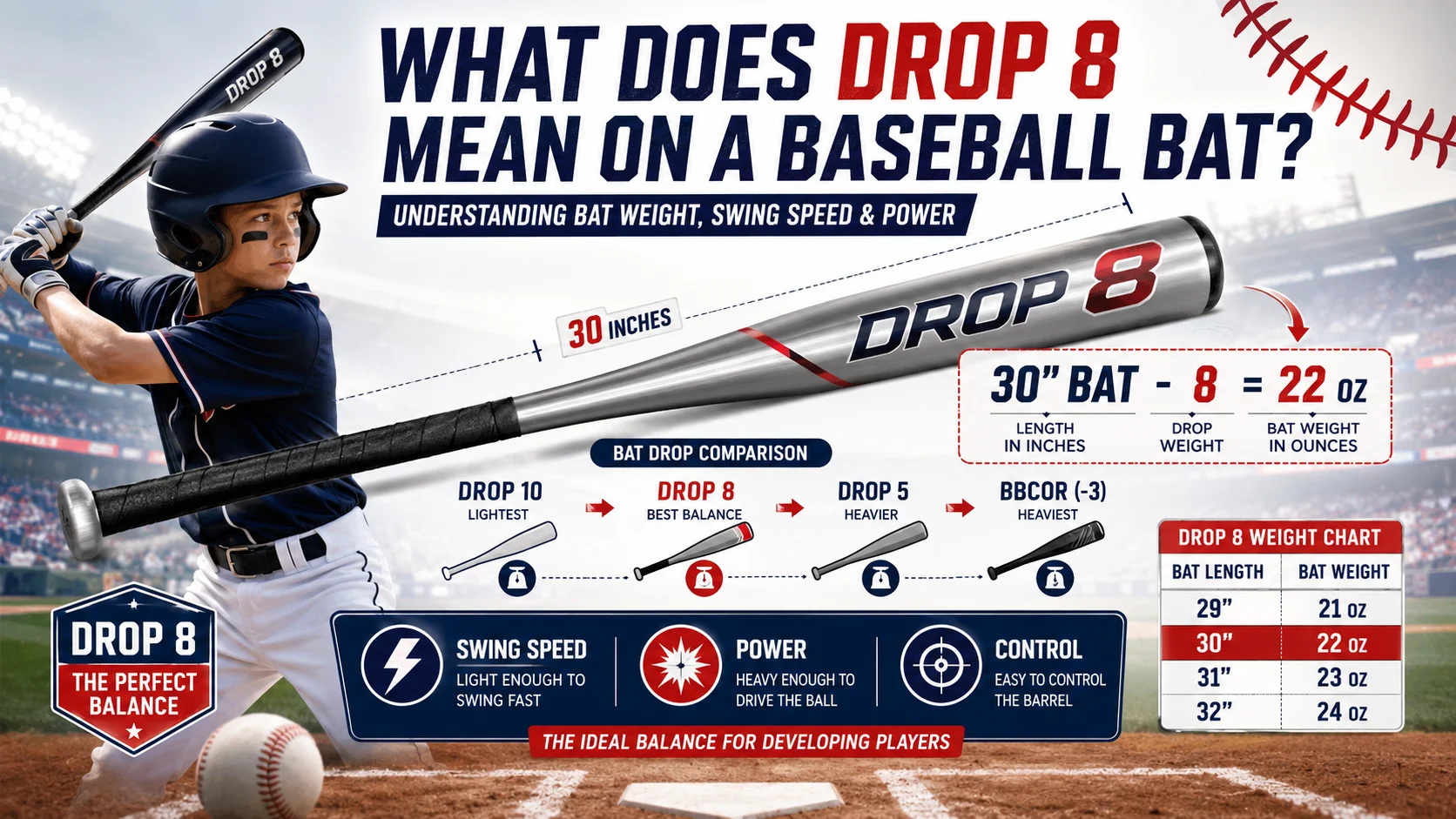
A Drop 8 baseball bat means the bat weighs 8 ounces less than its length in inches. For example, a 30-inch Drop 8 bat weighs 22 ounces (30 – 8 = 22). Drop 8 bats provide an excellent balance of swing speed and power, making them one of the most popular choices for intermediate and advanced youth baseball players transitioning to heavier bats.
Drop 8 means the bat’s weight is 8 ounces less than its length.
Examples:
| Bat Length | Drop | Bat Weight |
|---|---|---|
| 29 inches | -8 | 21 oz |
| 30 inches | -8 | 22 oz |
| 31 inches | -8 | 23 oz |
| 32 inches | -8 | 24 oz |
The lower the drop number, the heavier the bat becomes.
Quick Snapshot
| Feature | Drop 8 Baseball Bat |
|---|---|
| Meaning | Bat weighs 8 oz less than its length |
| Best For | Intermediate and advanced youth players |
| Swing Speed | Fast |
| Power Potential | High |
| Control | Excellent |
| Typical Ages | 10–14 years (varies by size and strength) |
| League Availability | USA Baseball and USSSA models available |
| Transition Level | Between lighter youth bats and heavier bats |
Understanding Baseball Bat Drop
Before choosing any baseball bat, it’s important to understand what bat drop actually means. Many parents assume Drop 8 refers to a bat model or brand, but it’s actually a measurement used throughout baseball to describe the relationship between a bat’s length and weight.
Bat drop helps players choose equipment that matches their strength, hitting style, and level of competition.
Think of it as a quick way to estimate how heavy a bat will feel during a swing.
A larger drop number means the bat is lighter.
A smaller drop number means the bat is heavier.
For example:
- Drop 12 = Very light
- Drop 10 = Light
- Drop 8 = Medium
- Drop 5 = Heavy
- Drop 3 = BBCOR adult standard
This simple number has a huge impact on swing mechanics, bat control, exit velocity, and player development.
What Does Drop 8 Mean?
A Drop 8 baseball bat simply means:
Bat Length (inches) − 8 = Bat Weight (ounces)
This is one of the easiest specifications to calculate.
Example 1
Length: 30 inches
30 − 8 = 22 ounces
Example 2
Length: 31 inches
31 − 8 = 23 ounces
Example 3
Length: 32 inches
32 − 8 = 24 ounces
Because the weight increases as the bat gets longer, every Drop 8 bat maintains the same weight-to-length relationship regardless of size.
Bat Drop Formula
The formula never changes.
Bat Weight = Bat Length − Drop
Examples:
| Length | Drop | Weight |
|---|---|---|
| 28″ | -8 | 20 oz |
| 29″ | -8 | 21 oz |
| 30″ | -8 | 22 oz |
| 31″ | -8 | 23 oz |
| 32″ | -8 | 24 oz |
| 33″ | -8 | 25 oz |
Once you understand this formula, choosing the correct bat becomes much easier.
Why Bat Drop Matters
Many players focus only on the bat’s brand, color, or material. However, experienced coaches know that bat drop affects performance far more than cosmetics.
The correct bat drop influences nearly every aspect of hitting, including:
- Swing speed
- Barrel control
- Timing
- Contact consistency
- Exit velocity
- Fatigue during games
- Confidence at the plate
Even an expensive bat won’t perform well if it’s too heavy or too light for the player.
How Drop 8 Affects Swing Speed
One reason Drop 8 bats are so popular is their balance between speed and power.
Compared to lighter bats like Drop 10, a Drop 8 requires slightly more strength to swing.
In return, hitters often generate:
- More momentum
- Better energy transfer
- Harder-hit baseballs
- Improved power without sacrificing too much bat speed
This makes Drop 8 an ideal progression for players growing stronger and preparing for higher levels of competition.
Why Many Coaches Recommend Drop 8
Youth players eventually outgrow lightweight bats.
As strength, coordination, and hitting mechanics improve, continuing to use an overly light bat can slow long-term development.
Many coaches recommend transitioning to Drop 8 because it helps players:
- Build proper swing mechanics
- Increase bat control under game speed
- Prepare for heavier bats in later age groups
- Develop stronger wrists and forearms
- Generate more consistent line drives
Rather than jumping directly from a Drop 10 to a much heavier Drop 5 or BBCOR bat, Drop 8 serves as an effective middle step.
Who Should Use a Drop 8 Baseball Bat?
A Drop 8 bat is generally best suited for players who have developed solid hitting fundamentals and enough strength to control a slightly heavier bat.
It is commonly recommended for:
- Competitive youth baseball players
- Travel baseball athletes
- Intermediate hitters
- Stronger Little League players
- Players transitioning from Drop 10
- Players preparing for Drop 5 or BBCOR bats
Instead of focusing only on age, coaches often evaluate:
- Height
- Weight
- Strength
- Swing mechanics
- Bat speed
- Confidence handling heavier equipment
A physically strong 11-year-old may comfortably swing a Drop 8, while another player of the same age may perform better with a Drop 10.
General Age Guide
| Player Age | Typical Recommendation |
|---|---|
| 7–8 | Usually Drop 10 or Drop 11 |
| 9–10 | Drop 10 or Drop 8 |
| 11–12 | Often Drop 8 |
| 13–14 | Drop 8 or Drop 5 |
| High School | BBCOR (-3) |
Note: Age alone should never determine bat selection. A player’s height, strength, league rules, and swing mechanics are equally important.
Benefits of Using a Drop 8 Baseball Bat
Choosing the right bat drop can improve both confidence and performance. A Drop 8 offers several advantages for developing players.
Excellent Balance Between Speed and Power
Drop 8 bats provide a middle ground between lightweight youth bats and heavier intermediate models. Players can still swing quickly while producing stronger contact.
Better Transition to Heavier Bats
Moving directly from a Drop 10 to a Drop 5 can feel challenging. A Drop 8 helps players adapt gradually, making future transitions smoother.
Improved Strength Development
Because Drop 8 bats require slightly more effort to swing, they encourage the development of wrist strength, forearm endurance, and better overall bat control without being overly demanding.
More Consistent Barrel Control
Many experienced hitters find that a Drop 8 bat offers better barrel awareness than very light bats. This can lead to more consistent contact and improved hitting mechanics.
Increased Exit Velocity Potential
When swung efficiently, the additional mass of a Drop 8 bat can transfer more energy to the baseball, resulting in harder-hit balls compared with lighter alternatives.
Common Misconceptions About Drop 8 Bats
There are several myths surrounding bat drop that can confuse parents and players.
Myth 1: A Lower Drop Always Means Better Performance
A heavier bat is not automatically better. If the bat is too heavy for the player, swing speed and contact quality often decrease.
Myth 2: All 12-Year-Olds Should Use a Drop 8
Age is only one factor. Strength, height, experience, and league regulations are just as important when selecting the right bat.
Myth 3: Drop 8 Is Only for Power Hitters
While stronger hitters often prefer Drop 8, many contact hitters also use it successfully because it offers a balanced combination of control and power.
Drop 8 vs. Drop 10 Baseball Bat
One of the most common questions parents ask is whether a player should use a Drop 8 or Drop 10 baseball bat. While both are popular in youth baseball, they serve different stages of player development.
A Drop 10 bat is 2 ounces lighter than a Drop 8 bat of the same length. Those two ounces may not seem significant, but they noticeably affect swing speed, control, and power.
Comparison Table
| Feature | Drop 8 | Drop 10 |
|---|---|---|
| Weight | Heavier | Lighter |
| Swing Speed | Fast | Faster |
| Power Potential | Higher | Moderate |
| Bat Control | Excellent | Excellent |
| Best For | Intermediate to advanced youth players | Beginners and younger players |
| Strength Required | Moderate | Low |
| Transition to Heavier Bats | Easier | More difficult |
When Should You Choose a Drop 10?
A Drop 10 bat is often the better option if a player:
- Is new to baseball.
- Has a smaller build or limited upper-body strength.
- Prioritizes faster swing speed.
- Is still learning proper hitting mechanics.
The lighter weight helps young players control the barrel and make consistent contact.
When Should You Upgrade to a Drop 8?
Moving to a Drop 8 makes sense when a player:
- Frequently squares up the ball with a Drop 10.
- Can maintain swing speed with a heavier bat.
- Wants to increase exit velocity.
- Is preparing for more competitive leagues.
Many travel baseball coaches view Drop 8 as the natural next step once a player has developed solid fundamentals.
Drop 8 vs. Drop 5 Baseball Bat
The jump from Drop 8 to Drop 5 is much larger than many parents expect.
Although the difference is only 3 ounces, it can significantly change how the bat feels during a game.
Comparison
| Feature | Drop 8 | Drop 5 |
|---|---|---|
| Swing Weight | Medium | Heavy |
| Swing Speed | Faster | Slightly Slower |
| Exit Velocity Potential | High | Very High |
| Strength Requirement | Moderate | High |
| Best For | Youth players | Older and stronger players |
Drop 5 bats are commonly used by:
- Middle school travel players
- Strong 13- and 14-year-olds
- Players preparing for high school baseball
If a player struggles to control a Drop 5 bat, using one too early can actually reduce hitting performance.
Drop 8 vs. BBCOR (-3)
Many players eventually transition to BBCOR (-3) bats for high school and college baseball.
BBCOR bats are significantly heavier than Drop 8 bats.
Comparison Table
| Feature | Drop 8 | BBCOR (-3) |
|---|---|---|
| Weight Difference | 8 oz lighter than length | 3 oz lighter than length |
| Typical Player | Youth | High School & College |
| Swing Speed | Faster | Slower |
| Power | High | Depends on player strength |
| League Approval | USA & USSSA (model dependent) | BBCOR leagues |
For example:
A 33-inch Drop 8 bat weighs 25 ounces.
A 33-inch BBCOR bat weighs 30 ounces.
That’s a 5-ounce increase, which is substantial over the course of a game.
This is why coaches often recommend using a Drop 8 before making the jump to BBCOR.
Is a Drop 8 Baseball Bat Good for Power Hitters?
Yes but only if the hitter can swing it efficiently.
Power doesn’t come from using the heaviest bat possible. It comes from generating:
- High bat speed
- Solid barrel contact
- Proper mechanics
- Strong hip rotation
- Efficient energy transfer
A Drop 8 bat provides slightly more mass behind the baseball than a Drop 10 while remaining manageable for most developing players.
For many youth athletes, it offers the ideal combination of:
- Power
- Control
- Bat speed
This balance makes Drop 8 one of the most versatile bat drops available.
Is a Drop 8 Better for Contact Hitters?
Many contact hitters assume they should always use the lightest possible bat.
In reality, that’s not always true.
A properly fitted Drop 8 bat can help contact hitters by:
- Improving barrel awareness.
- Creating a more controlled swing path.
- Producing harder line drives.
- Reducing weak infield pop-ups.
- Maintaining enough swing speed to react to faster pitching.
The key is choosing a bat that matches the player’s strength and mechanics not simply the lightest option available.
USA Baseball vs. USSSA Drop 8 Bats
One common misconception is that “Drop 8” refers to a specific certification. It does not.
Drop indicates the bat’s weight-to-length ratio, while USA Baseball and USSSA are certification standards that determine which leagues the bat can be used in.
USA Baseball Drop 8
USA Baseball-certified Drop 8 bats are designed for leagues that follow USA Baseball performance standards. They generally prioritize safety and balanced performance.
USSSA Drop 8
USSSA-certified Drop 8 bats often have a livelier barrel and are commonly used in travel baseball organizations that permit USSSA equipment.
Before purchasing any bat, always confirm your league’s certification requirements.
Does a Heavier Bat Always Hit Farther?
This is one of the biggest myths in youth baseball.
A heavier bat can produce more power but only if the player maintains good swing speed.
If the bat is too heavy:
- Swing speed decreases.
- Timing suffers.
- Players make weaker contact.
- Fatigue sets in faster.
- Strikeouts may increase.
A slightly lighter bat that a player can swing confidently often produces better overall results than a heavier bat that slows the swing.
Signs You’re Ready for a Drop 8 Bat
Instead of choosing a Drop 8 based only on age, look for these practical signs.
A player may be ready if they can:
- Swing a Drop 10 without losing balance.
- Maintain consistent bat speed throughout a full game.
- Drive the ball to the outfield regularly.
- Handle faster pitching without being late.
- Finish their swing with proper mechanics.
- Control the barrel through the hitting zone.
If these skills are present, moving to a Drop 8 is often a logical progression.
Signs a Drop 8 May Be Too Heavy
A bat that is too heavy can negatively affect development.
Watch for these warning signs:
- The swing starts slowly.
- The barrel drops before contact.
- The player frequently swings under the ball.
- Late swings against average pitching.
- Loss of confidence at the plate.
- Fatigue after only a few at-bats.
- Difficulty controlling the bat with one hand during drills.
If several of these issues appear after switching to a Drop 8, the player may benefit from returning to a lighter bat until they build more strength.
How Coaches Evaluate the Right Bat Drop
Experienced coaches rarely recommend a bat based solely on age. Instead, they assess a combination of physical ability, mechanics, and game performance.
Key factors include:
Height and Weight
Larger, stronger players often handle a Drop 8 more comfortably than smaller athletes of the same age.
Swing Mechanics
A player with efficient mechanics can usually control a slightly heavier bat without sacrificing bat speed.
Bat Speed
If swing speed remains consistent during batting practice and games, a Drop 8 is often an appropriate choice.
Strength and Endurance
Players should be able to complete multiple rounds of batting practice without noticeable fatigue or loss of control.
League Requirements
Always verify whether your league requires USA Baseball, USSSA, or BBCOR certification before purchasing a bat.
Expert Tip
Don’t choose a Drop 8 simply because another player on the team uses one. The best bat is the one that matches the player’s size, strength, swing mechanics, and league regulations. A well-fitted bat improves confidence, consistency, and long-term development far more than following trends or brand popularity.
How to Choose the Right Drop 8 Baseball Bat
Selecting the right Drop 8 baseball bat involves more than picking a popular brand or the most expensive model. The ideal bat should match a player’s size, strength, swing mechanics, and league requirements.
A well-fitted bat can improve confidence at the plate, increase solid contact, and help players develop proper hitting mechanics over time.
Before making a purchase, consider the following factors.
1. Check League Certification First
Before comparing bat materials or brands, confirm which certification your league requires.
| League | Common Certification |
|---|---|
| Little League | USA Baseball |
| Travel Baseball | USSSA |
| High School | BBCOR (-3) |
| College | BBCOR (-3) |
Buying the wrong certification can make an otherwise excellent bat ineligible for games.
2. Choose the Correct Length
Bat length affects reach, swing mechanics, and plate coverage.
A bat that is too long may feel difficult to control, while one that is too short can reduce hitting range and power.
General guide:
| Player Height | Suggested Bat Length |
|---|---|
| Under 4’8″ | 28–29 inches |
| 4’8″–5’0″ | 29–30 inches |
| 5’0″–5’4″ | 30–31 inches |
| Over 5’4″ | 31–32 inches |
These are starting points. The best length depends on the player’s build and comfort.
3. Consider the Player’s Strength
Not every player develops at the same pace.
Some 11-year-olds comfortably swing a Drop 8, while others perform better with a Drop 10.
Choose a bat the player can swing with:
- Smooth mechanics
- Good balance
- Consistent bat speed
- Full follow-through
- Minimal fatigue
If the swing slows noticeably, the bat is likely too heavy.
Aluminum vs. Composite Drop 8 Bats
Most Drop 8 bats are available in aluminum (alloy) or composite construction.
Each material offers unique advantages.
| Feature | Alloy | Composite |
|---|---|---|
| Ready to Use | Yes | Usually requires break-in |
| Durability | Excellent | Very Good |
| Feel | Stiffer | Smoother |
| Vibration Reduction | Moderate | Excellent |
| Sweet Spot | Smaller | Larger |
| Price | Lower | Higher |
Alloy Bats
Alloy bats are ideal for players who want:
- Immediate game-ready performance
- Excellent durability
- Lower cost
- Reliable performance in all weather conditions
Composite Bats
Composite bats are popular because they often provide:
- Larger sweet spots
- Reduced hand sting
- Better vibration control
- More forgiving contact on off-center hits
However, many composite models require a break-in period before reaching peak performance.
One-Piece vs. Two-Piece Drop 8 Bats
Bat construction also affects performance.
One-Piece Bats
One-piece bats are made from a single continuous piece of material.
Advantages include:
- Stiffer feel
- Greater energy transfer
- Better feedback
- Often preferred by stronger hitters
Two-Piece Bats
Two-piece bats connect the handle and barrel through a specialized joint.
Benefits include:
- Less vibration
- Improved comfort
- Greater barrel flex
- Easier swing for many youth players
Neither design is universally better the right choice depends on hitting style and personal preference.
Common Mistakes When Buying a Drop 8 Bat
Many parents focus on marketing claims instead of player fit.
Avoid these common mistakes.
Buying Based Only on Age
Two players of the same age can have very different strength levels.
Always consider height, weight, and swing mechanics.
Choosing the Longest Bat
Longer bats provide more reach but are harder to control.
A slightly shorter bat with consistent barrel control often leads to better performance.
Assuming Heavier Means More Power
Power comes from the combination of:
- Bat speed
- Barrel accuracy
- Efficient mechanics
A heavier bat that slows the swing usually produces weaker contact.
Ignoring League Rules
Always verify certification before purchasing.
A bat approved for one league may not be legal in another.
Buying Based Only on Brand
Popular brands produce excellent bats, but no single model is perfect for every player.
Fit matters more than the logo.
Tips for Maintaining a Drop 8 Baseball Bat
Proper care helps maximize performance and extend the bat’s lifespan.
Follow these best practices:
- Use the bat only with approved baseballs.
- Avoid striking rocks, fences, or hard surfaces.
- Store the bat in a dry environment.
- Keep it out of extreme heat or freezing temperatures.
- Rotate composite bats during break-in for even barrel wear.
- Inspect the bat regularly for dents, cracks, or loose end caps.
Routine maintenance helps ensure consistent performance throughout the season.
Expert Buying Advice
After years of coaching youth baseball and evaluating player development, one recommendation consistently stands out:
Choose the bat that the player swings best not the one with the biggest marketing campaign.
A properly fitted Drop 8 bat allows players to:
- Swing confidently.
- Stay balanced through contact.
- Develop sound mechanics.
- Transition smoothly to heavier bats in the future.
The best bat is the one that feels natural from the first swing.
Baseball Bat Drop Chart
One of the easiest ways to understand bat drop is by comparing how much a bat weighs at different drop ratings. The chart below shows the weight of common bat lengths using Drop 12 through BBCOR (-3).
| Bat Length | Drop 12 | Drop 10 | Drop 8 | Drop 5 | BBCOR (-3) |
|---|---|---|---|---|---|
| 28″ | 16 oz | 18 oz | 20 oz | 23 oz | 25 oz |
| 29″ | 17 oz | 19 oz | 21 oz | 24 oz | 26 oz |
| 30″ | 18 oz | 20 oz | 22 oz | 25 oz | 27 oz |
| 31″ | 19 oz | 21 oz | 23 oz | 26 oz | 28 oz |
| 32″ | 20 oz | 22 oz | 24 oz | 27 oz | 29 oz |
| 33″ | 21 oz | 23 oz | 25 oz | 28 oz | 30 oz |
| 34″ | 22 oz | 24 oz | 26 oz | 29 oz | 31 oz |
What This Chart Shows
As the drop number decreases, the bat becomes heavier.
For example:
- A 30-inch Drop 10 bat weighs 20 ounces.
- A 30-inch Drop 8 bat weighs 22 ounces.
- A 30-inch BBCOR (-3) bat weighs 27 ounces.
Even a small increase of two or three ounces can noticeably affect swing speed and barrel control during a game.
When Should a Player Move to a Drop 8 Bat?
There is no universal age when every player should switch to a Drop 8 bat. Instead, the decision should be based on skill development and physical readiness.
A player is often ready when they can:
- Consistently hit line drives instead of weak pop-ups.
- Maintain bat speed against faster pitching.
- Finish the swing with proper balance.
- Handle a full batting practice session without fatigue.
- Control the barrel through the hitting zone.
- Generate solid contact with a Drop 10 bat.
Making the transition at the right time helps players continue developing without sacrificing confidence or swing mechanics.
Practical Hitting Drills Before Switching to Drop 8
If you’re unsure whether a player is ready, these drills can help evaluate bat control and strength.
One-Hand Bat Control Drill
Using one hand at a time, the player performs slow, controlled swings.
This drill helps identify:
- Wrist strength
- Barrel control
- Balance
- Swing stability
Front Toss Drill
A coach or parent tosses baseballs from a short distance while the player focuses on:
- Hitting line drives
- Staying balanced
- Making consistent barrel contact
If the player can maintain good mechanics with a slightly heavier practice bat, they may be ready for a Drop 8.
Tee Work Progression
Hit 20–30 balls from a batting tee using:
- Current bat
- Slightly heavier training bat
- Drop 8 bat
Compare:
- Contact quality
- Swing speed
- Balance
- Fatigue
This progression provides valuable feedback without the pressure of live pitching.
How a Drop 8 Bat Supports Long-Term Development
Many coaches recommend transitioning gradually rather than making large jumps in bat weight.
A common progression looks like this:
| Development Stage | Typical Bat Drop |
|---|---|
| Beginner | Drop 12 or Drop 11 |
| Developing Player | Drop 10 |
| Competitive Youth | Drop 8 |
| Advanced Youth | Drop 5 |
| High School & College | BBCOR (-3) |
This gradual increase in bat weight allows players to build strength while maintaining efficient swing mechanics.
Does Bat Material Affect Drop 8 Performance?
Yes. Although two bats may both be labeled as Drop 8, they can feel very different because of their construction.
Several factors influence swing feel, including:
- Weight distribution
- Barrel design
- Handle stiffness
- Balance point
- Material composition
For example, a balanced Drop 8 bat often feels easier to swing than an end-loaded Drop 8, even if both have the same listed weight.
Balanced vs. End-Loaded Drop 8 Bats
Balanced Bats
Balanced bats distribute weight more evenly across the barrel.
Benefits include:
- Faster swing speed
- Better bat control
- Quicker reactions to fast pitches
- Easier handling for most youth players
Balanced models are a popular choice for contact hitters and all-around players.
End-Loaded Bats
End-loaded bats place more weight toward the end of the barrel.
Advantages include:
- Greater momentum through contact
- Increased power potential
- Stronger performance on well-struck balls
However, they require more strength and can reduce swing speed if the player isn’t ready.
Signs You’ve Chosen the Right Drop 8 Bat
The right bat should feel comfortable not like something the player has to fight during every swing.
Positive signs include:
- Smooth, controlled swings.
- Consistent line-drive contact.
- Good balance throughout the swing.
- Increased confidence against live pitching.
- Minimal hand sting or discomfort.
- No noticeable fatigue after several innings.
When a bat feels like a natural extension of the player’s swing, it’s usually a good fit.
Expert Insight: Bat Fit Matters More Than Brand
Many parents compare popular bat brands before considering whether the bat actually fits the player.
Experienced coaches know that proper fit has a greater impact on performance than the logo on the barrel.
Two players using the same model may experience very different results because of differences in:
- Strength
- Swing mechanics
- Height
- Timing
- Confidence
- Hitting style
A correctly fitted mid-range bat often outperforms a premium bat that is too heavy or too long.
FAQs
Will a heavier bat automatically increase home runs?
No. Power comes from a combination of bat speed, solid contact, and efficient mechanics. A bat that’s too heavy can actually reduce hitting distance.
Can my child use the same Drop 8 bat for several seasons?
Possibly. If the bat continues to fit the player’s size, strength, and league requirements, it may remain suitable. However, players should be reassessed as they grow.
Should I buy a more expensive Drop 8 bat?
Higher-priced bats often feature premium materials and advanced technology, but they are not automatically the best choice. Fit and comfort should always come before price.
What does Drop 8 mean on a baseball bat?
A Drop 8 bat weighs 8 ounces less than its length in inches. For example, a 30-inch Drop 8 bat weighs 22 ounces.
Is a Drop 8 bat heavier than a Drop 10?
Yes. A Drop 8 bat is 2 ounces heavier than a Drop 10 bat of the same length.
Who should use a Drop 8 baseball bat?
Drop 8 bats are generally best for intermediate and advanced youth players with the strength and mechanics to control a slightly heavier bat.
Is a Drop 8 good for a 12-year-old?
It can be. Many competitive 12-year-olds successfully use Drop 8 bats, but the right choice depends on the player’s height, strength, swing mechanics, and league rules.
Is Drop 8 better than Drop 10?
Neither is universally better.
Drop 10 emphasizes swing speed and control, while Drop 8 offers a stronger balance between power and bat speed.
The best option depends on the individual player.
Can beginners use a Drop 8 bat?
Some beginners can, but many younger or smaller players benefit from starting with a lighter Drop 10 or Drop 11 bat before progressing to Drop 8.
Does a Drop 8 bat hit farther?
Not automatically.
Distance depends on solid contact, swing speed, and proper mechanics. A well-fitted Drop 8 bat may help stronger players generate greater exit velocity than a lighter bat.
Is a Drop 8 bat legal in every league?
No. Legality depends on both the bat’s certification (such as USA Baseball or USSSA) and your league’s equipment rules. Always check league requirements before purchasing.
Final Expert Recommendation
If you’re considering a Drop 8 baseball bat, focus on the player not just the bat.
Ask these questions before buying:
- Can the player maintain good swing mechanics?
- Is bat speed consistent?
- Does the player make solid contact regularly?
- Is the bat approved for the league?
- Does the bat feel comfortable during a full practice session?
If the answer is yes to all of these, a Drop 8 bat is likely an excellent choice.
Conclusion
Understanding what a Drop 8 means on a baseball bat is essential for choosing equipment that supports both performance and long-term development. A Drop 8 bat weighs 8 ounces less than its length in inches, offering a balanced combination of swing speed, control, and power that suits many competitive youth players.
While Drop 8 is a popular transition option, there is no one-size-fits-all solution. The best bat is the one that matches the player’s physical development, hitting mechanics, confidence, and league requirements. By evaluating factors such as bat length, weight, certification, material, and balance, players and parents can make an informed decision that promotes consistent improvement at the plate.
Rather than chasing trends or relying solely on age-based recommendations, prioritize proper bat fit and regular skill development. A well-chosen Drop 8 bat can help players build stronger mechanics today while preparing them for the demands of Drop 5 and BBCOR bats in the future.

Emily Parker is a sports journalist at SportsOrbitX.com with a passion for covering cricket, tennis and major international sporting events. She is committed to producing clear, reliable and engaging content for sports enthusiasts worldwide.