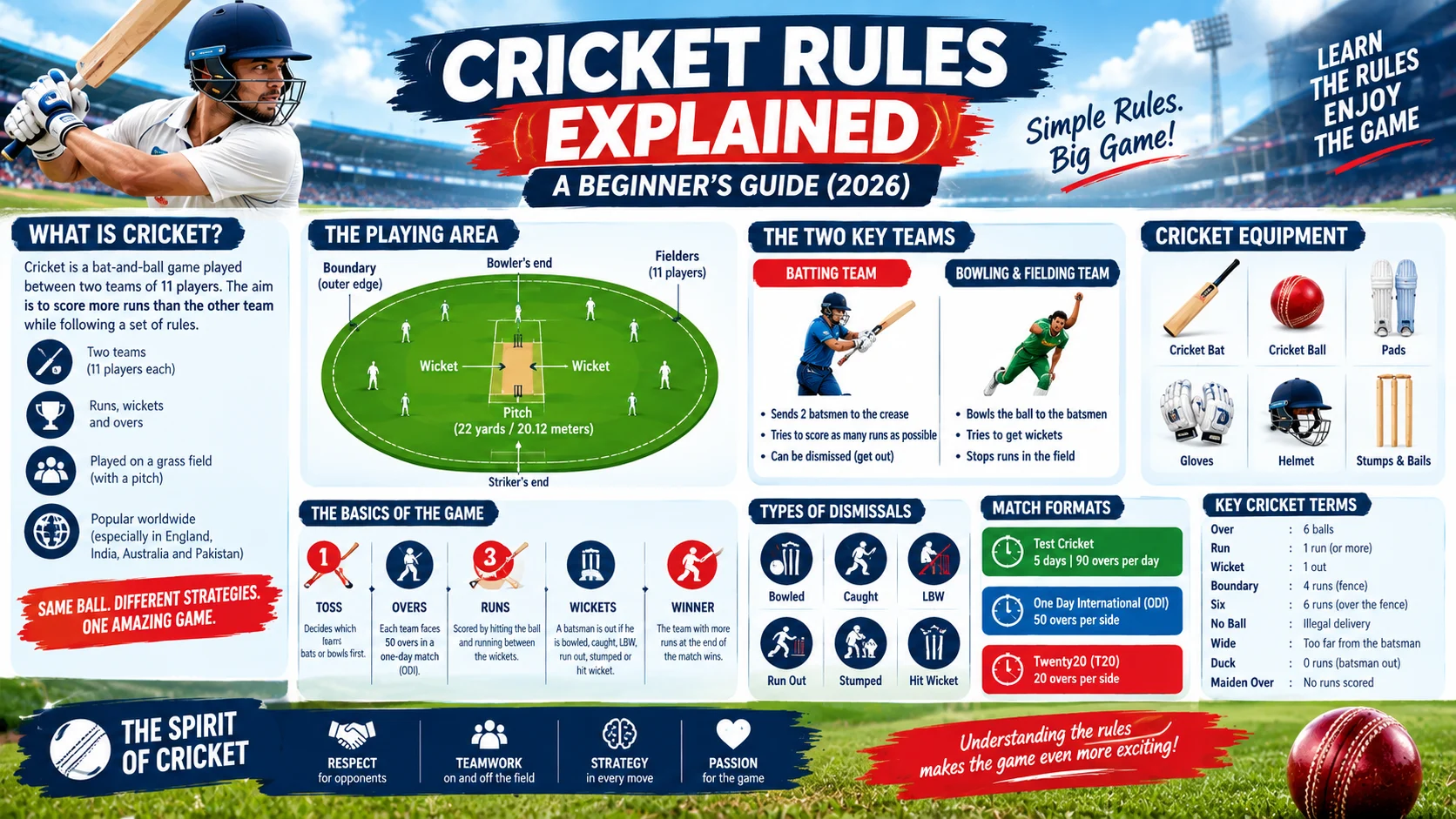
Cricket is played between two teams of 11 players on an oval field, with a rectangular 22-yard pitch in the middle. One team bats and tries to score runs, while the other bowls and fields, trying to get batters out. Runs are scored by hitting the ball and running between two sets of stumps, or by hitting the ball to the boundary for an automatic four or six runs. A team’s batting turn, called an innings, ends when ten batters are out or a set number of overs is completed. Whichever team scores more runs across the match wins.
Turn on a cricket match for the first time and it can look like organized chaos a bowler sprinting in, a batter guarding three sticks, fielders scattered in a giant circle, and a scoreboard full of numbers that mean nothing to a first-time viewer. But underneath the unfamiliar vocabulary, cricket runs on a fairly simple core idea: one team tries to score more runs than the other, while defending a target called a wicket. Once that clicks, everything else is detail.
With Major League Cricket growing fast across the United States and cricket returning to the Olympic program in 2028, more American sports fans are looking for a plain-English explanation of how the game actually works. This guide covers the essentials teams, equipment, scoring, dismissals, and formats without assuming any prior knowledge.
The Basic Setup
A cricket match involves two teams of 11 players each. At any given moment, only two batters from the batting team are on the field, standing at opposite ends of the pitch, while the entire fielding team including a bowler and a wicket-keeper is spread across the ground.
The pitch is the 22-yard strip at the center of the field, with a set of three wooden stumps and two bails standing at each end. These stumps are the target the bowler is trying to hit, and the target the batter is trying to protect.
How Scoring Works
Batters score runs in two main ways.
The first is by running. When the ball is hit into the field, the two batters can choose to run between the wickets, swapping ends. Each completed run between the wickets counts as one run. They can run multiple times off a single hit if there is time before the fielders return the ball.
The second is by hitting a boundary. If the ball is hit along the ground and crosses the boundary rope, it is worth four runs automatically, with no running required. If the ball clears the boundary in the air, it is worth six runs, similar in spirit to a home run in baseball.
Runs can also come from the bowling side’s mistakes, including wides (a ball bowled too far from the batter) and no-balls (an illegal delivery, often for overstepping the bowling line), both of which award an extra run to the batting team.
| Way to Score | Runs Awarded | Running Required? |
|---|---|---|
| Running between wickets | 1 run per completed run | Yes |
| Boundary (along the ground) | 4 runs | No |
| Boundary (in the air, over the rope) | 6 runs | No |
| Wide or no-ball | 1 extra run | No |
How Batters Get Out
A batter’s turn at the crease ends when they are dismissed. There is no strike limit like in baseball a batter can defend the ball for as long as they are able to, and they are only out through one of several specific dismissal methods.
Bowled means the ball hits the stumps directly and knocks off a bail. Caught means a fielder catches the ball on the full before it touches the ground, after the batter has hit it. Leg before wicket, or LBW, means the ball strikes the batter’s leg (or body) in a position where it would otherwise have gone on to hit the stumps. Run out happens when a fielder breaks the stumps with the ball while the batters are attempting a run and are not safely in their crease. Stumped is when the wicket-keeper breaks the stumps while the batter has stepped out of their crease to face a delivery.
| Dismissal | How It Happens |
|---|---|
| Bowled | Ball hits the stumps directly |
| Caught | Fielder catches the ball before it bounces |
| LBW | Ball strikes the batter’s body and would have hit the stumps |
| Run out | Stumps broken while batters are running between ends |
| Stumped | Wicket-keeper breaks the stumps while batter is out of the crease |
An innings ends once ten of the eleven batters are dismissed (since a batter always needs a partner at the other end), or once the team has faced the allotted number of overs, depending on the format.
Bowling Basics
A bowler delivers the ball with a straight arm bending the elbow during the release is illegal and called a throw, or “chucking.” Bowlers run up to the crease and release the ball so that it typically bounces once before reaching the batter, using variations in speed, seam position, and spin to try to deceive them.
An over consists of six legal deliveries bowled from one end, after which a different bowler takes over from the opposite end. This rotation continues throughout the innings.
The Wicket-Keeper and Fielders
The wicket-keeper is the only fielder with a fixed, specialist role, standing behind the stumps at the batter’s end to collect deliveries the batter misses and to attempt stumpings or catches. Every other fielding position names like slip, gully, cover, mid-on, and long-off can be moved around by the captain at any time between deliveries, based on the batter’s strengths, the bowler’s plan, and the match situation.
The Three Formats
Cricket is not played in a single fixed format the way baseball is. The three main formats differ mainly in how many overs (or days) each team gets to bat.
Twenty20 (T20) is the shortest and most popular modern format, with each team facing a maximum of 20 overs. Matches last around three hours, making it the closest cricket gets to the pace of a baseball or basketball broadcast. This is the format used by Major League Cricket in the United States.
One Day Internationals (ODIs) give each team 50 overs, with matches lasting roughly eight hours and completed in a single day.
Test matches are the sport’s oldest and most prestigious format, played over five days, with each team batting twice (two innings). Unlike T20 and ODI cricket, a Test match can end in a draw if the match is not completed within the five days.
| Format | Overs per Side | Typical Duration |
|---|---|---|
| T20 | 20 overs | About 3 hours |
| ODI | 50 overs | About 8 hours (1 day) |
| Test | Unlimited (2 innings each) | Up to 5 days |
Why the Rules Feel Unfamiliar to American Fans
Most of the confusion for new fans comes from three things that baseball simply does not have: no strike limit for batters, scoring that happens continuously rather than in discrete plays, and a field with no foul territory, meaning a ball can legally be hit in any direction. Once those three differences are understood, the rest of cricket’s vocabulary overs, wickets, boundaries becomes much easier to follow.
Interesting Facts
- A cricket over (six balls) has no direct baseball equivalent, since baseball outs are tracked per batter rather than per set of deliveries.
- A single batter can face an entire Test match innings without ever being dismissed, in theory batting for days.
- The wicket-keeper is the cricket position most similar to a baseball catcher, but with no chest protector or mask required in most formats.
- Cricket’s LBW rule is widely considered the hardest rule for new fans to understand, even though it exists to stop batters from simply blocking the ball with their legs.
- Major League Cricket’s Season 4 runs June 18 to July 18, 2026, using the fast-paced T20 format that is easiest for new fans to follow.
- A “duck” in cricket means a batter is dismissed without scoring a single run, similar in spirit to a golden sombrero in baseball.
Frequently Asked Questions
How many players are on a cricket team? Each cricket team has 11 players, though only two batters from the batting side are on the field at any one time, along with the full 11 fielders from the opposing team.
How does a team win a cricket match? The team that scores more total runs across the match wins. In Test cricket, a team can also win by dismissing all ten of the opposing team’s available batters (an innings win), or the match can end in a draw if time runs out.
What is an over in cricket? An over is a set of six legal deliveries bowled by one bowler from one end of the pitch, after which a different bowler continues the over count from the other end.
Why is LBW so confusing? LBW asks the umpire to judge where the ball would have gone had it not hit the batter’s body, which involves interpreting line, height, and trajectory in real time. It is a judgment call, which is why it remains one of the most debated rules in the sport.
Can a batter be out without the bowler getting credit? Yes. Run outs, for example, happen because of fielding, not bowling, so the dismissal is credited to the fielding side rather than to the bowler individually.
Is cricket similar to baseball? They share historical roots and some surface similarities a bat, a ball, and run-scoring but the rules for batting, outs, fielding, and match length are substantially different. A separate comparison breaks down those differences in full.
What is the easiest cricket format for a beginner to watch? Twenty20 (T20) is generally the easiest entry point, since it lasts about three hours, similar to a baseball game, and produces frequent boundaries and a faster pace than ODI or Test cricket.
Conclusion
Cricket looks complicated from the outside, but its foundation is straightforward: score more runs than the other team while defending your wicket. The details that feel foreign at first no strike limit, continuous scoring, three formats instead of one are exactly what give the sport its depth once they make sense.
For American fans just getting started, watching a T20 match, especially a Major League Cricket game, is the easiest way to see these rules in action at a pace that already feels familiar.

Emily Parker is a sports journalist at SportsOrbitX.com with a passion for covering cricket, tennis and major international sporting events. She is committed to producing clear, reliable and engaging content for sports enthusiasts worldwide.