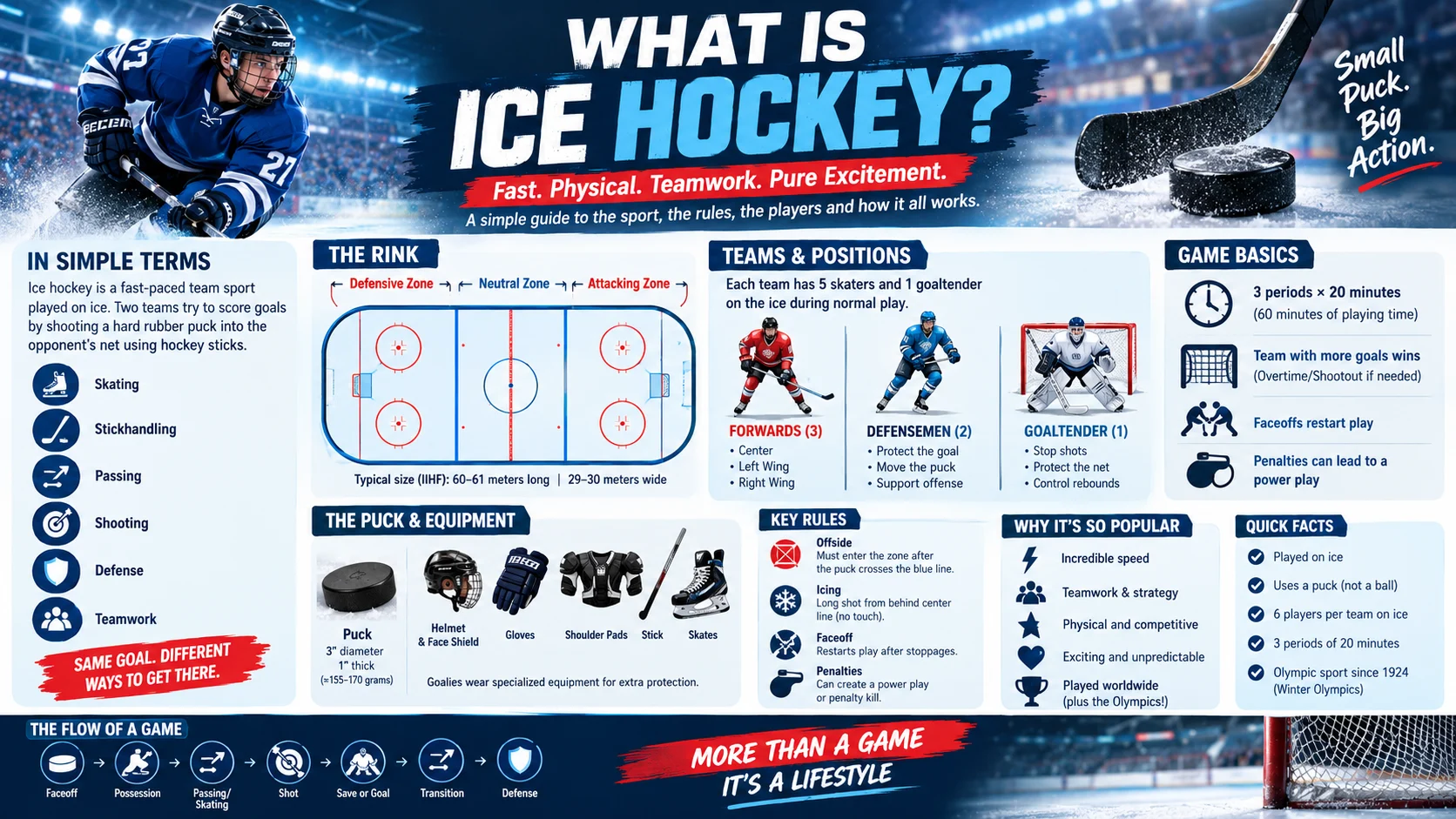
Ice hockey is a fast-paced team sport played on ice, where players use sticks to move a hard rubber puck and score goals against the opposing team. Each team normally has five skaters and a goaltender on the ice, with the game built around skating, passing, shooting, checking, teamwork, and quick changes of possession.
What Is Ice Hockey in Simple Terms?
Ice hockey is a competitive team sport played on a sheet of ice. Two teams try to score by shooting a small rubber puck into the opponent’s goal using hockey sticks.
What makes hockey different is its speed. Players can accelerate, change direction, pass, shoot, defend, and battle for the puck while skating on narrow blades. A game can shift from defense to a scoring opportunity within seconds.
Under international rules, a team has five skaters and one goaltender on the ice during normal full-strength play. Teams can make substitutions during play, allowing fresh players to enter while others leave.
At its heart, ice hockey combines:
- Skating skill
- Stickhandling
- Passing
- Shooting
- Defensive positioning
- Physical play
- Teamwork
- Speed and reaction time
That combination is what gives hockey its distinctive, high-energy style.
How Does Ice Hockey Work?
The basic objective is simple: score more goals than the other team.
Players control the puck with their sticks and attempt to create scoring opportunities. The defending team tries to regain possession, block passing lanes, protect its goal, and prevent shots.
A regulation game consists of three 20-minute periods, with intermissions between them. The clock stops during certain stoppages, so the actual time required to watch a game is considerably longer than 60 minutes.
The team with the most goals after regulation wins. If a competition requires a winner and the score remains tied, overtime and, where applicable, a shootout can determine the result. Exact overtime formats can vary by competition.
The Basic Flow of a Hockey Game
A typical sequence looks like this:
Faceoff → puck possession → passing/skating → attacking chance → shot → save or goal → transition → defense
The action constantly moves between the two ends of the rink. This rapid transition is one reason new viewers often find hockey exciting but initially difficult to follow.
How Many Players Are on an Ice Hockey Team?
During normal full-strength play, each side has:
| Position | Players on Ice | Main Job |
|---|---|---|
| Goaltender | 1 | Stop shots and protect the goal |
| Defensemen | 2 | Defend and move the puck out of the zone |
| Forwards | 3 | Attack, create chances and score |
| Total | 6 | 5 skaters + 1 goalie |
The three forwards normally consist of a center, left wing, and right wing. Teams also use defensemen and a goaltender.
Professional and international teams have larger rosters than the six players actually on the ice because players rotate in and out throughout the game.
What Are the Positions in Ice Hockey?
Understanding the positions makes the sport much easier to watch.
Center
The center usually operates in the middle of the forward line. Centers are heavily involved in faceoffs, passing, offensive creation, and defensive support.
A good center must be comfortable attacking and defending because the position connects different parts of the game.
Left Wing and Right Wing
The two wings play on the sides of the forward line. Their responsibilities include creating scoring opportunities, supporting the center, forechecking, and helping the defense when possession changes.
Defensemen
Defensemen protect their own end of the rink and attempt to stop opposing attacks before they become dangerous.
They also play an important offensive role by moving the puck, making passes, and taking shots from farther away.
Goaltender
The goaltender, or goalie, is the last line of defense.
The goalie uses specialized equipment to stop shots and control rebounds. Positioning, reaction speed, anticipation, and puck tracking are critical skills.
What Is the Ice Hockey Rink?
The playing surface is called a rink. It is enclosed by boards and protective glass, with markings that help officials and players apply the rules.
For IIHF competitions, the rink is generally 60–61 meters long and 29–30 meters wide. The playing surface contains a center red line, two blue lines, faceoff circles, goal creases, and other markings.
The Three Main Zones
The two blue lines divide the rink into three major areas:
- Defensive zone — where a team protects its own goal
- Neutral zone — the middle section of the rink
- Attacking zone — where a team tries to create scoring chances
Knowing these zones helps explain important rules such as offside.
What Is the Puck in Ice Hockey?
The puck is the object players try to control and shoot into the goal.
An official ice hockey puck is a flat, black, vulcanized-rubber disc approximately 7.6 cm (3 inches) in diameter and 2.5 cm (1 inch) thick, with a weight of roughly 155–170 grams under IIHF terminology.
Pucks are commonly frozen before use because the cold makes them less bouncy and easier to control during play.
How Do You Score in Ice Hockey?
A goal is scored when the puck completely crosses the goal line between the goalposts and underneath the crossbar.
Each goal counts as one point on the scoreboard for the team that scored it.
Unlike some sports, hockey can produce very rapid scoring changes. A team that is defending one moment can create a breakaway and score seconds later.
This constant transition is one of the sport’s biggest attractions.
What Are the Basic Rules of Ice Hockey?
You do not need to memorize the entire rulebook to understand a hockey game. Start with these essential rules.
Offside
Offside generally occurs when an attacking player enters the attacking zone before the puck crosses the blue line.
In simple terms:
The puck must enter the attacking zone before the attacking player does.
The rule prevents attackers from simply waiting deep in the offensive zone for a long pass.
Icing
Icing occurs when a team shoots the puck from behind the center red line across the opponent’s goal line without another player touching it, subject to specific rule exceptions.
When icing is called, play stops and a faceoff follows in the appropriate defensive-zone location.
Faceoff
A faceoff restarts play after certain stoppages.
An official drops the puck between opposing players, who compete to gain possession for their team.
Faceoffs take place at designated spots throughout the rink.
Penalties
Players can be penalized for breaking rules involving actions such as illegal stick use, tripping, hooking, dangerous contact, or other prohibited behavior.
A penalty can force a team to play with fewer skaters while the opponent receives a power play.
This creates one of hockey’s most important tactical situations: attacking with a numerical advantage.
What Is a Power Play in Ice Hockey?
A power play happens when one team has more skaters on the ice because an opposing player has been penalized.
For example, a team may have a five-on-four advantage.
The team on the power play usually tries to move the puck quickly, create passing lanes, move defenders out of position, and generate a high-quality shot.
The short-handed team focuses on protecting its goal, blocking shots, disrupting passes, and clearing the puck.
What Equipment Do Ice Hockey Players Wear?
Ice hockey is played at high speed, so protective equipment is essential.
Typical equipment includes:
- Helmet
- Face protection
- Shoulder pads
- Elbow pads
- Hockey gloves
- Hockey pants
- Shin guards
- Skates
- Hockey stick
- Protective athletic equipment
- Goaltender-specific equipment
Goalies wear substantially different equipment because they face direct shots from players.
A hockey stick is used for passing, puck control, shooting, and defensive play, while skates provide the speed and agility needed to move across the ice.
Why Is Ice Hockey So Fast?
The speed comes from several factors working together.
First, players skate rather than run. Second, the puck moves quickly across a smooth surface. Third, players can pass the puck ahead of themselves, allowing it to travel faster than an individual player.
There are also frequent substitutions. Players typically take relatively short shifts before returning to the bench for recovery. IIHF terminology notes that many shifts last 50 seconds or less, although actual shift length varies by situation and player.
This creates a rhythm of:
Explode → Attack → Defend → Change → Repeat
Is Ice Hockey a Physical Sport?
Yes, physical contact is an important part of many forms of ice hockey, although exactly what contact is legal depends on the applicable rules and level of play.
Checking can be used defensively to separate an opponent from the puck or prevent an advance. However, illegal contact can result in penalties.
The IIHF describes checking as legal contact against a player who is controlling the puck or has just controlled it, while prohibited forms of contact are addressed through the rules.
At youth and recreational levels, rules regarding body contact can differ significantly, so players should follow their league’s specific regulations.
Where Did Ice Hockey Come From?
The history of ice hockey developed over time rather than from a single moment or inventor.
Games involving sticks and balls have ancient roots, but modern ice hockey developed in Canada and evolved into an organized sport during the 19th century.
The IIHF identifies the March 3, 1875 game at the Victoria Skating Rink in Montreal as the first organized indoor game of ice hockey. Early versions of the sport used different numbers of players and rules than the modern game.
Ice hockey later became an international sport governed by organizations such as the International Ice Hockey Federation.
When Did Ice Hockey Become an Olympic Sport?
Ice hockey made its Olympic debut at the 1920 Summer Olympics in Antwerp before becoming part of the first Winter Olympics in Chamonix in 1924.
Women’s ice hockey was added to the Olympic program at the 1998 Winter Olympics in Nagano.
Today, international hockey includes men’s and women’s competitions at multiple levels, from youth tournaments to world championships and Olympic competition.
Ice Hockey vs Field Hockey: What’s the Difference?
Despite sharing the word “hockey,” ice hockey and field hockey are substantially different sports.
| Feature | Ice Hockey | Field Hockey |
|---|---|---|
| Playing surface | Ice | Field/turf |
| Main object | Puck | Ball |
| Movement | Ice skates | Running |
| Stick | Ice hockey stick | Field hockey stick |
| Typical pace | Very fast | Fast |
| Protective gear | Extensive | Different, generally lighter |
| Main goal | Score puck into net | Score ball into goal |
The biggest visual difference is obvious: ice hockey is played on skates with a puck, while field hockey is played on a field with a ball.
What Skills Do You Need to Play Ice Hockey?
A strong hockey player needs more than shooting ability.
Skating
Skating is the foundation. Players need acceleration, balance, stopping ability, edge control, and the ability to change direction quickly.
Stickhandling
Stickhandling means controlling the puck with the stick while moving.
Advanced players can manipulate the puck while skating at speed and under defensive pressure.
Passing
Passing allows teammates to move the puck faster than defenders can react.
Accurate passing is especially important when breaking out of the defensive zone or creating scoring opportunities.
Shooting
Players use different shooting techniques, including wrist shots, slap shots, backhand shots, and other variations.
Hockey IQ
Players must constantly read the ice:
Where is the puck? Where are my teammates? Where are the defenders? Where will the next passing lane open?
That decision-making ability is often just as important as physical skill.
Why Do People Love Ice Hockey?
Ice hockey has a unique combination of speed, skill, physical competition, strategy, and unpredictability.
One second can show a defensive battle along the boards; the next can produce a breakaway and a goal.
The sport also rewards teamwork. Players must coordinate line changes, defensive coverage, passing routes, forechecking, and offensive movement.
The IIHF describes ice hockey as a sport built around skill, speed, discipline, and teamwork, values that also make it accessible as both a competitive and recreational activity.
Ice Hockey Terms Every Beginner Should Know
| Term | Simple Meaning |
|---|---|
| Puck | Hard rubber disc used in the game |
| Rink | Ice playing surface |
| Faceoff | Method used to restart play |
| Goal | Puck completely crosses the goal line |
| Offside | Attacker enters the zone before the puck |
| Icing | Illegal long-distance puck clearance under the rule |
| Power play | Numerical advantage after an opponent’s penalty |
| Penalty kill | Defending while short-handed |
| Forecheck | Pressure applied in the offensive zone |
| Backcheck | Defensive effort while skating back |
| Crease | Protected area around the goal |
| Shift | Time a player stays on the ice before changing |
| Breakaway | Attacker gets a clear scoring opportunity |
| Save | Goalie stops a shot |
| Shootout | One-on-one style tiebreaker after required overtime |
Is Ice Hockey Hard to Learn?
Ice hockey can have a steep learning curve because players must learn to skate and control a puck at the same time.
For beginners, the best approach is to develop skills progressively:
- Learn basic skating.
- Practice stopping and turning.
- Learn stickhandling.
- Practice passing.
- Learn shooting technique.
- Add defensive skills.
- Play small-sided games.
- Gradually develop tactical awareness.
Beginners do not need to master everything immediately. Consistent practice is more important than trying to learn every advanced skill at once.
What Is Ice Hockey?
Ice hockey is a fast team sport played on ice in which two teams use sticks to control a rubber puck and score goals. A normal full-strength lineup has five skaters and one goaltender per side, while games are played in three 20-minute periods under international rules.
The sport combines skating, shooting, passing, stickhandling, defense, physical play, and rapid decision-making. Its simple objective score more goals than the opponent hides a highly tactical game where positioning and teamwork can be just as important as speed.
Frequently Asked Questions
What is the main goal of ice hockey?
The main goal is to score more goals than the opposing team by getting the puck completely across the opponent’s goal line.
How long is an ice hockey game?
Regulation play consists of three 20-minute periods, totaling 60 minutes of playing time. Stoppages, intermissions, overtime, and other factors make the complete event considerably longer.
How many players are on the ice in hockey?
At full strength, each team normally has six players on the ice: five skaters and one goaltender.
What is the puck made of?
An official hockey puck is made from vulcanized rubber and is approximately 3 inches in diameter and 1 inch thick.
What is offside in ice hockey?
Offside generally occurs when an attacking player enters the attacking zone before the puck crosses the blue line.
What is icing in hockey?
Icing generally occurs when a team shoots the puck from behind the center red line across the opponent’s goal line without another player touching it, subject to specific exceptions.
Is ice hockey only played in Canada?
No. Ice hockey is an international sport played across North America, Europe, Asia, and other regions. The IIHF represents national hockey associations around the world and organizes international competitions.
Final Takeaway
Ice hockey may look complicated when you first see players flying across the rink, but its core idea is surprisingly simple: control the puck, create chances, protect your goal, and score more than the other team.
What makes the sport special is everything happening between those goals blazing skating, precise passing, powerful shots, tactical positioning, physical battles, rapid substitutions, and split-second decisions.
Once you understand the six players, three zones, basic rules, positions, puck, penalties, and scoring, the game becomes much easier to follow and a lot more exciting to watch.

Daniel Brooks is a sports writer at SportsOrbitX.com, specializing in football, basketball and global sports news. He focuses on delivering accurate reporting, match analysis and timely updates that keep fans informed.