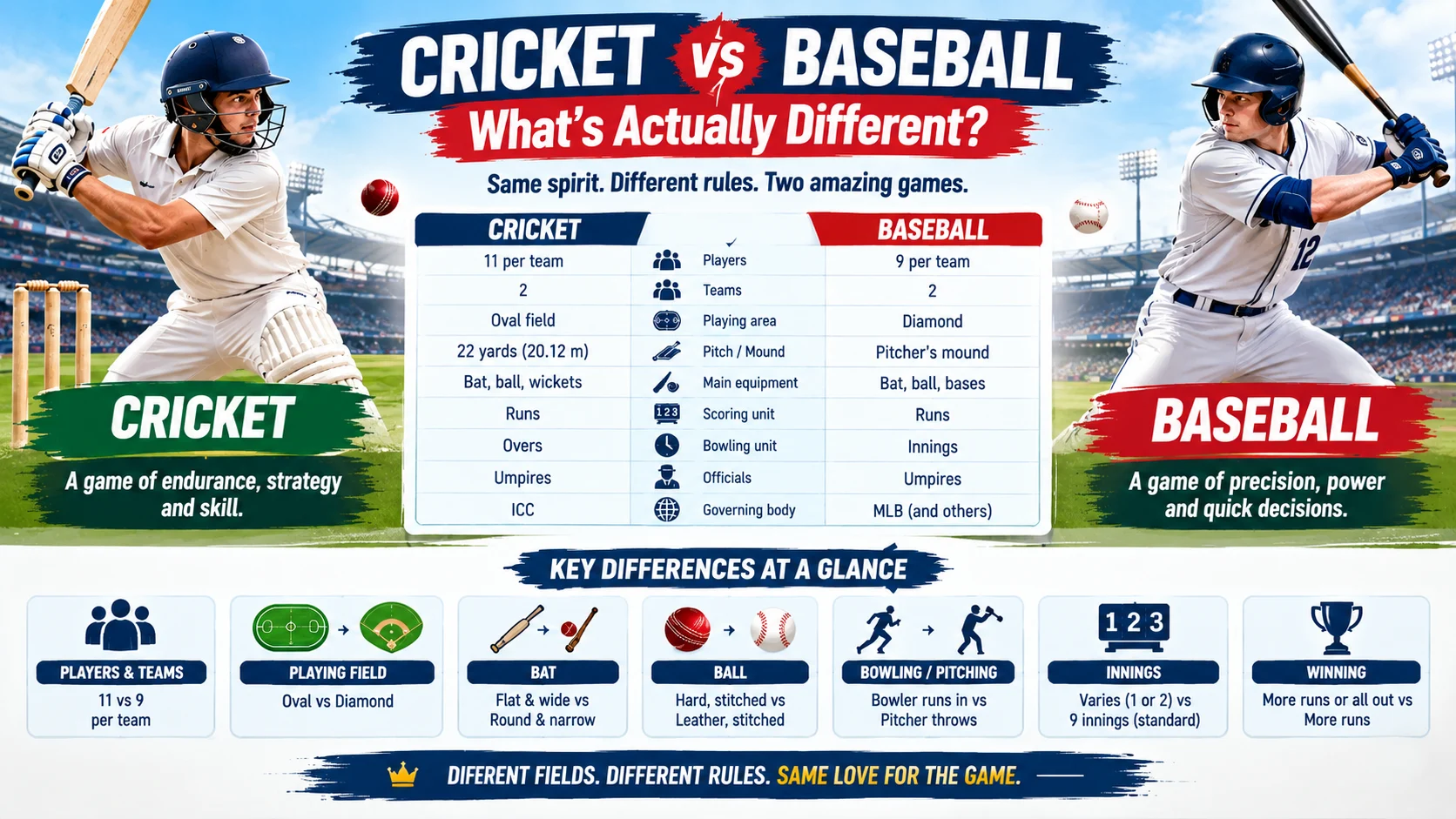
Cricket and baseball share a common ancestor in old English bat-and-ball games, but they have evolved into very different sports. Cricket is played on an oval field with a flat bat, batters do not have to run after every hit, and matches can last anywhere from three hours to five days. Baseball is played on a diamond with a rounded bat, batters must run the bases after contact, and a standard game lasts around nine innings, typically two to three hours. The core difference comes down to this: baseball is built around discrete innings and forced outs, while cricket is built around continuous run-scoring and a batter who can stay at the crease indefinitely.
If you grew up watching baseball and someone just handed you a cricket bat for the first time, you are not alone in feeling confused. The two sports look related from a distance a bat, a ball, fielders scattered around a grass field, batters trying to score runs but the moment a match actually starts, the resemblance mostly disappears. With Major League Cricket now in its fourth season and cricket set to appear at the 2028 Los Angeles Olympics, more American sports fans than ever are asking the same question: what actually separates cricket from baseball, and which one is harder to play?
This guide breaks down every major difference field shape, scoring, outs, equipment, match length, and strategy so you can watch either sport and know exactly what you are looking at.
The Historical Roots
Cricket traces back to south-east England, with recorded village matches dating to the 16th and 17th centuries before the sport was formalized and exported across the British Empire to countries like India, Pakistan, Australia, and the West Indies. Baseball developed later, in 19th-century America, evolving out of older English games including rounders. That shared ancestry explains the surface-level similarities, while more than two centuries of separate evolution explain almost everything else.
Field and Pitch Layout
The most visible difference is the shape of the playing area itself.
A cricket field is roughly oval or circular, with a rectangular strip called the pitch running through the center. The pitch measures 22 yards (about 20 meters) between two sets of three wooden stumps called wickets. There is no foul territory a ball can be hit in any direction, a full 360 degrees around the batter, and it still counts.
A baseball field is a diamond, with four bases arranged 90 feet apart. The batter stands at home plate, and only the area between the two foul lines (fair territory) counts as live play. Anything hit outside those lines is a foul ball.
| Feature | Cricket | Baseball |
|---|---|---|
| Field shape | Oval or circular | Diamond with foul lines |
| Scoring zone | Full 360 degrees around batter | Fair territory only |
| Central strip | 22-yard pitch with two wickets | 90-foot basepaths, home plate to first, second, third |
| Boundary | Marked rope or fence around the field | Outfield wall |
Bat and Ball Design
A cricket bat is flat on one side and has a rounded spine on the back, traditionally made from willow wood. It is heavier and wider than a baseball bat, designed to defend a wicket as much as to hit for power.
A baseball bat is round all the way around, made of wood (in professional leagues) or aluminum (in amateur and college play), and is designed purely for hitting distance and bat speed.
The balls are closer in weight than most people expect. A cricket ball weighs between 5.5 and 5.75 ounces, while a baseball weighs about 5 to 5.25 ounces. Cricket balls are typically red (in Test matches) or white (in limited-overs formats), with a single raised seam, while baseballs are white with red stitching in a distinctive figure-eight pattern.
How Batting Actually Works
This is where the two sports diverge the most.
In baseball, a batter gets a limited number of strikes (usually three) before being called out, and once they make contact, they must run toward first base whether they want to or not. A batter can also choose not to swing and simply draw a walk after four balls.
In cricket, a batter defends a wicket made of three stumps and two bails. There is no strike limit. A batter can block balls all day if they choose to, and they are only required to run between the wickets if they and their batting partner decide it is safe to do so. This is why a single batter in a Test match can remain at the crease for an entire day, scoring what is called a century (100 runs) or even a double century.
| Feature | Cricket | Baseball |
|---|---|---|
| Strikes before out | None batter can defend indefinitely | Three strikes |
| Must run after contact | Only if the batting pair chooses to | Yes, mandatory |
| Scoring shots | Runs (1s, 2s, 3s), plus boundaries (4s and 6s) | Singles, doubles, triples, home runs |
| Walking off | Only when given out | Out after three strikes, or safe on a hit/walk |
Ways to Get Out
Cricket has considerably more dismissal methods than baseball, and understanding them is often the biggest hurdle for new fans.
A batter in cricket can be out bowled (the ball hits the stumps), caught (a fielder catches the ball before it bounces), leg before wicket or LBW (the ball would have hit the stumps but struck the batter’s leg first), run out (a fielder breaks the wicket before the batter reaches the crease), stumped (the wicket-keeper breaks the stumps while the batter is out of their crease), or hit wicket, among a few rarer methods.
Baseball outs are simpler by comparison: a strikeout (three strikes), a fly out (the ball is caught before it touches the ground), a force out or tag out on the bases, or a batter simply popping the ball up in foul territory on a third strike.
Bowling vs Pitching
A cricket bowler must deliver the ball with a straight arm ending the elbow during the delivery is illegal and called a “throw” or chucking. Bowlers run up before delivering and bowl the ball so it usually bounces once before reaching the batter, using seam and swing to deceive them.
A baseball pitcher throws overhand or sidearm from a fixed mound, using wrist and finger grip to create movement like curveballs, sliders, and fastballs. There is no rule against bending the elbow, and the ball almost never bounces before reaching the plate.
Match Length and Formats
This is arguably the biggest practical difference for American fans used to a fixed nine-inning game.
Baseball has essentially one format: nine innings, taking roughly two and a half to three hours, sometimes longer with extra innings.
Cricket has three very different formats. Twenty20 (T20) matches, the format used in Major League Cricket, last about three hours, similar to a baseball game. One Day Internationals (ODIs) last roughly eight hours, played in a single day. Test matches, the sport’s oldest and most respected format, are played over five full days and can still end in a draw if neither team completes the match.
| Format | Approx. Duration | Overs/Innings |
|---|---|---|
| Baseball (standard) | 2.5–3 hours | 9 innings |
| Cricket T20 | Around 3 hours | 20 overs per side |
| Cricket ODI | Around 8 hours | 50 overs per side |
| Cricket Test | Up to 5 days | Unlimited overs, 2 innings per side |
Fielding Positions
Baseball has nine fixed fielding positions with standard names pitcher, catcher, first through third base, shortstop, and three outfielders and every player has one job.
Cricket has far more fielding positions (with names like slip, gully, mid-off, and long-on), but the captain can move fielders almost anywhere on the field between deliveries, adjusting the field based on the batter, the bowler, and the game situation. The only fixed specialist role is the wicket-keeper, cricket’s version of a catcher, who stands behind the stumps.
Why This Matters for American Fans Right Now
Cricket’s visibility in the United States has grown quickly. Major League Cricket, the country’s first ICC-sanctioned professional T20 league, has expanded its footprint from coast to coast since launching in 2023, and Season 3 saw ticket sales rise 53 percent year over year with the majority of buyers attending a match for the first time. The United States also co-hosted the 2024 ICC Men’s T20 World Cup, and cricket is scheduled to return to the Olympic program at the 2028 Los Angeles Games. For a baseball-literate audience, the T20 format is by far the easiest entry point, since its length and pace are closest to a baseball broadcast.
Interesting Facts
- A cricket pitch (22 yards) is almost exactly the length between home plate and second base in baseball.
- Cricket’s Test format can last five full days and still end without a winner if the match is not completed.
- The current cricket ball weight (5.5–5.75 oz) is close enough to a baseball (5–5.25 oz) that the two are sometimes mistaken for each other in photos.
- Major League Cricket’s Season 4 runs June 18 to July 18, 2026, featuring six franchise teams.
- Cricket is the second most-watched sport in the world after soccer, with an estimated global fan base of more than 2 billion.
- Unlike baseball, a cricket batter can theoretically never be forced out if they keep defending the stumps successfully there is no strikeout equivalent.
Frequently Asked Questions
Is cricket harder than baseball? Neither sport is definitively harder than the other; they demand different skills. Cricket batting requires facing bowling for extended periods with no strike limit, which demands endurance and technique, while baseball hitting demands split-second reaction to higher pitch speeds within a strict three-strike window.
Which is older, cricket or baseball? Cricket is significantly older. It has documented roots in 16th-century England, while baseball developed in the United States in the 19th century, partly influenced by older English bat-and-ball games including rounders.
Do cricket and baseball use the same size ball? They are close but not identical. A cricket ball weighs 5.5 to 5.75 ounces, while a baseball weighs 5 to 5.25 ounces. The cricket ball also has a single raised seam rather than baseball’s figure-eight stitching.
Why does a cricket batter not have to run after every hit? Cricket scoring is based on runs completed between two wickets, not on reaching bases. A batting pair can choose to leave the ball or block it without running, since there is no requirement to advance unless they judge it safe to take a run.
What is the closest cricket format to a baseball game in length? Twenty20 (T20) cricket, the format used in Major League Cricket, lasts around three hours, which is close to the length of a standard nine-inning baseball game.
Can a cricket match end in a draw? Yes, but only in the multi-day Test format. If five days pass without either team completing both innings, the match is declared a draw. Limited-overs formats like T20 and ODI cannot end in a draw under normal rules, though they can end in a tie.
Is cricket becoming more popular in the United States? Yes. Major League Cricket has seen ticket sales grow 53 percent year over year in its most recent season, the U.S. co-hosted the 2024 T20 World Cup, and cricket will feature at the 2028 Los Angeles Olympics, all pointing to sustained growth in American interest.
Conclusion
Cricket and baseball share a distant ancestor but have grown into two very different games. Baseball rewards quick reaction and power within a fixed nine-inning structure, while cricket rewards patience, technique and adaptability across formats that can run from three hours to five days. Neither sport is simpler or harder overall they just measure skill differently.
For American fans new to cricket, Major League Cricket’s T20 format is the easiest starting point, since its pace and length feel closest to a baseball broadcast. With MLC expanding, the T20 World Cup having been played on US soil, and cricket returning to the 2028 Olympics, now is a good time to learn the differences before the sport becomes a lot more familiar.

Emily Parker is a sports journalist at SportsOrbitX.com with a passion for covering cricket, tennis and major international sporting events. She is committed to producing clear, reliable and engaging content for sports enthusiasts worldwide.