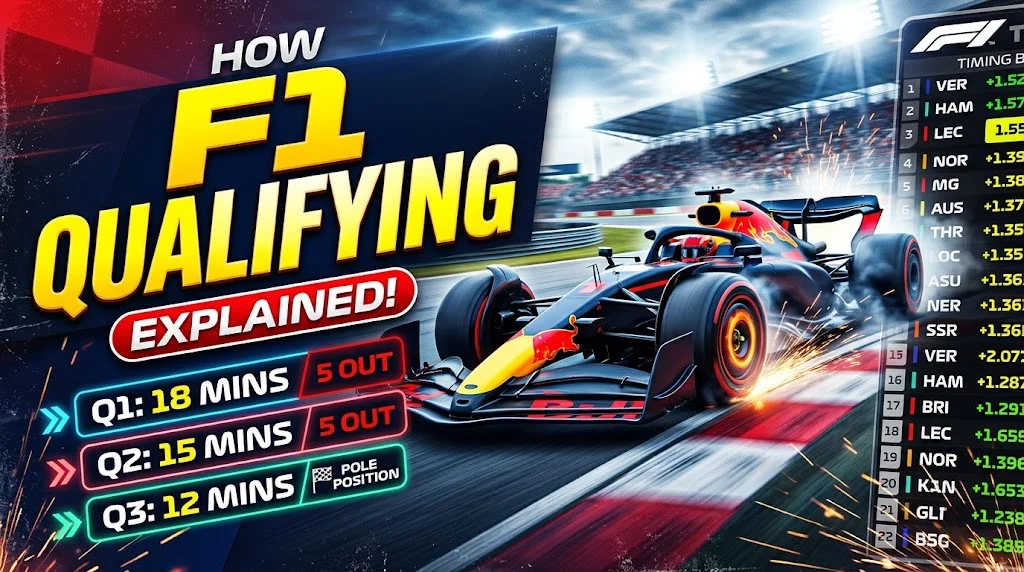
Formula 1 qualifying is a three-stage knockout session that determines the starting grid for the Grand Prix. In 2026, all 22 drivers begin in Q1, the slowest six are eliminated, another six leave after Q2, and the final 10 drivers battle in Q3 for pole position.
It looks simple on the surface: drive fast and set the quickest lap. But underneath that is a high-pressure game of tyre preparation, traffic management, timing, track evolution, and strategy. One mistake can send a driver from a potential front-row start to the back of the grid.
How Does F1 Qualifying Work?
F1 qualifying works as a knockout time trial.
Drivers don’t race wheel-to-wheel during qualifying. Instead, each driver attempts to set the fastest possible lap. At the end of each qualifying segment, the slowest drivers are eliminated.
For the 2026 22-car grid:
| Session | Time | Cars | Eliminated | Grid Positions |
|---|---|---|---|---|
| Q1 | 18 minutes | 22 | 6 | P17–P22 |
| Q2 | 15 minutes | 16 | 6 | P11–P16 |
| Q3 | 12 minutes | 10 | 0 | P1–P10 |
The fastest driver in Q3 earns pole position, while the remaining drivers are placed according to their best qualifying times.
What Is F1 Qualifying?
F1 qualifying is the session used to establish the starting order for the Grand Prix.
On a standard race weekend, qualifying takes place on Saturday after the final practice session. The result determines where each driver is provisionally positioned on Sunday’s starting grid, although penalties applied before the race can change the final grid order.
The driver who sets the fastest valid time in Q3 starts from P1, commonly called pole position.
That position matters because starting at the front can provide clean air, track position, and the first opportunity to control the race.
How Does Q1 Work in F1?
Q1 lasts 18 minutes and features all 22 cars in the 2026 field.
Every driver is allowed to go onto the track and attempt timed laps. Teams decide when to send their cars out based on traffic, tyre temperatures, track conditions, and the expected improvement in lap time.
At the end of Q1:
The six slowest drivers are eliminated.
Those six drivers occupy positions P17 through P22, ordered according to their best Q1 times. The remaining 16 drivers move into Q2.
Why Is Q1 So Important?
Q1 is particularly stressful for drivers near the bottom of the competitive order.
A driver can have a fast car but still be eliminated because of:
- Traffic
- A mistake on a flying lap
- Poor tyre preparation
- Yellow or red flags
- Track limits
- Changing weather
- Timing the final run incorrectly
The famous “Q1 elimination” is therefore not always a simple reflection of a car’s true pace.
How Does Q2 Work?
Once Q1 ends, there is a short break before Q2, which lasts 15 minutes.
The 16 remaining drivers return to the track and attempt to set another fast lap.
The pressure increases because only 10 drivers can advance.
At the end of Q2:
- Six drivers are eliminated.
- They occupy P11–P16.
- The fastest 10 advance to Q3.
The qualifying times from Q1 are not carried forward for the drivers who advance. Their Q1 times are deleted, and they effectively start Q2 from scratch. The same principle applies when moving from Q2 to Q3.
The Q2 “Cut Line”
One of the most exciting parts of qualifying is watching the live timing screen.
The driver sitting around P10 is often described as being “on the bubble.”
If another driver improves their lap and pushes them into P11, that driver is suddenly eliminated.
This is why the final minutes of Q2 can become chaotic.
How Does Q3 Work?
Q3 is where qualifying becomes a direct fight for the front of the grid.
Only 10 drivers remain, and they have 12 minutes to fight for positions P1 through P10.
The fastest driver earns:
P1 — Pole Position
The second-fastest earns:
P2
And so on through:
P10
Because there are no further eliminations, Q3 is essentially a 10-driver shootout for the best possible starting position.
What Is a Flying Lap in F1?
A flying lap is a driver’s timed lap when they are attempting to set their best qualifying time.
Before it, the driver completes an out-lap, during which the team and driver work to prepare the tyres and car for maximum performance.
After the flying lap, the driver normally completes an in-lap and returns to the pits.
The goal is to cross the timing line at the perfect moment with the tyres, brakes, battery, fuel load, and track position working together.
Why Do F1 Drivers Drive Slowly Before a Fast Lap?
You may notice several F1 cars travelling slowly before suddenly attacking a lap.
This isn’t because the driver has forgotten how to race.
The team is trying to prepare the car for its flying lap.
Drivers may need to:
- Build tyre temperature.
- Prepare the brakes.
- Manage battery deployment.
- Create space from other cars.
- Avoid traffic.
- Find clean air.
However, driving too slowly can create its own problems because other cars may also be searching for space.
That makes qualifying a strange combination of maximum speed and careful timing.
Do F1 Drivers Get Multiple Attempts in Qualifying?
Yes.
Drivers can make multiple runs during a qualifying segment, provided there is enough time and they have the necessary tyre sets available.
A common pattern is to make an early run to establish a competitive time and then return to the pits for adjustments or fresh tyres before making a final attempt.
The final run is often crucial because the circuit can become faster as more rubber goes down and track conditions improve.
Why Does the Track Get Faster During Qualifying?
Track evolution is one of the hidden weapons in qualifying.
As cars circulate, tyre rubber is deposited onto the racing surface. This can improve grip.
At the same time, weather conditions can change.
For this reason, a lap set near the end of a session can be substantially faster than an earlier lap.
Teams must therefore decide whether to:
Set a safe time early or wait for a potentially faster track later.
Waiting can produce a brilliant lap—or leave a driver without enough time for another attempt if something goes wrong.
What Happens to a Driver Eliminated in Q1?
A driver eliminated in Q1 cannot participate in Q2 or Q3.
Their best Q1 qualifying time determines their position among the drivers eliminated in that session.
For the 2026 22-car field, the six Q1 eliminations occupy P17–P22.
For example, if Driver A is the fastest of the six eliminated drivers and Driver F is the slowest, Driver A will start ahead of Driver F, subject to any subsequent grid penalties or other sporting decisions.
What Happens to Drivers Eliminated in Q2?
The same basic principle applies.
The six drivers eliminated in Q2 are placed P11–P16 according to their best Q2 times.
They do not compete in Q3, so their qualifying session ends after Q2.
How Is Pole Position Decided?
Pole position goes to the driver with the fastest valid lap in Q3.
For example:
| Driver | Q3 Time | Position |
|---|---|---|
| Driver A | 1:29.450 | P1 |
| Driver B | 1:29.612 | P2 |
| Driver C | 1:29.780 | P3 |
Driver A gets pole because their Q3 lap is the fastest.
If two drivers record exactly the same time during a qualifying period, the driver who set that time first receives priority under the FIA regulations.
Does Qualifying Decide the Final Race Grid?
Not always.
Qualifying establishes the qualifying classification, but penalties can change the actual starting grid.
For example, a driver could qualify P2 but receive a grid penalty and start further back.
That means there are two important concepts:
Qualifying result: Where the driver finished qualifying.
Race starting grid: Where the driver actually starts after any applicable penalties and sporting adjustments.
This distinction is important when reading an F1 starting grid.
What Is the Difference Between Qualifying and Sprint Qualifying?
This is another common source of confusion.
Normal Qualifying determines the starting grid for the Grand Prix.
Sprint Qualifying determines the starting grid for the Sprint.
The Sprint format uses the same basic knockout concept but with shorter sessions.
In the 2026 format:
| Session | Duration | Purpose |
|---|---|---|
| SQ1 | 12 minutes | Eliminates six |
| SQ2 | 10 minutes | Eliminates six |
| SQ3 | 8 minutes | Top 10 fight for Sprint pole |
With 22 cars, six are eliminated after SQ1 and another six after SQ2, leaving 10 drivers to compete in SQ3.
So, in simple terms:
Qualifying → sets the Grand Prix grid
Sprint Qualifying → sets the Sprint grid
Why Is F1 Qualifying So Important?
A great qualifying performance can change an entire race weekend.
Starting near the front can help a driver:
- Avoid first-lap traffic.
- Control the pace early.
- Protect track position.
- Reduce the need for overtaking.
- Take advantage of clean air.
For some circuits, qualifying can be even more important because overtaking is difficult.
That makes every thousandth of a second matter.
A difference of 0.050 seconds might separate pole from second place. A few tenths can sometimes separate the front of the grid from the midfield.
What Does “Pole” Mean in F1?
Pole position means starting the Grand Prix from the first position on the grid.
The term comes from early motor racing, when the first position was associated with the inside/front position of a starting arrangement.
In modern F1, pole is awarded to the driver who sets the fastest qualifying time in Q3.
What Does “P1 in Q1” Mean?
If a driver finishes Q1 in P1, it means they were the fastest driver during Q1.
It does not mean they start the Grand Prix from first place.
The driver still has to survive Q2 and Q3.
This is an important distinction because qualifying is reset between stages for the drivers who advance.
A driver can be fastest in Q1 and still fail to take pole.
What Happens if a Driver Does Not Set a Qualifying Time?
A driver who fails to set a qualifying time is not automatically guaranteed a starting position.
The FIA regulations contain procedures governing drivers without times and whether they may be allowed to start. In certain circumstances, the Stewards can permit a driver to participate in the race, subject to the applicable rules.
This is why a driver listed at the bottom of qualifying isn’t necessarily the whole story.
F1 Qualifying Explained in One Simple Example
Imagine 22 drivers enter qualifying.
Q1
All 22 drivers compete.
Six are eliminated.
16 remain.
Q2
The remaining 16 compete.
Six are eliminated.
10 remain.
Q3
The final 10 compete for the top 10 grid positions.
The fastest driver gets:
P1 — Pole
The slowest of the Q3 group gets:
P10
The six Q2 eliminations fill P11–P16, while the six Q1 eliminations fill P17–P22, based on their respective qualifying times.
That’s the entire qualifying system in one sequence:
22 → 16 → 10 → Pole
F1 Qualifying Strategy: What Fans Should Watch
If you want to understand qualifying beyond the basic rules, watch these five things:
Tyre Temperature
Drivers need their tyres operating in the right temperature window. A perfect lap on poorly prepared tyres can disappear before the first corner.
Traffic
A slower car in the wrong place can ruin a qualifying lap. Drivers and teams constantly search for clean track.
Track Evolution
The track can become faster as qualifying progresses, making timing extremely important.
Battery Deployment
Modern F1 cars use electrical energy strategically. How and where that energy is deployed can influence lap time.
The Final Run
The last attempt often determines the result.
That is when drivers have to put everything together:
car setup + tyres + traffic + energy + confidence + precision.
Frequently Asked Questions
How long is F1 qualifying?
For the 2026 standard qualifying format, Q1 lasts 18 minutes, Q2 lasts 15 minutes and Q3 lasts 12 minutes. There are breaks between the sessions.
How many drivers qualify for Q2?
In the 2026 22-car field, 16 drivers advance from Q1 to Q2.
How many drivers qualify for Q3?
10 drivers advance from Q2 to Q3.
Who gets pole position in F1?
The driver who sets the fastest valid lap in Q3 gets pole position.
Do Q1 times carry over to Q2?
No. For drivers who advance, their Q1 times are deleted before Q2. The same happens to Q2 times when the remaining drivers advance to Q3.
Can an F1 driver be eliminated in Q1?
Yes. The six slowest drivers in Q1 are eliminated in the 2026 22-car format.
Does qualifying decide who wins the race?
No. Qualifying determines the starting order. The race itself decides the winner.
Is F1 qualifying a race?
Not exactly. It is a timed session, not a conventional wheel-to-wheel race. Drivers compete against the clock to set their fastest lap.
Why do F1 drivers go out at different times?
Teams manage traffic, tyre preparation, track position and changing circuit conditions. Going out at the right time can be just as important as setting a fast lap.
What is the difference between Q1, Q2 and Q3?
Q1 starts with the entire field, Q2 contains the remaining drivers after the first elimination, and Q3 is the final 10-driver battle for the top 10 positions and pole.
Final Verdict
So, how does F1 qualifying work?
It’s a high-speed elimination battle against the clock.
In the 2026 format, 22 cars enter Q1, 16 move into Q2, and the fastest 10 reach Q3. Six drivers are eliminated after Q1, six more after Q2, and the remaining 10 fight for the top 10 starting positions. The fastest Q3 lap earns pole position.
But the real magic of qualifying is that it isn’t simply about having the fastest car. Drivers and teams have to choose the right moment, prepare the tyres, avoid traffic, manage energy, read the track and deliver one near-perfect lap when the pressure is at its highest.
That’s why F1 qualifying can be every bit as dramatic as the race itself.
22 cars. Three sessions. One perfect lap. One pole position.

Daniel Brooks is a sports writer at SportsOrbitX.com, specializing in football, basketball and global sports news. He focuses on delivering accurate reporting, match analysis and timely updates that keep fans informed.