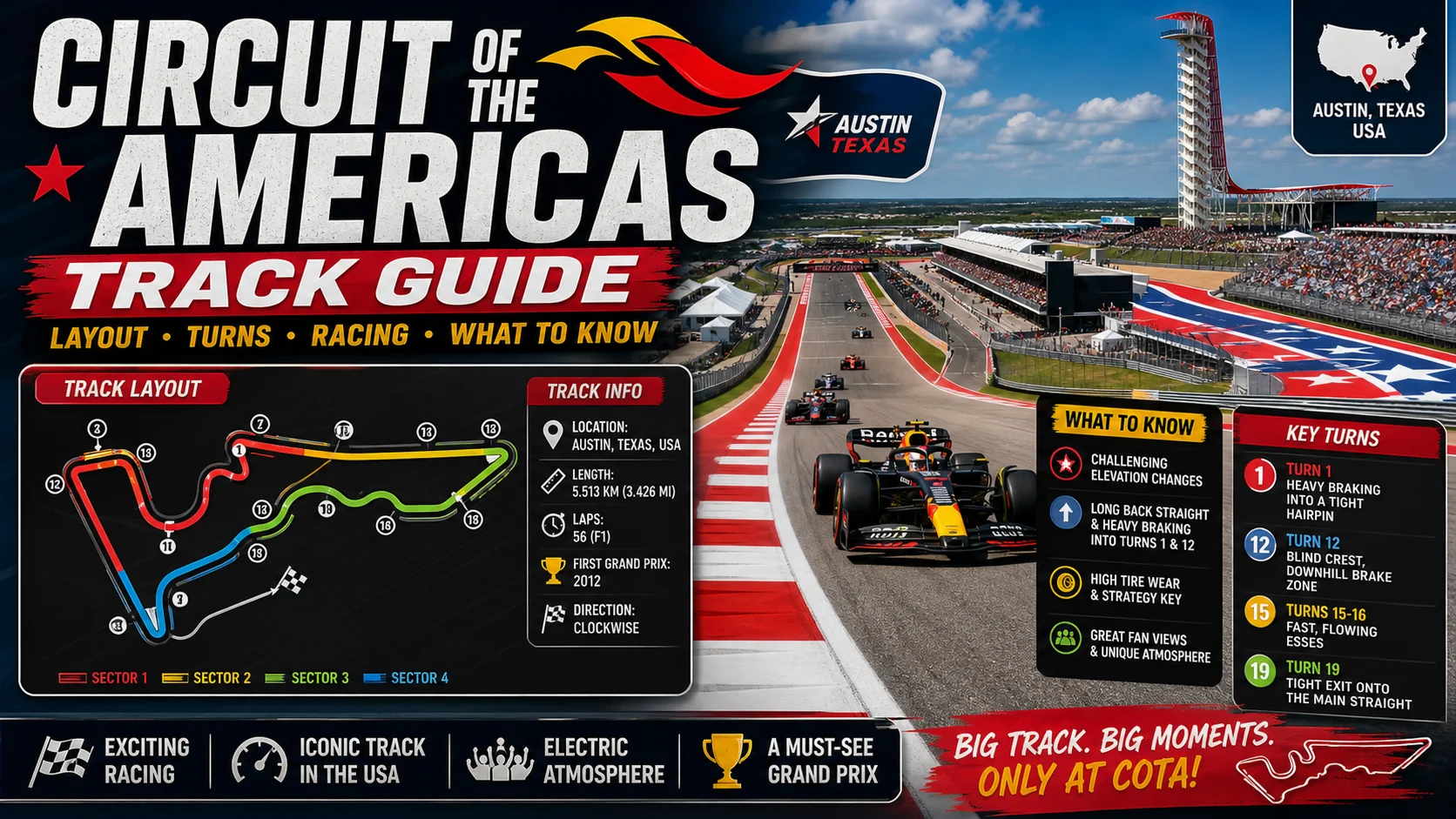
Circuit of the Americas (COTA) is a 3.426-mile, 20-turn road course in Austin, Texas, famous for its steep Turn 1 climb, fast Esses, long back straight, and technical final sector
It is a track where speed alone isn’t enough: drivers must combine aggressive braking, precision, traction, and rhythm to master one of the most challenging circuits on the modern F1 calendar.
Circuit of the Americas at a Glance
| Feature | COTA |
|---|---|
| Location | Austin, Texas, USA |
| Track Length | 5.513 km / 3.426 miles |
| Turns | 20 |
| Direction | Counter-clockwise |
| F1 Debut | 2012 |
| F1 Race Laps | 56 |
| F1 Race Distance | 308.405 km |
| Left Turns | 11 |
| Right Turns | 9 |
| Biggest Elevation Feature | ~133 ft climb to Turn 1 |
| Circuit Designer | Hermann Tilke |
| Main F1 Event | United States Grand Prix |
COTA was built as a purpose-designed Grand Prix facility and has become a major American motorsport venue. Formula 1 first raced there in 2012, while MotoGP arrived in 2013.
What Is the Circuit of the Americas?
The Circuit of the Americas, commonly called COTA, is a permanent racing circuit located southeast of downtown Austin, Texas.
The 5.513-kilometer circuit was designed by German architect and circuit designer Hermann Tilke, with the layout deliberately borrowing ideas from famous corners and sequences around the world.
That design philosophy is one reason COTA feels familiar and unusual at the same time.
The opening Esses echo the fast Maggotts-Becketts-style rhythm of Silverstone, while Turns 12–15 draw inspiration from Hockenheim’s stadium section. The result is a track that constantly changes character rather than settling into one rhythm.
Why Is COTA So Difficult?
COTA’s biggest challenge is its variety.
A driver can go from a fast, flowing sequence into a heavy-braking corner within seconds. The track also uses significant elevation changes, particularly the dramatic climb toward Turn 1.
The circuit combines:
- High-speed direction changes
- Heavy braking zones
- Slow hairpins
- Long straights
- Multi-apex corners
- Significant elevation changes
- Technical traction zones
That means a setup that works beautifully in one part of the lap can create compromises somewhere else.
COTA rewards versatility.
Circuit of the Americas Track Layout
A lap begins with one of the most recognizable sections of the circuit: the uphill approach to Turn 1.
From there, the track flows through the fast Esses before opening into a series of medium-speed corners. The lap then reaches the long back straight and its major braking zone at Turn 12.
The final sector is more technical, with the famous multi-apex section from Turns 16 through 18 followed by Turns 19 and 20 before the cars return to the start-finish straight.
COTA runs counter-clockwise and contains 20 corners: 11 left-hand and 9 right-hand turns.
COTA Turns Explained
Turn 1: The Hill
Turn 1 is arguably COTA’s signature corner.
The track rises dramatically toward the corner, creating a steep approach and a partially blind apex. The elevation gain is around 133 feet, making the braking zone particularly dramatic.
It is also wide enough to give drivers multiple lines.
That makes Turn 1 particularly exciting at the start of the United States Grand Prix, when a full field arrives together with limited space and huge braking demands.
Why it matters:
A good exit from Turn 1 sets up the rhythm of the opening sector, while the wide layout creates opportunities for side-by-side racing.
Turns 3–6: The Fast Esses
This is where COTA begins to feel seriously fast.
Turns 3 through 6 form a rapid left-right sequence inspired by Silverstone’s famous high-speed changes of direction.
The challenge isn’t simply turning the steering wheel quickly. Drivers must maintain the correct rhythm while keeping the car balanced through several direction changes.
A small mistake early in the sequence can compromise the following corners.
Key requirement: aerodynamic stability and confidence.
Turns 7–10: Building Toward the Hairpin
After the fast opening section, the circuit becomes more technical.
Turns 7 through 10 require drivers to transition from flowing corners into a tighter complex before reaching Turn 11.
This section rewards precision rather than aggression.
The goal is to carry enough speed without compromising the approach to the next major braking zone.
Turn 11: The Hairpin
Turn 11 is a slow left-hand hairpin that precedes one of COTA’s most important acceleration zones.
This corner is critical because drivers exit onto the long run toward Turn 12.
A poor exit can cost significant time all the way down the straight.
For overtaking, that makes Turn 11 strategically important even though it isn’t necessarily the main passing corner itself.
Turn 12: The Big Braking Zone
If you’re looking for one of the most important overtaking locations at COTA, Turn 12 is the obvious candidate.
Drivers arrive after a long straight before braking heavily for the left-hander.
That combination high speed followed by heavy braking creates one of the clearest opportunities for a driver to attack.
MotoAmerica also identifies Turn 12 as a major passing opportunity at the end of the long back straight.
For spectators: this is one of the sections where the difference between late braking and over-braking becomes very easy to see.
Turns 13–15: The Stadium Section
The next sequence is one of COTA’s most technical areas.
Turns 13 through 15 take inspiration from Hockenheim’s stadium section, but they have their own character because of the changing radius and positioning of the corners.
Drivers need to be extremely precise here.
Turn 15 is particularly interesting because the complex encourages different lines, and getting the exit right can influence the next part of the lap.
This is also an area where tyre management and balance become important.
Turns 16–18: COTA’s Multi-Apex Challenge
Turns 16, 17 and 18 form a long, sweeping right-hand complex.
Instead of treating each corner as an isolated turn, drivers must think about the entire sequence.
The car needs to remain stable while carrying speed through multiple apexes.
The biggest challenge is finding a line that is fast across the whole complex rather than maximizing one individual corner.
Turns 19–20: The Final Run
The lap finishes with Turns 19 and 20.
Turn 19 is another quick corner where precision matters, while Turn 20 is the final left-hander leading onto the start-finish straight.
Turn 20 may look simple compared with some of COTA’s other corners, but it has an important job.
A good exit is everything.
The final corner determines how quickly the car accelerates onto the long straight and sets up the next lap’s attack into Turn 1.
Where Are the Best Overtaking Spots at COTA?
COTA provides several opportunities to attack, but the most obvious locations are associated with heavy braking after high-speed approaches.
Turn 1
The wide uphill corner provides multiple lines and can create opportunities immediately after the race start or following a straight-line run.
Turn 12
The long back straight makes Turn 12 one of the circuit’s most important overtaking zones.
Turn 11 Exit
Although Turn 11 itself is tight, its exit determines the speed a driver can carry toward Turn 12.
Final Straight
A strong exit from Turn 20 gives a pursuing driver a chance to attack before Turn 1 on the following lap.
This creates a strategic chain: Turn 20 → straight-line speed → Turn 1 attack.
What Makes COTA Different From Other F1 Tracks?
COTA doesn’t specialize in just one type of corner.
Instead, it combines several racing styles in one lap.
| Section | Main Challenge |
|---|---|
| Turn 1 | Uphill braking + multiple lines |
| Turns 3–6 | High-speed direction changes |
| Turns 7–10 | Medium-speed rhythm |
| Turn 11 | Slow corner + exit traction |
| Turn 12 | Heavy braking + overtaking |
| Turns 13–15 | Technical precision |
| Turns 16–18 | Multi-apex high-speed cornering |
| Turns 19–20 | Final-sector speed + exit |
That’s why COTA can be difficult to perfect even for elite drivers.
COTA Lap Record
For the modern Formula 1 configuration, the official F1 statistics list Charles Leclerc’s 1:36.169 from the 2019 United States Grand Prix as the lap record.
It’s important to distinguish a lap record from the fastest lap ever recorded during qualifying or a practice session. Different sessions, regulations, tyre compounds, and track conditions can produce different times.
How Long Is the Circuit of the Americas?
The COTA Grand Prix circuit is 5.513 km (3.426 miles) long.
For the Formula 1 United States Grand Prix, drivers complete 56 laps, covering a total race distance of approximately 308.405 km (191.634 miles).
How Many Turns Does COTA Have?
The Circuit of the Americas has 20 turns.
There are:
- 11 left-hand turns
- 9 right-hand turns
The circuit runs counter-clockwise.
What Races Are Held at COTA?
COTA is much more than an F1 venue.
The facility has hosted major motorsport championships including:
- Formula 1
- MotoGP
- NASCAR
- FIA World Endurance Championship
- IMSA
- FIA World Rallycross
- MotoAmerica
The circuit describes itself as a purpose-built facility for premier motorsport championships, while MotoGP has competed there since 2013.
This variety makes COTA one of the most significant motorsport destinations in the United States.
Best Places to Watch Racing at COTA
If you’re attending an event, your ideal viewing area depends on what you want to see.
Turn 1
Best for watching:
- First-lap battles
- Heavy braking
- Overtaking
- Multiple racing lines
The elevated location also gives spectators an impressive view across the circuit toward Austin.
Turns 15–16
These stands put fans close to the technical stadium section and provide a strong view of cars working through the slower complex. Formula 1 specifically highlights the Stadium Section around Turns 15/16 as a strong location for seeing racing action up close.
Main Grandstand
The main grandstand provides a view of the start-finish area, pit lane activity, race starts, and the final corner sequence.
COTA for First-Time Visitors
If this is your first visit, don’t think of COTA as simply a place to watch cars go around a circuit.
The experience is built around the combination of racing, Austin culture, live entertainment, and the scale of the venue.
The facility sits on roughly 1,500 acres outside central Austin and includes major entertainment infrastructure in addition to the racing circuit.
That means race weekend can be an all-day experience rather than a two-hour event.
Final Verdict
Absolutely.
The Circuit of the Americas succeeds because it refuses to be predictable.
It starts with a dramatic uphill attack into Turn 1, throws drivers into fast Esses, sends them down a long straight toward a major braking zone, then finishes with a demanding technical sector.
Its 20 corners, 5.513-kilometer layout, elevation changes, overtaking opportunities, and mix of high- and low-speed sections make it one of the most complete circuits on the modern racing calendar.
And that’s the real appeal of COTA: there isn’t one trick to mastering it.
A driver needs bravery for Turn 1, rhythm through the Esses, precision through the stadium section, and patience on corner exits. Get all of those pieces right, and a lap around COTA can look effortless. Get just one wrong, and the stopwatch tells the story.

Emily Parker is a sports journalist at SportsOrbitX.com with a passion for covering cricket, tennis and major international sporting events. She is committed to producing clear, reliable and engaging content for sports enthusiasts worldwide.