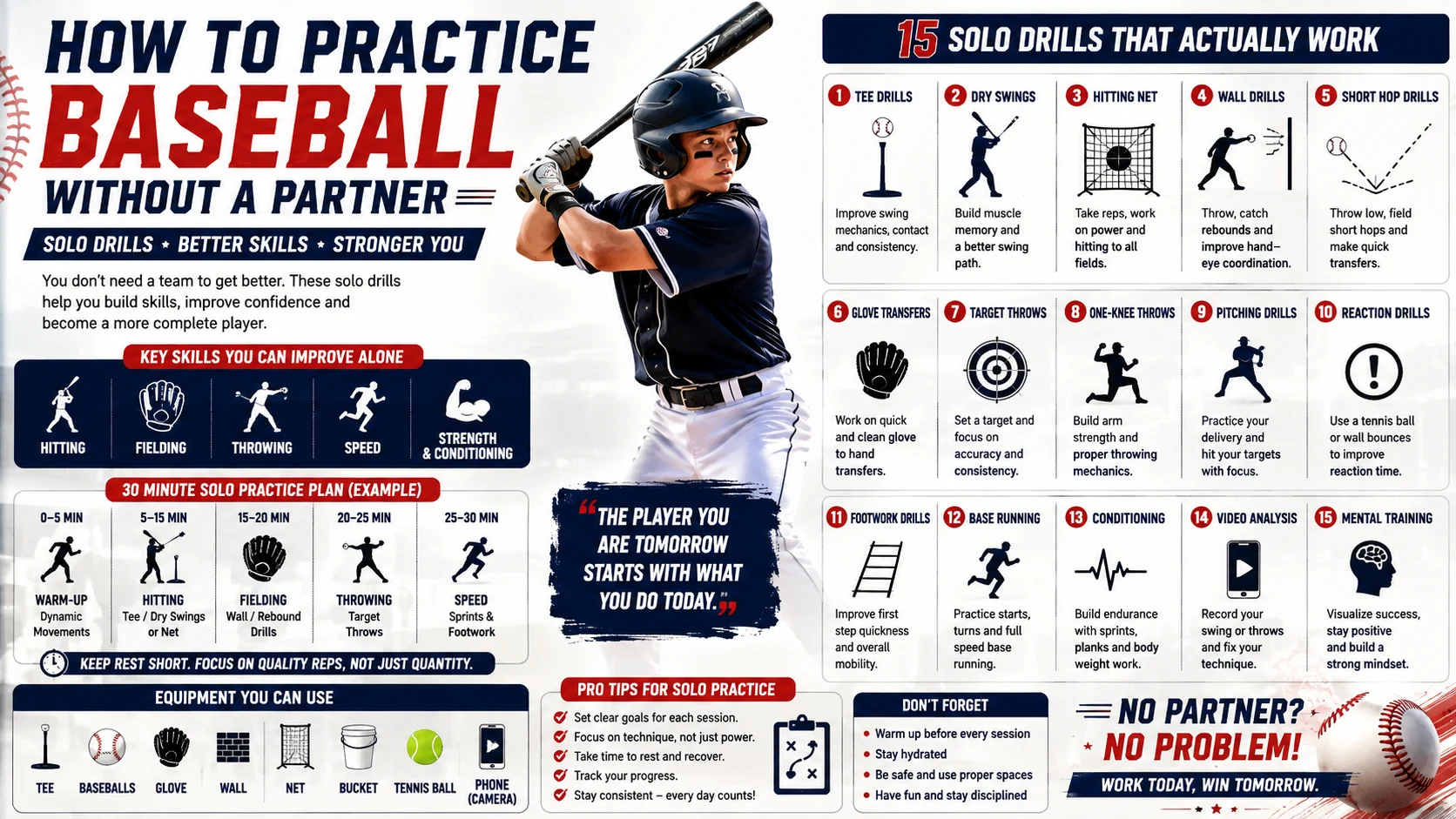
Yes, you can practice baseball effectively without a partner. The best solo baseball drills use a tee, net, wall, rebounder, bucket of balls, or even no equipment at all to improve hitting, throwing, fielding, footwork, reaction time, and conditioning. With 20–30 minutes of focused practice, a player can build skills at home, in a backyard, garage, or empty field even when nobody is available to train with.
How Can You Practice Baseball Alone?
The easiest way to practice baseball without a partner is to divide your session into specific skills:
- Hitting: tee drills, dry swings, front-foot drills
- Throwing: target throws, wall throws, one-knee throwing drills
- Fielding: ground-ball rebounds, wall drills, short-hop drills
- Pitching: dry-motion drills and target work
- Base running: sprint starts, reaction drills, change-of-direction work
- Athleticism: footwork, balance, core, and mobility exercises
You don’t need a full baseball field to get better. What matters most is quality repetitions with a clear purpose.
Quick Solo Baseball Practice Plan
| Skill | Drill | Time |
|---|---|---|
| Warm-up | Dynamic movement | 5 minutes |
| Hitting | Tee or dry swings | 10 minutes |
| Fielding | Wall/rebound drills | 5 minutes |
| Throwing | Target throws | 5 minutes |
| Speed | Sprint or footwork drills | 5 minutes |
| Total | Solo practice | 30 minutes |
Why Practicing Baseball Alone Is Worth It
A partner is useful, but waiting for someone else to become available shouldn’t stop your development.
Solo practice has one major advantage: you control the repetitions.
You can slow a movement down, repeat a weak skill 20 times, correct your technique, and immediately try again.
This is particularly useful for young players who need to improve fundamentals rather than simply spend time playing games.
A good solo session can improve:
- Hand-eye coordination
- Bat-to-ball skills
- Throwing mechanics
- Glove work
- Footwork
- Balance
- Reaction speed
- Sprinting ability
- Muscle memory
- Confidence
The goal isn’t to make solo practice look like a real game. The goal is to isolate the movements that make you better when the game arrives.
1. Hit Off a Baseball Tee
If you have a tee, you already have one of the best tools for practicing baseball alone.
A tee removes the timing of a moving pitch and allows you to concentrate on swing mechanics and contact quality.
How to Do It
Set the ball at a comfortable hitting height and take controlled swings.
Don’t simply try to hit the ball as hard as possible.
Instead, work on:
- Balanced setup
- Quiet head
- Proper load
- Hip rotation
- Hands working through the zone
- Full finish
Make It More Challenging
Move the tee to different locations:
- Inside
- Middle
- Outside
- High
- Low
This teaches you to adjust your swing rather than repeating one identical movement.
Solo practice tip: Pick a target area before every swing. For example, try to drive outside pitches toward the opposite field.
2. Practice Dry Swings
No tee? No problem.
Dry swings are one of the simplest ways to practice baseball at home.
Stand in your normal batting stance and perform controlled swings without a ball.
Focus on the movement rather than maximum effort.
Try This Sequence
Take:
- 5 slow-motion swings
- 5 normal swings
- 5 game-speed swings
Pay attention to whether your balance changes as you increase speed.
If you lose your posture when swinging harder, slow down and rebuild the movement.
3. Use a Net for Solo Hitting
A hitting net lets you take repeated swings without chasing baseballs around the yard.
You can combine a tee and net to create a simple home hitting station.
Try three rounds:
Round 1: 10 controlled contact swings
Round 2: 10 line-drive swings
Round 3: 10 game-speed swings
The objective is quality, not simply completing as many swings as possible.
4. Practice Fielding Against a Wall
A sturdy wall can become your solo throwing partner.
Stand several feet away and throw a baseball against the wall. Field the rebound and repeat.
This works especially well for developing:
- Hand speed
- Soft hands
- Reaction time
- Glove positioning
- Throwing accuracy
Start with easy throws and gradually increase the difficulty.
Wall Fielding Progression
- Catch directly in front of you.
- Move slightly left and right.
- Throw the ball lower for short hops.
- Increase the throwing angle.
- Field the ball and make a quick transfer.
This creates hundreds of repetitions without needing another player.
Important: Only use a wall and location where throwing is safe and permitted. Avoid roads, windows, vehicles, and areas where other people may unexpectedly enter.
5. Practice Short Hops
Short hops are extremely valuable for infielders.
You can create your own short-hop drill by throwing a baseball toward a safe wall at a low angle.
The ball should bounce once before returning to you.
Work on:
- Getting your body behind the ball
- Keeping your glove low
- Watching the ball into the glove
- Making a quick transfer
Don’t rush.
Good fielding starts with clean technique.
6. Work on Glove Transfers
Fielding isn’t finished when the ball enters your glove.
The next movement is the transfer from glove to throwing hand.
Stand in an athletic position and repeatedly practice:
Glove → transfer → throwing position
You don’t even need a baseball every time.
Perform 20–30 controlled repetitions while concentrating on making the movement smooth.
This is particularly useful because fast transfers need to become automatic during games.
7. Practice Throwing at a Target
If you have a safe throwing area, place a target against a wall or use a suitable net.
Choose a target and throw from different distances.
Don’t only measure success by whether you hit the target.
Evaluate:
- Foot placement
- Arm path
- Direction
- Follow-through
- Accuracy
Start close and move farther away as your accuracy improves.
8. One-Knee Throwing Drill
The one-knee throwing drill is useful for focusing on upper-body throwing mechanics without worrying too much about lower-body movement.
Place the throwing-side knee down and make controlled throws toward a safe target.
Concentrate on:
- Proper grip
- Elbow position
- Shoulder rotation
- Release point
- Follow-through
This is a technique drill, so avoid turning it into a maximum-effort throwing competition.
9. Practice Pitching Mechanics Without a Batter
Pitchers can get valuable work in without facing hitters.
You don’t even need to throw a baseball for every repetition.
Practice the pitching motion slowly and deliberately.
Work through:
- Set position
- Balance
- Leg lift
- Stride
- Arm action
- Release
- Follow-through
Film a few repetitions with your phone if possible.
Video can reveal problems that aren’t obvious while you’re performing the movement.
Important Pitching Tip
More throwing isn’t automatically better.
If your arm feels painful rather than simply tired, stop. Solo pitching practice should reinforce mechanics not encourage unnecessary throwing volume.
10. Improve Hand-Eye Coordination
You can improve coordination without a baseball field.
Try tossing a tennis ball against a wall and catching it with one hand.
Start with:
- Right hand
- Left hand
- Alternating hands
Then increase the distance or change the angle.
You can also use two tennis balls for a more challenging coordination drill if you already have good control.
11. Practice Baseball Footwork
Good baseball players aren’t just good with their hands.
They get their feet into position quickly.
Set up two objects a few feet apart and practice moving between them.
Try:
- Shuffle left
- Shuffle right
- Crossover step
- Drop step
- Forward sprint
- Backward movement
Keep the movements short and explosive.
For fielders, efficient footwork often determines whether a difficult ball becomes an out or a base hit.
12. Practice Base Running Alone
You don’t need a full baseball diamond to improve your running mechanics.
Mark a short distance in a safe area and practice explosive starts.
Solo Base-Running Drill
Start from a standing position.
On a self-given signal:
- Explode forward.
- Sprint for 10–20 yards.
- Slow down under control.
- Walk back.
- Repeat.
You can also practice rounding a marker to simulate running through first base or turning a base.
Focus on acceleration rather than simply running long distances.
13. Practice Reaction Drills
Reaction speed matters at almost every position.
Stand several feet from a wall and throw a tennis ball against it.
Try catching the rebound after:
- One bounce
- No bounce
- A higher throw
- A lower throw
- A throw from different angles
This forces you to react rather than predict exactly where the ball will go.
14. Use Video to Fix Your Swing
One of the most overlooked solo baseball tools is your smartphone.
Place the phone at a side or front angle and record several swings.
Then review:
- Stance
- Load
- Head movement
- Balance
- Bat path
- Finish
Don’t try to fix ten things at once.
Choose one mechanical issue, make an adjustment, and record another set.
This creates a simple feedback loop:
Practice → Record → Review → Adjust → Practice again
That is far more productive than taking hundreds of swings without knowing whether your mechanics are improving.
15. Build a No-Equipment Baseball Workout
Sometimes you don’t have a tee, net, wall, or baseball.
You can still train.
Try this 15-minute routine:
3 Minutes: Athletic Stance
Hold a balanced defensive position and move laterally.
3 Minutes: Dry Swings
Perform controlled swings with proper mechanics.
3 Minutes: Fielding Footwork
Practice shuffle, drop-step, and crossover movements.
3 Minutes: Sprint Starts
Perform short explosive starts.
3 Minutes: Core and Balance
Use planks, single-leg balance, or controlled bodyweight movements.
You won’t replace baseball skill work completely, but you’ll maintain athletic qualities that transfer directly to the game.
A 30-Minute Solo Baseball Practice Routine
If you want a simple routine you can repeat several times per week, use this structure.
| Time | Activity | Main Goal |
|---|---|---|
| 0–5 min | Dynamic warm-up | Mobility |
| 5–15 min | Tee/dry swings | Hitting |
| 15–20 min | Wall fielding | Glove work |
| 20–25 min | Target throwing | Accuracy |
| 25–30 min | Sprint/footwork | Athleticism |
The key is to keep each section focused.
Don’t spend 30 minutes randomly swinging a bat.
Give every five-minute block a specific purpose.
How Often Should You Practice Baseball Alone?
Consistency matters more than marathon sessions.
For most developing players, 20–30 minutes of focused solo practice several times per week can be more useful than one exhausting two-hour session.
A simple weekly structure might look like:
| Day | Focus |
|---|---|
| Monday | Hitting + footwork |
| Tuesday | Fielding + throwing |
| Wednesday | Rest or mobility |
| Thursday | Hitting + reaction |
| Friday | Fielding + base running |
| Saturday | Longer skill session |
| Sunday | Rest |
Adjust the workload based on age, experience, season schedule, and recovery.
What If You Don’t Have Any Equipment?
You can still improve.
No Bat
Practice dry swings and rotational movement.
No Baseball
Use a tennis ball for many coordination and wall drills.
No Tee
Use dry swings or a safe substitute designed for hitting practice.
No Net
Use a safe open area for drills that don’t require hitting a ball.
No Partner
Use a wall, rebounder, target, or video recording to create feedback.
The important thing is to avoid turning “I don’t have equipment” into “I can’t practice.”
The Biggest Mistake in Solo Baseball Practice
The biggest mistake is practicing without a goal.
Doing 100 swings doesn’t automatically make you a better hitter.
Doing 100 random throws doesn’t automatically make you a better fielder.
Instead, define the purpose of each session.
For example:
“Today I’m working on keeping my head still during the swing.”
Or:
“Today I’m working on getting my glove-to-hand transfer faster.”
That small change makes practice much more productive.
Final Thoughts
You absolutely can practice baseball without a partner. A tee, wall, net, tennis ball, smartphone, or even your own body can provide enough tools to develop important baseball skills.
The most effective solo practice combines deliberate repetition, feedback, and consistency. Hit from a tee to improve contact, use a wall for fielding and throwing, practice footwork for defensive movement, work on sprint starts for base running, and record your movements to identify mechanical problems.
Most importantly, don’t measure a practice session by how tired you are. Measure it by what you improved.
If you have only 20 minutes, make those 20 minutes count. Pick one or two skills, perform quality repetitions, review your technique, and come back tomorrow ready to build on them.
That’s how practicing alone becomes more than a backup plan it becomes one of the most effective ways to sharpen your baseball fundamentals.