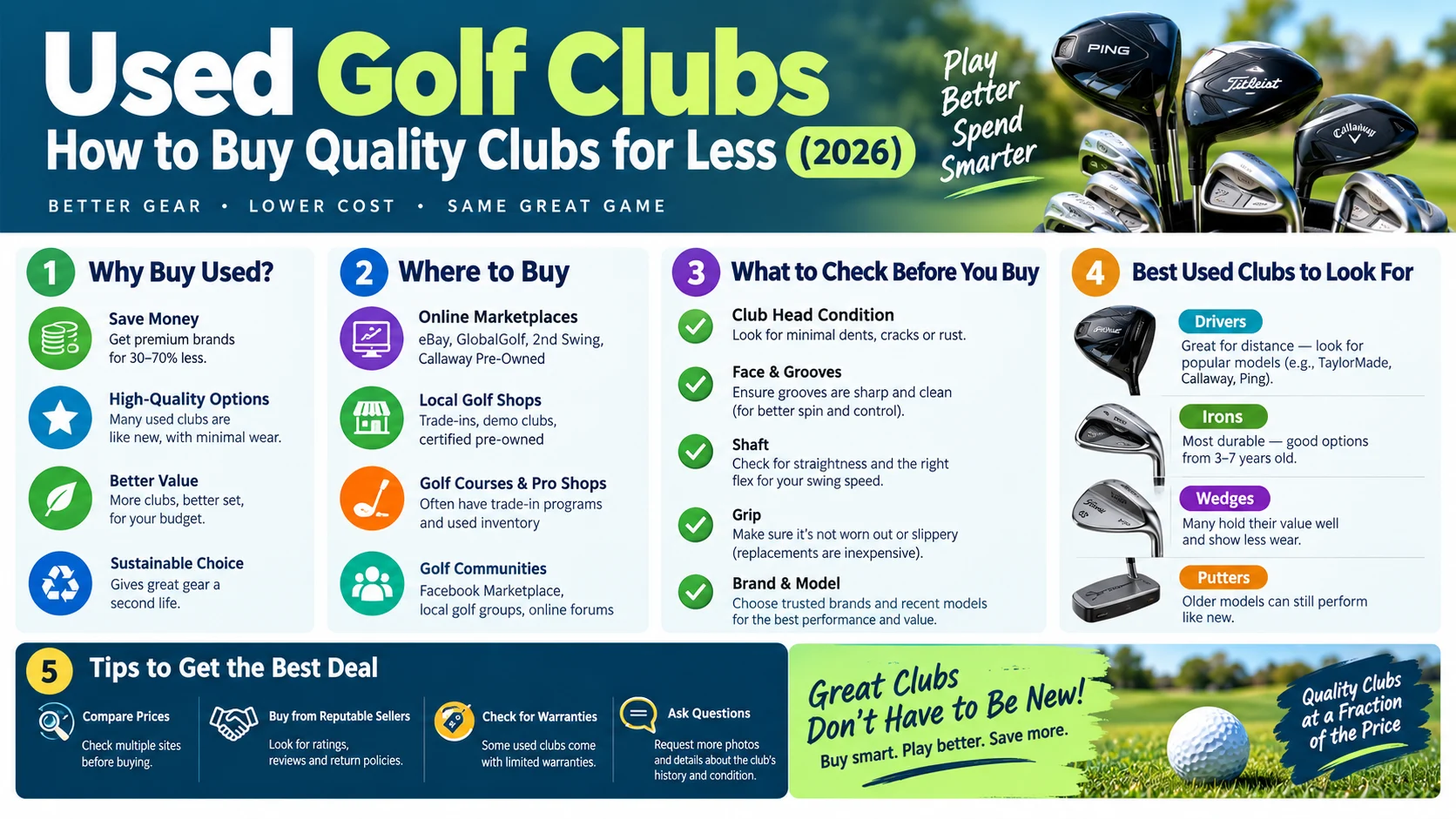
Used golf clubs can deliver excellent performance at a much lower price than new clubs. The key is checking club condition, shaft, loft, grip, authenticity, and fit before buying. If you want to improve your golf game without spending hundreds or even thousands of dollars on brand-new equipment, used golf clubs can be one of the smartest ways to build a golf bag.
A used driver, iron set, wedge, or putter can still perform extremely well when it has been properly maintained. In fact, golfers often sell clubs because they upgrade, change their swing, or simply want the latest model not because the club has stopped working.
But there is an important difference between buying a great used golf club and buying someone else’s problem.
This guide explains what to look for, how much used clubs should cost, which clubs are safest to buy used, and the mistakes that can turn a bargain into an expensive purchase.
Are Used Golf Clubs Worth It?
Yes, used golf clubs are worth considering if they are authentic, properly fitted, and in good condition.
The biggest advantage is value. Golf equipment can lose significant resale value after newer models are released, even though the actual performance difference may be small for many recreational golfers.
A good used club can offer:
- Lower purchase price
- Access to premium golf brands
- Better equipment for the same budget
- Opportunity to experiment with different clubs
- Less financial risk when upgrading
- Excellent options for beginners and improving golfers
The most important factors are condition and fit, not simply how new the club looks.
What Are Used Golf Clubs?
Used golf clubs are clubs that have previously been owned and played by another golfer.
They can range from almost-new clubs that were used only a few times to heavily worn equipment with significant face, sole, shaft, or grip wear.
Common used golf equipment includes:
| Golf Club | Common Used Options |
|---|---|
| Driver | Adjustable, standard, draw-biased |
| Fairway Wood | 3-wood, 5-wood, 7-wood |
| Hybrid | 2H–6H |
| Irons | Individual clubs or complete sets |
| Wedges | Pitching, gap, sand, lob |
| Putter | Blade and mallet |
| Complete Sets | Driver through putter |
The condition can vary considerably, so golfers should inspect more than just the clubhead.
Why Buy Used Golf Clubs?
Save Money on Premium Equipment
One of the biggest reasons golfers shop for used clubs is simple: you can often get more club for your money.
Instead of spending your entire budget on a new entry-level set, you may be able to purchase a higher-quality used driver or iron set.
For example, a golfer with a limited budget might compare:
New budget equipment vs. older premium equipment in good condition.
The second option may provide better materials, shaft choices, adjustability, or overall construction.
Get Previous-Generation Technology
Golf manufacturers release new clubs regularly, but that does not mean older clubs suddenly become ineffective.
A driver from a few years ago can still be a highly capable golf club.
For many recreational players, improvements in swing consistency, contact, and fitting can make a larger practical difference than simply moving to the newest model.
Try Different Equipment
Used clubs are also useful when you’re experimenting.
You might want to discover whether you prefer:
- A blade or mallet putter
- Steel or graphite shafts
- Regular or stiff flex
- Cavity-back or players irons
- More forgiving or more workable clubs
- A higher- or lower-lofted driver
Buying used can make experimentation less expensive.
What Should You Check Before Buying Used Golf Clubs?
Don’t judge a club entirely by its appearance.
Use this checklist before buying.
1. Clubface Condition
The clubface receives repeated impact with the golf ball, so inspect it carefully.
Look for:
- Excessive grooves wear
- Deep scratches
- Cracks
- Unusual dents
- Severe face discoloration
- Damage around the sweet spot
Normal cosmetic marks are not necessarily a problem. Structural damage is much more important.
2. Shaft Condition
The shaft deserves particular attention.
Check for:
- Cracks
- Dents
- Splits
- Severe scratches
- Bends
- Loose connections
A damaged shaft can affect both performance and safety.
Also check the shaft’s flex, weight, and material.
Common flex options include:
- Ladies (L)
- Senior (A)
- Regular (R)
- Stiff (S)
- Extra Stiff (X)
The correct flex depends on the golfer rather than simply their disability.
3. Grip Condition
Golf grips wear out faster than many golfers realize.
A used club can have an excellent clubhead and shaft but require a new grip.
Look for grips that are:
- Cracked
- Hard
- Shiny
- Slippery
- Worn smooth
- Torn
Replacing grips is usually much easier than replacing a damaged shaft or clubhead, so worn grips should not automatically eliminate a good purchase.
4. Clubhead and Hosel
For adjustable drivers and woods, inspect the hosel carefully.
Make sure the adjustment mechanism works correctly and that there are no signs of damage.
On irons, inspect the hosel where the shaft meets the clubhead.
Any major separation, cracking, or movement deserves caution.
5. Authenticity
Counterfeit golf clubs are a real concern when buying from unknown sellers.
Be cautious if:
- The price seems unrealistically low
- Logos look incorrect
- Serial numbers appear suspicious
- Font or graphics look unusual
- The seller refuses detailed photos
- The club’s specifications don’t match the manufacturer’s information
Buying from an established retailer or reputable used-equipment seller can reduce this risk.
How Much Do Used Golf Clubs Cost?
There is no single price for used golf clubs.
Value depends on:
- Brand
- Model
- Age
- Condition
- Club type
- Shaft
- Custom specifications
- Demand
- Original retail price
A newer premium driver in excellent condition will usually cost more than an older driver with significant wear.
The same principle applies to iron sets.
Instead of asking only “Is this club cheap?”, ask:
“Is this club fairly priced for its model, condition, and specifications?”
That question leads to much better buying decisions.
Best Golf Clubs to Buy Used
Some categories can make particularly good used purchases.
Used Drivers
Drivers can be expensive when purchased new, making the used market attractive.
Look for:
- Face condition
- Crown damage
- Shaft condition
- Correct loft
- Appropriate shaft flex
- Adjustable hosel condition
A used driver can be an excellent value when properly matched to the golfer.
Used Irons
Used iron sets are extremely popular because a complete new set can represent a significant investment.
When buying used irons, inspect:
- Clubface
- Grooves
- Sole wear
- Shafts
- Grips
- Set composition
Make sure the set actually contains the clubs you need.
Used Wedges
Wedges require more attention to groove condition because grooves influence spin and short-game control.
A heavily worn wedge may not provide the same performance as a newer one.
If you’re buying used wedges, groove condition matters more than small cosmetic scratches.
Used Putters
Putters are often among the easiest clubs to buy used.
Look for:
- Face condition
- Shaft straightness
- Grip condition
- Headcover
- Alignment features
Because putting is highly individual, a used putter can also be an affordable way to test different head shapes.
Used Golf Clubs for Beginners
Beginners do not necessarily need brand-new equipment.
In fact, used golf clubs can make sense while a new golfer is still learning what equipment suits their swing.
A beginner should generally prioritize:
- Forgiveness
- Appropriate shaft flex
- Correct club length
- Comfortable grips
- Reasonable loft
- Consistent set composition
- Condition
Don’t buy a difficult-to-hit players iron simply because it looks impressive.
A forgiving club that produces more consistent contact can be far more useful during the early stages of learning.
Used Golf Clubs vs. New Golf Clubs
| Factor | Used Golf Clubs | New Golf Clubs |
|---|---|---|
| Price | Usually lower | Usually higher |
| Condition | Varies | New |
| Latest technology | Not always | Usually available |
| Selection | Often extensive | Current models |
| Customization | Depends on listing | Usually easier |
| Resale risk | Generally lower purchase cost | Higher initial investment |
| Best for | Value-focused golfers | Golfers wanting current equipment |
Neither option is automatically right for every golfer.
The better choice depends on your budget, playing level, equipment needs, and how important having the latest model is to you.
Where Can You Buy Used Golf Clubs?
Used clubs are available through several channels.
Golf Retailers
Established golf retailers may offer used equipment that has been inspected and graded.
The advantage is that you may receive more information about the club’s condition and specifications.
Online Used Golf Club Marketplaces
Online marketplaces can provide a huge selection.
However, carefully examine:
- Seller reputation
- Detailed photographs
- Return policy
- Club specifications
- Condition description
- Authenticity information
Local Golf Shops
Local stores allow you to physically inspect clubs before purchasing.
This can be especially useful if you want to compare shafts, grips, and clubhead designs.
Golfers and Private Sellers
Buying directly from another golfer can sometimes produce good deals, but there is less protection if the club turns out to be damaged or counterfeit.
Inspect the equipment carefully before paying.
Should You Get Used Golf Clubs Fitted?
Yes, fitting can still matter when buying used golf clubs.
Golfers sometimes assume fitting is only important when purchasing new equipment. That’s not true.
A used club can still be the wrong choice if it has:
- Incorrect shaft flex
- Wrong length
- Incorrect lie angle
- Unsuitable loft
- Poor shaft weight
- Uncomfortable grip size
If you already know your specifications, shopping for used clubs becomes much easier.
For example, instead of searching simply for a particular iron model, you can search for:
Model + shaft + flex + length + lie
That dramatically narrows the chances of buying the wrong configuration.
Common Mistakes When Buying Used Golf Clubs
Buying Only Because the Price Is Low
A cheap club is not automatically a good deal.
A damaged or poorly fitted club can cost more after repairs or replacement.
Ignoring the Shaft
Golfers often focus on the clubhead and forget the shaft.
The shaft can significantly influence how a club feels and performs.
Buying a Complete Set You Don’t Need
You may find an attractive complete set, but don’t assume every golfer needs the same configuration.
Some players benefit more from hybrids or fairway woods than long irons, for example.
Ignoring Grip Replacement
Old grips can make an otherwise good club feel terrible.
Remember to include potential regripping costs in your total budget.
Buying Without Checking Specifications
Two clubs with the same model name can have very different shafts, lofts, lengths, and configurations.
Always verify the exact specifications.
Choosing Looks Over Performance
A scratched club that fits your swing can be far more valuable than a beautiful club that doesn’t.
How to Clean Used Golf Clubs
Cleaning used clubs is relatively simple.
For most irons:
- Use warm water and mild soap.
- Clean the grooves with an appropriate brush.
- Wipe the clubhead thoroughly.
- Dry it completely.
- Inspect the face and grooves again.
Avoid soaking components unnecessarily, particularly clubs with adjustable mechanisms or areas that could trap moisture.
For grips, use appropriate cleaning methods and allow them to dry completely before playing.
Are Older Golf Clubs Still Good?
Absolutely.
Age alone does not determine whether a golf club is useful.
A golfer should consider the club’s:
- Condition
- Design
- Technology
- Specifications
- Fit
- Personal performance
A well-maintained older club can outperform a newer club that doesn’t match the golfer.
The newest model isn’t automatically the best model for every swing.
Used Golf Clubs: A Smart Buying Checklist
Before clicking Buy, run through this checklist:
✓ Correct club and model
✓ Authentic equipment
✓ Suitable loft
✓ Correct shaft flex
✓ Appropriate shaft weight
✓ Correct length and lie
✓ Clubface inspected
✓ Shaft inspected
✓ Grips checked
✓ Grooves checked
✓ No major dents or cracks
✓ Seller has a trustworthy reputation
✓ Return policy reviewed
✓ Total cost calculated
If all of these boxes are checked, you’re much more likely to turn a used-club purchase into a genuine value.
Frequently Asked Questions
Are used golf clubs worth buying?
Yes. Used golf clubs can provide excellent performance at a lower cost, particularly when the equipment is authentic, well maintained, and properly fitted.
What should I look for when buying used golf clubs?
Check the clubface, grooves, shaft, grips, hosel, clubhead, specifications, and authenticity. Also verify the seller’s reputation and return policy.
Is it better to buy used golf clubs or new?
It depends on your priorities. Used clubs generally offer lower prices, while new clubs provide current models, new grips, warranties where applicable, and more customization options.
Can beginners use used golf clubs?
Yes. Used golf clubs can be an excellent option for beginners, especially when the clubs are forgiving and correctly matched to the golfer.
How old is too old for golf clubs?
There is no universal age limit. Condition, design, performance, and fit are more important than the calendar age of a club.
Should I buy used golf irons?
Used irons can be a particularly good value. Inspect the grooves, faces, shafts, grips, and lie angles before buying.
Can used golf clubs improve my game?
The right equipment can help, but equipment alone won’t replace practice and proper technique. A correctly fitted used club can give you suitable performance without requiring the cost of brand-new equipment.
Final Thoughts
Used golf clubs are not simply cheaper versions of new clubs they can be a practical way to access quality equipment for less money.
The secret is knowing what you’re buying.
Don’t focus only on the brand or price. Check the condition, shaft, loft, grip, grooves, specifications, authenticity, and fit. A carefully selected used driver, iron set, wedge, or putter can remain a valuable part of your golf bag for years.
For golfers who want better equipment without automatically paying the highest price, the used market is worth exploring.
The best deal isn’t necessarily the cheapest club.
It’s the club that gives you the performance you need at a price that makes sense.

Emily Parker is a sports journalist at SportsOrbitX.com with a passion for covering cricket, tennis and major international sporting events. She is committed to producing clear, reliable and engaging content for sports enthusiasts worldwide.