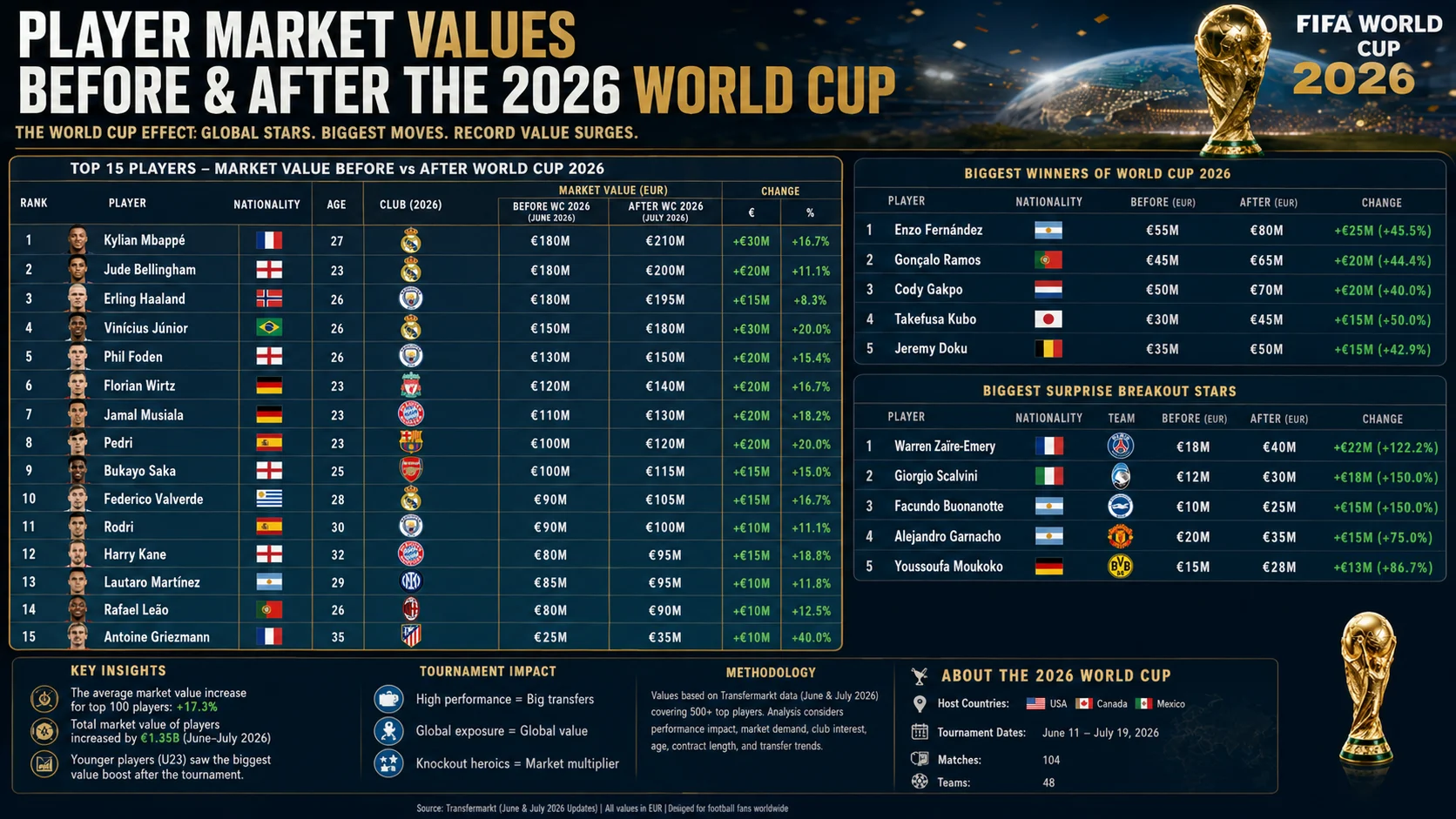
Quick Answer: Following the 2026 World Cup, Lamine Yamal and Erling Haaland became the first players in Transfermarkt’s history to reach a market value of €220 million each, both rising €20 million from their pre-tournament valuations, while Kylian Mbappé’s value also rose €20 million to €200 million despite France’s final defeat.
A World Cup doesn’t just crown a champion it quietly reshapes the transfer market before a single summer deal is even announced. Within days of Spain lifting the trophy in New Jersey, Transfer market released its first post-tournament valuation update, and the numbers confirmed what millions of viewers had watched unfold live: a handful of players had just made themselves significantly more expensive in the eyes of the football world.
This guide breaks down how player market values changed before and after the 2026 World Cup, which stars saw the biggest increases, and what these shifts typically mean for the upcoming transfer window across Europe’s biggest leagues.
How Market Values Are Calculated After a World Cup
Transfermarkt, the industry-standard platform for tracking football market valuations, updates player values periodically throughout the year, with a major update always following the conclusion of a World Cup given the tournament’s outsized influence on the sport. These post-tournament valuations factor in on-field performance during the competition, age and remaining career trajectory, existing contract length, and how a player’s tournament form is likely to influence transfer interest in the following window. A standout World Cup performance, especially from a younger player, tends to produce a more significant valuation increase than a similar performance from an established veteran nearing the end of his prime playing years.
Lamine Yamal: From €200 Million to €220 Million
Barcelona’s teenage winger entered the 2026 World Cup already valued at €200 million, having established himself as one of the sport’s brightest young talents over the preceding two seasons of consistent, high-level performances. Following Spain’s tournament victory, Yamal’s value rose €20 million to €220 million, making him, alongside Erling Haaland, the first player in Transfermarkt’s history to cross the €220 million threshold since the platform began tracking valuations in 2004. Notably, Yamal’s individual tournament statistics were relatively modest, with one goal and one assist across eight matches, suggesting his valuation increase reflected his overall contribution to Spain’s title run and continued growth as a generational talent rather than standout individual scoring output alone.
Erling Haaland: Matching Yamal at €220 Million
Norway’s Erling Haaland delivered one of the tournament’s standout individual campaigns, finishing with seven goals and one assist in five matches as he led Norway to an unexpected run to the quarterfinals before elimination by England after extra time. His performances pushed his market value up €20 million to match Yamal’s €220 million valuation, with Transfermarkt explicitly crediting his tournament form as the primary driver behind the increase, given Norway’s status as a significant underdog reaching that stage of the competition against considerably more fancied opposition.
Kylian Mbappé: Golden Boot Winner, Third in Valuation
Despite winning the tournament’s Golden Boot with 10 goals and finishing as the World Cup’s all-time leading scorer across his three tournament appearances, Kylian Mbappé’s market value increase of €20 million placed him third overall at €200 million, behind both Yamal and Haaland. France’s defeat in the final, and their subsequent third-place playoff loss to England, appears to have limited how much Transfermarkt’s valuation model rewarded his individual scoring exploits, illustrating how team success continues to weigh heavily in these post-tournament assessments alongside pure individual statistics.
Rising Stars: Cubarsí and Enzo Fernández Join the €100 Million Club
Beyond the tournament’s headline names, several younger players crossed significant valuation milestones for the first time in their respective careers. Pau Cubarsí, Barcelona’s 19-year-old defender, saw his value rise €20 million to reach €100 million after being named the tournament’s Best Young Player, a remarkable achievement for a defender still relatively early in his professional development. Argentina’s Enzo Fernández also reached the €100 million mark following a strong tournament in Argentina’s run to the final, reflecting how a strong World Cup can meaningfully accelerate a player’s market trajectory well ahead of the typical development curve seen in most professional careers.
Market Value Changes: Quick Reference Table
The table below summarizes the most notable market value changes confirmed by Transfermarkt following the conclusion of the 2026 World Cup.
| Player | Nation | Before World Cup | After World Cup | Change |
|---|---|---|---|---|
| Lamine Yamal | Spain | €200m | €220m | +€20m |
| Erling Haaland | Norway | €200m | €220m | +€20m |
| Kylian Mbappé | France | €180m | €200m | +€20m |
| Pau Cubarsí | Spain | €80m | €100m | +€20m |
| Enzo Fernández | Argentina | €80m | €100m | +€20m |
Why World Cup Performances Move the Transfer Market So Significantly
A World Cup remains the single most-watched event in world sport, meaning strong individual performances receive a level of global exposure that even a full club season rarely matches across an entire year. This visibility directly influences transfer interest from other clubs, giving valuation platforms like Transfermarkt clear justification for updating figures shortly after the tournament concludes each cycle. For younger players in particular, a standout World Cup can meaningfully compress what might otherwise take several club seasons to achieve in terms of reputation and market recognition, as reflected in both Cubarsí and Enzo Fernández’s rapid rise to nine-figure valuations at relatively young ages in their respective careers.
Do Market Value Changes Always Reflect Actual Transfer Fees?
Not necessarily. While Transfermarkt valuations are widely referenced across football media and by fans and pundits alike, actual transfer fees are ultimately determined by individual negotiations between clubs, contract length, release clauses, and a selling club’s willingness to negotiate at all. A rising valuation increases a player’s perceived worth and can strengthen a club’s negotiating position, but it doesn’t guarantee any specific transfer will occur, or that a fee matching the updated valuation will actually be paid if a move does happen during the upcoming window.
Historical Context: How Past World Cups Have Moved the Market
The 2026 tournament is far from the first World Cup to produce significant market value shifts, though the scale of this year’s increases, particularly the historic €220 million valuations for Yamal and Haaland, represents a new benchmark for the sport as a whole. Previous tournaments have similarly launched or accelerated careers, with breakout performances at past World Cups regularly translating into major transfer moves or valuation jumps in the months that followed each edition. What distinguishes the 2026 update is the sheer scale of the figures involved, reflecting football’s continued financial growth as a global industry and the increasingly sophisticated methodology valuation platforms now apply when assessing tournament performances across every position on the pitch.
Other Notable Market Movements From the Tournament
Beyond the tournament’s headline names, several other players saw meaningful valuation changes following their World Cup performances across different nations and clubs. Michael Olise’s strong showing for France throughout the tournament contributed to a notable rise in his own market standing, reinforcing his emergence as one of the sport’s most sought-after wide players heading into the new season. Jude Bellingham’s continued excellence for England, including his decisive extra-time goal in the quarterfinal against Norway, further cemented his status among the world’s most valuable midfielders, even as England ultimately fell short in the semifinal against Argentina after leading for much of the match.
How Clubs Use Market Value Data in Negotiations
While Transfermarkt valuations aren’t official transfer prices, clubs and agents frequently reference them as a starting point during negotiations, particularly when a release clause or valuation benchmark needs public justification to fans and media outlets. A significant post-World Cup increase can strengthen a selling club’s negotiating position, giving them public-facing evidence to support a higher asking price, while also potentially attracting interest from clubs that hadn’t previously considered a move given the player’s newly elevated profile following their tournament performances. This dynamic is part of why the weeks immediately following a World Cup often see a noticeable uptick in transfer speculation involving standout tournament performers, even before any formal negotiations have begun between the clubs involved in a potential deal.
Does the Same Market Value Effect Apply to Women’s Football?
While this guide focuses on the men’s 2026 World Cup, it’s worth noting that a similar valuation dynamic increasingly applies following major women’s tournaments as well, as the women’s game continues its own rapid commercial growth across major leagues worldwide. Standout performances at recent editions of the FIFA Women’s World Cup have produced comparable, if generally smaller-scale, valuation increases for breakout players, reflecting how tournament visibility drives market interest regardless of gender, even as the overall financial scale of women’s football valuations continues to grow from a smaller historical base compared to the men’s game and its established commercial infrastructure.
Frequently Asked Questions
The following questions address the most common points of curiosity about how the World Cup influenced player valuations this year.
How much did Lamine Yamal’s market value increase after the 2026 World Cup? Lamine Yamal’s market value rose by €20 million, from €200 million before the tournament to €220 million afterward following Spain’s title-winning campaign.
Who has the highest market value after the 2026 World Cup? Lamine Yamal and Erling Haaland are tied at €220 million each, the first players to reach that valuation in Transfermarkt’s history since 2004.
Did Kylian Mbappé’s market value increase despite France losing the final? Yes, Mbappé’s value rose €20 million to €200 million, driven by his Golden Boot-winning performance, though the increase was smaller than Yamal’s and Haaland’s respective rises.
Why didn’t Mbappé have the highest market value despite winning the Golden Boot? Team success and overall tournament outcome factor heavily into valuation updates, and France’s final and third-place playoff defeats appear to have limited how much his individual scoring output was ultimately rewarded.
What is the source for these player market value figures? These figures come from Transfermarkt, the industry-standard platform for tracking football market valuations, based on its official post-World Cup update.
Do market value increases guarantee higher transfer fees? No, market value is a widely referenced estimate, but actual transfer fees depend on individual club negotiations, contracts, and release clauses.
Did any other players see significant valuation increases besides the tournament’s top scorers? Yes, players like Michael Olise and Jude Bellingham also saw notable valuation increases following strong individual tournament performances for France and England respectively.
How often does Transfermarkt update player valuations? Transfermarkt updates valuations periodically throughout the year, with a major update always following the conclusion of a World Cup to reflect tournament performances.
Conclusion
The 2026 World Cup didn’t just crown Spain as champions it reshaped the football transfer market’s financial landscape almost overnight, with Lamine Yamal and Erling Haaland emerging as the first players ever valued at €220 million. From established stars like Mbappé to breakout performers like Cubarsí and Enzo Fernández, the tournament’s post-competition valuation update offers a clear snapshot of how a single month on the world’s biggest stage can meaningfully shift a player’s market standing, setting the stage for what promises to be an eventful upcoming transfer window. Want to explore more about the tournament itself? Check out our guide on 2026 FIFA World Cup: The Complete Tournament Guide for the full story.

Emily Parker is a sports journalist at SportsOrbitX.com with a passion for covering cricket, tennis and major international sporting events. She is committed to producing clear, reliable and engaging content for sports enthusiasts worldwide.