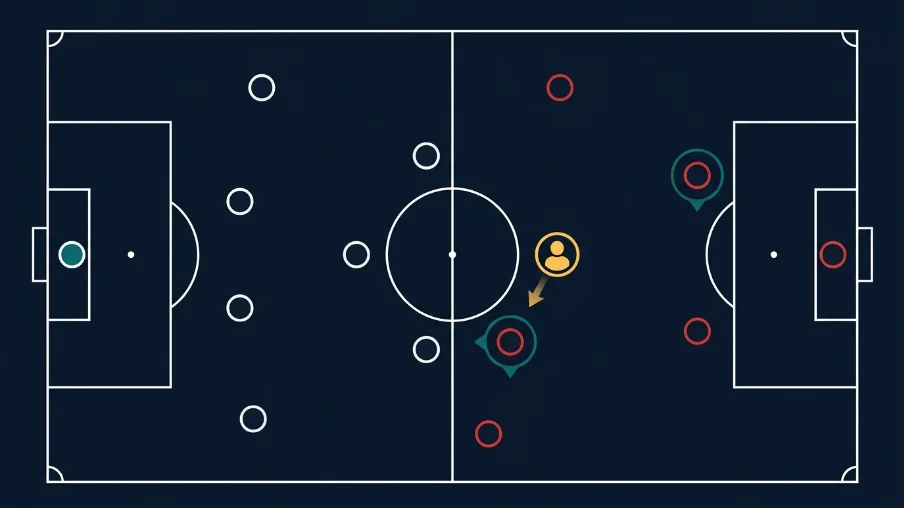
Quick Answer: A false 9 is a striker who drops deep into midfield instead of staying on the last defensive line, dragging opposition center-backs out of position and creating space for teammates to attack into.
A striker who doesn’t stay near the goal sounds like a contradiction. Yet some of the most effective attacking systems in modern football are built around exactly that idea. When Pep Guardiola’s Barcelona dismantled Real Madrid 6-2 in 2009, the man wearing the number 9 shirt spent much of the match nowhere near the penalty box and it worked because the entire opposition defense didn’t know who was supposed to mark him, leaving gaps that Barcelona’s other attackers ruthlessly exploited throughout the game.
That role is called the false 9, and it remains one of the most misunderstood tactical concepts in football for newer fans. This guide explains exactly what a false 9 is, how the role actually functions during a match, why it causes so many problems for defenses, and which players have defined it at the highest level of the professional game.
This guide has been researched using match analysis from professional coaching resources and cross-checked against how the role has actually been deployed by top-level managers over the past two decades, so you’re getting an accurate tactical breakdown rather than a surface-level definition.
What Does False 9 Actually Mean?
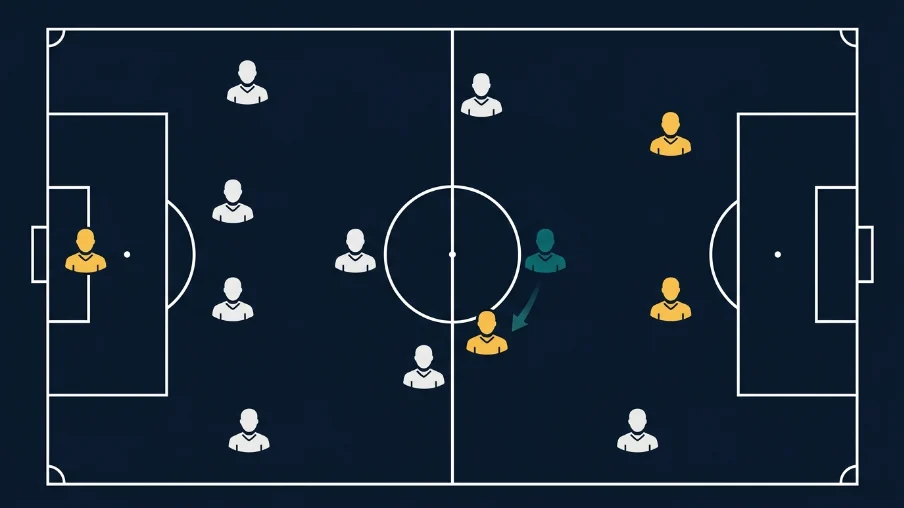
The number 9 shirt has traditionally been worn by a team’s central striker a player who stays high up the pitch, close to the opposition’s goal, focused primarily on scoring. A false 9 wears that same shirt and nominally occupies that same central striker role on the team sheet, but plays it very differently in practice. Instead of remaining pinned to the last line of defense, a false 9 regularly drops into midfield areas, effectively becoming an extra playmaker while still being expected to finish chances when they arise.
The word “false” refers to this contradiction between the position listed on paper and how the player actually moves during a match a subtle but important distinction that separates it from other attacking midfield roles that never carry the striker designation at all.
How Does the False 9 Role Confuse Defenses?
Center-backs are trained to mark the striker directly in front of them. When that striker drops deep instead of staying put, a defender faces a difficult choice: follow the striker into midfield and abandon their defensive position, or hold the line and let the striker operate freely in space.
Neither option is ideal for the defending team. If the center-back follows, gaps open up behind the defense that wingers or attacking midfielders can exploit with late runs. If the center-back holds position, the false 9 gets time and space in midfield to pick out passes, turn defenders, or launch attacks. This built-in dilemma is the core reason the tactic remains effective even against well-organized, disciplined defenses at the highest level of the sport.
Key Skills Required to Play as a False 9
Not every striker can play this role effectively. It demands a specific skill set that differs significantly from a traditional out-and-out finisher:
Vision and Passing Range
A false 9 needs to spot and execute passes from midfield areas, often under pressure from multiple defenders converging at once.
Close Control in Tight Spaces
Dropping into midfield means operating in congested areas where defenders and midfielders are packed closely together, requiring excellent close control to retain possession.
Off-the-Ball Movement
Timing is critical a false 9 has to know exactly when to drop deep to receive the ball and when to make late runs back into the box to arrive as a genuine scoring threat.
Game Intelligence
Perhaps most importantly, the role requires a strong tactical understanding of space and opposition structure, since much of its effectiveness comes from reading the game rather than raw athleticism.
Famous False 9 Players in Football History
Lionel Messi
Messi’s deployment as a false 9 under Pep Guardiola at Barcelona, particularly during the 2008-09 treble-winning season, is widely regarded as the role’s most influential modern example. His dropping movement combined with elite dribbling made him almost impossible to mark consistently.
Francesco Totti
Under coach Luciano Spalletti at Roma, Totti was redeployed from an attacking midfield role into a false 9 position, using his passing range and finishing ability to devastating effect during the 2006-07 Serie A season.
Roberto Firmino
At Liverpool under Jürgen Klopp, Firmino became known for a pressing-focused interpretation of the false 9, combining defensive work rate with the space-creating movement that allowed wingers Mohamed Salah and Sadio Mané to thrive.
A Brief History of the False 9 Role
The tactical roots of the false 9 stretch back further than most fans realize. Hungary’s national team, coached by Gusztáv Sebes in the early 1950s, is widely credited with pioneering the concept through forward Nándor Hidegkuti, who regularly dropped deep instead of staying central. This approach was put on full display in Hungary’s famous 6-3 win over England at Wembley in 1953, a result that stunned English football and exposed how unprepared traditional defensive systems were for a striker who refused to stay put.
The role largely faded from prominence for decades before resurfacing in a modern, highly refined form under Pep Guardiola at Barcelona, where Lionel Messi’s deployment in the position between 2008 and 2012 became the reference point most fans and analysts associate with the tactic today. Since then, variations of the false 9 have appeared across top European leagues, adapted by different managers to fit their own tactical philosophies.
How Defenses Try to Counter the False 9
Because the false 9 exploits indecision in defensive marking, opposition coaches have developed several counter-strategies over the years:
- Zonal marking — Instead of following the striker man-for-man, defenders hold their zone and pass the striker off to a deeper midfielder as they enter midfield areas.
- Aggressive pressing — Some teams choose to press the false 9 immediately upon receiving the ball, denying them time to pick out a pass before it becomes dangerous.
- Compact defensive shape — Keeping defensive lines tightly packed reduces the space a false 9 can exploit even after dropping deep, limiting the tactic’s overall effectiveness.
No single counter-strategy fully neutralizes the role, which is part of why it remains a relevant, actively used tactic in professional football today rather than a tactical trend that faded after its initial success.
False 9 Compared to Other Attacking Roles
| Aspect | False 9 | Traditional Striker |
|---|---|---|
| Positioning | Drops into midfield frequently | Stays on the last defensive line |
| Primary strength | Vision, passing, link-up play | Finishing, aerial ability, movement in the box |
| Defensive impact | Drags center-backs out of position | Occupies center-backs directly |
| Goal-scoring style | Often arrives late into the box | Consistently positioned to finish chances |
Advantages and Disadvantages of the False 9 System
Advantages:
- Creates numerical overloads in midfield, helping teams dominate possession
- Confuses defensive structures built around man-marking a central striker
- Allows wingers and attacking midfielders more space to exploit in behind
Disadvantages:
- Reduces a team’s direct aerial and central goal threat
- Requires technically gifted, tactically intelligent players who are rare
- Can be neutralized by disciplined defenses that stay compact rather than following the striker
How Coaches Use the False 9 Today
Modern managers rarely deploy a pure false 9 for an entire match. More commonly, the role appears situationally a striker might drop deep during build-up phases to help retain possession, then push higher once the team is ready to attack the penalty box directly. This hybrid approach blends the tactical benefits of the false 9 with the more traditional goal-scoring presence teams still need in the final third.
This flexible application also reflects how tactical analysis in football has evolved. Rather than treating positions as fixed labels, top-level coaches increasingly think in terms of spaces and phases of play where a player needs to be during build-up, during progression, and during the final attacking phase can differ significantly, even for a player nominally listed as the team’s central striker on a printed lineup sheet.
Notable Matches That Showcased the False 9
Certain matches are frequently referenced by analysts and coaches when explaining the false 9’s real-world impact:
- Hungary 6-3 England (1953) — Hidegkuti’s deep-lying movement contributed directly to England’s first-ever home defeat to a team from outside the British Isles, exposing how unprepared traditional marking systems were for the tactic.
- Barcelona 6-2 Real Madrid (2009) — Messi’s false 9 performance is still cited as a textbook example of how the role can dismantle even elite, well-organized defenses.
- Liverpool 4-0 Barcelona (2019 Champions League semi-final) — Firmino’s pressing-focused false 9 display helped create the platform for one of the competition’s most famous comebacks.
Frequently Asked Questions
What is the difference between a false 9 and a second striker? A second striker typically plays just behind a more traditional central striker, while a false 9 occupies the central striker position itself but drops deep rather than staying on the last line.
Who invented the false 9 role? While the concept has earlier roots, Nándor Hidegkuti’s performances for Hungary in the 1950s, particularly in a famous 1953 win over England, are often credited as the first widely recognized use of the tactic at international level.
Is the false 9 still used in modern football? Yes, though usually in a hybrid form rather than for an entire match, with several top clubs incorporating false 9 movement into broader positional play systems.
Can any striker play as a false 9? Not effectively. The role requires strong passing ability, vision, and game intelligence in addition to typical striker qualities like finishing.
Why is it called a false 9 specifically? The name refers to the number 9 shirt traditionally worn by central strikers the player is “false” because they don’t play the role that shirt number traditionally represents.
Does playing a false 9 mean a team has no natural striker? Not necessarily. Some teams use the false 9 as a rotational tactic within a match, while others build their entire system around a naturally gifted playmaker occupying the position full-time.
What’s the difference between a false 9 and a deep-lying forward? The terms are often used interchangeably, though a deep-lying forward can describe a slightly broader tactical concept, while false 9 specifically emphasizes the contradiction with the traditional central striker role.
Conclusion
The false 9 remains one of football’s most tactically rich positions precisely because it breaks the assumption that a striker must stay near the goal to be effective. By dropping into midfield, a false 9 forces defenders into impossible decisions, creates space for teammates, and adds a layer of unpredictability that structured defenses still struggle to solve, even decades after Hidegkuti first exposed the concept at Wembley in 1953.
Understanding this role makes it far easier to recognize why certain teams build their entire attacking identity around one specific player’s movement, rather than simply judging a striker by goals alone. Want to explore more football positions and tactics? Check out our guide on Football Positions and Their Roles for the complete breakdown of every position on the pitch.

Emily Parker is a sports journalist at SportsOrbitX.com with a passion for covering cricket, tennis and major international sporting events. She is committed to producing clear, reliable and engaging content for sports enthusiasts worldwide.