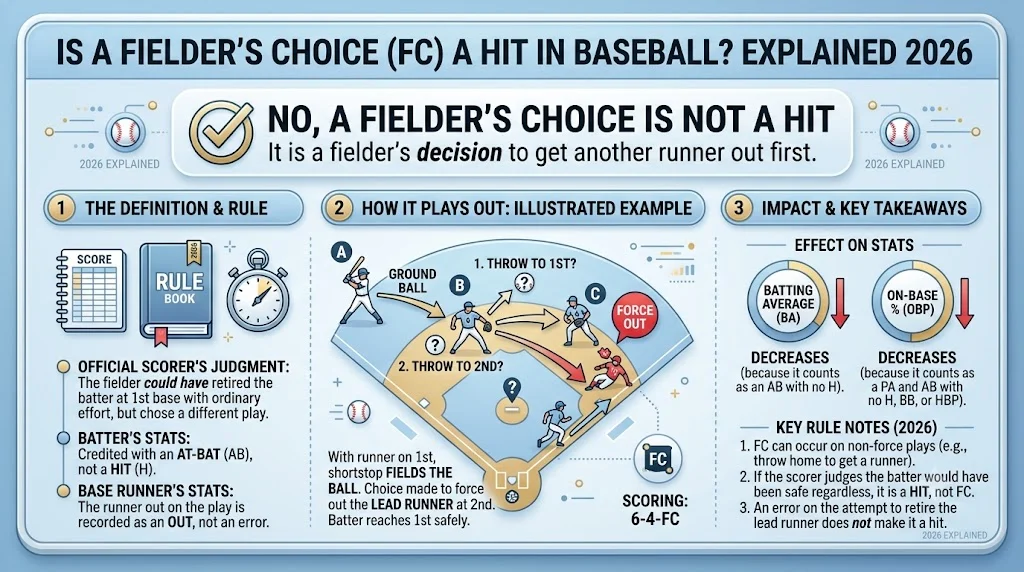
Quick Answer: No, a fielder’s choice is not scored as a hit in baseball. When a batter reaches base safely because a fielder chose to attempt an out on another runner instead, the play counts as an official at-bat but does not credit the batter with a hit, meaning it actually lowers both batting average and on-base percentage.
A batter smacks a ground ball, sprints down the line, and reaches first base safely. The crowd might cheer, but the official scorebook tells a very different story than a clean base hit does. This single, common play trips up more new fans and even some players than almost any other scoring decision in baseball, largely because reaching base safely feels like it should count as a hit, even when the record books firmly disagree with that intuitive assumption.
This guide explains exactly whether a fielder’s choice is a hit in baseball, how the play is officially scored, why it affects a batter’s statistics the way it does, and how it differs from similar plays like an error or a genuine base hit.
What Exactly Is a Fielder’s Choice?
A fielder’s choice occurs when a fielder, after fielding a batted ball, chooses to attempt to put out a different baserunner rather than throwing to first base to retire the batter at the plate. The most common example involves a runner on first base and a ground ball hit to an infielder, who then throws to second base to force out the lead runner instead of throwing to first. The batter, benefiting from the fielder’s decision to prioritize the other runner, safely reaches first base, but this outcome is directly credited to the fielder’s choice rather than to any hitting skill or effort on the batter’s part.
How a Fielder’s Choice Is Officially Scored
Under official scoring rules, a fielder’s choice results in the batter being charged with an official at-bat but receiving no credit for a hit, regardless of whether the fielder’s attempted out on the other runner actually succeeds or not. This means the play negatively affects two of a batter’s most closely tracked statistics simultaneously, in a way that surprises many casual fans. Batting average, calculated as hits divided by at-bats, decreases because the at-bat count increases without a corresponding hit being recorded. On-base percentage, which only counts hits, walks, and hit-by-pitches as times reaching base, is similarly unaffected in the positive direction, meaning a fielder’s choice lowers OBP in the same way it lowers batting average, contrary to a common misconception that reaching base safely automatically helps this particular statistic.
Does It Matter If the Fielder’s Attempted Out Succeeds?
Interestingly, a fielder’s choice is scored the same way whether or not the fielder actually succeeds in putting out the other runner during the play. According to official scoring rules, if an official scorer judges that a fielder had a legitimate attempt at retiring a preceding runner, the play is recorded as a fielder’s choice regardless of the actual outcome of that specific attempt. If the throw is off-target and both the runner and batter end up safe, it can still be ruled a fielder’s choice, provided the scorer determines the fielder had a genuine chance to make the out in the first place. This distinguishes a fielder’s choice from a simple missed play, since intent and reasonable opportunity matter more than whether the attempted putout actually succeeded on the field.
Fielder’s Choice vs. Error: What’s the Difference?
These two scoring decisions often cause confusion, but they represent fundamentally different situations from an official scoring perspective. A fielder’s choice occurs when a fielder makes a reasonable, deliberate decision to attempt an out on one runner instead of another, with the batter reaching base as a direct consequence of that specific decision. An error, by contrast, is charged when a fielder makes a play that a competent fielder would normally be expected to complete successfully but fails to do so due to a physical mistake, such as a dropped ball or an errant throw. If a scorer determines a fielder genuinely had no reasonable chance to retire the batter at first and instead attempted a play on another runner purely because the batter couldn’t have been thrown out anyway, the play is typically scored as a base hit rather than a fielder’s choice.
Fielder’s Choice vs. Hit: Quick Comparison
| Aspect | Fielder’s Choice | Base Hit |
|---|---|---|
| Counts as an at-bat? | Yes | Yes |
| Credited as a hit? | No | Yes |
| Affects batting average? | Lowers it | Raises it |
| Affects on-base percentage? | Lowers it | Raises it |
| Typical scoring notation | FC | 1B, 2B, 3B, or HR |
Why Fielder’s Choice Matters for Team Strategy
Beyond individual statistics, a fielder’s choice frequently represents a deliberate, strategically sound defensive decision rather than a missed opportunity. In many situations, particularly with multiple runners on base, retiring the lead runner is considerably more valuable to the defense than getting the batter out at first, since it removes the runner closest to scoring and reduces the offense’s overall threat. This is why coaches and fielders actively pursue fielder’s choice plays in appropriate situations, even knowing the batter will reach base safely, treating the trade-off as a clear net positive for the defensive team’s chances of preventing a run.
How Official Scorers Make These Judgment Calls
Determining whether a play should be scored as a fielder’s choice, an error, or a hit ultimately falls to the official scorer, a designated statistician present at every professional game whose rulings carry real statistical weight. This judgment involves assessing whether a fielder could have reasonably retired the batter at first base “with ordinary effort,” a standard that requires interpretation rather than a simple objective measurement. Scorers must consider factors like the batter’s running speed, the difficulty of the fielding play, and the distance and accuracy required for a successful throw, all within the split seconds it takes for a play to unfold on the field. This inherent subjectivity is part of why fielder’s choice rulings occasionally generate genuine debate among players, coaches, and broadcasters, even though the underlying rules themselves are clearly defined.
Other Situations Scored as a Fielder’s Choice
Beyond the most common scenario involving a force out at second base, official scoring rules recognize several other situations under the fielder’s choice designation. When a runner advances an extra base specifically because a fielder chose to make a throw elsewhere rather than attempting to prevent that advance, the play can also be recorded using fielder’s choice notation in the scorebook. Additionally, certain strikeout situations involving a dropped third strike can result in a play being scored as both a strikeout and a fielder’s choice simultaneously, if the catcher or another fielder completes a force play on a different baserunner rather than simply throwing to first to retire the batter. These less common applications reflect how broadly the fielder’s choice designation is used to account for defensive decision-making throughout a game, not just the single most familiar ground-ball scenario.
How Fielder’s Choice Impacts Advanced Baseball Statistics
Beyond traditional batting average and on-base percentage, fielder’s choice plays also factor into more advanced sabermetric statistics increasingly used to evaluate player performance. Weighted on-base average and other modern metrics that attempt to capture a hitter’s true offensive contribution generally treat a fielder’s choice similarly to a standard out, since it represents a genuinely unproductive outcome for the batter’s individual statistical line, regardless of any benefit to team run prevention through the resulting force out. Some situational statistics do give partial credit for productive outs, including certain fielder’s choice plays that advance a trailing runner into scoring position, reflecting ongoing efforts within baseball analytics to more accurately capture a batter’s contextual contribution beyond simple traditional counting statistics.
Frequently Asked Questions
Is a fielder’s choice a hit in baseball? No, a fielder’s choice is not scored as a hit. It counts as an official at-bat for the batter but does not credit them with a base hit.
Does a fielder’s choice hurt a player’s batting average? Yes, since it counts as an at-bat without a hit, a fielder’s choice lowers a batter’s batting average, similar to making an out.
Does a fielder’s choice affect on-base percentage? Yes, contrary to a common misconception, a fielder’s choice does not count as a positive outcome for on-base percentage and effectively lowers it, since only hits, walks, and hit-by-pitches count toward reaching base for that statistic.
What is the difference between a fielder’s choice and an error? A fielder’s choice involves a deliberate, reasonable decision to attempt an out on a different runner, while an error involves a fielder failing to complete a play they would normally be expected to make.
Is a fielder’s choice scored the same way if the attempted out fails? Yes, as long as the official scorer judges the fielder had a legitimate attempt at retiring a preceding runner, the play is scored as a fielder’s choice regardless of whether that specific attempt succeeds.
Why would a team intentionally choose a fielder’s choice over an easy out at first? Retiring a lead runner, especially one closer to scoring, is often more strategically valuable to the defense than getting the batter out, even though it means the batter reaches base safely.
Can a fielder’s choice also be recorded as a strikeout? Yes, in certain dropped third strike situations, a play can be scored as both a strikeout and a fielder’s choice if a force play is completed on another baserunner instead of simply retiring the batter at first.
How do advanced baseball statistics treat a fielder’s choice? Modern sabermetric statistics generally treat a fielder’s choice similarly to a standard out for the batter’s individual line, though some situational metrics give partial credit when it productively advances a trailing runner.
Conclusion
So, is a fielder’s choice a hit in baseball? Despite the batter safely reaching base, the answer is a clear no, a distinction that reflects how baseball’s scoring system prioritizes crediting the actual defensive decision-making behind a play rather than simply the outcome for the runner.
Understanding this rule, along with how official scorers make these judgment calls and how it differs from an error, makes it much easier to follow why a batter’s statistics can shift even on plays that look identical from the stands.