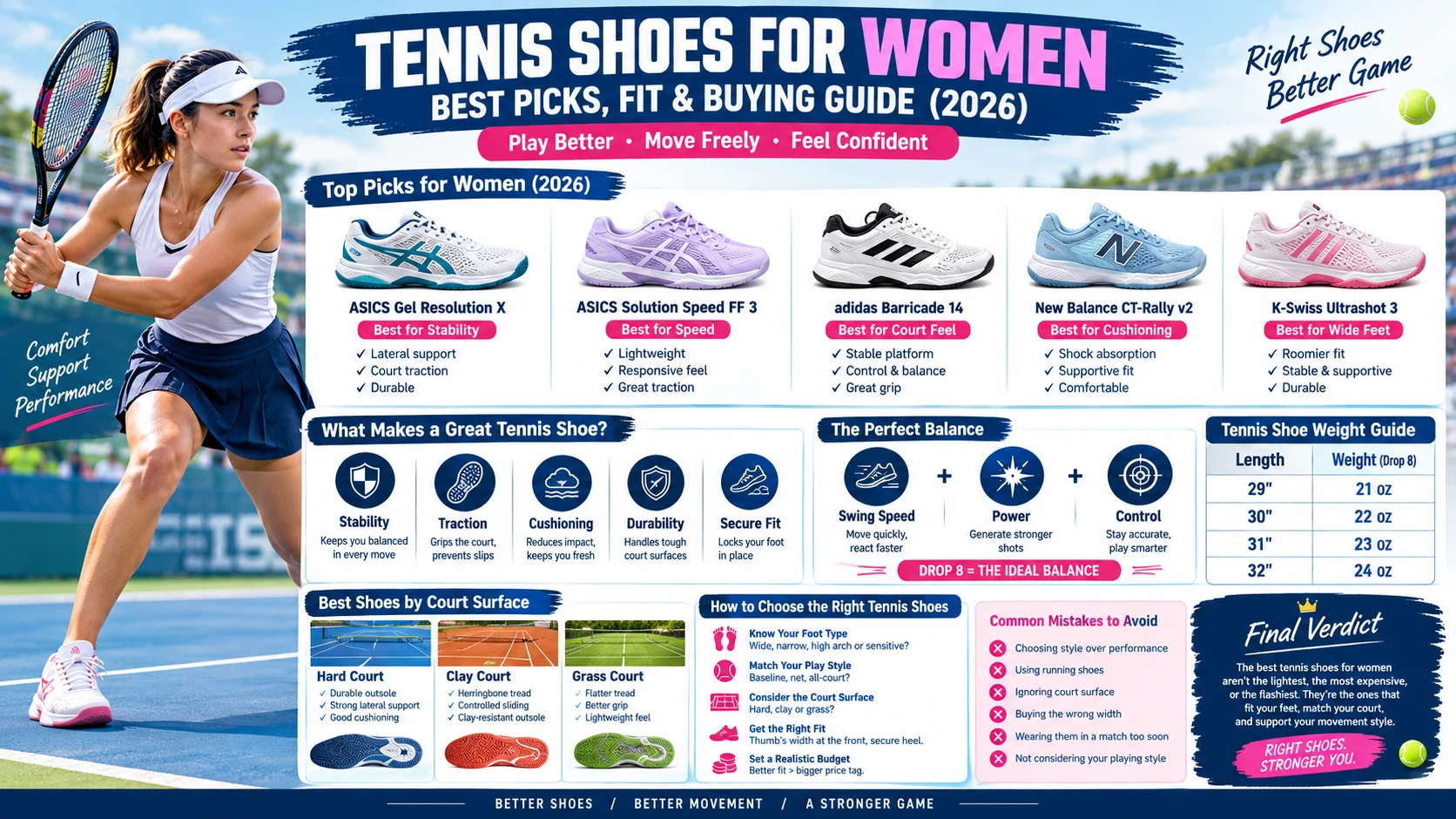
AI Overview: The best tennis shoes for women combine lateral stability, court-specific traction, cushioning, durability, and a secure fit. Unlike running shoes, tennis shoes are built for sudden stops, side-to-side movement, quick pivots, and explosive court coverage. In 2026, top options include the ASICS Gel Resolution X, adidas Barricade 14, New Balance Fresh Foam X CT-Rally v2, ASICS Solution Speed FF 3, and K-Swiss Hypercourt Supreme 2, depending on your court surface, foot shape, and playing style.
What Are the Best Tennis Shoes for Women?
If you want a simple starting point, choose your shoe based on what matters most to your game:
| Best For | Recommended Shoe | Why It Stands Out |
|---|---|---|
| Overall stability | ASICS Gel Resolution X | Excellent support and court traction |
| Speed | ASICS Solution Speed FF 3 | Lightweight, responsive feel |
| Court feel | adidas Barricade 14 | Low, stable platform |
| Cushioning | New Balance Fresh Foam X CT-Rally v2 | Excellent impact protection |
| Wide feet | K-Swiss Ultrashot 3 | Roomier fit options |
| Comfortable play | K-Swiss Hypercourt Supreme 2 | Cushioning + breathable upper |
| Stylish performance | Diadora Blushield Torneo 2 | Performance with a fashion-forward look |
| Grass/clay | Reebok Nano Court | Strong traction and secure fit |
The right choice is not necessarily the most expensive shoe. The best women’s tennis shoe is the one that matches your court, movement style, foot shape, and playing frequency.
Why Women Need Tennis-Specific Shoes
A tennis match can involve hundreds of short movements: lateral shuffles, sudden stops, split steps, pivots, forward sprints, and backward recovery.
That is why a normal running shoe is not an ideal substitute.
Running shoes are primarily designed for forward motion, while tennis shoes are constructed to handle the multidirectional forces created by court movement. Tennis-specific footwear generally sits closer to the court and emphasizes lateral stability, traction, and durability.
A good tennis shoe should help you feel:
- Stable when changing direction
- Secure when stopping suddenly
- Comfortable during long rallies
- Confident when pushing off
- Protected from repeated court impact
- Locked into the shoe without your heel slipping
That combination matters far more than simply choosing a shoe because it looks good.
Best Tennis Shoes for Women in 2026
1. ASICS Gel Resolution X — Best for Stability
The ASICS Gel Resolution X is one of the strongest choices for women who prioritize stability and support.
It is particularly appealing to aggressive baseline players who constantly move side-to-side and need a shoe that feels planted during hard cuts.
Independent 2026 testing highlights its strong construction, stability, and court traction, making it especially suitable for players who move explosively.
Best for: Baseline players, competitive players, stability seekers
Why choose it: Excellent lateral support and a secure court feel.
Potential drawback: Its supportive construction can feel less lightweight than speed-focused models.
2. ASICS Solution Speed FF 3 — Best for Speed
If you hate the feeling of heavy shoes, the ASICS Solution Speed FF 3 deserves a close look.
It is designed for players who want to move quickly without giving up essential traction and support. Verywell Fit rated it highly for beginners, particularly on hard courts, where its traction and supportive feel help players become more confident with movement.
Best for: Beginners, quick movers, players who prefer lightweight footwear
Why choose it: Fast, responsive feel with dependable hard-court traction.
Potential drawback: The fit can feel snug for women who need a very roomy toe box.
3. adidas Barricade 14 — Best for Court Feel
The adidas Barricade 14 is a strong option for players who want to feel connected to the court.
Its relatively low profile and stable platform make it attractive to players who value controlled footwork and surface feedback. Current testing has highlighted its stability and balance between braking and sliding.
Best for: Experienced players, aggressive movers, players who like court feel
Why choose it: Stable, controlled, and confidence-inspiring.
4. New Balance Fresh Foam X CT-Rally v2 — Best for Cushioning
If comfort is your priority, look closely at the New Balance Fresh Foam X CT-Rally v2.
This model stands out for shock absorption and support. Independent testing found particularly strong cushioning while also noting its wide forefoot and substantial lateral support.
Best for: Long matches, comfort-focused players, players wanting extra cushioning
Why choose it: Excellent impact protection and a supportive platform.
Potential drawback: It is heavier than many speed-oriented tennis shoes.
5. K-Swiss Ultrashot 3 — Best for Wide Feet
Women with wider feet often make the mistake of buying a narrow performance shoe and hoping it will stretch.
That can lead to pressure around the toes, discomfort, and an unstable feeling.
The K-Swiss Ultrashot 3 is worth considering if you need more room while still wanting a performance-oriented tennis shoe. It has been highlighted among women’s tennis shoes for wider feet.
Best for: Wide feet, players wanting stability with more room
Why choose it: A more accommodating fit without abandoning court performance.
Best Tennis Shoes for Women by Court Surface
Your court surface should influence your shoe choice almost as much as your foot shape.
Hard Court Tennis Shoes
Hard courts are demanding because they create significant friction and repetitive impact.
Look for:
- Durable rubber outsole
- Strong lateral support
- Reinforced toe area
- Reliable cushioning
- Stable heel structure
The ASICS Gel Resolution X, adidas Barricade 14, ASICS Solution Speed FF 3, and New Balance CT-Rally v2 are strong options for hard-court players. Current 2026 testing continues to emphasize durability, traction, and lateral stability as key requirements for hard courts.
Clay Court Tennis Shoes
Clay requires a different type of traction.
A clay-court outsole generally uses a herringbone-style tread designed to provide grip while allowing controlled sliding. The shoe should also help prevent loose clay from becoming trapped in the outsole.
If you primarily play clay, do not automatically assume an all-court shoe is the best option.
Grass Court Tennis Shoes
Grass is naturally more slippery than hard court, particularly when damp.
Grass-court shoes generally use a flatter, specialized outsole pattern designed to provide traction without digging aggressively into the surface.
The Reebok Nano Court is one option highlighted for grass and clay play, with testing noting its traction and secure fit.
How to Choose Women’s Tennis Shoes for Your Feet
Finding the right shoe starts with your feet not the logo.
For Wide Feet
Look for:
- Wide or roomy sizing
- A broader toe box
- Less pressure across the forefoot
- A secure heel that does not allow excessive movement
Your toes should not feel compressed when you perform a split step.
For Narrow Feet
A shoe that is too wide can be just as problematic as one that is too narrow.
If your heel lifts inside the shoe during quick movement, you may need a more secure heel counter or narrower overall fit.
For High Arches
Look for adequate midfoot support and cushioning.
Women with high arches often appreciate shoes that provide enough structure without creating uncomfortable pressure across the top of the foot.
For Sensitive Feet
Prioritize cushioning, a comfortable upper, and a smooth heel collar.
The shoe should feel supportive without creating pressure points.
What Should a Good Women’s Tennis Shoe Feel Like?
A good tennis shoe should feel secure, not restrictive.
When standing normally, you should have enough room at the front for your toes to spread naturally. At the same time, your heel should remain securely locked when you move.
One useful fitting guideline is roughly a thumb’s width of space between your longest toe and the front of the shoe.
When testing shoes, try these movements:
- Walk quickly.
- Perform a few side-to-side shuffles.
- Stop suddenly.
- Push off laterally.
- Bend into a tennis-ready stance.
If your foot slides inside the shoe, the fit is wrong.
If your toes hit the front, the shoe is too short.
If your forefoot feels squeezed, look for a wider option.
Tennis Shoes vs Running Shoes for Women
| Feature | Tennis Shoes | Running Shoes |
|---|---|---|
| Movement | Multi-directional | Primarily forward |
| Lateral support | High | Usually lower |
| Court traction | Designed for court surfaces | Designed for roads/trails |
| Stability | Strong | Varies |
| Outsole | Court-specific | Running-specific |
| Best use | Tennis | Running |
The biggest mistake is assuming that a comfortable running shoe will automatically work for tennis.
It may feel excellent while jogging but unstable when you suddenly plant your foot and change direction.
How Much Should You Spend on Women’s Tennis Shoes?
You do not need the most expensive shoe to play good tennis.
A practical approach is:
Casual player: Prioritize comfort, fit, and reasonable durability.
Regular recreational player: Spend more on stability and outsole durability.
Competitive player: Prioritize court-specific traction, lateral stability, cushioning, and a proven fit.
If you play several times per week, durability becomes increasingly important. Paying more for a shoe that survives your playing schedule can be better value than repeatedly replacing cheaper shoes.
Common Mistakes Women Make When Buying Tennis Shoes
Buying for Appearance Alone
Tennis shoes can look fantastic, but style should come after fit and performance.
Choosing Running Shoes
They may be comfortable but are not optimized for tennis’s lateral movements.
Ignoring Court Surface
Hard, clay, and grass courts place different demands on the outsole.
Buying the Wrong Width
A narrow shoe can create painful pressure, while an overly wide shoe can allow your foot to move inside the shoe.
Wearing Them Straight Into a Match
Even comfortable shoes may require a short adjustment period.
Wear your new shoes during shorter sessions before relying on them for a long competitive match.
Ignoring Your Playing Style
A lightweight shoe may be perfect for a fast-moving player but less appealing to someone who values maximum stability.
How Long Do Women’s Tennis Shoes Last?
There is no universal mileage number because tennis shoes experience very different amounts of stress depending on the player.
A recreational player who plays occasionally may keep a pair much longer than someone playing four or five times every week.
Instead of relying only on age, inspect the shoe.
Replace your tennis shoes when you notice:
- Worn outsole patterns
- Reduced traction
- Flattened cushioning
- Excessive upper stretching
- Heel instability
- New foot or knee discomfort
- Visible damage around the toe area
Performance matters more than the calendar.
Are Expensive Tennis Shoes Worth It?
Sometimes but not automatically.
A premium tennis shoe can offer better materials, stronger stability, more sophisticated cushioning, and improved durability. But those advantages only matter if the shoe fits your foot.
A $150 shoe that pinches your toes is worse than a less expensive shoe that fits perfectly.
For most women, the buying priority should be:
Fit → Stability → Traction → Comfort → Durability → Weight → Style
That order will usually produce a better decision than choosing based on brand or appearance alone.
FAQs
What are the best tennis shoes for women?
The best shoe depends on your needs. The ASICS Gel Resolution X is a strong stability choice, the Solution Speed FF 3 suits players who want speed, the New Balance CT-Rally v2 emphasizes cushioning, and the adidas Barricade 14 is attractive for players who value court feel.
Can women wear men’s tennis shoes?
Yes. Tennis shoes are not inherently restricted by gender. What matters most is the actual fit, width, shape, weight, and performance characteristics. However, women’s models may use different sizing, dimensions, and fit profiles, so compare measurements rather than assuming equivalent sizes.
Are tennis shoes good for walking?
They can be comfortable for walking, but their stiff, court-focused construction may not be as comfortable as a walking or lifestyle shoe for long everyday use.
Can I use running shoes for tennis?
You can physically play tennis in them, but they are generally not the best choice. Tennis shoes provide the lateral stability and court-specific traction needed for frequent direction changes.
What tennis shoes are best for beginners?
Beginners should prioritize comfort, stability, traction, and a secure fit rather than chasing the lightest or most advanced model. The ASICS Solution Speed FF 3 is one current option highlighted for beginners.
What are the best tennis shoes for wide feet?
Look for a roomy toe box and appropriate width options. The K-Swiss Ultrashot 3 is one current women’s option highlighted for wider feet.
Final Verdict
The best tennis shoes for women are not simply the lightest, softest, or most fashionable pair.
They are the shoes that allow you to move aggressively without feeling unstable.
For maximum stability, consider the ASICS Gel Resolution X. For speed, the ASICS Solution Speed FF 3 is a strong option. If cushioning is your priority, look at the New Balance Fresh Foam X CT-Rally v2. For court feel, the adidas Barricade 14 deserves attention, while women needing a roomier fit should consider options such as the K-Swiss Ultrashot 3.
Most importantly, choose according to your court, your feet, and your movement style.
Because when your shoes disappear from your attention during a match, that’s usually a very good sign you can focus on the ball instead of your feet.

Emily Parker is a sports journalist at SportsOrbitX.com with a passion for covering cricket, tennis and major international sporting events. She is committed to producing clear, reliable and engaging content for sports enthusiasts worldwide.