Quick Answer: Baseball earned the nickname “America’s Pastime” in the decades following the Civil War, as the sport became a unifying, widely accessible pastime across a divided country, cementing its cultural status well before the myth of Abner Doubleday inventing the game in 1839 was later proven false.
The story most Americans learned about baseball’s origin is a myth. No single inventor dreamed up the sport in a Cooperstown pasture, and the phrase “America’s Pastime” has less to do with baseball being the country’s most-watched sport today than with a nation trying to stitch itself back together after its bloodiest war. The real story is stranger, older, and considerably more interesting than the legend most schoolchildren were once taught as established historical fact.
This guide explains exactly why baseball is called America’s pastime, debunks the popular Doubleday origin myth, and traces how the sport earned its lasting cultural title even as its popularity has shifted over the past century of American sports history.
The Doubleday Myth: Baseball’s False Origin Story
For decades, American schoolchildren were taught that Civil War hero Abner Doubleday invented baseball in Cooperstown, New York, in 1839, a story presented as settled historical fact in textbooks nationwide. According to baseball’s official historian John Thorn, this story is entirely false, and Doubleday himself never claimed to have invented the game during his lifetime, nor did any of his contemporaries credit him with the achievement. The myth originated from a commission led by National League president Abraham Mills, formed in the early 1900s specifically to settle a dispute between sportswriter Henry Chadwick, who believed baseball evolved from the British game rounders, and baseball executive Albert Spalding, who insisted the sport was purely American in origin. After three years of investigation, the Mills Commission controversially declared Doubleday the inventor, a conclusion Thorn notes would have genuinely surprised Doubleday, who died 15 years before being posthumously credited with creating America’s national game.
Baseball’s Real Origins: Older Than the Myth Suggests
Contrary to the Doubleday legend, evidence shows bat-and-ball games resembling baseball were played in America as far back as the 1700s, evolving gradually from British games rather than being invented in a single moment by one identifiable person. According to Thorn, the sport only began attracting serious public attention once professional gamblers took an interest in wagering on match outcomes during the 1800s, a detail conveniently omitted from the more wholesome, patriotic origin story that later took hold in American culture and textbooks for generations.
How Baseball Became “America’s Pastime” After the Civil War
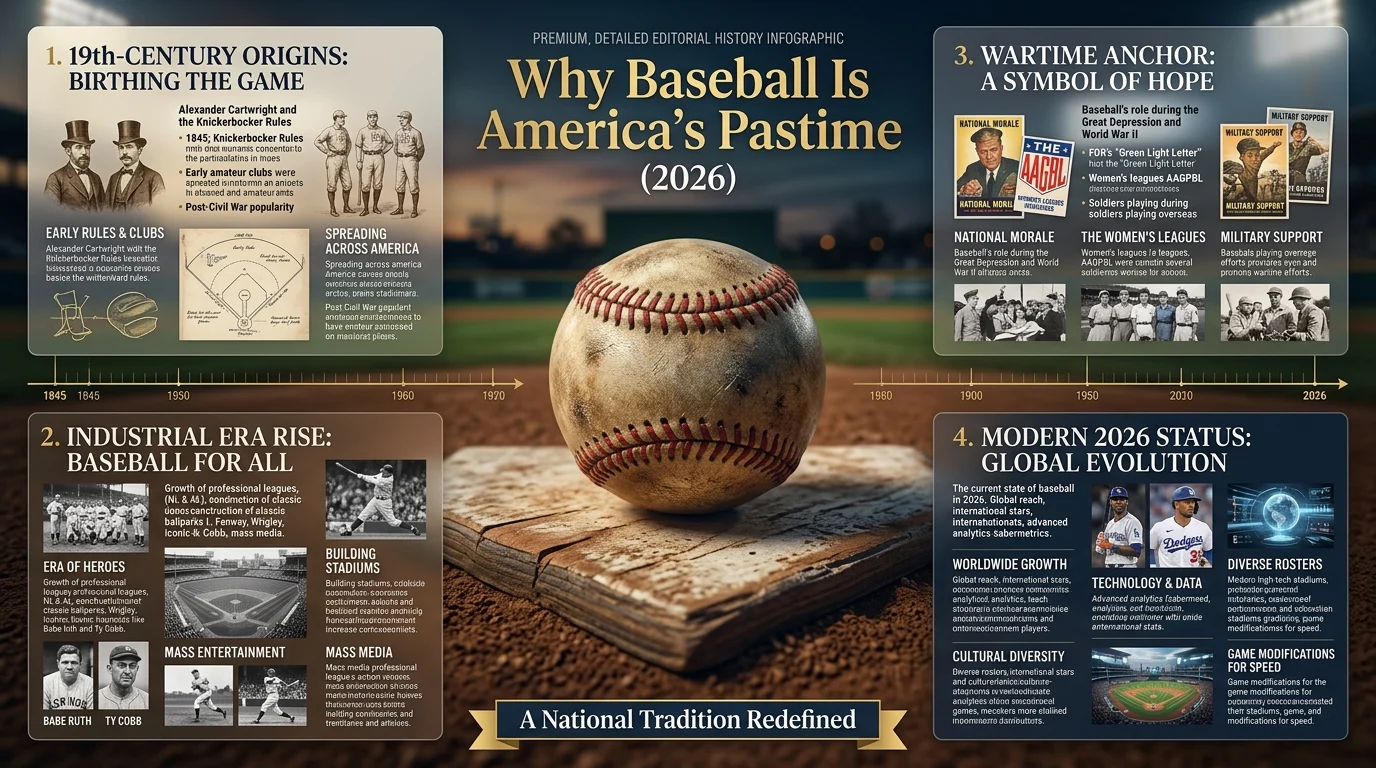
The phrase “America’s Pastime” took root specifically in the years following the Civil War, when the sport served a genuine unifying function for a country still reeling from division and devastating conflict. University of Colorado historian Tom Zeiler notes that after the war, the country was actively seeking ways to unify, and baseball filled that role effectively, spreading rapidly among veterans from both the Union and Confederacy who had sometimes played the game together even during the conflict itself, particularly in prisoner-of-war camps and military encampments. Cincinnati holds a particularly significant place in this history, home to the Cincinnati Red Stockings, established in 1869 as the first openly professional baseball team, a milestone that helped formalize the sport’s transition from informal recreation to organized, nationally followed competition.
The Phrase Takes Hold in American Culture
By the late 1920s, the concept of baseball as the “National Pastime” or “America’s Pastime” had become so deeply embedded in American culture that it began appearing in mainstream entertainment well beyond the sport itself. In 1930, one of the first baseball simulation board games, designed by Clifford Van Beek, was released under the title “National Pastime,” reflecting how thoroughly the phrase had permeated popular culture and everyday vocabulary by that point. The earlier 1908 song “Take Me Out to the Ballgame,” still sung during the seventh-inning stretch of games today, further reinforced baseball’s position as a beloved, culturally central American tradition during this formative era of the sport’s development.
Baseball’s Role During Wartime: The Green Light Letter
Baseball’s status as a unifying national institution was tested again during World War II, when Commissioner Kenesaw Mountain Landis wrote to President Franklin D. Roosevelt in 1942 asking whether professional baseball should continue operating during the intensifying war effort. Roosevelt’s response, which became known as the “Green Light Letter,” expressed his belief that baseball was necessary for maintaining national morale and should continue despite wartime disruptions and resource constraints affecting the country. This presidential endorsement significantly reinforced the sport’s cultural standing, cementing its role as a source of continuity and comfort for Americans during one of the country’s most difficult and uncertain periods in modern history.
Is Baseball Still America’s Most Popular Sport?
Despite retaining the “America’s Pastime” nickname, baseball hasn’t been the country’s most-watched sport since roughly the 1960s, when American football began overtaking it in television ratings and overall cultural attention nationwide. This shift raises a legitimate question addressed by baseball writers and historians alike: does the phrase still accurately describe the sport’s place in American culture, or has it become more of a historical honorific than a literal description of current popularity trends? Most baseball historians argue the nickname persists specifically because of the sport’s deep historical roots and enduring cultural symbolism, rather than any claim to current viewership dominance over football or basketball in modern television ratings.
Interesting Facts About Baseball’s American Pastime Status
- The Mills Commission that credited Doubleday with inventing baseball took three full years of investigation to reach its now-discredited conclusion.
- The Cincinnati Reds’ status as the first professional team means the city has traditionally hosted the first game of each new MLB season.
- Twelve U.S. presidents have thrown out a ceremonial first pitch on Opening Day, a tradition reflecting baseball’s continued political and cultural significance.
- President Bill Clinton threw out the first pitch at the christening of Jacobs Field in Cleveland on April 2, 1994.
- On Opening Day 1974 in Cincinnati, Hank Aaron tied Babe Ruth’s home run record, a moment intrinsically tied to the city’s status as the sport’s historical birthplace and cultural home.
Baseball as a Window Into American History
Beyond simple entertainment, historians frequently point to baseball as a uniquely revealing lens for examining broader shifts in American society across more than a century of the country’s development. Tom Zeiler, who co-teaches a university course specifically examining American history through the sport, notes that baseball’s milestones have often mirrored ongoing changes in gender relations, race relations, and economic and cultural shifts throughout the country’s history. Jackie Robinson’s breaking of the color barrier in 1947 stands as perhaps the most significant example of this dynamic, with the sport’s integration serving as both a reflection of and, in some ways, a catalyst for broader civil rights progress happening across American society during that pivotal era.
The Ongoing Debate Over Baseball’s Modern Identity
In recent years, sportswriters and baseball historians have increasingly debated whether recent rule changes and shifts in how the game is played risk undermining the sport’s historical identity and connection to its “America’s Pastime” title. Modern adjustments like pitch clocks, larger bases, and restrictions on defensive shifts, introduced to speed up gameplay and boost declining attention spans among younger audiences, represent some of the most significant rule modifications in the sport’s modern history and competitive structure. Some traditionalists argue these changes, while commercially necessary, distance the modern game from the version of baseball that originally earned its cultural title in the decades following the Civil War, creating an ongoing tension between preserving tradition and ensuring the sport’s continued commercial relevance in a crowded sports media landscape.
Why the Nickname Has Endured Despite Declining Viewership
Even as football and basketball have surpassed baseball in modern television ratings and overall cultural attention, the “America’s Pastime” nickname has proven remarkably durable across generations of American sports fans and families. This endurance likely reflects baseball’s unique combination of historical depth, statistical tradition, and generational continuity, with the sport frequently passed down through families in a way that feels distinct from other major American sports and their fan cultures. The nickname persists not as a claim about current viewership numbers, but as a recognition of baseball’s foundational role in shaping American sporting culture during the era when organized professional sports first took root nationally across the country.
Frequently Asked Questions
The following questions address the most common points of curiosity about baseball’s historical nickname and true origins.
Why is baseball called America’s pastime? Baseball earned the nickname in the decades following the Civil War, as the sport became a unifying, widely accessible activity across a divided country recovering from conflict.
Did Abner Doubleday really invent baseball? No, this is a myth. Baseball’s official historian confirms bat-and-ball games existed in America since the 1700s, and Doubleday never claimed to have invented the sport during his own lifetime.
Why was the Doubleday myth created in the first place? A commission led by Abraham Mills was formed to settle a dispute over whether baseball originated in America or evolved from the British game rounders, ultimately and controversially crediting Doubleday with the invention.
Is baseball still the most popular sport in America? No, baseball hasn’t been the most-watched American sport since roughly the 1960s, when football overtook it, though it retains the “America’s Pastime” nickname for deep historical and cultural reasons.
What was the Green Light Letter? It was a 1942 letter from President Franklin D. Roosevelt to MLB Commissioner Kenesaw Mountain Landis, encouraging baseball to continue during World War II for the sake of national morale.
Which city is considered the birthplace of professional baseball? Cincinnati is widely recognized as professional baseball’s birthplace, home to the Cincinnati Red Stockings, established in 1869 as the sport’s first openly professional team.
How has baseball reflected broader changes in American society? Historians note that baseball’s milestones, such as Jackie Robinson breaking the color barrier in 1947, have often mirrored ongoing shifts in gender relations, race relations, and cultural change throughout American history.
Are recent rule changes threatening baseball’s traditional identity? Some traditionalists argue that modern adjustments like pitch clocks and shift restrictions, while commercially necessary, distance today’s game from the version that originally earned the “America’s Pastime” title.
Conclusion
So, why is baseball called America’s pastime? The answer has far less to do with a single inventor or a claim to current popularity, and everything to do with a sport that helped stitch a divided country back together after its darkest conflict, then remained woven into the nation’s cultural fabric through wars, generations, and shifting sporting tastes ever since. Understanding this real history, rather than the comfortable Doubleday myth, makes the nickname feel earned rather than simply inherited, even as the sport continues to evolve and debate its own modern identity. Want to explore more baseball history? Check out our guide on History of the World Series for another deep dive into the sport’s most storied traditions.