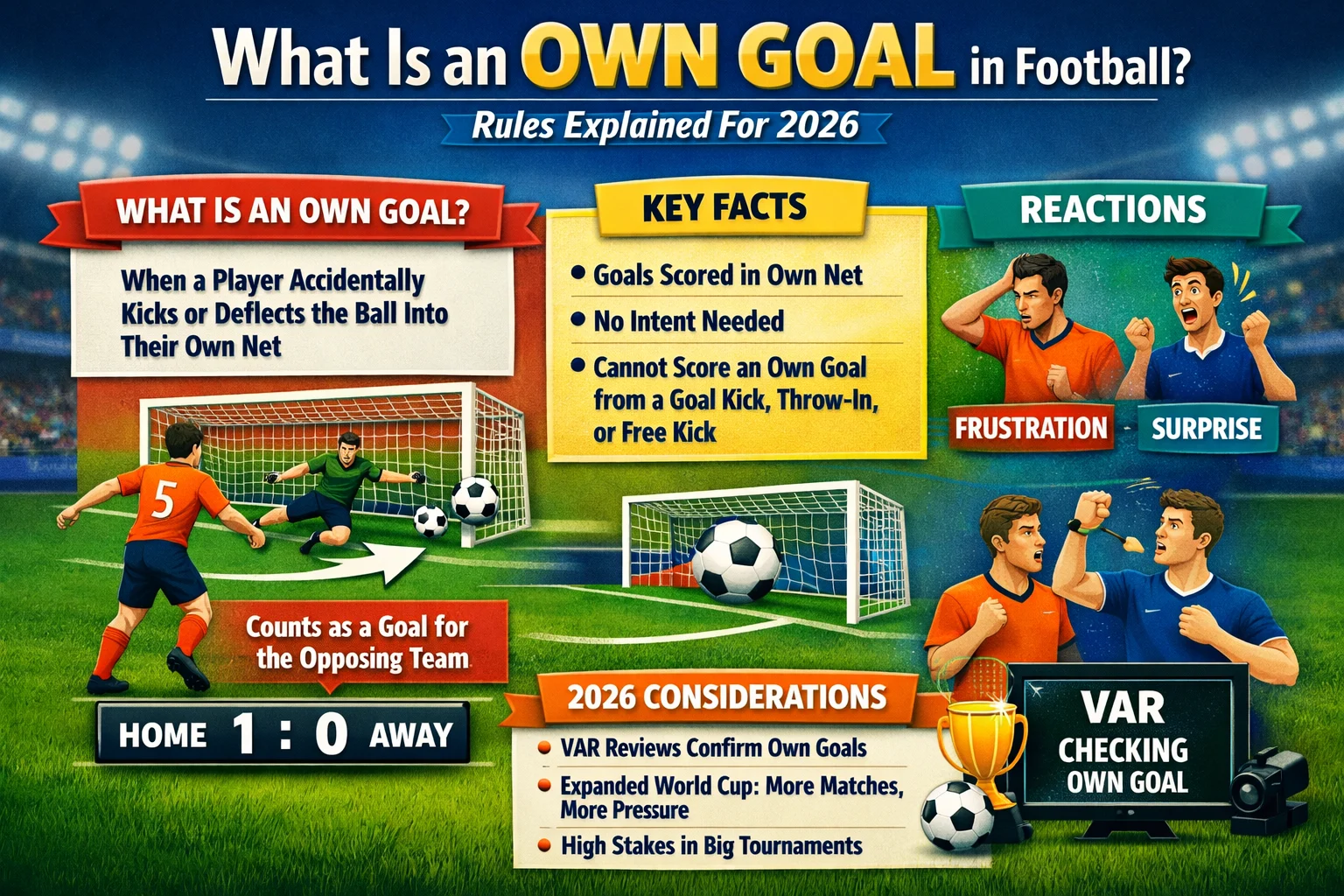
Quick Answer: An own goal occurs when a player unintentionally puts the ball into their own team’s net, and under the Laws of the Game, it counts as a goal for the opposing team, credited officially as an “own goal” rather than to any opposition player who may have been nearby.
There’s no moment in football quite as deflating for a player, or as awkwardly silent for a stadium, as watching a defender accidentally divert the ball into their own net. It’s one of the sport’s few genuinely universal moments of misfortune, instantly understood by fans regardless of language or nationality, and it happens far more often than most casual viewers realize, even at the very highest level of the professional game.
This guide explains exactly what is an own goal in football, how referees and officials determine when one has occurred, how it’s officially recorded in match statistics, and some of the most famous, widely discussed examples in the sport’s long history.
What Counts as an Own Goal?
Under IFAB’s Laws of the Game, an own goal is recorded when a player, in an attempt to play the ball, inadvertently sends it into their own net during the course of normal play. This typically happens through a deflection, a mistimed clearance, or a defensive header that goes the wrong way under pressure from an onrushing attacker. Importantly, the action must be a genuine attempt to play the ball if a defender is judged to have deliberately put the ball into their own net without any real footballing purpose, officials can, in rare and extreme cases, treat the incident differently, though this is exceptionally uncommon in professional football at any level.
How Is an Own Goal Officially Recorded?
When an own goal occurs, it’s credited to the team that benefits from the goal, not to any specific opposition player who may have been involved in the buildup. In official statistics and match reports, it’s typically listed with the responsible player’s name followed by “(OG),” clearly distinguishing it from a standard goal scored through direct attacking play. This distinction matters significantly for individual player statistics, since own goals are never counted toward a player’s personal goal tally, regardless of which team ultimately benefits from the resulting score on the day.
Common Causes of Own Goals
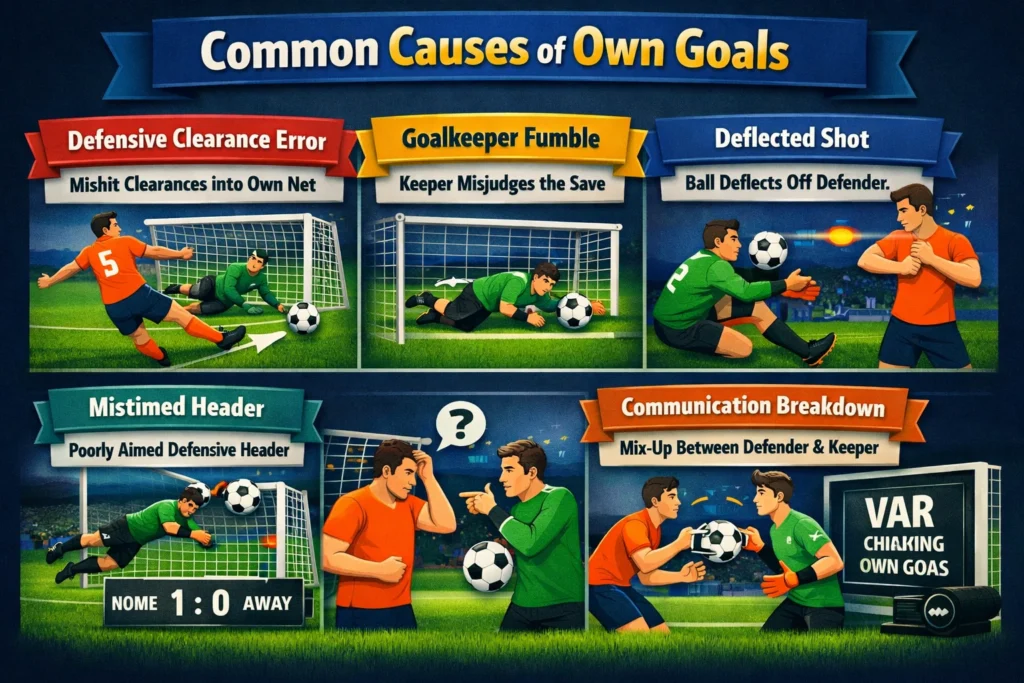
Own goals typically result from a handful of recurring situations during a match, most of which involve a defender reacting under significant time pressure:
- A defender attempting to clear a cross or through-ball, but misjudging the direction and deflecting it into their own net
- A goalkeeper fumbling or misjudging a save, allowing the ball to cross the line unintentionally
- A deflected shot changing direction off a defender in a way that wrong-foots the goalkeeper entirely
- A defensive header intended to clear danger, but mistimed and directed the wrong way under pressure
- Confusion between defenders and the goalkeeper over who should play the ball, resulting in an unintentional touch into the net
Does an Own Goal Count Toward Assist or Shot Statistics?
No. Since an own goal is, by definition, an unintentional action by the defending player, the attacking player whose original shot, cross, or pass led to the own goal does not receive an assist for it under standard statistical conventions used by most football data providers worldwide. The play is simply recorded as an own goal for the scoring team, with the responsible defending player noted separately, without any individual attacking player receiving direct statistical credit for the outcome.
Famous Own Goals in Football History
- Bayern Munich’s Jerome Boateng deflected the ball into his own net during a memorable Bundesliga match, one of several high-profile own goals involving elite defenders that circulated widely on social media and sports highlight shows in subsequent years.
- The 1994 World Cup saw a notable own goal from Colombian defender Andres Escobar, a moment tragically overshadowed by events following the tournament, which remains one of the most somber reference points in football history regarding the human impact of high-pressure sporting mistakes.
- Manchester United and Liverpool matches have historically produced several memorable own goals given the rivalry’s intensity and high-stakes nature, with such moments frequently replayed in retrospective football content for years afterward by fans and pundits alike.
Own Goals vs. Other Types of Unusual Goals
| Type | Description | Counted As |
|---|---|---|
| Own goal | Defender unintentionally scores in their own net | Goal for the opposing team, no individual scorer credited |
| Deflected goal | Attacker’s shot changes direction off a defender but still results from an attacking action | Goal for the original attacking player in most statistical systems |
| Penalty goal | Scored directly from a penalty kick | Goal for the player who took the penalty |
| Free-kick goal | Scored directly from a free-kick | Goal for the player who took the free-kick |
Do Own Goals Happen More Often at Certain Levels of Football?
Own goals can occur at any level of the sport, but they tend to happen more frequently in high-pressure, high-intensity matches where defenders are forced into rushed, reactive decisions under significant physical and tactical pressure from attacking players. Statistically, own goals are also slightly more common from set pieces like corners and crosses, where crowded penalty areas increase the likelihood of an unintentional deflection finding its way past a goalkeeper who may already be partially unsighted by the surrounding players.
The Psychological Impact of Scoring an Own Goal
Beyond the statistical and rule-based side of own goals, the psychological toll on the player involved is often significant and widely discussed among sports psychologists and coaches working with elite athletes. Unlike a missed shot or a failed tackle, an own goal is a uniquely visible, unambiguous mistake that directly and immediately costs the team a goal, often replayed repeatedly across broadcasts and social media in the moments following the incident. Many professional clubs now incorporate specific psychological support and resilience training partly to help players recover quickly from high-profile mistakes like own goals, recognizing that a player’s confidence and subsequent performance can be meaningfully affected if the moment isn’t processed and moved past effectively before the next match.
Which Players and Competitions See the Most Own Goals?
Statistical analysis of professional football consistently shows that center-backs and full-backs are involved in own goals more frequently than other position groups, simply due to their proximity to their own goal during defensive situations throughout a match. Premier League statistics, tracked extensively by football data providers, have shown a gradual increase in recorded own goals over the past decade, a trend some analysts attribute partly to increasingly aggressive high-pressing tactics that force defenders into faster, higher-risk clearances under pressure from attacking players. Certain competitions with historically higher average own goal counts tend to feature leagues with faster tempo, more direct crossing patterns, and higher overall attacking intensity throughout a typical match.
How VAR Has Affected Own Goal Decisions
The introduction of VAR has added a layer of scrutiny to marginal own goal situations, particularly in cases where it’s unclear whether the ball would have crossed the line regardless of a defender’s touch, or where a deflection’s exact path needs closer review to confirm official goal-scorer credit for statistical purposes. In some instances, what initially appears to be an own goal on the field is later reclassified as a standard goal for the attacking player once VAR review determines the shot was already destined to cross the line independent of the defensive touch, highlighting how modern technology has added new precision to a previously more subjective aspect of goal-scoring record-keeping in professional football.
Do Other Sports Have an Equivalent to the Own Goal?
Football isn’t the only sport where a player can inadvertently contribute to the opposing team’s score, though the concept manifests differently across different games and rule structures. In ice hockey, a similar situation occurs when a player accidentally deflects the puck into their own net, officially recorded in a comparable way to football’s own goal convention. In basketball, there’s no direct equivalent since the sport’s scoring structure doesn’t allow for a defensive player to accidentally score for the opposing team in the same manner as football or hockey. This relative rarity across other major sports is part of what makes football’s own goal such a distinctly recognizable and often meme-worthy moment within global sports culture, since the concept translates so clearly even to fans unfamiliar with the sport’s finer rules.
Frequently Asked Questions
What is an own goal in football? An own goal occurs when a player unintentionally puts the ball into their own team’s net, and it’s credited as a goal for the opposing team rather than any individual player on the scoring side.
Does an own goal count toward a player’s individual goal tally? No, own goals are never counted toward a player’s personal goal statistics, regardless of which team benefits from the resulting score during that particular match.
Can a player be given an assist for causing an own goal? No, since an own goal results from an unintentional action by the defending player, the attacking player involved does not receive an assist under standard statistical conventions used across the sport.
Are own goals common in professional football? Own goals happen regularly across professional football, particularly from crowded set-piece situations like corners and crosses where deflections are more likely to occur unexpectedly.
Is an own goal treated differently if it happens deliberately? Deliberate own goals are extremely rare in professional football and, in extreme cases, could be treated as a disciplinary or match-fixing matter rather than a standard own goal recorded through normal play.
Who gets credit for an own goal in official statistics? The own goal is credited to the responsible defending player, listed with “(OG)” next to their name, while the goal itself counts toward the opposing team’s score.
Can VAR change whether a goal is classified as an own goal? Yes, in some cases VAR review can determine that a shot was already destined to cross the line regardless of a defensive touch, reclassifying what initially looked like an own goal as a standard goal for the attacking player.
Do certain positions cause more own goals than others? Yes, center-backs and full-backs are statistically involved in own goals more frequently than other position groups, largely due to their proximity to their own goal during defensive situations.
Conclusion
So, what is an own goal in football? At its core, it’s simply an unintentional goal scored by a player into their own net, officially credited as a goal for the opposing side without any individual attacking player receiving statistical credit for the outcome. While often a source of frustration or even heartbreak for the player involved, own goals remain a natural, if unfortunate, part of a sport built around split-second decisions under pressure, and modern tools like VAR have only added further precision to how these moments are officially recorded and understood by fans. Want to explore more football terminology? Check out our guide on Football Fouls and Cards Explained for another key part of the rulebook every fan should understand.