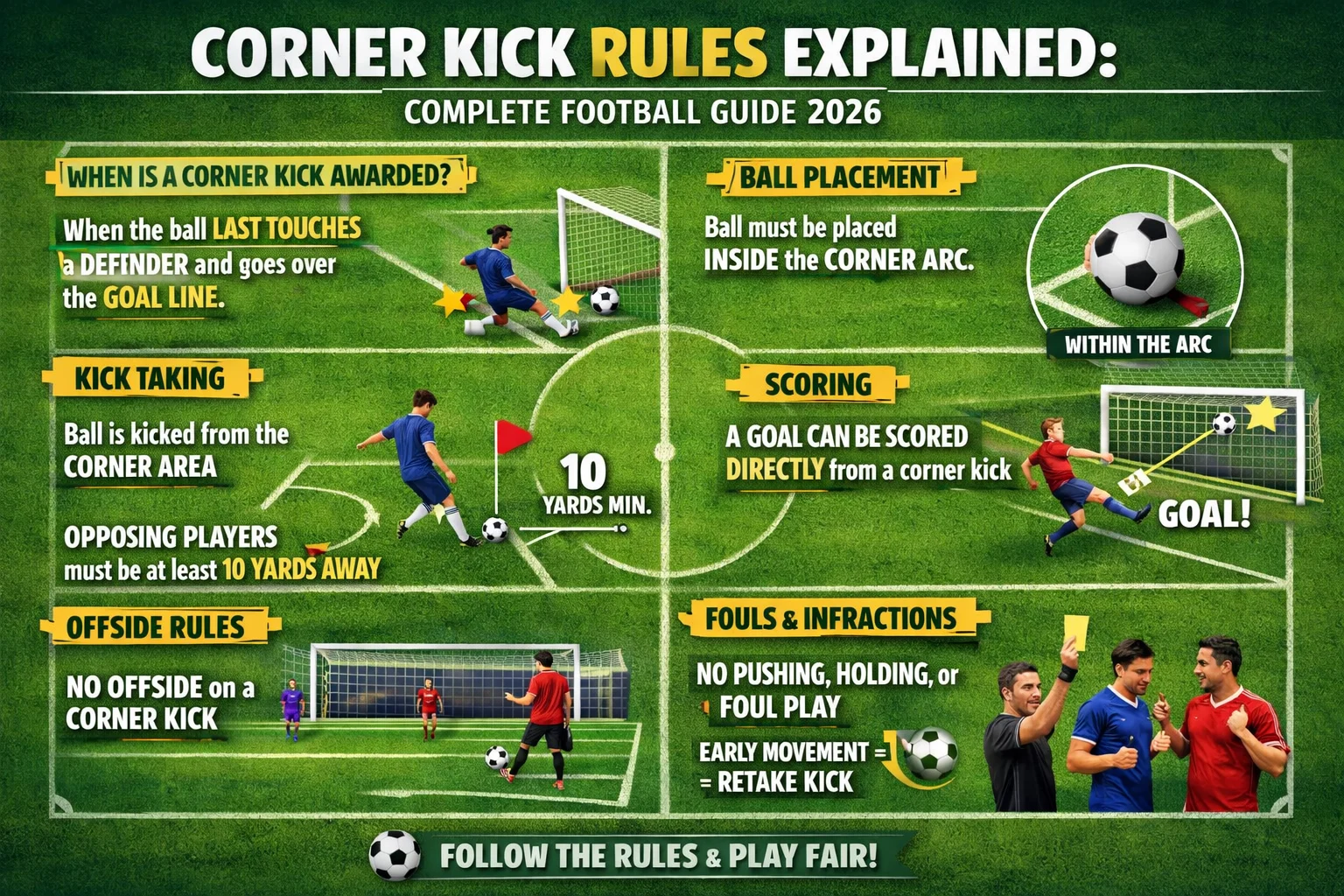
Quick Answer: A corner kick is awarded to the attacking team when the ball goes out of play over the goal line, either on the ground or in the air, having last touched a player from the defending team, and is taken from the corner arc nearest to where the ball crossed the line during play.
The ball flies over the byline off a defender, the referee points toward the corner arc, and suddenly the penalty box fills with players jostling for position. Corner kicks are among football’s most tactically loaded set pieces, quietly responsible for a significant share of goals scored across professional football, yet the specific rules governing them are often only vaguely understood by casual fans watching from the stands or on television.
This guide breaks down the complete corner kick rules explained clearly, covering when they’re awarded, how they must be taken, common infringements, and the tactics teams use to maximize scoring chances from this crucial set-piece opportunity that appears repeatedly throughout every match.
When Is a Corner Kick Awarded?
Under IFAB’s Laws of the Game, a corner kick is awarded whenever the ball fully crosses the goal line, either along the ground or in the air, after last touching a player from the defending team, without a goal being scored in the process. This commonly happens when a defender deliberately clears the ball out of danger, or when a goalkeeper tips a shot over the crossbar or around the post during a save attempt under pressure from an attacking play.
How Must a Corner Kick Be Taken?
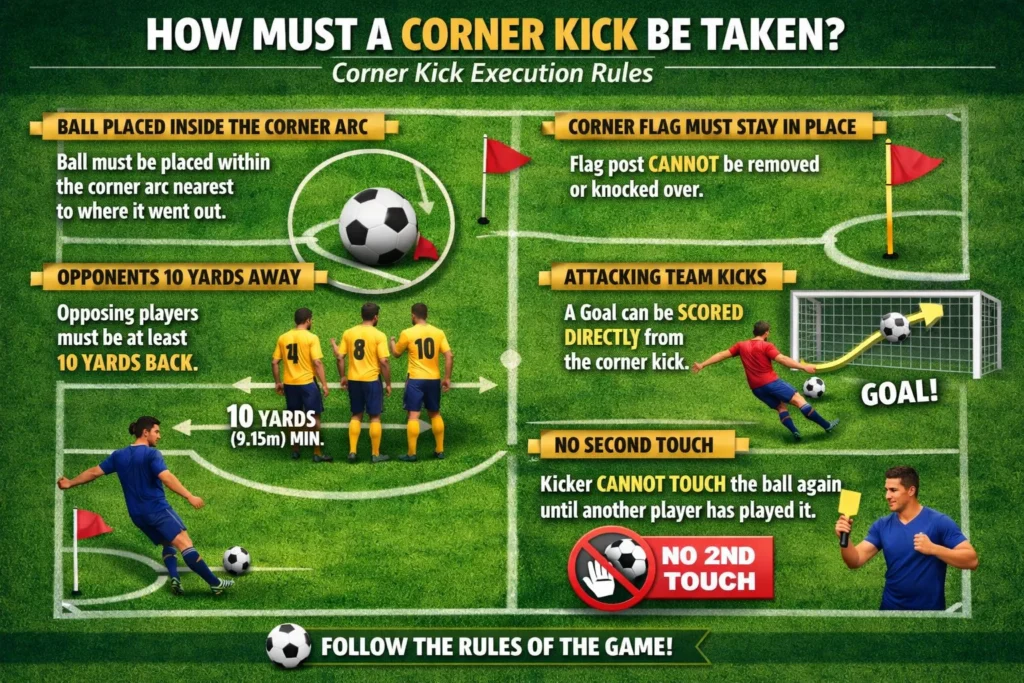
Several specific requirements govern how a corner kick must be executed under the official Laws of the Game:
- The ball must be placed within the corner arc nearest to where it went out of play, a quarter-circle marked at each corner of the pitch
- The corner flag post must remain in place and cannot be removed or knocked over during the kick
- Opposing players must retreat at least 10 yards (9.15 meters) from the corner arc until the ball is in play
- The kick must be taken by a player from the attacking team, and a goal can be scored directly from a corner kick without the ball touching another player first
- The kicker cannot touch the ball a second time until it has been played by another player, under the same “second touch” restriction that applies to free-kicks and throw-ins
Can You Score Directly From a Corner Kick?
Yes, unlike some other set pieces, a goal scored directly from a corner kick counts, provided it goes into the opponent’s goal rather than the kicker’s own net by mistake. This is famously known as an “Olympic goal” or “Olimpico” in football culture, a rare but celebrated moment when a corner kick curls directly into the net without any other player touching the ball. While spectacular, direct corner goals remain relatively uncommon at the professional level, since most corners are specifically designed to create a crossing or set-piece opportunity for teammates in the box rather than attempt a direct shot at goal from such a wide angle.
Common Corner Kick Infringements
Referees watch for several specific violations during corner kicks throughout a match:
- Defending players encroaching within the required 10-yard distance before the kick is taken
- The kicker touching the ball a second time before another player makes contact
- The ball not being properly placed within the corner arc before the kick is taken
- Offside offenses occurring from the resulting play, since players can still be caught offside from a corner kick under certain circumstances involving the flight and control of the ball
Corner Kick Tactics: How Teams Use Them
Corner kicks have become a significant area of tactical focus at the professional level, with many clubs employing dedicated set-piece coaches specifically to design and rehearse corner routines throughout the season. Common corner kick tactics include:
- In-swinging corners — Curled toward the goal, making it easier for attackers to redirect the ball on goal with a header
- Out-swinging corners — Curled away from the goal, often used to create space for a player arriving late into the box
- Short corners — A nearby teammate receives a short pass instead of a direct cross, allowing the team to reset and create a different attacking angle
- Zonal vs. man-marking defense — Defending teams choose between marking specific opposition players or defending designated areas of the box, each with distinct tactical trade-offs
Corner Kicks vs. Other Set Pieces: Quick Comparison
The table below compares corner kicks against other common football set pieces:
| Set Piece | Awarded When | Can Score Directly? |
|---|---|---|
| Corner kick | Ball crosses goal line off a defender | Yes |
| Goal kick | Ball crosses goal line off an attacker | No (must touch another player first) |
| Throw-in | Ball crosses the sideline | No, cannot score directly from a throw-in |
| Direct free-kick | Serious fouls, certain offenses | Yes |
| Indirect free-kick | Technical infringements, dangerous play | No, must touch another player first |
Why Corner Kicks Matter Statistically
Corner kicks represent a meaningful share of overall goal-scoring opportunities in professional football, with data analysts increasingly studying corner-kick efficiency as a key performance indicator for teams across a full season. Some clubs track detailed statistics on corner conversion rates, near-post versus far-post delivery success, and which specific routines produce the highest quality scoring chances, treating set-piece analysis as a genuine competitive advantage rather than a secondary concern compared to open-play tactics.
A Brief History of the Corner Kick Rule
The corner kick has been part of football’s official rulebook since 1872, just nine years after The Football Association first standardized the sport’s laws in 1863. Before its introduction, there was no specific mechanism for restarting play when the ball went out over the goal line off a defender, which created inconsistency across matches. The rule’s introduction gave the attacking team a clear, standardized advantage for forcing the ball out of play defensively, fundamentally shaping defensive strategy around avoiding unnecessary corners whenever possible, a principle that remains just as relevant in professional coaching today as it was in the sport’s earliest formalized decades.
Famous Corner Kick Moments in Football History
Certain matches have become memorable specifically because of dramatic corner-kick-related moments:
- Direct “Olimpico” goals scored straight from a corner kick remain rare enough that each occurrence tends to generate significant highlight and social media attention, given how technically difficult it is to curl a ball directly into the net from such a wide angle.
- Several major tournament matches have been decided by headers scored from well-rehearsed corner routines, with set-piece goals frequently proving decisive in tightly contested knockout fixtures where open-play chances are limited.
- Teams renowned for set-piece efficiency, particularly in recent Premier League seasons, have built meaningful portions of their overall goal tallies specifically from corner kick routines, reflecting how seriously top-level clubs now treat this area of the game.
How Goalkeepers Defend Against Corner Kicks
Goalkeepers play a uniquely important role during corner kicks, often required to make split-second decisions about whether to come and claim a cross or stay on their line and react to a shot. Modern goalkeeper coaching places significant emphasis on commanding the six-yard box during corners, using height, timing, and communication with defenders to minimize the danger posed by a crowded penalty area. A goalkeeper’s positioning and decisiveness during corner kicks is frequently cited by analysts as one of the clearer indicators of overall goalkeeping quality, since hesitation in these crowded, high-pressure moments often directly leads to conceded goals.
Corner Kicks in Youth and Amateur Football
While professional teams often invest heavily in dedicated set-piece coaching, corner kick fundamentals remain a core part of youth football development at every level. Coaches typically introduce basic corner kick concepts early, teaching young players the correct distance requirements, proper technique for both in-swinging and out-swinging deliveries, and basic positional awareness for both attacking and defending a corner. Even at amateur and recreational levels, corners frequently represent a disproportionately high share of goal-scoring opportunities relative to their brief duration within a match, making them a valuable teaching tool for coaches looking to demonstrate the tactical depth hidden within what might otherwise seem like a simple restart.
How Rule Interpretations Have Evolved Around Corner Kicks
While the core corner kick rule has remained largely consistent since 1872, certain interpretations have evolved over time, particularly around encroachment enforcement and VAR’s role in reviewing marginal offside calls stemming from corner-kick phases of play. Modern officiating has become notably stricter about enforcing the 10-yard distance requirement compared to earlier decades, partly due to increased scrutiny from broadcast technology that makes encroachment violations far more visible to officials, pundits, and fans alike than they would have been through the naked eye alone in the sport’s earlier eras.
Frequently Asked Questions
What is a corner kick in football? A corner kick is awarded to the attacking team when the ball crosses the goal line off a defending player, taken from the corner arc nearest to where the ball went out.
Can you score a goal directly from a corner kick? Yes, a goal scored directly from a corner kick counts, provided it enters the opponent’s goal without necessarily being touched by another player first.
How far must defenders stand during a corner kick? Defending players must retreat at least 10 yards (9.15 meters) from the corner arc until the ball is in play.
Can a player be offside from a corner kick? Yes, players can still be flagged offside from a corner kick under certain circumstances during the resulting phase of play, though the corner taker themselves is not subject to offside.
What is an Olympic goal in football? An Olympic goal, or “Olimpico,” refers to a goal scored directly from a corner kick without touching any other player, a rare and celebrated moment in the sport.
What happens if the corner kick taker touches the ball twice? If the kicker touches the ball a second time before another player makes contact, it results in an indirect free-kick awarded to the opposing team.
When was the corner kick rule first introduced? The corner kick has been part of football’s official rulebook since 1872, just nine years after The Football Association first standardized the sport’s laws in 1863.
Do goalkeepers play a significant role during corner kicks? Yes, goalkeepers are responsible for commanding their six-yard box during corners, making crucial decisions about claiming crosses versus staying on their line, with their positioning often directly influencing whether a corner results in a conceded goal.
Conclusion
Understanding the corner kick rules explained here transforms a routine-looking set piece into one of football’s most tactically rich moments, with entire coaching staffs dedicating significant time to designing and rehearsing specific corner routines since the rule’s introduction back in 1872. From the required 10-yard distance to the rare thrill of a direct Olympic goal, corner kicks carry far more nuance than their brief appearance in a match might suggest. Want to explore more football rules? Check out our guide on What Is the Offside Rule Explained Simply for another key concept every fan should understand.