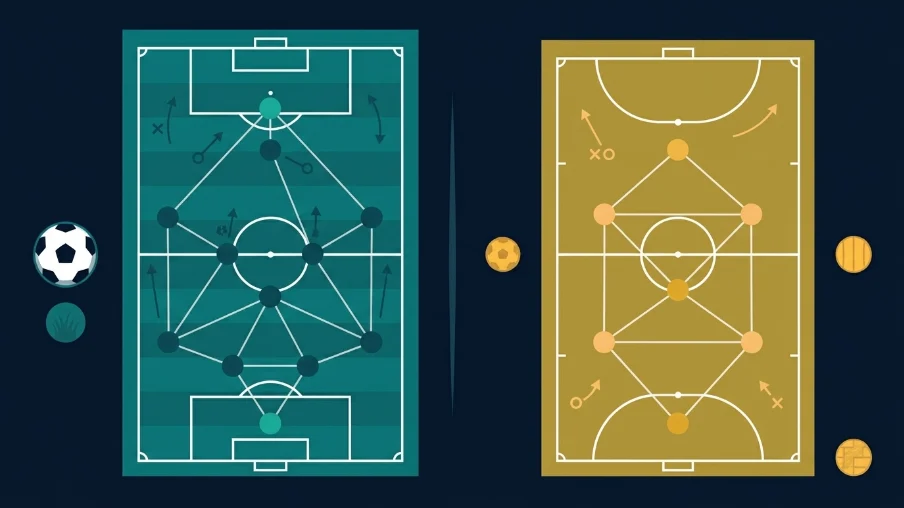
Quick Answer: The main difference between football and futsal is team size and playing surface football is played 11-a-side on a large grass pitch, while futsal is played 5-a-side on a smaller hard court, using a smaller, low-bounce ball that encourages closer ball control and faster decision-making.
Watch a futsal match for the first time after years of following traditional football, and something feels immediately different the pace is faster, the touches closer, the space tighter, and somehow the ball barely seems to bounce at all. Despite sharing obvious similarities, football and futsal are governed by genuinely distinct rulebooks, and understanding those differences explains why so many elite footballers credit futsal with sharpening their technical skills long before they ever stepped onto a full-sized pitch.
This guide breaks down the full difference between football and futsal, covering team size, playing surface, ball type, rules, and why so many professional footballers started their careers playing futsal first.
Football vs Futsal: Quick Comparison Table
| Aspect | Football | Futsal |
|---|---|---|
| Players per team | 11 (including goalkeeper) | 5 (including goalkeeper) |
| Playing surface | Grass or artificial turf | Hard indoor court |
| Ball size | Size 5, standard bounce | Size 4, low-bounce, heavier |
| Match duration | 90 minutes (two 45-minute halves) | 40 minutes (two 20-minute halves) |
| Pitch/court size | Approx. 100–130 yards long | Approx. 25–42 meters long |
| Substitutions | Limited (typically 3–5 per match) | Unlimited, rolling substitutions |
| Governing body | FIFA (association football) | FIFA (futsal division) |
Team Size: 11 vs 5 Players
The most immediately obvious difference is squad size. Football fields 11 players per team, including a goalkeeper, spread across a large pitch with defined defensive, midfield, and attacking zones covering considerable distances. Futsal, by contrast, uses just 5 players per team, including a goalkeeper, on a much smaller playing area. This dramatic reduction in numbers and space forces futsal players into significantly tighter, faster-paced situations, with far less time to think before making a decision on the ball, often measured in fractions of a second rather than the slightly longer windows available in traditional football.
Playing Surface: Grass vs Hard Court
Football is traditionally played on natural grass, though artificial turf has become increasingly common at lower levels and in climates unsuitable for consistent grass upkeep throughout the year. Futsal, on the other hand, is specifically designed as an indoor sport, played on a hard, flat court similar in texture to a basketball court. This surface difference significantly changes how the ball behaves and how players move, favoring quick changes of direction over the longer sprints more common in football’s larger, more open playing space.
The Ball: Size, Weight, and Bounce
One of the most technically significant differences lies in the ball itself. Futsal uses a smaller, heavier ball with a significantly reduced bounce compared to a standard football, typically reduced by around 30 percent. This low-bounce characteristic is intentional, designed to keep the ball closer to the playing surface and encourage precise passing and control rather than long, high balls that would be impractical in futsal’s confined space. Many coaches specifically credit this ball design with accelerating young players‘ first-touch development, since the reduced bounce demands significantly more precision on every single contact.
Match Duration and Stoppages
Football matches run for 90 minutes, split into two 45-minute halves, with the clock running continuously except for stoppage time additions at the end of each half. Futsal matches are shorter, typically 40 minutes across two 20-minute halves, but the clock stops for every dead-ball situation, similar to basketball, meaning the actual real-world duration of a futsal match often extends well beyond the official 40 minutes of playing time once every stoppage is factored in.
Substitution Rules
Football limits substitutions, with most competitions now allowing 5 substitutions per match, following recent rule changes across top leagues worldwide. Futsal takes a dramatically different approach, permitting unlimited, rolling substitutions throughout the match, similar to how ice hockey handles line changes during play. Players can be substituted repeatedly at any stoppage, allowing coaches to manage fatigue far more aggressively given futsal’s intense, high-tempo pace throughout the entire match.
Goalkeeper Rules: Key Differences
While both sports restrict handball to the goalkeeper within a designated area, futsal introduces additional restrictions not found in football. A futsal goalkeeper, for example, cannot handle a back-pass from a teammate and faces stricter time limits on how long they can hold the ball before releasing it, encouraging a faster tempo of play even from goal kicks and goalkeeper distribution, further reinforcing futsal’s emphasis on quick transitions over slower, more deliberate build-up play.
Why Many Footballers Started With Futsal
Several of football’s most technically gifted players, including Lionel Messi, Cristiano Ronaldo, and Neymar, have publicly credited futsal with playing a significant role in their technical development as young players growing up in South America and Portugal. The smaller space, constant ball contact, and need for quick decision-making under pressure are widely believed to accelerate close control, agility, and spatial awareness in ways that traditional 11-a-side football, with its larger pitch and lower touch frequency per player, simply cannot replicate as efficiently at a young developmental age.
Is Futsal Officially Recognized by FIFA?
Yes, futsal is FIFA’s officially recognized indoor variant of football, complete with its own dedicated World Cup, the FIFA Futsal World Cup, first held in 1989. FIFA maintains separate rules, referee certifications, and competition structures for futsal, distinguishing it clearly from other informal indoor football variants like five-a-side, which typically follows more relaxed, non-standardized rules depending on the specific league, facility, or region where it’s being played.
Common Misconceptions About Football and Futsal
- Futsal is just five-a-side football.” False — while related, futsal has its own distinct, FIFA-recognized rulebook covering ball type, goalkeeper restrictions, and substitution rules that differ meaningfully from generic five-a-side football.
- Futsal is only for beginners or children.” False — futsal is played competitively at a professional level worldwide, including a dedicated FIFA World Cup for the discipline.
- Skills learned in futsal don’t transfer to football.” False — numerous elite professional footballers credit futsal specifically with improving their technical ability in full 11-a-side football.
- “Futsal uses the same ball as football, just smaller.” False — the futsal ball isn’t simply a smaller version of a standard football; it’s specifically weighted and designed for reduced bounce.
A Brief History of Futsal
Futsal originated in Montevideo, Uruguay, in 1930, when a teacher named Juan Carlos Ceriani developed a version of football suitable for playing on basketball courts, partly in response to heavy rainfall that frequently made outdoor grass pitches unusable. The name “futsal” itself derives from a combination of the Spanish and Portuguese terms “fútbol sala” or “futebol de salão,” roughly translating to “indoor football.” The sport spread steadily across South America through the mid-20th century before gaining wider international recognition, eventually coming under FIFA’s official governance and leading to the establishment of the first FIFA Futsal World Cup in 1989, held in the Netherlands.
Tactical and Playing Style Differences
Beyond the structural rule differences, football and futsal demand genuinely different tactical approaches from players and coaches. Football tactics often revolve around exploiting space across a large pitch, with formations designed to control specific zones and create passing lanes over longer distances. Futsal tactics, by contrast, focus heavily on quick combination play, constant movement to create passing triangles in tight spaces, and rapid transitions between defense and attack, given how quickly possession can change hands in such a confined playing area. Defensive systems in futsal also tend to be more aggressive and man-oriented compared to football’s more zonal defensive structures, since the smaller court simply doesn’t allow for the same kind of spread-out defensive shape.
Youth Development: Why Coaches Recommend Futsal
Many football associations and youth academies now formally incorporate futsal into player development pathways, particularly for younger age groups. The reasoning is fairly consistent across coaching philosophies: futsal forces significantly more touches on the ball per player during a single session compared to a standard football match, accelerating the development of close control, quick thinking, and comfort under pressure. Some national football federations have gone as far as officially recommending futsal as a core component of youth training curriculums, citing its role in producing more technically rounded players by the time they transition fully into 11-a-side football.
Equipment Differences Between Football and Futsal
Beyond the ball itself, players in each sport typically wear different footwear suited to their respective playing surfaces. Football players wear studded boots or cleats designed to grip natural grass or turf, providing traction for sprinting and sudden directional changes on a softer surface. Futsal players, by contrast, wear flat-soled indoor court shoes similar in design to those used in basketball or handball, since studs would be both unnecessary and potentially dangerous on a hard indoor court. This equipment difference reflects the broader theme running through nearly every rule variation between the two sports: futsal is engineered specifically for a fast, technical indoor game, while football remains built around the demands of a much larger outdoor playing environment.
Frequently Asked Questions
What is the main difference between football and futsal? The main differences are team size (11 vs 5 players), playing surface (grass vs hard court), and ball type (standard bounce vs low-bounce futsal ball).
Is futsal harder than football? Neither sport is objectively harder, but futsal demands faster decision-making and closer ball control due to the smaller space, while football demands greater physical endurance across a larger pitch.
Do futsal and football use the same rules for fouls and cards? Both sports use yellow and red cards for serious offenses, though futsal has additional specific rules, such as accumulated team fouls leading to a direct free-kick without a wall after a certain threshold.
Can football skills transfer to futsal and vice versa? Yes, many technical skills like close control, quick passing, and spatial awareness transfer well between the two sports, which is part of why futsal is popular in youth football development programs.
Is there a FIFA Futsal World Cup? Yes, FIFA has organized the Futsal World Cup since 1989, recognizing futsal as an official, competitively organized variant of the sport at the international level.
How many players are on a futsal team? Futsal teams field 5 players per side, including a goalkeeper, compared to 11 players per side in standard football.
Where did futsal originate? Futsal originated in Montevideo, Uruguay, in 1930, developed by teacher Juan Carlos Ceriani as a version of football suitable for indoor courts during periods of heavy rainfall.
Do professional football clubs use futsal in training? Yes, many professional clubs incorporate futsal-style small-sided games into training sessions, particularly for youth academy players, to improve technical skills and decision-making in tight spaces.
Conclusion
Understanding the difference between football and futsal reveals two sports that share a common origin but have evolved into genuinely distinct disciplines since futsal’s creation in 1930s Uruguay, each demanding different physical and technical qualities from players.
From team size and playing surface to ball design and substitution rules, futsal’s faster, tighter format has proven to be more than just a training tool it’s a fully recognized, competitively organized sport in its own right, one that has directly shaped the technical foundations of some of football’s greatest players. Want to understand more football basics?

Daniel Brooks is a sports writer at SportsOrbitX.com, specializing in football, basketball and global sports news. He focuses on delivering accurate reporting, match analysis and timely updates that keep fans informed.