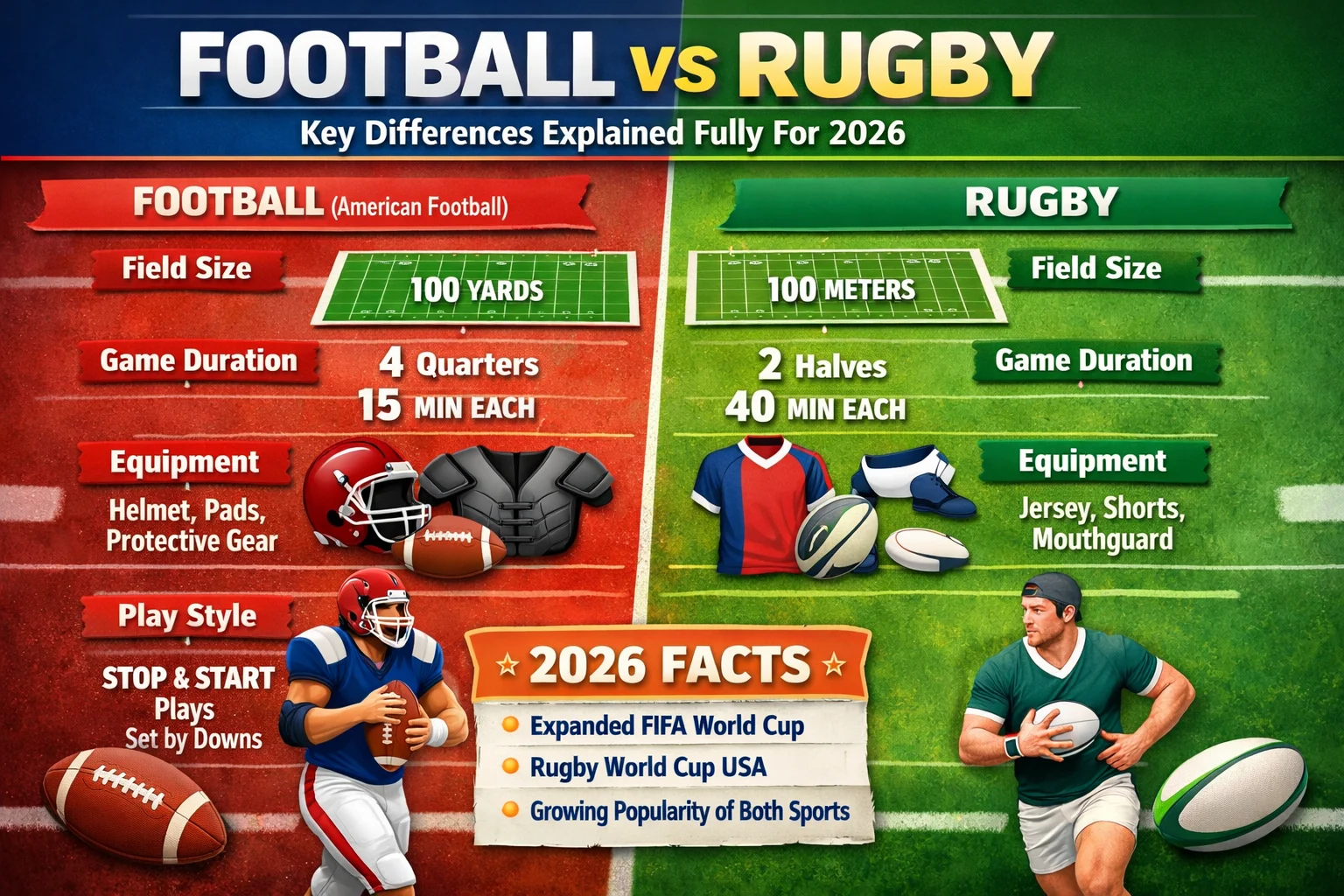
Quick Answer: The core difference between football and rugby is ball handling football restricts outfield players from using their hands entirely, while rugby is built around carrying, passing, and tackling the ball-carrier, resulting in a far more physically contact-heavy sport.
Two sports, two ovals of green turf, two passionate global fanbases and almost nothing else in common once you actually look closely. Football and rugby share distant historical roots, having once been tangled together as loosely defined “football” games in 19th-century England, but they’ve since evolved into two fundamentally different sports with distinct rules, scoring systems, and physical demands that continue to shape how each is coached, played, and watched today.
This guide breaks down the full comparison of football vs rugby, covering rules, scoring, physicality, team structure, and how both sports diverged from a shared 19th-century origin into the entirely distinct games played and followed by millions today.
Football vs Rugby: Quick Comparison Table
| Aspect | Football | Rugby |
|---|---|---|
| Ball handling | Feet, chest, head only (no hands for outfield players) | Hands and feet, ball can be carried and passed |
| Scoring | Goals (1 point each) | Tries, conversions, penalties, drop goals (varying points) |
| Players per team | 11 | 15 (Union) or 13 (League) |
| Match duration | 90 minutes | 80 minutes |
| Physical contact | Limited, mostly incidental | Central to the sport, including tackling |
| Ball shape | Spherical | Oval/prolate spheroid |
| Governing body | FIFA | World Rugby (Union) / IRL (League) |
The Fundamental Difference: How the Ball Is Handled
The single biggest difference between football and rugby comes down to one simple rule: what players are allowed to do with their hands. In football, only the goalkeeper may use their hands, and only within their own penalty area, meaning outfield players must control, pass, and shoot using their feet, chest, thighs, or head throughout the entire match. Rugby takes the opposite approach entirely, actively encouraging players to catch, carry, and pass the ball by hand, with forward passes by hand actually prohibited in favor of lateral or backward passing while running forward with the ball.
Scoring Systems: Goals vs Tries
Football uses a straightforward scoring system: one point for every goal, scored by getting the ball fully across the goal line and between the posts. Rugby’s scoring system is considerably more layered and multi-faceted. A try, scored by grounding the ball in the opponent’s in-goal area, is worth 5 points in Rugby Union (4 in Rugby League), followed by an optional conversion kick worth 2 additional points. Rugby also awards points for penalty kicks (3 points) and drop goals (3 points in Union), creating a scoring system where multiple different actions contribute to a team’s total, unlike football’s single, uniform goal value.
Physical Contact and Tackling
Perhaps the most visually obvious difference is the level of physical contact involved. Rugby is built around tackling the ball-carrier to stop their progress, a legal and central part of the sport’s structure, governed by strict rules around tackle height and technique to protect player safety and reduce injury risk. Football, by contrast, treats significant physical contact as a foul in most situations, with tackling primarily aimed at winning the ball rather than physically stopping an opponent’s forward momentum through contact.
Team Size and Structure
Football fields 11 players per team, including one goalkeeper, organized into defensive, midfield, and attacking roles across the pitch. Rugby Union fields 15 players per team, split between forwards (focused on physical contests like scrums and rucks) and backs (focused on speed and ball-carrying in open space). Rugby League, a related but distinct code, uses 13 players per team with a somewhat faster, more open style of play compared to Union’s more structured, set-piece-heavy approach.
Match Duration and Structure
Football matches run 90 minutes, split into two 45-minute halves, with the clock running continuously except for stoppage time additions. Rugby matches run slightly shorter at 80 minutes, split into two 40-minute halves, though like football, the actual real-world duration often extends beyond this due to stoppages for injuries, scrums, and other set pieces.
The Historical Split: How Football and Rugby Diverged
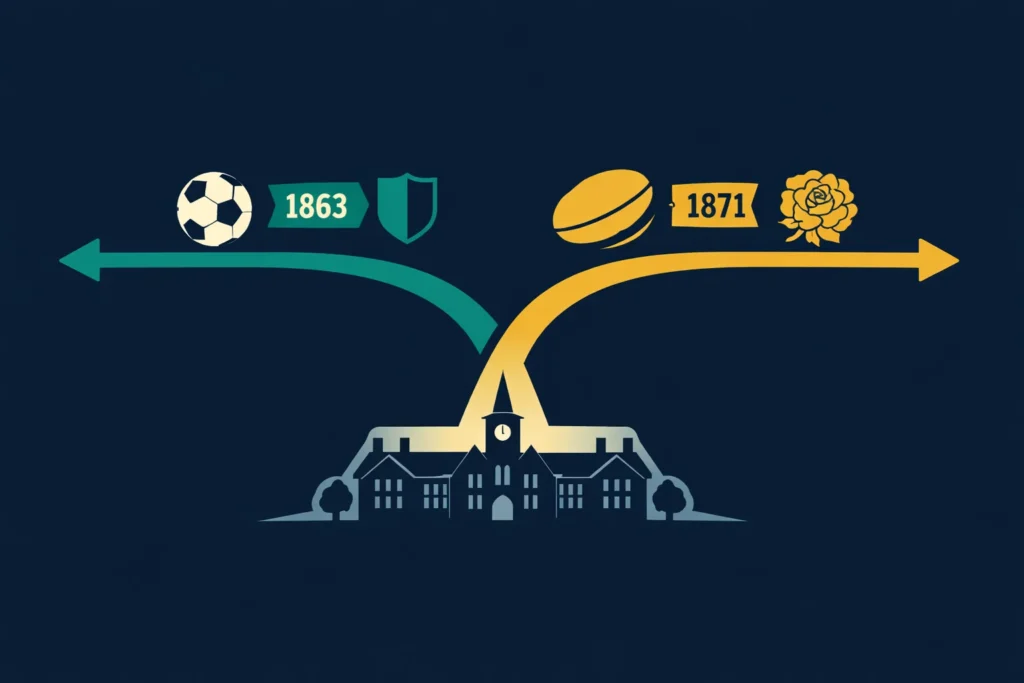
Both sports trace back to loosely organized “football” games played across English schools and universities in the early-to-mid 1800s, where rules varied significantly from institution to institution some allowed handling the ball, others didn’t. This inconsistency came to a head in October 1863, when representatives from London clubs met to standardize rules and formed The Football Association, explicitly banning the use of hands. Clubs that wanted to preserve handling and tackling broke away, eventually forming the Rugby Football Union in 1871, named after Rugby School, where the handling version of the game is traditionally said to have originated. From that single split, both sports developed entirely separate rule structures, governing bodies, and playing cultures over the following century and a half.
Rugby Union vs Rugby League: A Quick Note
It’s worth noting that “rugby” itself actually splits into two distinct codes: Rugby Union and Rugby League, which separated in 1895 over disputes about player payments and professionalism. While both share the core concept of carrying and tackling, they differ in team size (15 vs 13), scoring values, and several structural rules around rucks, mauls, and tackle restarts. When most people casually reference “rugby” without further specification, they’re typically referring to Rugby Union, the more globally widespread of the two codes.
Injury Risk and Physical Demands
Given rugby’s foundational emphasis on tackling and physical collisions, injury rates and types differ meaningfully between the two sports. Rugby players face a higher likelihood of impact-related injuries, including concussions, due to the sport’s structural reliance on tackling and physical contests like scrums and rucks. Football injuries more commonly stem from non-contact issues like muscle strains from sprinting, or occasional ligament damage from tackles, though incidental physical contact certainly still occurs. Both sports have invested heavily in recent years in improving concussion protocols and player safety research, though the underlying physical demands of each sport remain fundamentally different by design.
Global Popularity: Football vs Rugby
Football holds a significant edge in overall global popularity, played and followed by an estimated 3.5 billion fans across more than 200 countries, according to FIFA. Rugby, while still a major sport with passionate followings, particularly in the UK, Ireland, France, South Africa, New Zealand, and Australia, has a considerably smaller global reach, in part due to football’s much lower barrier to entry requiring only a ball and open space, compared to rugby’s greater reliance on structured coaching and protective considerations given its physical nature.
Common Misconceptions About Football and Rugby
- Football and rugby have the same offside rule.” False while both sports have an offside concept, the specific mechanics differ significantly, with rugby’s offside line constantly shifting relative to the ball during open play rather than football’s fixed relationship to the last defender.
- “Rugby is just football with tackling allowed.” False beyond tackling, rugby has an entirely different scoring system, ball shape, team structure, and set-piece rules like scrums and lineouts that have no equivalent in football.
- “American football evolved directly from rugby.” Partially true, but oversimplified American football does share historical roots with rugby through early college games, but developed its own distinct rule set, including forward passing and a stop-start structure very different from rugby’s continuous flow.
- Rugby has no goalkeeping equivalent position.” True in the literal sense, but rugby does feature a fullback role that shares some defensive last-line responsibilities conceptually similar to a sweeper-keeper in football, without the handling restrictions.
Tactical and Playing Style Differences
Beyond the rule differences, football and rugby demand genuinely different tactical thinking from coaches and players. Football tactics often center around space creation, passing triangles, and exploiting gaps in an opponent’s defensive shape through movement and quick combination play. Rugby tactics, by contrast, revolve heavily around structured phases of play, forward momentum through repeated tackles and rucks, and set-piece execution through scrums and lineouts that have no real equivalent in football’s more continuous, free-flowing structure. This difference also extends to player specialization rugby forwards and backs train very differently based on their distinct physical and tactical roles, whereas football’s positional demands, while varied, don’t create quite as stark a physical divide between position groups.
Why These Differences Matter for New Fans
Understanding these structural differences matters most for someone transitioning from following one sport to the other, since assumptions carried over from football can create genuine confusion when watching rugby, and vice versa. A football fan watching rugby for the first time might be surprised that forward passes by hand are illegal, while a rugby fan watching football might initially find the total absence of tackling opportunities for outfield players counterintuitive. Recognizing that these aren’t simply variations of the same game, but genuinely distinct sports with their own internal logic, makes it much easier to appreciate each on its own terms rather than constantly comparing one against the other.
Frequently Asked Questions
What is the main difference between football and rugby? The main difference is ball handling football restricts outfield players from using their hands, while rugby is built around hand-carrying, passing, and tackling the ball-carrier.
Do football and rugby share the same historical origin? Yes, both sports trace back to loosely organized “football” games in 19th-century England before splitting in 1863, when handling was banned in what became football, leading to the formation of the Rugby Football Union in 1871.
Is rugby more physical than football? Yes, rugby is structurally built around tackling and physical contests like scrums and rucks, making it a considerably more contact-heavy sport compared to football.
What is the difference between Rugby Union and Rugby League? Rugby Union uses 15 players per team while Rugby League uses 13, with differing rules around scoring, tackle restarts, and overall pace of play, following a split between the two codes in 1895.
How many points is a try worth in rugby? A try is worth 5 points in Rugby Union and 4 points in Rugby League, with additional points available through conversions, penalties, and drop goals.
Which sport is more popular globally, football or rugby? Football is significantly more popular globally, played and watched by an estimated 3.5 billion fans, compared to rugby’s smaller but still significant global following.
Do football and rugby use similar offside rules? Not really. While both sports have an offside concept, rugby’s offside line constantly shifts relative to the ball during open play, while football’s offside is judged relative to the last defender at the moment a pass is made.
Conclusion
Football and rugby may share a common 19th-century ancestor, but the 1863 split that separated them created two genuinely distinct sports, each with its own identity, physical demands, and global following. From how the ball is handled to how points are scored, and even down to how each sport’s tactical philosophy has developed over the decades, understanding these key differences makes it much easier to appreciate both sports on their own terms, rather than viewing one as simply a variation of the other. Want to explore more football basics?
Check out our guide on Types of Football Formations for the complete rules breakdown.

Daniel Brooks is a sports writer at SportsOrbitX.com, specializing in football, basketball and global sports news. He focuses on delivering accurate reporting, match analysis and timely updates that keep fans informed.